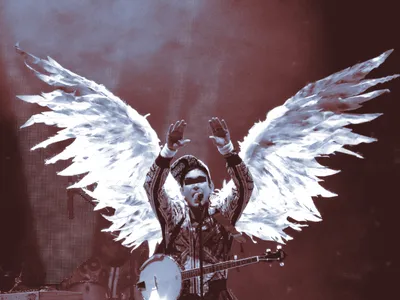
'Sufjan Stevens performing at Coachella Valley Music and Art Festival, April 2016' | Wikimedia Commons (edited by the Author)
issue #247 of brennan.day
REVIEW: Sufjan Stevens' Carrie and Lowell, Ten Years Later

brennan.day — issue #247
Publisher: Brennan Kenneth Brown
Place of publication: Calgary, Alberta, Canada
Available at: https://brennan.day
Contact: mail@brennanbrown.ca
There are a handful of albums that I've listened to front-to-back over and over hundreds of times throughout my life. These records are not only a collection of songs, but carry a powerful throughline from start to finish.
Death Cab for Cutie's Transatlanticism, Neutral Milk Hotel's In the Aeroplane Over the Sea, The Mountain Goats' The Sunset Tree, Joni Mitchell's Blue, Frank Ocean's Blonde, and Bright Eyes' I'm Wide Awake, It's Morning. If you've pegged me for a Tumblr-era /mu/core Millennial hipster, then you're more than correct. More recently, I've been listening to Little Simz Sometimes I Might Be Introvert, Phoebe Bridgers' Punisher, and Lizzy McAlpine's Older (and Wiser) the same way.
One of these albums that's had a profound influence on me and my life has been Sufjan Stevens' 7th LP, Carrie and Lowell, released back in 2015. I remember listening to the record on repeat each day after my pre-calc classes in summer school in grade 13.
This album is the harsh salt of reckoning in the wound and the balm and salve of catharsis, it is immeasurable grief, and yet it is also impossible forgiveness. It is the record I return to when I'm feeling at my lowest—not because it pulls me out of it, but because it provides me an honest, clear mirror.
For those unaware, the album is named after Stevens' late mother, Carrie, and his stepfather, Lowell Brams. Carrie suffered from schizophrenia, bipolar disorder, and severe substance abuse, and she abandoned Sufjan and his siblings multiple times when he was very young.
In earlier albums, Stevens wrote about his mother in anger and resentment. On the 2003 Michigan album, Stevens confessed how ashamed he was of her on "Romulus." On the 2005 Illinois album, the song "The Seer's Tower" laments "oh, how she betrayed us!"
In his later years, Stevens partially reconnected with Carrie, though their relationship remained distant and complicated. Stevens spent a few summers with her and his stepfather in Oregon during his childhood, where a lot of the inspiration for the album came from.
The two had brief contact later in life, but Carrie died due to stomach cancer in 2012, which began the creation of the album. In this, we can view the record as an intimate documentary of grief, processing profound sorrow, childhood absence, and mortality.
Throughout the album, Stevens grapples with how he never had the ability to reconcile properly while Carrie was alive. Her death not only causes him to have a crisis of faith, but also causes him to question whether he should be alive at all. In the track "The Only Thing" Stevens lists out the many different ways he considered ending his life:
The only thing that keeps me from driving this car
Half-light, jack knife into the canyon at night.
and:
The only thing that keeps me from cutting my arm
Cross hatch, warm bath, Holiday Inn after dark
In an interview about this album, Stevens confesses he felt connected to his mother after she died by replicating her self-destructive behaviour:
In lieu of her death, I felt a desire to be with her, so I felt like abusing drugs and alcohol and fucking around a lot and becoming reckless and hazardous was my way of being intimate with her.
The only thing keeping Stevens alive ends up being his faith, and the incomprehensible grace of God. I resonate deeply with this, discussing the temptation of suicide similarly presented in works like BoJack Horseman, or my book review of Yiyun Li's Things in Nature Merely Grow.
This is what I mean when I say the album holds up a clear, honest mirror. Stevens is writing during the darkest time of his life, during a time of immense grief that cannot be channelled into something survivable. And yet, even still, he manages to find a reason, the signs and wonders are enough for him to maintain and continue. I cannot think of anything more important to hear when you're at that point.
The most haunting and heartbreaking song on the album is "Fourth of July," and it has been reworked and re-released more times than almost anything else in all of Stevens' catalogue. There's the PPD Remix as the B-side to the "Exploding Whale" 7" that same year, the woozy 900X Remix (James McAlister's handiwork) on 2017's The Greatest Gift mixtape, a live rendition captured November 9, 2015 in North Charleston and released as part of Carrie & Lowell Live, the April Base Version recorded back in 2014 at Justin Vernon's Eau Claire studio and sat on for eight years before finally surfacing in 2022. The sparser DUMBO Version, cut the same year at Stevens' old Brooklyn studio with just voice, guitar, and a few piano notes standing in for the album take's ghostly synths. And finally Version 4, the thirteen-minute, cinematic outtake unearthed for 2025's 10th Anniversary Edition.
The core mantra in the track, between the sweet nicknames exchanged by Stevens and Carrie is "we're all going to die" as the songwriter grapples with mortality. It is no surprise to see how this has bled into my own personal philosophy, for indeed we all must die.
In many ways, I think Stevens is just as haunted by his own record as I am. He released a live version of the album two years later, alongside the mixtape The Greatest Gift, containing demos, cut tracks, and remixes. Reading his NPR interview about the album a decade later, he has an acceptance of grief, saying the process of "grieving is eternal and you never really get over it. It just moves around within you and transforms you, but it never goes away."
Stevens goes even further, saying that the album was "the first time [he] realized that not everything can be sublimated into art, that some things just remain unsolvable, or insoluble" and views Carrie and Lowell as "evidence of creative and artistic failure from [his] vantage point." Hm.
My Original 2015 Review
Now, I want to do something I haven't done before—back in high school, I attempted to start a music review blog with a fellow music-loving friend of mine. We actually did manage to write a handful of reviews before abandoning the project. One of the records I wrote about was, in fact, Carrie and Lowell. I haven't read the piece since I published it over ten years ago, and I'm curious what has changed and what has stayed the same, reader, in this time capsule of mine:
CARRIE AND LOWELL: REVISITED. VALENTINE, SPURN MY SORROW. (Posted June 19, 2015)
Sufjan Stevens is a sad man who has—reportedly—whispered praise to his banjos at his concerts.
In celebrating the month since our first post, I decided to take a second glace [sic] at the first album that my fellow music reviewer decided to review, one that she didn't actually like. Which was odd since Carrie and Lowell is widely considered one of Sufjan's best record [sic] so far. (Or maybe taking a purposefully controversial stance is intelligent for clickbait? I don't actually know, I'm not an expert in audience dick-sucking.)
At first, I mostly agreed with her review. But I confess that was mainly because I didn't try to figure out Sufjan. I didn't attempt to read into the lyrics, or realize that the album wasn't just a portrait of experiemental nhilistic [sic] elder photography[1]. But then I did, and then I cried. I sincerely cried, reading up on Genius everything that I plainly missed.[2]
Ephinany [sic] can be brutal, like a sudden stomach ulcer or a crowded broken elevator. Our eurekras [sic] shroud themselves, they sometimes tease the edges of our minds.
Something hit home hard for me within this album, and that's the actual reason I decided to write this review.
The Strongest Clan
It is the sentimentalist in me, I cannot help but feel that the synecdoche of family within art. It is the most powerful way to represent our humanity. More often than not, we cannot relate to the nuclear family, for most of us there is no feeling of empathy when we view parent and child in merry discussion at the dinner-table. This is not, in spite of popular belief, what family is.
What then, is family? Family is where we find solace and cathatrisis [sic], it's the perseverance of those we are forced to love and choose to hate. Family is those who are close enough to us to shape us as people. Family is a mother, bipolar and schizophrenic, and suffering from drug addiction and substance abuse.
When I was three, three maybe four,
She left us at that video store.
Be my rest, be my fantasy.
It is difficult to come anywhere close to imagining how Sufjan actually feels, here; to have your pre-determined caretaker abandon you at such a young age. To have a parent that is so irrepairably [sic] difficult, that's a burden.
Fireworks and Forests
And yet, in this album is not anger. In this album is not bitterness or betrayal. Instead we hear pleas of forgiveness and attempts at understanding.
The climax of this record is Fourth of July, where Stevens has a discussion with his passed mother. It's where my player revolves to every time I attempt to listen to the album in full.
There's the seemingly blunt mantra, depicting how Carrie retells Sufjan that he needs to learn about the fleeting and fragile nature of the world by comparing it to the massive devistation [sic] of Tillamook, as well as the ephemeral beauty of the fireworks on Independence Day. In addition to this, it is difficult to say the last line doesn't sound like the bleeding pessimism of a defeated woman:
Tell me what did you learn from the Tillamook burn?
Or the Fourth of July?
We're all gonna die.
But, ultimately, this isn't what gets you. You don't feel a chill down your spine at the futile hopelessness of Carrie's lament. You instead bawl hard at the contrast, at how heartwarming she is when speaking to him.
My little hawk, why do you cry?
The maudlin is so powerful—how deep the corny pet-names will carve into you. You cannot help but buy into the image of a deathbed filled with a broken past dressed in a pure white dress and smiling.
Verdict
This, to me, is the most spectacular thing about Carrie and Lowell. Sufjan somehow takes in such a horrific aspect of his life, and delicately lays out its most beautiful aspects and then appreciates them.
Having terrible parents is perhaps one of the most stress-inducing and heartbreaking situations someone can be placed into. It can sometimes feel as though loving them is a choice and hating them isn't, but the opposite is true.
For such a situation, Stevens goes on throughout this album searching for the remedy. His answer is to forgive and love them, regardless.
This is the ephinany [sic] that comes through, since you wouldn't be around if it weren't for them, would you?
I think it's a problem to instantly buy into the concept that an album is 'wallpaper' music, because it completely changes your listening experiencing [sic]. Stevens is soothing and soft, his strings are always well places [sic] and never danceable. This can create the illusion that nothing exciting is being summoned. Within this album, you couldn't be further from the truth. ↩︎
I contemplate the trickiness and hypocrisy of using other people's opinions and interpretations to influence how one feels about something. Is it truly an ephinany [sic] if you need somebody to spoonfeed it to you? How shallow does this make me? ↩︎


Comments
To comment, please sign in with your website:
How it works: Enter your website URL. IndieLogin checks your rel="me" links on GitHub, GitLab, Codeberg, and email. Setup instructions.
Signed in as:
No comments yet. Be the first to share your thoughts!