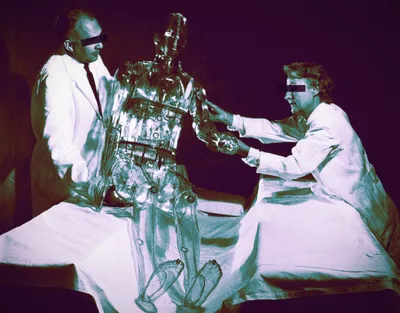
'NIH - Unidentified Laboratory Photos' from the archives of the National Institute of Health (U.S.). Photographer unknown. Date Unknown. | Flickr (edited by the Author)
issue #273 of brennan.day
SAD MACHINE

brennan.day — issue #273
Publisher: Brennan Kenneth Brown
Place of publication: Calgary, Alberta, Canada
Available at: https://brennan.day
Contact: mail@brennanbrown.ca
In the past few days, Debian has held a lengthy and rather bureaucratic vote on how the project will handle genAI and LLM contributions moving forward. There were eight possible options, ranging from a ban to full acceptance, decided by Debian's Condorcet voting system.
The winner was for permissive usage, #5 "Responsible Use of Generative AI" proposed by Marc Haber. Disclosure of AI use is encouraged, not required, and the policy explicitly ducks the copyright status question. To get into the weeds of it, this option was the only one in the "Schwartz Set" to beat every other option head-to-head, including the stricter "Allow AI-Assisted Contributions with conditions" (Option 2) by 203–14.
Debian has always been my operating system of choice, as I've always preferred stability over bleeding-edge updates. Ubuntu, the most popular GNU/Linux distro in the world, is based on Debian. Where do we go from here, then?
I've already written on how generative AI contributions are becoming increasingly inescapable in open-source codebases, and that we should aspire towards a harm reduction approach rather than an absolutist stance because of that.
I'm certainly not saying that LLMs are the future and here to stay, but rather that using only genAI-free software is becoming increasingly difficult as time goes on and more maintainers decide to go the permissive route.
On a similar note, I raised an issue yesterday regarding the IndieWeb is Punk manifesto being mostly created by Claude instead of being handmade by a human—which is what the manifesto explicitly advocates for.
Good Faith and Apathy
For the past several months, I have attempted an approach of good faith and have assumed all the writing, art, and code I've encountered online has been human-made unless stated otherwise. I've also tried to take an apathetic approach to genAI.
I have been trying to uplift and spread awareness of the good human web—of people still using their own hands and minds and hearts.
And yet the world is still trying to insist on a genAI future. As OpenAI gives Trump a stake of their company, as Hollywood uses Midjourney without disclaiming, as genAI cheating scandals become more widespread, and as ChatGPT continues to drive people to suicide. There is a never-ending ledger, and it is growing miles and miles in front of us.
I am not someone who would think negatively of people who use genAI; I am not someone who would call them names, or feel disdain toward the humans in these situations.
Rather, I have been looking at the trade-offs, here.
A Devil's Bargain
One-shotting the output of any mainstream, consumer LLM will always result in something obviously AI and rather uninspiring. Garbage in, garbage out. The only way to get these models to produce something high-quality is with thorough coaxing and human intervention—paragraphs of human writing in markdown files, hours-long back-and-forth conversations.
And a lot of people have been deceived into thinking that labour is necessary, because they simply can't do the damn thing on their own. And that couldn't be further from the truth—you can instead spend that time learning and doing on your own.
Reliance on genAI obscures the know-how to do things ourselves, and will actively deskill you. Your capacity and capabilities atrophy the more you use generative AI.
And I have to wonder if people who constantly create and share genAI work do not see and understand its obviousness—have they been incubated for so long that the low-variance, piss-average genAI output looks no different to them than high-variance, human-made work?
NFTs Were No Different
Let me make a comparison: it's easy to instantly perceive the low-quality, garbage aesthetic of Web3 NFTs, such as Gary Vaynerchuk's "VeeFriends", rushed shitty sketches that earned him thousands of dollars. Many grifting blockchain-based games made during the peak of the hype were also low-quality, asset-flipped, rushed jobs.
There were many thinkpieces during this time discussing how cryptobros simply didn't understand aesthetic or art or simply didn't care. It was always just a means to the end goal of making money.
I think we are experiencing a parallel—there is a decay of aesthetic and care of aesthetic, and with genAI it is far more widespread and mainstream. The problem is that the initial deception is far more convincing: the writing is verbose and grammatically correct; the website has the semantics you expect; the art is fully rendered and coherent.
But as soon as you examine closely, it really is just as ugly and boring as the grifts of NFTs that came before. There is no substance, no novel compulsion, no skin in the game.
And again, I'm unsure whether people are unaware, or just don't care. People were upset that invisible watermarks are being added to Claude? There have already been visible (load-bearing) watermarks (added) this entire time.
The Mystery of the Potemkin Village
I do not know why the push for genAI continues. No corporation (with the exception of Nvidia) has found profitability. 95% of generative AI pilots at companies are failing.
I do not know who is gaining from maintaining the Potemkin village of generative AI. I do not know who is fooled by "Agentic AI," which does not change the underlying foundational technology at play, and is instead a dozen sycophant chatbots rather than just one.
I also do not know what this means for the future of the web or my presence on it. I do not want to be defined by my enemies. I do not want to go gently into that good night. Maybe I'll give up the HTTP protocol altogether and exclusively publish to Gemini and Gopher. It's hard for me to say at this point.



Comments
To comment, please sign in with your website:
How it works: Enter your website URL. IndieLogin signs you in through your site's IndieAuth server if it has one (e.g. indieauth.com), or checks your rel="me" links on GitHub, GitLab, Codeberg, and email. Setup instructions.
Signed in as: