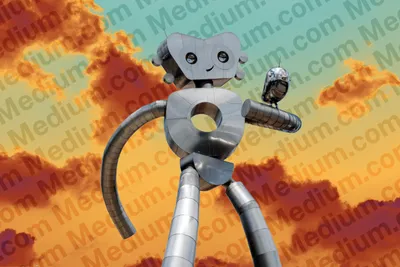
'Traveling Man' scupture by Brad Oldham, Brandon Oldenburg, and Reel FX Creative Studios, photo taken by Carol M. Highsmith, 2014. | Library of Congress (edited by the author)
issue #285 of brennan.day
I, CEO: How Medium.com went from being anti-AI to pro-AI

brennan.day — issue #285
Publisher: Brennan Kenneth Brown
Place of publication: Calgary, Alberta, Canada
Available at: https://brennan.day
Contact: mail@brennanbrown.ca
When I first joined Medium.com, I thought I was late to the party. Little did I know I would be one of the platform's most veteran members still writing and publishing here after over ten years. One of my first-ever posts was about getting into the discourse about what Medium should be. It's a rather embarrassing read a decade later, but it's important to note I've always been interested in the longevity of this place while also not shying away from being critical when necessary.
For my first nine or so years on the platform, I was just blogging as a hobby. It was an enjoyable way to write and get my thoughts out into the world. Only last November did I really start to take writing seriously as my career, and I've been on a steady posting cadence since—writing around 25 posts per month, with each post averaging around 2,000 words.
While a lot of my work doesn't gain that many views, the few breakout hits that do have virality have been sufficient for me to make writing my full-time job now. It's a modest income, not livable for most, but it is for me. I've had quite a number of my stories boosted, and even had one highlighted as a Staff Pick a few days after my 30th birthday.
I'm not shy to criticize this platform that pays me a living, but I am going to make sure it's for good reason. I have also been someone who's been critical of generative artificial intelligence for months, writing around a dozen stories covering the topic. My first was going over how we're going to face an authenticity crisis and a crisis of mediocrity because of the technology.
PART ONE: A Brief History
Why are we talking about AI now, anyways? Well, let me start at the beginning. Medium.com was founded by Ev Williams on September 25, 2012, and the platform has had a simple and stubborn mission: to be a place for human writing.
The Internet was (and obviously still is) rewarding fast, shallow, click-driven content. Junk food for the mind. Williams wanted to create a clean, distraction-free place for meaningful writing exceeding short character limits, giving thoughtful ideas better accessibility. His vision was an alternative system which measured stories by how much time people spent reading them rather than sensationalized headlines designed only for ad clicks. He wasn't new to this, either, having been one of the creators of blogger.com years before.
Medium.com never set out to be the highest-paying or fastest-growing platform. The premise was, rather, that it would be a place where people could think in public, and share ideas longhand without the short attention-spans and white noise of corporate social media.
And that premise has survived over a decade. It's survived the pivot to subscriptions, the death of in-house publications, and the numerous logo and branding changes.
What it did not survive, though, was a new CEO changing his mind.
Tony Stubblebine, founder and former CEO of Coach.me, took over Medium from Ev Williams in 2022. Stubblebine saved the company, managing to turn $2.6 million per month in losses into Medium's first profitable month in August 2024. By his own account, this was done by refusing to chase the so-called genAI "content" gold rush hollowing out other platforms.
For three years, "no AI" was the turnaround story for Medium.com. And that's what is being dismantled now, by none other than Stubblebine himself.
While this story is about Medium.com, it can also be seen in nearly every other industry. There's a case study here of what happens when the person in power finds themselves increasingly absorbed by the temptation and seduction of the machine.
PART TWO: The Wall (2023-2024)
Medium's first AI policy went up in January 2023, written by VP of Content, Scott Lamb. Things were still rather tentative regarding how we ought to tackle AI in general, and so it was rather permissive by later standards. AI-generated posts were allowed as long as the AI usage was disclosed, but it was already declaring the platform's identity: Medium is for human storytelling, not machine-generated writing. By July 2023, the language changed from "welcome" to merely "allow," and any fully AI-written story was restricted to reaching only the author's existing followers, suppressed from reaching the rest of the site's audience.
In September of that year, the wall was up. Medium blocked OpenAI's GPTBot crawler and rewrote its terms of service to forbid scraping. Medium joined the likes of CNN, the New York Times, and other publishers resisting unlicensed genAI training. Stubblebine declared the default answer on genAI training was no.
A few months later, in an interview, he disclosed that an AI company's CEO had privately offered Medium a buyout in the millions for training rights, and that Medium shrugged it off as insultingly small.
In April 2024, a new Partner Program policy banned AI-generated writing from monetization, regardless of whether or not it was disclosed.
Jim Clyde Monge, and many other writers on the platform, understood the new policy update as a line in the sand against genAI. Days later, Stubblebine reaffirmed in a Q&A that Medium would not let AI companies train on the work of writers, regarding this "rejection of AI" as core to the platform's mission. By December 2024, Stubblebine was continuing to do press about minimizing AI-generated content on the platform. As of late March 2025, Medium was actively suspending writers over suspected undisclosed genAI usage.
For two years, it was clear that every stance and policy coming from Medium.com was that it believed it needed to be human-first and anti-AI. To maintain integrity, yes, but to also ensure the platform survived. The position was steadfast and consistent.
PART THREE: The Turning Point (2025-2026)
Almost exactly a year ago on September 10th, 2025, Medium joined Reddit, Yahoo, Quora, and O'Reilly Media in launching Really Simple Licensing. This was a new open standard, letting publishers set machine-readable terms for genAI crawlers. Stubblebine's own announcement argued that since genAI runs on stolen content, the standard was a legitimate way to force AI companies to either pay, stop, or shut down.
But really, this was a change from blocking to licensing. The AI companies were no longer hostile trespassers antithetical to the platform, but were now partners to be negotiated with. AI was now a line of revenue, and understood fatalistically as a fact of the new ecosystem to be priced, no longer being refused outright.
Nine days later the other shoe dropped at Medium Day 2025. Medium announced TK, a new writing and notes app built explicitly around AI-assisted composition. Stubblebine had been asked directly a few days earlier whether Medium was building AI-enabled tools, and he answered yes.
Anecdotally, I know many creatives that feel negatively about genAI, and very few who are neutral or in support of it. Most of the writers I've encountered on Medium are not fans. Which is why Stubblebine's decisions in the past year have been so baffling.
And so we've witnessed a steady change of Medium's rhetoric on genAI over the past year. In October 2025, Stubblebine described a coming "writing renaissance" in which AI serves as a thoughtful companion for writers, contrasting with the idea of an AI assistant writing and doing all the work for you.
Stubblebine began using the term "second brain" to describe what he wanted genAI to do instead TK, saying the app had the ability to surface a writer's decades of notes and drafts on demand. Compare that to how, in earlier interviews, he described how AI was being wildly oversold as something that could do everything. He still insisted genAI could never substitute the human connection built through writing, and yet he was building an editor that generated machine prose on request.
By August 2026, in an interview, Stubblebine was arguing that genAI killed the old creator economy by exposing how much was never more than content written at a machine level to begin with. RSL reached its 1.0 spec, and Medium was still named as a backer.
TK moved out of invite-only beta to general availability for Friends of Medium subscribers through the first half of 2026. Medium's own messaging had grown noticeably defensive. The July newsletter of this year acknowledged the tension between the platform's anti-genAI stance and its new genAI writing app in the same breath. The argument being made was that TK's AI merely prompts you to create. It wasn't doing the creating for you. Right?
A review by longtime Medium writer Jacqueline Dooley called TK an AI-assisted writing app in practice, no matter how Medium tried to angle the copy on the product page. The generation was within the drafting and writing itself, a complete reversal of what the platform had spent two years promising. Dooley ended up leaving for Substack over this (something I personally wouldn't recommend), after being a writer on Medium for eight years. There were accusations by others that Medium.com was in fact paying writers who produced favourable early reviews of TK.
PART FOUR: My Thoughts
Medium Day for 2026 is only a few days away, and I was initially accepted as a speaker for the event, but I've since decided not to go through with it after looking at what Medium's stance on generative AI has become over the past year. Tony is once again set to do a keynote, where he's going to most likely going to to speak positively about generative AI.
For me, personally, it has been more than frustrating watching the guy who saved Medium start writing articles about how he got back into morning pages thanks to AI, or how he feels as though he has a daily presidential briefing thanks to AI. I have been a fan of Stubblebine since the Coach.me days, and I can tell he's passionate and smart—the decisions he's been making haven't been out of malice, but I do think they're misaligned.
It is difficult to not view this as someone who has found a personal fascination with the technology and then decided to implement it into his professional business. And to be honest, I can't imagine everyone internally at Medium is happy with this pivot over the past year.
I think it would be beneficial to everyone—and I mean writers, readers, staff and publication editors alike—if Medium returned to being a human-only platform and anti-AI company. I recognize that this ask is essentially an impossibility at this point. The genie is out, and I'm trying to close the barn doors when all the robotic horses are already gone. But the cognitive dissonance and mental gymnastics are obvious to everyone.
I also recognize it is rather callous with regard to the time and effort that's most likely gone into developing the TK product and app, but it makes the most sense regardless. But I think TK can still exist, actually. But it shouldn't have a connection to Medium.com—if Stubblebine is interested in generative AI, I'm not going to mark that as a scarlet letter against him, but I do think it needs to be compartmentalized and separated from Medium as a platform. Just because a CEO's views changed doesn't mean the entire company's views need to change in turn.
Overall, I am still going to be here, writing and reading on Medium, because I do not think the decisions Stubblebine is making are ruining Medium. It still has an incredible payment model for creators and writers, and is still one of the few places online that values longform, high-quality writing. It would be alarmist and just plain wrong to say the decision to lean into genAI is stopping any of that.




Comments
To comment, please sign in with your website:
How it works: Enter your website URL. IndieLogin checks your rel="me" links on GitHub, GitLab, Codeberg, and email. Setup instructions.
Signed in as:
No comments yet. Be the first to share your thoughts!