All Collections

History

Essays on the past—events, figures, and movements that shaped the world we live in today.

7 posts
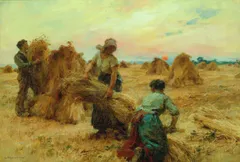
Oil painting of three farm workers binding wheat sheaves into stooks at sunset. A man on the left lifts a bundle of wheat onto a stack, a woman in a white blouse and bonnet carries an armful of cut wheat toward the stack, and a second woman crouches in the foreground gathering stalks. Rows of wheat stooks dot the golden stubble field under a pastel sky with a low orange sun on the horizon. Signed 'L. Lhermitte' in the lower left.

Farming is Why Humanity is Fucked

A mind-shattering concept from a first-year university class that upended how I think about humanity. Daniel Quinn's Ishmael trilogy argues that totalitarian agriculture is why civilization is in peril. On the Law of Limited Competition, the Food Race, and how farming broke humanity's equilibrium with nature.
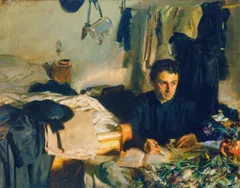
Oil painting of a dark-haired young man seated at a small desk in a cramped, sunlit room, writing intently in a book or letter. He wears a dark robe or coat and has an intense, weary gaze. The cluttered room around him features an unmade bed with white sheets, dark coats and a hat hanging from pegs on the wall, a washbasin and jug, and a vase or bundle of cut flowers and greenery spilling across the foreground table. Loose, impressionistic brushwork in muted greens, golds, and blacks. Signed 'John S. Sargent' in the upper left.

COMPULSION: The Writers Who Wrote The Most in History

I've been writing publicly every day for seven months, and I wanted to know what that looked like for other compulsive writers. From Chesterton dictating past midnight, to Chinese web fiction authors racing through 10,000 words daily. What does their obsessive output reveal about the nature of writing itself? The volume isn't the point. The showing up is.
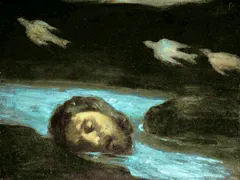
A dark oil painting depicting a man's head lying at the edge of a luminous turquoise river, his eyes half-open and expression serene or unconscious. The surrounding landscape is rendered in deep blacks and earth tones, with the vivid blue-green water serving as the primary light source. Three pale birds fly through the dark sky above him. The brushwork is loose and expressive, evoking a Romantic or Symbolist style. The overall mood is ethereal and elegiac.

On Being a River

Sixty thousand miles of blood vessels run inside each of us, more than twice around the Earth. 330 billion cells are replaced every single day. Humanity has always built civilization beside rivers because we are rivers. Always in motion, never stepping into the same current twice, carrying cells that live only days alongside neurons that will last precisely as long as we do.
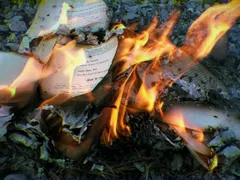
Printed pages burning on rocky ground outdoors, with tall orange flames rising from the center. The pages are from a book, and visible names include Steve Wozniak, Stanley Kubrick, and Leslie Stern, M.D., with a section header reading '[End Of Tra...' and a headline at the top beginning 'Why Did Navidson Go Back To The Hou...' The surrounding area shows ash, gravel, and dry vegetation. The image has a subtle chromatic aberration effect, giving the edges a yellow-green fringe.

Writers Who Burned All Their Words feat. Bix Frankonis

I am a compulsive archivist, terrified of losing my words, but many of history's greatest writers asked for theirs to be burned. Kafka, Dickinson, Plath, Virgil all had their reasons. A meditation on self-erasure, ego, and the difference between the writing and the written thing, with an interview with Bix Frankonis, a contemporary writer who one day decided he needed to be smaller online, not bigger.
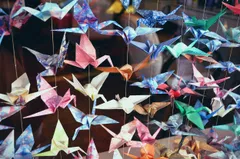
Dozens of origami paper cranes in a wide variety of colours and patterns. Blues, pinks, reds, greens, white, and earth tones, many made from patterned washi-style paper with florals and stripes, suspended from thin strings against a blurred warm-toned background.

A THOUSAND CRANES: Why I Write Every Day

My daily writing is a practice of releasing messages in bottles and folding paper cranes—from Montaigne in his tower and Johnson writing in poverty, to Sadako Sasaki folding 1,450 cranes in a hospital ward. What the essayists, drift bottles, and Senbazuru share, and why the attempt itself is the whole math.
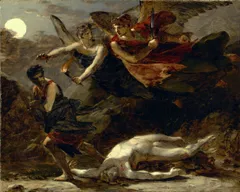
A dark Romantic-era oil painting depicting an allegorical scene of divine retribution. Two winged figures descend dramatically from a moonlit, storm-clouded sky — one holds a torch, the other brandishes a dagger and wears flowing red drapery. Below them, a dark-clad figure flees to the left, glancing back in terror, also carrying a torch. In the foreground, a pale, nearly nude human body lies prostrate on the ground, face-down, with a small wound visible on the torso. The palette is dominated by deep browns, greys, and blacks, with the pale body and the full moon providing stark contrast. The composition conveys swift, inevitable pursuit.

How Do We Account for Evil?

Drawing on Susan Neiman's philosophy of evil, the 'missing stair' problem, and Elinor Ostrom's principles for governing the commons, I try to explore the difference between withdrawal due to burnout versus accountability, and argue that ethical communities must distinguish between systemic failures and intentional bad-faith actors while implementing graduated sanctions and accessible conflict resolution.
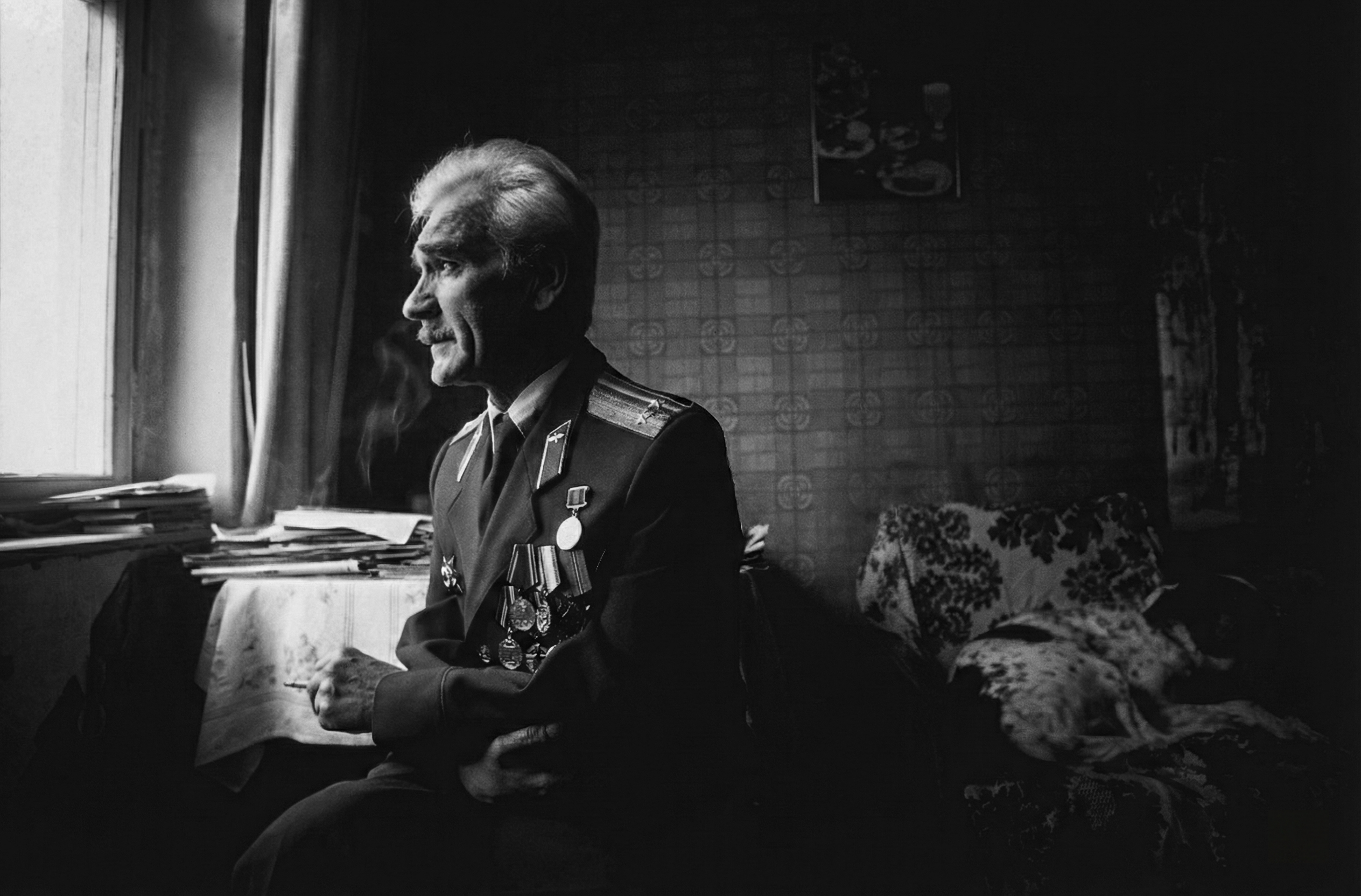
Stanislav Petrov, the man who made the decision not to fire at the United States after a faulty report from Russian missile detection indicated a nuke fired, preventing WWIII.

The Three Times the World Nearly Ended

Ordinary people chose to do the right thing and saved us all. We barely remember them.

↑ TOP