Welcome to the Neighborhood of Make Believe | Source (edited by the Author)
Won't you be my neighbour?

This post is, naturally, dedicated to Mister Rogers.
The Blank Pages
One of the most heartbreaking I see on other people's sites are the empty or sparse pages that declare "work in progress," filled with bright orange pylons of "under construction" or "to be written." Don't get me wrong, you aren't obligated to finishing any particular thing, but if not now, when?
When I started brennan.day, I wanted it to be mostly complete to make sure that I wouldn't start writing posts with a bunch of pages that I'd never end up getting around to.
And I was smart to trust my intuition, because the few pages I didn't complete before launching are still works-in-progress.
One of these is personally important, my /canon page explaining the works of art and media that have shaped me and how I live and understand the world. It is a little overwhelming, and I don't feel satisfied listing off a couple things and then adding more to it later. Each item would require an essay of its own. For example, my blog post on the Mountain Goats or on Bon Iver. Just two examples and already over 5,000 words. I think the best plan moving forward would simply to keep writing essays on important pieces of media and then start the page once I have a respectable amount. (I, somehow, miraculously, can always find more to write about. It is like an infestation at this point.)
The other is communally important, and what I want to talk about in this post today. My /blogroll! I have a few placeholders there, and a couple more on my sidebar, but it's rather daunting to work on this proper, to be honest. There are so many good blogs out there, so many that I want to immerse myself into and read no different than a paperback novel. As Matt put it, "the IndieWeb dies without people spreading the word."
But recommending blogs I enjoy reading is not the actual important thing. The important thing is linking to other sites in order to have Internet neighbours, you see. To be an active, deliberate, intentional node in the, well, web!
By the way, what's up with the "web" anyways?
The Web is Not Mechanical
As you might have noticed, I love metaphors. So does the Internet! While there is a lot of discourse on whether to use the term IndieWeb or Human web or small web, I want to focus on that second word there: web, or net.
Long before computers, a network was a woven thing in our human world. Threads knotted into strength, rail lines crossing continents, telegraph wires humming across distance. When engineers began linking machines in the late 20th century through projects like ARPANET, they borrowed the old textile word. A “net” described the built nodes connected by many paths, resilient like mesh, modeled in the mathematics of graphs and distributed systems.
The Internet itself (literally an inter network) was the joining of many such nets into one vast fabric. And when Tim Berners-Lee introduced the World Wide Web at CERN, he chose another ancient image: the web. Hyperlinks radiating outward like silk strands; you could enter anywhere and travel along invisible filaments to somewhere unexpected.
The Internet is not mechanical but textile. It is not a machine in metaphor but a weaving, threads under tension, holding because they cross.
Think of Indra’s Net in Buddhism. In the Avatamsaka Sutra, an infinite net hanging over the palace of the god Indra. At each node of the net sits a brilliant jewel, and in the polished surface of each jewel are reflected all the other jewels in the net, infinite in number. Each reflected jewel reflects all other jewels, so there is an infinite reflecting process occurring. The jeweled net is where every part of the universe is intimately connected to every other part. When any jewel in the net is touched, all other jewels in the network are affected. The hidden interconnectedness and interdependency of everything and everyone in the universe.
Our Ecosystem's Health
And, too, think of the web of life in ecology. A healthy ecosystem is defined by the strength of networks. In a previous post, I looked at Abhram's idea of the more-than-human world. I want to look at another important aspect of nature and how it applies to us here.
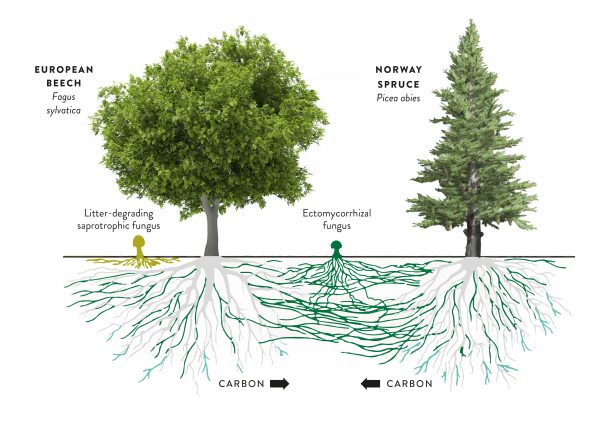
For a long time, it was thought that trees and other plants in forests were competitive, trying to hedge one another out for resources to grow. We know now this is simply not the case. There are, in fact, mycorrhizal networks[1] connecting everything. These networks exist underground, found in forests and other plant communities, created by the hyphae of mycorrhizal fungi joining with plant roots. This network connects individual plants together. Mycorrhizal relationships are most commonly mutualistic, with both partners benefiting.[2]
My favourite part is that these networks are part of what is sometimes called the "wood wide web" For there is actually a massive, 500-million-year-old underground network of fungi and other bacteria that connects tree roots in forests, facilitating the exchange of nutrients (carbon, phosphorus, nitrogen), water, and chemical warning signals.[3][4]
This is the example we ought to follow, here on the IndieWeb.
And this, too, is what I was talking about when I defined being pro-social as the second principle of the IndieWeb. When I link to many other independent sites that follow values and principles I think are important to promoting a sustainable, warm, human-first Internet, and they too link to other sites, we are no longer dependent on corporate search engines. We, instead, become dependent on each other. And I think this is a wonderful thing.
My Webring Neighbours!
In the meantime though, I am asking—do you want to be my neighbour? I'm lucky enough to be part of quite a few webrings, and as a result already have a lot of wonderful web neighbours! Through these webrings, I've discovered some incredible corners of the web. As of March 3rd, 2026, these are my webring neighbours.
In the Bucketfish Webring, I'm neighbours with skoula.cz and krill0w.garden, while the Hotline Webring connects me with andreilazer.me and gnatpost.neocities.org. The Static.Quest Webring places me between the passionate 11ty advocate bobmonsour.com and burgeonlab.com, and the IndieWeb Webring links me to kevinmarks.com and www.jonaharagon.com.
The Dinhe.net Webring connects me with fanlistings.nickifaulk.com and loser.moe, while the CSS Joy Webring places me near frontend.die-katrin.eu and joshuastuebner.com. Through Fediring, I'm linked with njbraun.de and cobra.monster, and the Webmaster Webring connects me to durokotte.foo.ng and bisq.neocities.org.
The accessibility-focused a11y Webring places me between markwyner.com and jarema.me, while Webring.fun connects me with birdbyrocket.com and burgeonlab.com. The Silly Webring puts me in the delightful company of biolent.neocities.org and stacasdepths.neocities.org. I'm also part of the XXIIVV Webring, where I'm situated between gregori.studio and L1Zb3th. Each of these sites represents a unique voice and perspective on the web, and I'm honoured to be counted among their neighbours.
Previous neighbours who are no longer in my webrings: islandinthenet.com, micro.alexezell.com
Even though I mirror my site on Neocities, (tutorial for that here) I don't primarily host there. I am a house with wide acres of woodland all around me.
How Do Others Do This?
The community has created several discovery tools and directories. IndieNews is an IndieWeb news aggregator, similar to Hacker News, which only accepts submissions via webmention.
Some folks use XFN (XHTML Friends Network) to add semantic meaning to their links by adding a rel attribute to links, you can indicate relationships like "friend," "colleague," "met," or "me" (for your own content elsewhere).
Others maintain link blogs, either dedicated sites or regular posts that link to and comment on interesting articles and webpages they've encountered recently
I'm Bad at This!
You see, truth be told, I'm not a people person. Far from. I score incredibly high on any evaluation for introversion. I am also shy and socially-anxious. Though the three often get conflated, they all are different, unique traits. I can often rub people the wrong way and find myself being considered unapproachable or abrasive. I'm trying my hardest to change this, and I try to work for a community instead of just myself. I think this is one of my biggest goals becoming a netizen on the IndieWeb—to build lasting, meaningful friendships in ways that I've failed to in my life previously.
So far, I think I've done a good job at trying. I've been really enjoying my time being social on the fediverse and omg.lol's IRC chat as well as 32-bit Café's Discourse forum and the BBJ of tilde.town. My website has comments enabled, in addition to having Webmentions and a guestbook and many other ways to contact me.
A New Collective?
There are still plenty of other things I want to do: I want to have guest posts on this blog! I also want to partake in the IndieWeb carnival (I think all I have to do is write a blog post about the monthly theme and send it to the host? It's silly that I'm uncertain). The current month's theme (February 2026) is "Intersecting Interests," hosted by Zachary Kai.
As someone who loves to start new projects, I've been mulling how to contribute more to the community-aspect of the IndieWeb. I think want to make an IndieWeb collective based on my principles. You could think of this as a clique or group, I'm not 100% on the terminology yet.
I really love omg.lol and the community that's created simply by having everyone use services behind a (really fair) paywall. But I want to create something that has no paywall.
There are similar initiatives, and I definitely don't want to reinvent the wheel, but things like tilde servers require technical knowledge and getting started creating a site on a place like NeoCities is relatively simple but trying to figure out how to "join" a "community" can be intimidating because there isn't really a centralized, local place for this. I think 32-bit cafe does an excellent job and they also have the best resource list for the IndieWeb that I've seen, but they primarily use Discourse, which is fine! But I don't want my collective to be a forum, I want it to be more philosophical. I also want this collective to centre around the marginalized and previously voiceless.
I believe there needs to be more graceful, accessible onboarding for the IndieWeb. I believe that the homepage of IndieWeb.org frankly does not do a good enough job of introducing non-tech people to the concepts or how to get onto the IndieWeb. There are many different pages about many different concepts, and the organization and informational design leaves a lot to be desire for me, personally.
So, instead, I want to create a simple static site explaining what the IndieWeb is, and provide the easiest/least expensive resources for people to join the IndieWeb on their terms.
Beyond that though, I want to make it community-oriented. I want to do bi-weekly or monthly virtual meetups (with cams somewhere like Zoom or Google Meet, whatever the best IndieWeb tech solution is for this). I want to connect it to my business Berry House where I can help people set up their technical solution free-of-charge or low-cost. I want a 88x31 badge people can put on their sites to indicate they're part of the collective. I want to do contests and collective projects and other things that enable people to feel like they're part of a community and get to know others on the IndieWeb in a warm, cozy way. Stuff like that!
My point here, is that I want more of the human part of the human web. I want to strengthen our shared ecosystem. My blog is so often navel-gazing and essays conjured from inhabiting my mind like a hermit crab in his shell, words made from neurotically overthinking. I want more talking, more dialogue, more back-and-forth. I want more weaving and textile and connection. What do you think?
The discovery of these networks was pioneered by Professor Suzanne Simard at the University of British Columbia in 1997. She revealed that trees are linked to neighboring trees by an underground network of fungi that resembles the neural networks in the brain. In her landmark studies, Simard used radioactive carbon isotopes to track the movement of carbon between trees, definitively proving resource sharing, finding that up to 40% of the carbon in a tree's fine roots could come from other trees. ↩︎
Trees provide carbohydrates to the fungi (the mycorrhizal network retains about 30% of the sugar that connected trees generate), while the fungi enhance the trees' ability to absorb water and nutrients from the soil. Older, larger trees, often called "mother trees," can supply younger seedlings with carbon and other nutrients, enhancing their survival rates. A single mother tree can be connected with thousands of trees and even small seedlings, giving these young trees a higher survival rate thanks to the large amounts of nutrients and carbon transferred to them. ↩︎
When a tree is under attack by insects or pathogens, it can send chemical signals through the network to neighboring trees. These signals prompt receiving trees to produce defensive compounds, preparing them for potential attacks. Studies have shown that when broad bean plants come under attack by aphids, they release chemicals through mycorrhizal networks that not only repel their attackers but also attract wasps that prey on the aphids. ↩︎
It's worth noting that recent scientific analysis has urged caution about the more anthropomorphic claims made about these networks, as evidence suggests that while mycorrhizal networks exist and facilitate some resource transfer, the extent and motivations are more complex than simple cooperation. But the fundamental point remains: forests are not collections of isolated individuals but interconnected communities where relationships matter. ↩︎


Comments
To comment, please sign in with your website:
How it works: Your website needs to support IndieAuth. GitHub profiles work out of the box. You can also use IndieAuth.com to authenticate via GitLab, Codeberg, email, or PGP. Setup instructions.
Signed in as:
I agree wholeheartedly on the idea of cross-site linking to build up a strong healthy network that's independent of search engines or any other centralized services and their arcane algorithms.
However, I don't agree with your position on WIP pages. I am a (practicing) fan of digital gardens, which I've found to be weirdly controversial on the indieweb. I think getting our ideas down and cultivating them later is fine, and for some having to find some new angle for a new blog post every time they want to update their views on some subject can be quite limiting. It also adds pressure, perhaps phantom obligations to hit a certain posting cadence or to fully flesh out an idea before being able to talk about it online (which can lead to burnout). I find a digital garden very liberating, as I don't need to make something perfect or even good before allowing it to exist online. Sure it's possible I won't get around to updating it in the future, if my passion and interests and motivation are focused on other topics, but I don't think there's any harm in having a WIP and it's not like that WIP being public took away from other parts of the site - a private WIP that I lose motivation working on before finishing takes the same amount of time away.
And for slash pages, you're in this awkward position where it's not a publish and forget page, so you're expected to keep it up to date, but the rest of your site being exclusively "published" pages gives you the pressure of feeling like the slash pages can't ever be stale or incomplete, and that just sounds like pressure I wouldn't want to willingly submit myself to.
Great post! You are way further down the Indieweb path than I am. Encouraging more interaction and cross-linking is definitely to be encouraged.
I actually dislike people (sorry to take it personally) who let `work in progress' pages be seen on the Internet, especially in their early stages. To me, the point of the word `publish' is that an article is deemed to be of publishable quality is let out into the world, and then that article should be regarded as cast in stone, in my opinion. If there are amendments or alterations of facts to be made later, this can always be done by posting a follow-up publication, pushed-back as a comment on the original. But original posts have unique identifiers, and I would like to think that that means I will always see the /same/ original post under that identifier.
I'd be interested to know what others think about this.