
A rainbow, inspired by the signature 'Somewhere Over the Rainbow' song from the movie The Wizard of Oz, at Storybook Land, a family attraction in Aberdeen, South Dakota taken by Carol Highsmith, 2021. | Library of Congress
issue #264 of brennan.day
IndieWeb Ethos and Pagecord

brennan.day — issue #264
Publisher: Brennan Kenneth Brown
Place of publication: Calgary, Alberta, Canada
Available at: https://brennan.day
Contact: mail@brennanbrown.ca
Around a month ago, I wrote an article about accessible approaches to the IndieWeb and meeting people where they are. I wrote about how writers who don't come from a technical background can utilize an already existing platform to focus solely on their writing, rather than the web development aspects of HTML and CSS.
In the past couple days, there have been a couple responses to this, from Eetu of Moonwriting and Pagecord creator Olly, which was one of the platforms I initially recommended in the 4th paragraph of my article.
Now, my article was itself a response to Adam's post, Hardcore IndieWeb where he explained how someone could host a site with NFS for a penny a day and went over a lot of details about making a website. It was really helpful and cool, and my response was aimed at people who'd be intimidated by such a guide and trying to explain progressive disclosure, and other possibilities of starting points.
Eetu's response actually explained exactly why I think such a thing is important:
Brennan Kenneth Brown, a writer I admire, uses a ladder analogy to encourage people to learn HTML and CSS in order to eliminate dependence from platforms that could shut down any day.
Yes, exactly! (Also, thank you for the kind words.) Although he later continues by writing "[t]inkering with my site is something I would rather avoid," I do not advocate for learning webweaving for the sake of tinkering. I advocate for it because the more dependencies we have, the more fragile our writing is on the web.
It's awesome to have a platform where all you do is write and hit "publish" and thankfully there are multiple that exist; however, they come with trade-offs the way everything does. You either are paying money, or you're sacrificing privacy, or you'll have a lot of limits you wouldn't if you were doing things on your own.
Learning to have a website of your own also has trade-offs, it's technical and time-consuming and at times, can be frustrating as hell. But one of the reasons I wrote the WEBMASTER@ manifesto is because I believe far too many people have learned helplessness when it comes to technology. Everyone is capable of learning the basics to get their own website up.
There is no gatekeeping here on my part. I want everyone to use their right to create and have digital autonomy and sovereignty. My 40+ articles on the IndieWeb have been in an attempt to get people of all forms and from all backgrounds introduced to the independent web.
And, likewise, if you'd rather stay on a platform instead, that's okay! But don't say I'm saying it's lesser or inferior—it isn't, and I don't think it is. There's no "right" way to IndieWeb. What I do think is that we've seen products and services shut down time or get acquired and time and time again. At the very least, ensure you have local redundant personal backups of your writing and all your important works.
Case Study: Olly and Pagecord
Regrettably, a good example of why you shouldn't be dependent on a specific platform developed in real-time in the past couple days. Olly wrote:
For me, by far the most important thing is supporting the IndieWeb ethos, not subjecting yourself to all the hassle that HTML, CSS, static sites, deployment and whatnot will bring you. I've been programming professionally since 1995 and I can assure you it is a hassle, or will be one way or another!
I agree, it is a hassle, and if that's where his argument stopped, that'd be fine by me because I say the same thing. But then he continued:
If you choose the hardcore DIY approach, you're subjecting yourself to a lot of maintenance, unexplained errors and headaches that suck up a lot of time, or might require an LLM to fix it when you're stumped.
Now, this is an edited version of what he wrote originally, which was that people would have to pay for an LLM to fix things when you're stumped.
The IndieWeb has a general anti-genAI sentiment the way most creative subcultures do, and people pointed out that this was a weird counterargument to make. People can ask others (that's what community is all about) or simply do a web search to try to find a solution to the problem. No LLMs required.
Olly himself has not made it a secret that he uses LLMs like Claude to build Pagecord. From February of this year:
Claude thinks I should scale Pagecord by switching to bare metal. It's an AI after my own hacker heart! It takes me right back to those halcyon days of racking up servers in 2012.
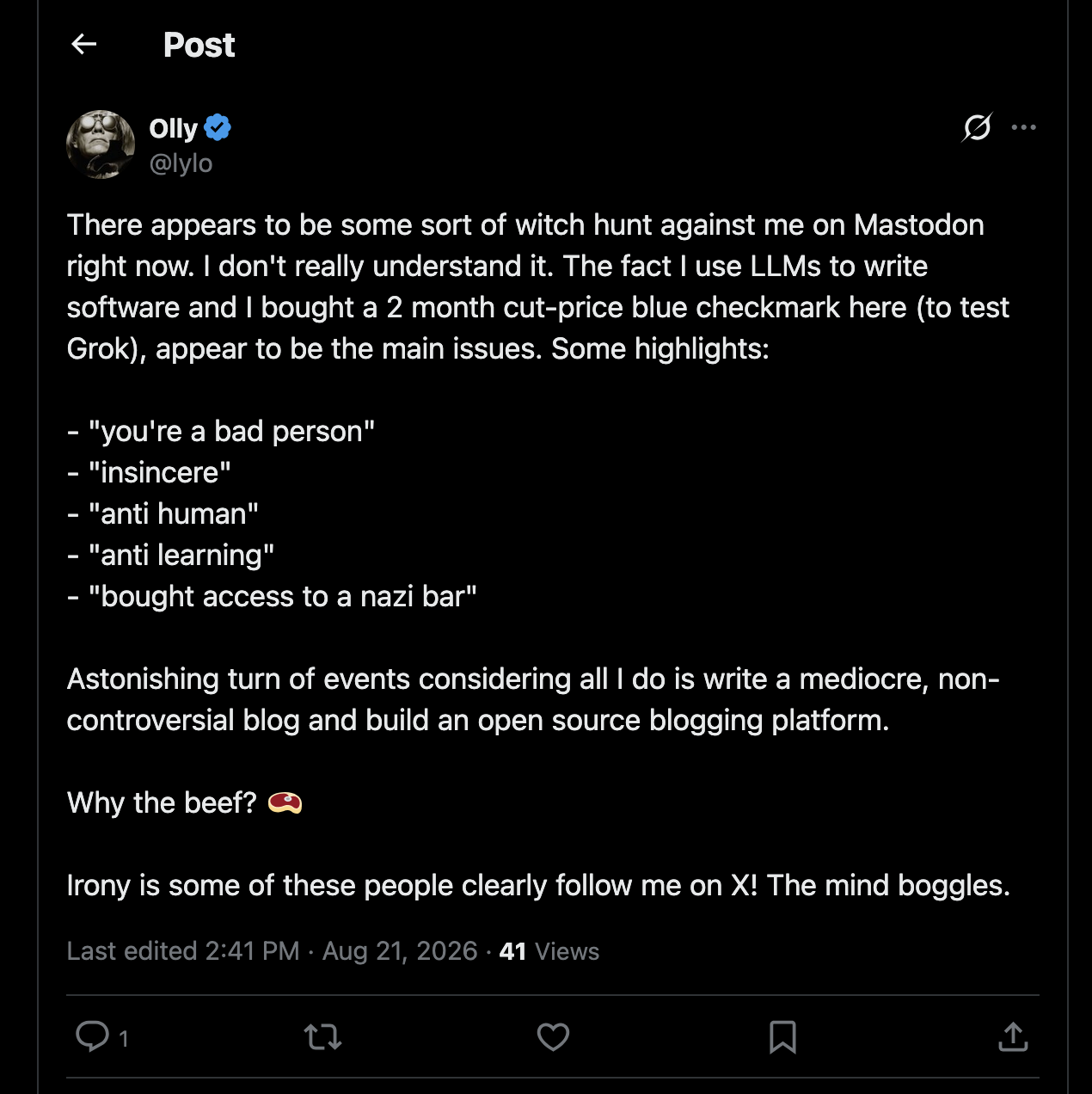
But Olly became increasingly upset at people criticizing the original remark he made. He's subsequently deleted his Mastodon account and now is on Twitter exclusively, where he pays for a blue checkmark beside his name.
It's okay to be sensitive, and it's also okay to fuck up (I've fucked up plenty worse myself) but when you're a creator with a public-facing project like Pagecord, you need to be able to handle criticism, even when it's unfair or aggressive. This is the Internet. Many marginalized folks face far worse harassment for simply existing.
I think, too, if you're going to make a product and market it as "a product that is built around [IndieWeb] ethos" and call yourself an "IndieWeb builder," then being pro genAI and being a paying user of Twitter are both going to raise questions from people. Because neither of those are generally considered IndieWeb ethos—at all.
Olly wrote on his blog in a now deleted post titled "Social Faux Pas" about how "Mastodon was just as toxic as X" (and yet he seems fine being on X and not Mastodon) in response to this. Hm.
I know this article I'm writing right now could be taken in bad faith, and seen as continuing to contribute to the so-called "witch hunt," but I'm not telling you to stop using Pagecord if you do use it. I don't think Olly is a bad person. Nor would I dissuade somebody from starting out with it. I still think it has a lot of cool features, which I've written previously time and time again. But it certainly is good and important to be aware and mindful of how the creators of the platforms you depend on operate, and why I recommend eventually trying your hand at hosting things yourself in the first place.
UPDATE: Since writing this, omg.lol user love has shared the following:
"I stopped using pagecord and went to self hosted for my blog when I realized how much the admin relies on LLM. actually, he fed the entirety of my 26 year blog into Claude to figure out how to port it to pagecord, without my prior consent. I only knew afterward when I read his blog on how he resolved the situation"
Olly wrote a blog post, proud of his solution, where he did not even read the output of the LLM before pushing its code to production. Now, this is fine for a personal project, but Pagecord is an actual service people pay for and have real, sensitive data attached to.
Olly seems to be wholly callous to the privacy and security implications of his actions for the people that use his products.
Love continued:
"It felt really invasive because those were blogs that were written since I was 10. a lot of them were really personal too, like how I started dealing with death of loved ones, personal health struggles (mostly mental like suicidality etc). they are public now but a lot of those started as private. I think a lot of times writing gets treated as the red headed stepchild when it comes to infringement - it's not as visibly bad like drawing genAI. but I spent decades refining my skill of writing both fiction and non fiction and to think it was fed to an AI without my consent has grossed me out more and more as time has gone on, especially with the subject matter being very personal and dark at times.
"I talked to my husband about it and he was like "well if your blog was public at any point and is public now then its definitely already been scraped by AI" and I'm like there's a difference between me making something public and a rogue agent lifts it versus me entrusting a third party with the data and it gets pushed to an LLM. I also have the windows on my house fully open so someone with a nice camera could take pictures of the inside of my house, which would suck, but that feels somehow less invasive than if I invited a new friend in and they took pictures from inside the house while I was in the bathroom."







Comments
To comment, please sign in with your website:
How it works: Enter your website URL. IndieLogin signs you in through your site's IndieAuth server if it has one (e.g. IndieKey), or checks your rel="me" links on GitHub, GitLab, Codeberg, and email. Setup instructions.
Signed in as: