All Collections

Lyric Essays

Essays that blur the line between prose and poetry. Fragmentary, associative, and deeply personal.

14 posts
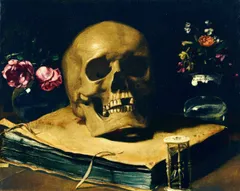
Oil painting of a vanitas still life: a human skull resting on an open book with blue-edged pages, set against a dark background. To the left, pink roses in a glass vase; to the right, a bouquet of colorful flowers with a small paper scroll bearing handwritten text. An hourglass sits on the book's edge in the lower right, and a dark, curved snuffed candle rests near the flowers.

You Must, You Must, You Must

I've been sitting with a single word change. 'Will' versus 'must' in the Latin phrase Memento Mori, and it's shifted everything for me. A meditation on mortality as obligation rather than fate, and what it means to truly reckon with the fact that we must die, and therefore we must live and love.
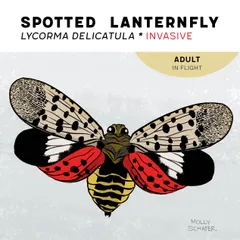
Scientific illustration of the spotted lanternfly (Lycorma delicatula), an invasive species, depicted as an adult in flight against a light grey background. The insect is shown from above with wings fully extended. The outer forewings are tan/beige with scattered black oval spots and dark grey tips. The inner hindwings are vivid red with black spots and white patches near the body, edged in solid black. The abdomen is yellow with bold black horizontal bands. The head is dark brown with visible eyes. Text at top reads 'SPOTTED LANTERNFLY / Lycorma delicatula * INVASIVE' in bold black and red type. A gold badge in the upper right reads 'ADULT IN FLIGHT.' Illustrated by Molly Schafer.

THE LANTERNFLY.

The spotted lanternfly is beautiful and terrible, an invasive species that illuminates even as it destroys. AI-generated content is flooding the Internet, and authenticity is becoming a premium commodity. We must refuse the premise that human writing is a niche product.
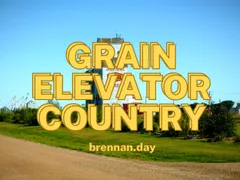
Bold yellow outlined text reading 'GRAIN ELEVATOR COUNTRY' in large stacked letters, with 'brennan.day' in smaller bold yellow text below. The background photograph shows a white wooden grain elevator marked 'SASKATCHEWAN' in a small prairie town, flanked by green trees and shrubs under a clear blue sky. A curved gravel road runs along the bottom foreground, with additional grain storage structures visible to the left and power lines to the right.

GRAIN ELEVATOR COUNTRY

A fifteen-hour road trip across Saskatchewan with my brother, watching the prairie unfold through grain elevators and abandoned towns. The quiet weight of prairie masculinity, the failure of academic knowledge to translate into brotherly wisdom, and the architecture of goodwill found in midnight motels.
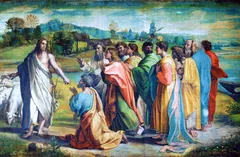
A robed Christ stands at left, gesturing toward a group of apostles in a lush pastoral landscape. At centre, an older bearded man—Peter—kneels in supplication before him, arms raised. Behind Peter, a crowd of apostles in vibrant draped robes of coral, green, gold, blue, and red look on with varying expressions of attention and concern. A flock of white sheep grazes at left. In the background, rolling green hills, scattered trees, and the towers of a distant village recede under a pale blue sky. The painting surface shows visible cracking consistent with age.

30: Finding My Footing

My annual birthday essay on turning thirty: examining the cross-cultural agreement—from Confucius to the Hebrew Bible to Zoroaster—that thirty is when formation ends and function begins. My dark year of depression which turned out to be preparation rather than delay, and on writing 200,000 words since, which turned out to be the same thing.
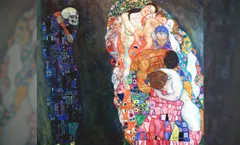
On the left stands a skeletal figure representing Death—a skull-headed form draped in a dark robe covered in crosses, circles, and geometric patterns in deep blues, blacks, and purples, gazing toward the right. On the right, a dense, intertwined mass of human figures representing Life cluster together in sleep or reverie—infants, adults, and elders pressed close, their bodies wrapped in richly decorated robes and garments featuring Klimt's signature mosaic-like patterns of reds, pinks, oranges, and greens. The figures of Life face away from or remain oblivious to Death's presence. The background is a murky, painterly dark green-grey.

Loss, and Loss, and Loss: A Eulogy

A eulogy for two kinds of loss: those who die and those who become simply elsewhere. Filtered through Didion, Barthes, C.S. Lewis, and Pema Chödrön. On ambiguous grief, the names written down so they don't disappear, and the sixteen-year-old who already knew that love stems out from verbs.
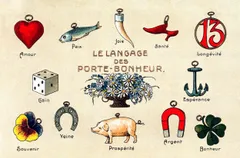
French illustrated card titled 'Le Langage des Porte-Bonheur' (The Language of Good Luck Charms), featuring fourteen labelled lucky symbols arranged around the title: a red heart charm (Amour / Love), a fish (Paix / Peace), a horn (Joie / Joy), a red shoe (Santé / Health), the number 13 in a circle (Longévité / Longevity), a dice (Gain / Gain), a bouquet of daisies and forget-me-nots at centre, an anchor (Espérance / Hope), a pansy flower (Souvenir / Memory), a horseshoe (Veine / Luck), a pig (Prospérité / Prosperity), a red horseshoe magnet (Argent / Money), and a four-leaf clover (Bonheur / Happiness).

The Blogging Übermensch, or, Being the Luckiest Person on Earth

Exploring constitutive moral luck through Nagel and Williams alongside Nietzsche's Übermensch and amor fati, I reflect on the recursive gratitude I feel for who I constitutively am—and argue that blogging is a philosophical practice of self-overcoming: a daily, recursive Yes to existence.
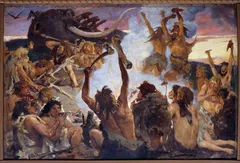
A dramatic 19th-century painting depicting a Stone Age scene with prehistoric humans gathered around a massive woolly mammoth. The central figure stands with arms raised holding a large bone or tusk, while others surround them in animated poses. Some figures work with mammoth tusks and bones in the foreground, while others celebrate or dance in the background. The scene is set against a dusky sky with birds flying overhead, and the composition conveys a sense of triumph and communal activity following a successful hunt.

12,000 Generations: On Deep Time, Grief, and the Body

Turning thirty during a breakup while the world unravels. Meditating on the 12,000 generations of homo sapiens that came before us, and what it means to be embodied in this particular moment of deep time.
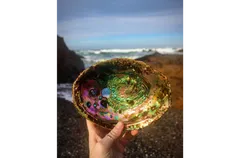
A hand holding an abalone shell up toward the camera on a rocky beach, displaying its iridescent interior of swirling greens, purples, pinks, and golds with characteristic respiratory holes visible on the left side. Crashing ocean waves and dark coastal rocks are visible in the blurred background under a partly cloudy sky.

What Can I Offer? The Shell.

I believe writing is sacred medicine, and I have been thinking about the writing I have been offering you over the past few months. Is it healing? Is it good? Please, let me know. I am here to give you an offering.
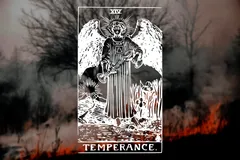
The Temperance tarot card (XIV) overlaid on a wildfire background. The black and white card depicts a winged angel with a radiant halo, wearing flowing robes with a triangle symbol on the chest. The angel pours liquid between two cups, one in each hand. The scene includes a sun symbol in the lower left, water at the angel's feet, iris flowers on the right, and mountains in the distance.

Unseasonal

Reflections on an unseasonably warm February day in Calgary, contemplating the accelerating pace of change in our world and finding meaning in small moments of connection and presence.
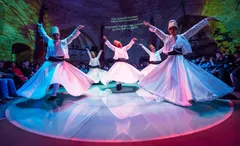
Whirling dervishes performing a traditional Sufi sema ceremony in a historic stone venue with arched architecture. Five performers in white robes and tall brown hats spin with arms outstretched, their wide skirts creating flowing circular patterns.

To Dance is to Live

Nietzsche and Rumi had something in common: dancing. I wrote this mundane life update and found myself getting into the weeds of what's important to the physical body. What can I offer myself? How can I enact movement each day?

You will never do anything productive or meaningful with your life.

You will never do anything productive or meaningful with your life.

The liberation of realizing you can’t waste your time.
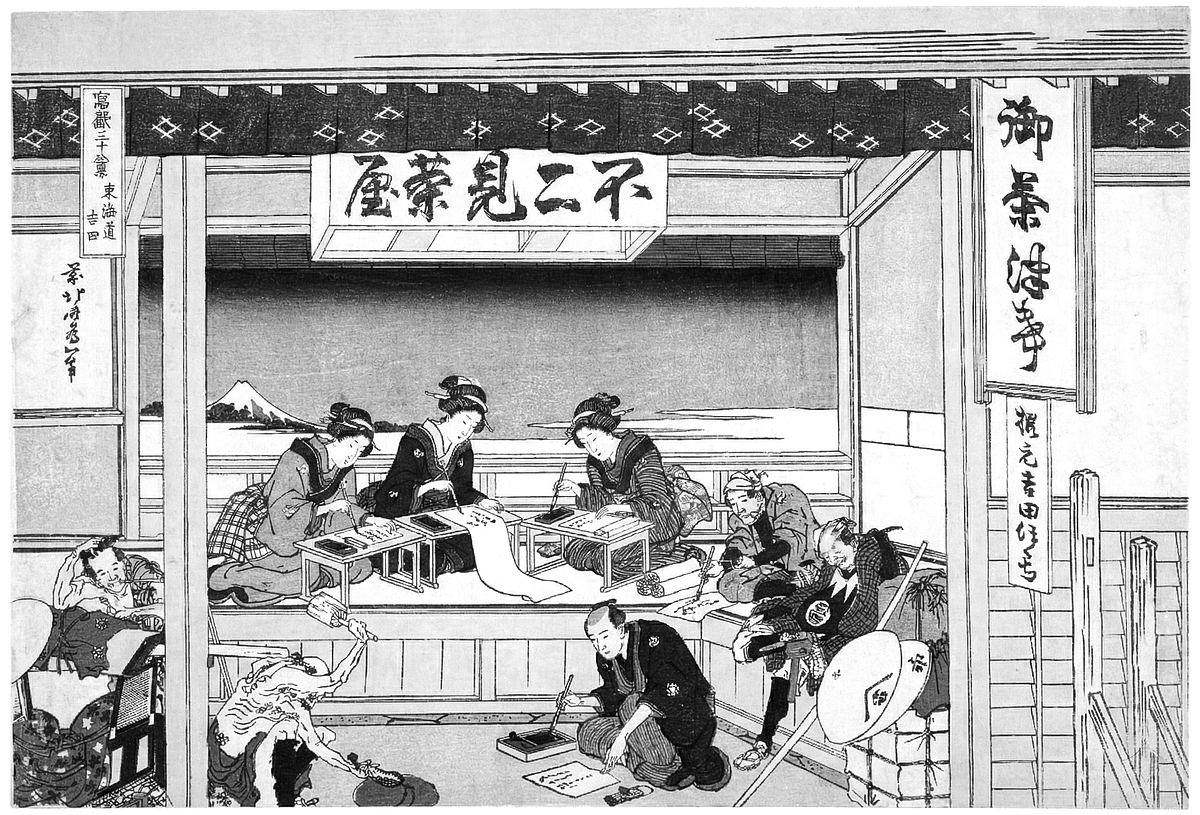
Yoshida on the Tokaido (Tokaido Yoshida), from the series “Thirty-six Views of Mount Fuji (Fugaku sanjurokkei)” by Katsushika Hokusai (Edited by the Author)

THE ART OF THE MICROESSAY

29 Examples to Get You Started!
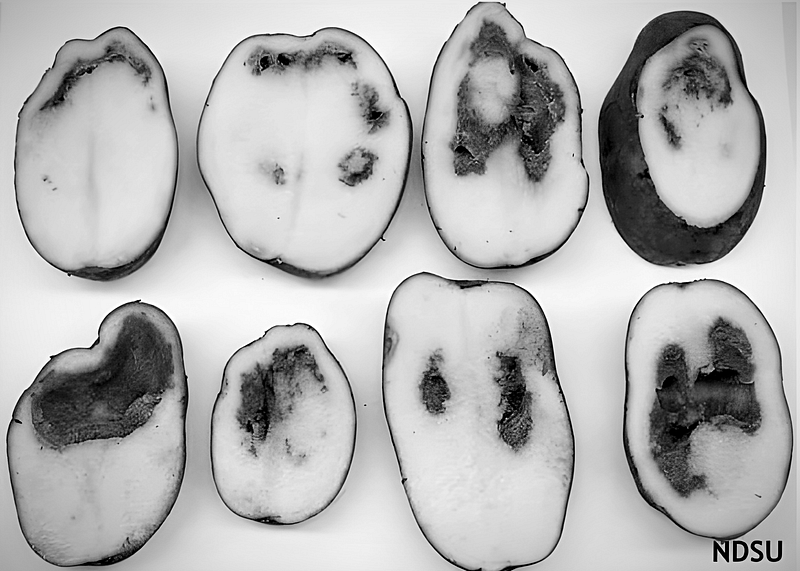
When We Get Blackheart

When We Get Blackheart

An Essay on Potatoes, Figs, Men, and the Truth.
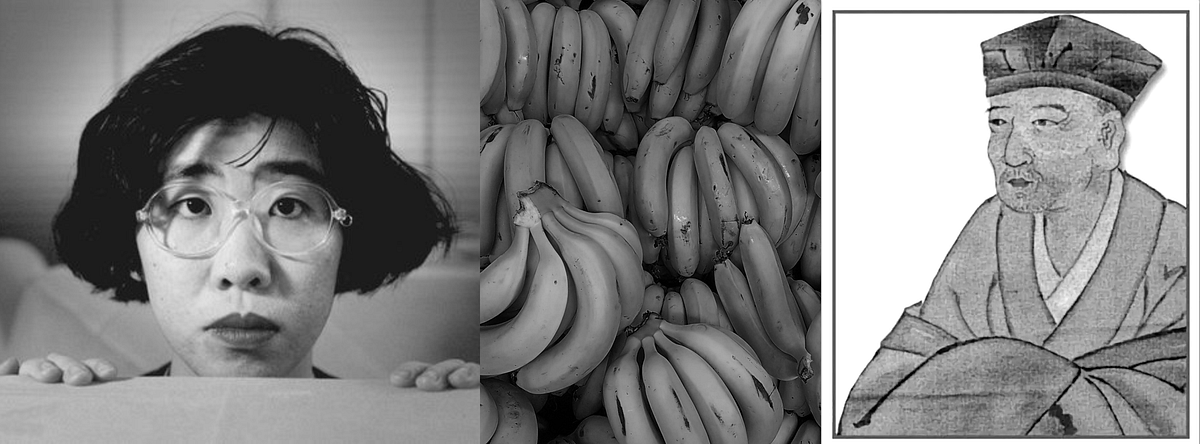
From left to right: Banana Yoshimoto, a pile of bananas, and Matsuo Bashō

THE BANANA MYSTERY

A Literary Question Across Centuries in the East

↑ TOP