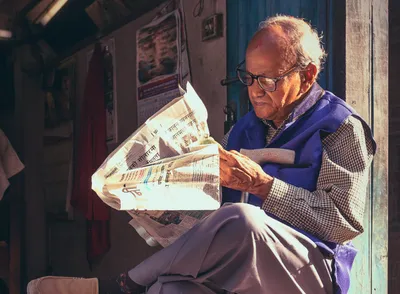
An elderly man reads a Nepali newspaper in the early morning light at Basantapur, Kathmandu, Nepal. November 15, 2019. Photo by Bijay Chaurasia | Wikimedia Commons (edited by the Author)
issue #169 of brennan.day
Being a Citizen Journalist
brennan.day — issue #169
Publisher: Brennan Kenneth Brown
Place of publication: Calgary, Alberta, Canada
Available at: https://brennan.day
Contact: mail@brennanbrown.ca
You ever notice the silence after a difficult conversation? Sitting in your sternum like a stone, heavy and wrong-shaped.
Widdowson Exchange Post-Mortem
I have been mulling over my interview with Widdowson since it happened yesterday. In our exchange, I was explicitly uninterested in the what, in the facts and figures she was trying to prove. This is already well-documented. APTN Investigates has done the work, and Scholar Sean Carleton at the University of Manitoba has spent years cataloguing the tactics, cherry-picking, and deliberate minimization. It is mind-boggling to me how Widdowson cannot, at the very least, see the optics of her argument being so distasteful. Her questioning of the number 215 dead is so easy to compare to the holocaust denier questioning the number six million dead. The dead are not a debate.
What I was interested in was the why. I have a genuine curiosity as to why she has dedicated herself to this, specifically. What gets her out of bed? What gives her days shape and purpose?
And I did learn that through interviewing her. For Widdowson, the answer is twofold. First, she believes Canada has been in "mass hysteria" since the burial discovery at Tk'emlúps te Secwépemc. The mass hysteria being, according to her, Orange Shirt Day, flags at half-mast, and the Pope's formal apology for Canada's genocide against Indigenous Peoples. She's not upset that these acts are performative, which is a criticism many Indigenous people have, myself included. The federal government lowered its flags and then eventually raised them again. The Pope flew in, spoke his words, and flew home. I've written about the frustration of the hollow choreography of reconciliation before.
Widdowson isn't frustrated that the gestures were hollow. She seems upset that there was any gesture at all—that there was any care or apology toward Indigenous Peoples for the harm done to them. I cannot help but find that level of anger disturbing.
Second, she claims that while there are many falsehoods in the world, she is dedicated to this one because she is uniquely knowledgeable on the topic. Widdowson does hold a doctorate in political science from York University. She was an associate professor in economics, justice, and policy studies at Mount Royal University from 2008 until her termination in 2021 following an investigation into her harassment towards a colleague. The harassment tells us how she moves through the world. Since her firing, she has toured university campuses across Canada, often showing up to campuses where she has been explicitly told she is not welcome—the University of Victoria arrested her for trespassing. She wears signs reading "What Remains?" beside images of herself holding a sign that reads "Zero Bodies," placed next to Every Child Matters roadside markers. The performance of it. The deliberate intrusion into spaces of grief to insist that the grief is fraudulent.
But why here? Why this? Given her knowledge on Indigenous policy and institutional formation—however compromised the institution—why not direct those years of expertise toward the things that are undeniably, measurably, statistically, devastatingly true? Such as:
- How Indigenous languages, traditions, and ways of life hover on the brink of extinction.
- The ongoing crisis of missing and murdered Indigenous women and girls.
- The overrepresentation of Indigenous people in child welfare and prison systems.
- The continuous lack of clean drinking water on reserves.
- The medical and health disparities carving years off Indigenous lives.
The list is never completed, and it is heartbreaking that Widdowson has not dedicated her life to any of the above. It is clear that a white settler from British Hong Kong has no interest in trying to help improve the systemic injustices Indigenous Peoples in Canada face. Instead, she is weaponizing her credentials to continue harm against Indigenous Peoples. As I've noted before, Widdowson has become cozy with hateful, malicious bad actors, publicly allying with Dallas Brodie and Jim McMurtry, both fired academics who share her anti-Indigenous campaign, perpetuating falsehoods that cause active, intentional harm.
Role and Responsibility
The exchange made me take a step back and consider my role and responsibility. There are those who would be angry that I gave Widdowson a platform at all. That despite my clear position, having a dialogue legitimizes and normalizes Indian Residential School denialism, regardless. This is why I steered the conversation toward her motivations rather than the specifics of her argument. There's no need to relitigate distorted evidence. Instead, I wanted to examine the human machinery.
I'm not trained in journalism. I briefly tried it and dropped out in exchange for English literature and creative writing. I typically stick to lyric essays and standalone pieces—writing that has the luxury of sitting with a subject in solitude. But I find myself diving more and more into topical events, into what I would call citizen journalism, or indie journalism. This is a tradition older than the credentialed press would want to admit.
In 1998, Matt Drudge called himself a "citizen journalist" from the stage of the National Press Club—having just broken the Monica Lewinsky story that Newsweek had prepared and then sat on, too cautious to publish. He had scooped the entire Washington press corps from a website that was functionally a newsletter. You can criticize Drudge's politics, accuracy, and his long shadow of damage—and you'd be right. But the act itself proved a single person with a modem and a willingness to push send could move the world. The mainstream press called him irresponsible. The mainstream press was also afraid.
Salam Pax, the "Baghdad Blogger" began posting dispatches on a free Blogger site titled Where Is Raed? in September 2002. He was a gay Iraqi architect living in Baghdad, writing in English, describing the city as American bombs fell on it. The world's major newspapers poured millions into war coverage, but it was Salam Pax who delivered what The Guardian later called the most compelling account of the invasion. He was doing it by dial-up, during power outages, sometimes continuing his diary on paper when the internet went down, intending to post it later. He served as an interpreter for foreign journalists who didn't know they were talking to the most-read journalist in the world. He eventually became a Guardian columnist and won the Royal Television Society's award for innovation in 2003. He was, at first, just a citizen in his house while his city was on fire, deciding that someone had to write it down.
Darnella Frazier was seventeen, taking her nine-year-old cousin to buy snacks when she saw a man being killed on a Minneapolis street. She pulled out her phone and hit record, the ten minutes of footage she uploaded to Facebook. It was Derek Chauvin's knee on George Floyd's neck while Floyd begged for his life. That video became "one of the most important civil rights documents in a generation." It was entered into evidence, played repeatedly to the jury, and was central to Chauvin's conviction on all three counts. In 2021, the Pulitzer Prize Board awarded Frazier a special citation for "courageously recording the murder of George Floyd, a video that spurred protests against police brutality around the world, highlighting the crucial role of citizens in journalists' quest for truth and justice." This was a teenager who was in the right place at the right time, and had the bravery and presence of mind to document what power wanted to go undocumented. The Minneapolis Police Department's initial report described Floyd's death as a "medical incident." Without her, that would have been the record that stands.
Zhang Zhan was a former lawyer who traveled to Wuhan in February 2020 when the city had gone into total lockdown and Chinese state media was controlling all official narrative. She documented what was actually happening on the ground, walking the streets and posting to WeChat, Twitter, and YouTube. She reported on hospitals overwhelmed with patients, on the government detaining other independent journalists, on the harassment of COVID-19 victims' families. In May 2020 she disappeared; it emerged she had been detained in Shanghai. In December of that year she was sentenced to four years in prison for "picking quarrels and provoking trouble," a catch-all charge China deploys against dissidents. She served her full term, going on hunger strikes in prison and was force-fed. She was the first citizen journalist convicted for reporting on the pandemic in China. At least two others, Fang Bin and Chen Qiushi, were also imprisoned or disappeared for the same work. She was released in May 2024, though her movements remained restricted. Her crime was that she told the truth. The act of publishing—of deciding someone has to write it down—carries heavier weight in different jurisdictions. Drudge was afraid of being called irresponsible. Zhang Zhan was afraid of being killed and she did it anyway.
I am completely independent. And as I've written before, I'm extremely lucky to have Deflect.ca as my CDN and DDoS protection. This means I can write whatever I want without worrying about being shut down—no advertiser to offend, no corporate parent to satisfy, no Postmedia editorial line to maintain. That's a rare, privileged position and I plan on using it.
The Media We Have
Journalism as a field is in a dangerous, fragile state. Actually, fragile is too gentle, "hollowed" is more accurate. Postmedia Network Canada Corp. owns more than 130 newspaper brands across this country. The National Post, the Calgary Herald, the Vancouver Sun, the Ottawa Citizen, the Financial Post, the Montreal Gazette. Papers that were once the institutional memory of their cities and local voices covering local lives. They are now unified under the ownership of American hedge funds—Postmedia is 98% owned by US financial interests. The company's strategy has been to merge competing newsrooms, eliminate staff, and strip local coverage to the bone while continuing to publish two papers in a single city. Papers that, before, competed, and had different reporters working different beats, developing different sources. They now share an editorial desk.
2023 marked the worst year on record for the loss of local print outlets in Canada. 2024 marked the worst year for local private broadcasting closures. PostMedia bought SaltWire Network Inc. and the Halifax Herald Ltd.
In parts of Newfoundland and Labrador, the only paper in town has closed. The 145-year-old St. John's Telegram—a paper that was alive before Confederation—now publishes once a week. The paper of record for a province, reduced to a weekly pamphlet thanks to hedge fund debt management.
Local journalism is community memory, it is not merely business. The reporter who knows which city councillor's brother owns the company that just won the no-bid contract. The coverage of the school board meeting that nobody else will sit through. When that disappears, what fills the vacuum? The answer, increasingly, is platforms optimized for engagement, optimized for outrage, optimized for the kind of harm Widdowson and her colleagues have learned to produce so efficiently.
I am just a person with a blog. And in the past, that's held weight. Drudge. Salam Pax. The bloggers who, in 2002, caught Trent Lott making apparently pro-segregationist remarks at a party—remarks the mainstream press had attended and elected not to cover—and kept the story alive until Lott was forced to resign his Senate leadership position. The individual voice, when it is honest and dogged and willing to stay on a thing, has broken the press's monopoly on truth before.
To Shine Light in Dark Pipelines
I'm not interested in normalizing or legitimizing harmful, malicious ideas. That is how we got to our current state of political instability, democratic backsliding, and rising of authoritarianism. But I do not believe that means we sweep dangerous, harmful ideas under the rug. Because the lack of understanding why dangerous, harmful beliefs appeal to people is how they sneak into lives without the recognition of where they're coming from.
In pop culture and mainstream media, the people who hold these beliefs are presented as uniformly unintelligent, wholly evil, and cartoonish. We instead need to question how they got there, and who is responsible for the conditions that made the journey possible.
Take the far-right radicalization of young men and the mainstream response being "Andrew Tate bad." The actual account is uglier, complex, and requires more of us. Consistently, research shows that young men enter radicalization pipelines because they have real, unaddressed struggles—economic anxiety, loneliness, a sense of purposelessness that the left has largely failed to speak to—not because they are inherently hateful. There are "soft entry points" within the manosphere, spaces which begin with relatable grievances and gradually escalate toward misogyny, white nationalism, and political violence. The algorithm serving slightly more extreme content click after click until a boy who started with sports commentary is now watching fascist content and believes it is "just asking questions."
Far-right ideologues have tragically become extraordinarily good at reaching people emotionally. Speaking to shame, to humiliation, to the loneliness of men who feel they are failing at something they were told was their birthright. The propaganda is insidious. The propaganda arrives as community, as validation, as someone finally taking your pain seriously.
The tradwife movement performs a similar function for women. Aestheticizing domesticity and submission as freedom, wrapping white nationalist ideology in cozy linens and fresh sourdough and sunlit kitchens. Researchers studying the cottagecore-to-tradwife overlap on platforms like Tumblr found that explicitly extreme content stays within tradwife-only spaces while palatable versions of the same ideology migrate into broader aesthetic communities. The mainstreaming effect means nobody consciously chooses radicalization. People are just following what's pretty.
If we cannot understand why these ideas appeal to the people they appeal to—if we only know how to villify and mock the destination, and not trace the road—we cannot do anything to interrupt the trip. That's why I went to talk to Widdowson. Not to debate her, but to understand the why.
The Problem of the Platform
I previously considered the work of Andrew Callaghan of Channel 5 and All Gas No Brakes some of the most interesting journalism still being made. Someone willing to go to fringe, bizarre, and harmful communities and listen, holding a deadpan microphone up to the spectacle of American political life, letting people speak uninterrupted until truth was revealed. His HBO documentary This Place Rules followed the lead-up to January 6th from within the crowd.
In January 2023, just days after the documentary's release, multiple women came forward with allegations of sexual coercion and assault. Callaghan issued an apology which barely acknowledged his behaviour and announced plans for therapy and a twelve-step program, going quiet for months before returning to YouTube. By February 2023, The Stranger had published an additional report with two more accusers alleging rape and sexual assault.
I believe a reason people have looked past multiple, serious allegations is because nobody else is really doing work like that. And that is a fucking terrible reason to look past rape allegations. In this, Callaghan is perpetuating the toxic, systemic harm he claims to be attempting to shed light on. In this, he demonstrates how talented men can get away with violence against women simply because of their talent.
If we are to move on, then we need people who are not compromised by their own behaviour to continue. When looking at this mode of journalism, particularly if you're attempting it, you must ask difficult questions. What do you inherit from the method and what do you refuse? What does it mean to interview people who hold harmful views, to sit in proximity to them, to make them legible to an audience? When is the journalist themselves not clean? I don't have a clean answer. I have a commitment to trying to be honest about the question.
What I Owe
I've written before about the Society of Professional Journalists' Code of Ethics, a voluntary code and the shared principles of journalism. The four pillars are: seek truth and report it; minimize harm; act independently; be accountable and transparent. I want to say what each of those looks like for me, from here.
Seek truth and report it. I will not amplify claims I cannot substantiate. When I interview someone who spreads disinformation, as I did with Widdowson, I will not act in neutrality. I will name what I observe as they speak. I will correct the record, in the piece or alongside it, when the record needs correcting. I will link to the scholarship, the reportage, the primary sources.
Act independently. I have no advertisers. I have no corporate parent. I have Deflect and readers who give me two dollars a month because they think this matters. I will write what I actually think.
Be accountable and transparent. I will acknowledge when I get it wrong. I will publish corrections prominently. I am an independent writer with a blog and no journalism degree, just a reckless conviction that truth is worth pursuing even when you're not credentialed to pursue it.
Minimize harm. This is the hardest one. My calculation, which I am willing to revise, is that unnamed ideas cause more harm than named ones. But I will not make that argument without being conscientious. I will continue listening to Indigenous Peoples and other marginalized folks about whether this work serves or costs them.
"The din of small voices," that's how Matt Drudge described the internet in 1998, at the National Press Club, with a smirk on his face. He was more right than he knew, and in more directions than he intended. We are in the din now. One of those voices is mine. I intend to make it worth hearing.


Comments
To comment, please sign in with your website:
How it works: Enter your website URL. IndieLogin signs you in through your site's IndieAuth server if it has one (e.g. indieauth.com), or checks your rel="me" links on GitHub, GitLab, Codeberg, and email. Setup instructions.
Signed in as:
No comments yet. Be the first to share your thoughts!