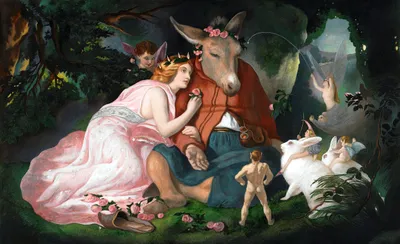
Samuel A. Cousins (after Sir Edwin Henry Landseer), Midsummer Night's Dream, 1858. Hand-coloured mezzotint. | Minneapolis Institute of Art
issue #166 of brennan.day
Right-wing Conservatives Cannot Make Good Art

brennan.day — issue #166
Publisher: Brennan Kenneth Brown
Place of publication: Calgary, Alberta, Canada
Available at: https://brennan.day
Contact: mail@brennanbrown.ca
Faint, acrid, tangy. There is a smell from conservative art. The sugary synthetic aftertaste pretending to be nourishment. The scent of a humid, locked room where people are agreeing loudly with one another about what they already believe and call it culture.
Alright, alright. I concede my blanket statement from the get-go: Evelyn Waugh wrote devastating novels of a decaying world. Flannery O'Connor was a devout Catholic who gave us grotesque, searingly moral fiction. T.S. Eliot's politics were reprehensible—anti-Semitic, reactionary, arch-traditionalist—and The Waste Land remains one of the great English-language poems of the twentieth century. J.G. Ballard called himself a right-wing republican libertarian while writing transgressive, visionary fiction. Clint Eastwood made Westerns and crime films with moral gravity, and he's a registered Republican.
But these artists aren't making conservative art. They're artists focused on craft, the truth, and the terrible human mystery of being alive in a body that will die. The politics came in through the character, through the texture of the world, through an earned and complex vision. What the contemporary American right is producing is categorically different.
God's Not Dead
In 2014, a film called God's Not Dead grossed $64.7 million on a $2 million budget. On Rotten Tomatoes it received a 13% critical rating. "Deploying sledgehammer theatrics instead of delivering its message with a dose of good faith, God's Not Dead makes for bad drama and an unconvincing argument to the unconverted." The A.V. Club's Emily St. James gave it a D-, writing that even by the lax standards of the Christian film industry, it was a disaster. And yet it worked financially. Evangelicals turned out in droves to see a college student debate an atheist philosophy professor played by Kevin Sorbo and win. The villain gets hit by a car and converts to Christianity before he dies. The crowd cheered.
The film was functioning as a pep rally, not as art. A mirror held up not to life but to the audience's own anxieties, reflecting them back transformed into triumph. It told them they're right. They are persecuted, and they will win.
This is not what art does. Art holds up a mirror where you discover something you didn't know already. Art makes you reckon. God's Not Dead let its audience off the hook.
The franchise spawned four sequels. The most recent entries were panned by Christians and non-Christians alike, with Christianity Today calling the whole thing a wasted opportunity—a series that emerged when American Christianity needed to wrestle seriously with its decline, and instead chose to produce "a pep rally for the soul."
Failed Screenwriters
Ben Shapiro is a Harvard Law graduate, conservative media's favourite public intellectual, a man who has made a career of the claim that facts don't care about your feelings, actually once wanted to be a Hollywood screenwriter. He tried. He failed. He claims he was blacklisted for his political views. His co-founder, Jeremy Boreing, moved to Los Angeles in the mid-2000s to work as a film producer and screenwriter. After a time in which he failed as well, and drifted toward conservative media.
Two rejected Hollywood strivers founding a media empire to compete with the industry that rejected them. This is the origin story. This is the wound. The genesis of the Daily Wire's entertainment venture is "one of spite". Shapiro himself said he wanted to "blow up the Death Star that is the Left-wing monopoly on entertainment." What has ever been made with bitter resentment as a creative engine?
Money and Money and Money
Spite cannot metabolize into art, but it does a really good job at becoming a podcast. Or a loud political rally. Or a streaming platform.
But art requires the maker be interested in human experience beyond their own vindication. Requires curiosity about the Other rather than hostility toward them. Requires that the artist be "primarily concerned with the beauty of his work rather than the ideas which it contains.". The great novelist Milan Kundera coined a word for those who force art to serve political ends, misomuse, one who hates the muses while wearing their face.
The Daily Wire spent over $100 million building an entertainment division. They produced films and series. They recruited the castoffs—Gina Carano, fresh off being fired from The Mandalorian; Vincent Gallo, who had not appeared in a film since 2013 due to online tirades during which he declared that granting women the right to vote had been a mistake; Mike Richards, the disgraced former Jeopardy! host fired after one day when his offensive comments about Asian women and sexual assault allegations resurfaced.
No company has failed harder at breaking free of MAGA narrowcasting.
Terror on the Prairie, their most serious attempt at mainstream filmmaking, starring Carano as a frontier heroine, grossed $804 during its one-day theatrical run. Not $804,000. A nice dinner for six. The film was then criticized by the very right-wing audience it was made for, for being too woke, the male characters supposedly too passive and the heroine too capable. The audience turns on the art for failing to confirm what they already believed.
A Lock and Bentkey
Bentkey is the Daily Wire's children's streaming platform, launched in October 2023 on the 100th anniversary of the founding of the Walt Disney Company. Once again a bitter, resentful passive-aggressive move. Its flagship original series, Chip Chilla, features chinchilla parents home-schooling their kits and going on adventures. Critics immediately described it as a "dull" and blatant knockoff of Bluey, the beloved Australian cartoon about a family of cattle dogs which is currently the most popular contemporary children's television.
Do you know what makes Bluey extraordinary? Generosity. The show imagines children as full moral subjects. It trusts parents to fail and learn. It is interested in boredom, in disappointment, in the grief a child feels when a game goes wrong. The show is emotionally porous, allowing both children and adults to find themselves inside it. Created with curiosity about human experience.
Chip Chilla was created by people who were opposed to Bluey's politics. Even the colour palette was derivative, which Chip himself a few shades of blue darker than Bluey. Bentkey spent more than $100 million on content that was described, even by the outlet The Federalist, as a name with an unavoidably creepy connotation. The "bent" key, named after a literal bent key hanging inside the shirt of a stranger to all the children watching. The rest of Bentkey's catalogue was largely re-dubbed European and Asian cartoons padded out to fill the home screen.
In March 2025, the Daily Wire laid off the entire staff of Bentkey. The children's division—over $100 million sunk—dissolved. Jeremy Boreing stepped down as co-CEO. The company hired a bankruptcy lawyer.
The dream of a conservative Disney, a right-wing PBS, a counter-cultural children's entertainment ecosystem—gone. No liberal conspiracy in sight. The product was derivative, hollow, and built on resentment rather than love.
You cannot fake warmth. Children know. They are the most honest audience in the world. Why would they sit through a mirror held up to their parents' politics? Children want to feel seen, held, moved. They want to feel the kind of expansive joy that Bluey generates by trusting that the world, and the people in it, are fundamentally worth caring about.
Cultural Leftovers
I think about the Super Bowl.
In February 2026, as Bad Bunny performed the halftime show on the main stage and Turning Point USA held a counter-event featuring Kid Rock. Even the conservative outlet First Things acknowledged that it was obvious which event represented "the cool kids' table". "Parading a culturally eclipsed conservative lineup, obsessed with petty nostalgia, and desperate for approval." Kid Rock, born Robert James Ritchie, whose musical peak was 1998's Devil Without a Cause, who attended Trump's inauguration and smashed Bud Light cans on camera in protest of a trans influencer, stood on a stage in 2026 as the conservative cultural movement's best answer to Latin pop.
The conservative media machine produces "safe retreads of popular entertainment with on-the-nose political messages, bland renditions of Bible stories with the edges sanded off, and carbon copies of Hollywood genre films from the early 2000s." An ideology of the familiar, trying to produce art—which is inherently an encounter with the unfamiliar.
You can see it in who shows up at Turning Point USA's AmericaFest. This past December, Nicki Minaj walked onto the AmericaFest stage hand-in-hand with Erika Kirk, widow of Charlie Kirk, as Super Bass played. Minaj called Trump and Vance "role models." She drew parallels between herself and the president, noting that both come from Queens. She mocked Gavin Newsom using Trump's nickname for him.
Nicki Minaj once celebrated fluid identities and cultivated one of pop's more Queer-friendly fan bases. She was appearing at an event where, the previous year, Charlie Kirk had said he would never consider her specifically to be a good role model for Black girls. The crowd at AmericaFest, who do not know a single lyric of Super Bass, who would in most contexts find her music antithetical to their values, cheered. They embarrassingly need her and the cultural credibility. They need Nicki not to legislate, but to distract.
The right, for all its money and platforms and institutional power, cannot generate genuine cultural magnetism from within its own ranks. It has to import and poach. The right waits for artists who were built in other rooms—in the rooms of marginalization, of hunger, of the long irregular beat of life outside the mainstream—to fall and then carry their borrowed glow into the auditorium.
Creativity and Politics
A 2007 study in Personality and Individual Differences found that, controlling for verbal ability and openness, students endorsing more conservative positions had fewer creative accomplishments and produced photo essays and drawings judged as less creative by independent raters. One commenter at The Imaginative Conservative wrote that "it is anathema to step outside of adherence to tradition, God, family, etc for a conservative and without that ability to break free of those shackles you can't ever really see or explore the bigger picture."
Art, at its most essential, is an act of imaginative departure. Conservatism, as a political disposition, is suspicious of departure. Oriented toward preservation, the already-known and the managed maintenance of what exists. As Evie Magazine noted, political propaganda "necessitates suspending the cognitive faculties employed in making excellent art: creativity, openness to experience, and a willingness to contend with complex, ambiguous ideas."
The Daily Wire raised hundreds of millions of dollars. They had a clear audience, infrastructure, and the backing of wealthy donors who understood culture war and wanted to fund the weapons.
They failed anyway, embarrassingly, publicly, laying off 25% of their workforce, watching their entertainment empire dissolve in real-time.
Art school faculty lean liberal at rates of 60–80% because the disposition required to spend years developing a craft for uncertain economic reward. The disposition of risk, of openness, of genuine curiosity about human experience all map poorly onto the risk-aversion, the hierarchy-valuing, the comfort-seeking tendencies that political conservatism selects for. Art schools, writing programs, film schools are made of people willing to be uncomfortable.
And in the art press, the art world, the gallery, the studio, "right-wing" immediately conjures "far-right," which conjures "fascist." The twentieth century's most explicit experiments in state-produced politically conservative art were the aesthetics of fascism. Blood-and-soil murals, the heroic sculpture, the monumental architecture of a people who believed themselves to be the pinnacle. As one c2c Journal essay noted with dry irony, Ayn Rand's vision of "Romantic Realism" where artists would create "scenes, melodies, and stories to present the essentially heroic character of man" was "not much different than Soviet-style Socialist Realism."
Historical literary canon skews conservative. Dickens' paternalism, Faulkner's apologia for slavery, Hemingway's "founding father of toxic masculinity," Fitzgerald's Gatsby as the neckbeard's playbook. These are the writers the conservative intellectual tradition tends to lionize. And yet every single one of them made work that was capacious enough to be inhabited by people who disagreed with them. The work centered around grief, aspiration, failure, and being alive. The current explicitly reactionary, algorithmically radicalized, grievance-industrial right-wing conservatism cannot reach this.
James Baldwin's fire, Toni Morrison's archaeology of grief, the Harlem Renaissance's astonishing act of collective self-invention in the teeth of a country that wanted to erase Black culture entirely. Good art explores the cost of being who you are in a world that doesn't want you. The right is a coalition of people who have never been on the wrong side of power's arrangements. It is a coalition organized around the preservation of those arrangements.
You cannot purchase the conditions that make art possible. You can purchase distribution and name recognition. You can purchase, at great expense, the cosmetic appearance of a creative ecosystem. But you cannot purchase hunger, truth, and empathy.

Comments
To comment, please sign in with your website:
How it works: Enter your website URL. IndieLogin signs you in through your site's IndieAuth server if it has one (e.g. indieauth.com), or checks your rel="me" links on GitHub, GitLab, Codeberg, and email. Setup instructions.
Signed in as:
No comments yet. Be the first to share your thoughts!