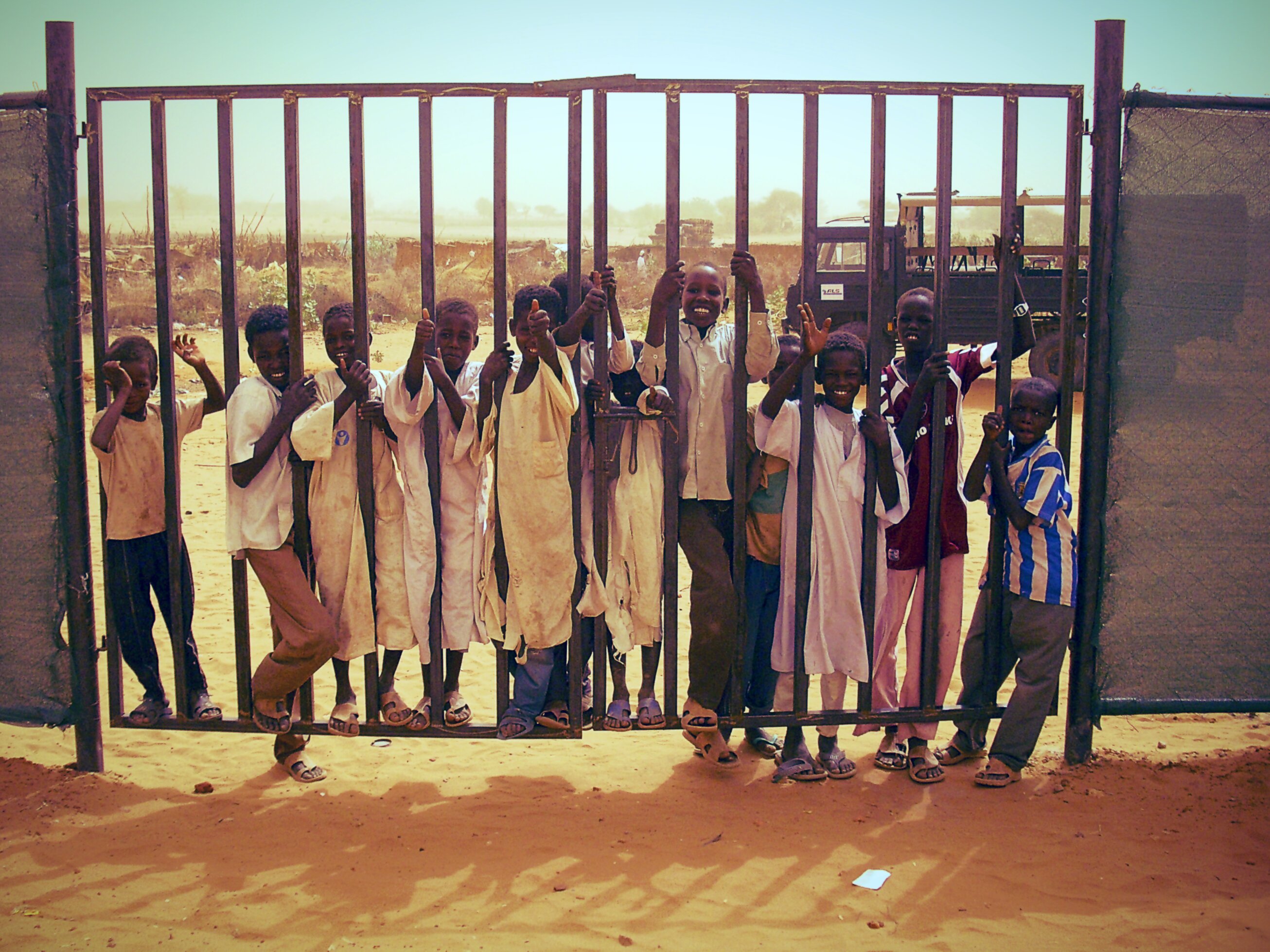
Children at Zamzam IDP camp in North Darfur, Sudan, 2006. Taken by Medhus. | Source (edited by the Author)
Behind Glass
A few minutes before I begin writing this, I woke up into an anxiety attack.
There are a lot of issues I could be writing about, for the world is fraught with uncertain violence. I offer you a braided essay, a weaved piece of writing, drifting between my own personal experience and the most important, under-reported news I can find right now.
I want to try to write about issues that you haven't heard about, issues that aren't fully present in the headlines. This is a story about me, and also a story about North Darfur and Kansas and Haiti and India. I ask this: whose suffering gets reported?
Whose death counts behind glass?
i.
The radiator mouths hot air through the vent inches from my pillow, all night blasting against my skin. I suddenly sit up straight and return to my body without ceremony, without any memory of having left it. One moment: nothing. The next: my room, this thermal weight, this gnaw at the centre of me where a proper meal should have been. I look at my gas-station liturgy on the table beside me. Chocolate-covered pretzels, crackers, seaweed, an accumulation of plastic and colourful wrappers.
In the Zamzam displacement camp in North Darfur, home to approximately 500,000 people, roughly half of them children, families have been surviving on something called ambaz. The leftover pressed matter from beans and sesame after the oil has been extracted. This is animal feed. This is what is eaten because sorghum and millet have become unaffordable. Families have been forced to survive on less than two litres of water a day, which is against the minimum requirement of twenty, and the soup kitchens—more than 1,500 of them across Sudan—closed immediately when the United States froze its USAID payments in January 2025. The bill was presented at 4:30am in the form of a child's body. In Zamzam, at least one child was dying every two hours at the crisis's peak.
I am writing this from a city in Treaty 7 territory where the radiator still works.
ii.
My body does a slow arithmetic of neglect, tallying up every hour. It is 4:30AM. What I know clinically is that low blood sugar activates the sympathetic nervous system. Hunger is not an absence, but an alarm tripping ancient circuitry. What I know personally is that when it's bad enough, something animal in the brainstem decides we are dying. It is not wrong, exactly. Just early. Sometimes I wake up, heart racing, thinking I am dying.
What I know politically is that researchers at the Center for Global Development have calculated that the USAID program cuts could contribute to a million additional deaths annually. USAID programs saved approximately 90 million lives over two decades, and permanent cuts could lead to 14 million avoidable deaths by 2030. On current trajectories, a child under five could die every 40 seconds by 2030 as a direct consequence of these cuts.
The alarm that trips ancient circuitry. The brainstem deciding we are dying.
The difference is that my brainstem was wrong about me. And it is not wrong about them.
iii.
My body becomes unfamiliar. Fingers arrive at objects with a small apologetic delay, as if uncertain they still belong to the same transaction. The chest tightens into a birdcage underneath a slow hand. Depersonalization is what clinical literature describes as a sense of observing yourself from outside, separated by a barrier, as though behind glass.
The self troweling loose from its scaffolding. Consciousness begins to unhinge from the body's architecture the way wet plaster separates from the lath. Slowly, and then in one cold sheet. Your hands are suddenly in quotation marks.
What the Western media does with African crises is always behind-glass. Hands in quotation marks.
Whose death counts?
A disaster that kills one person in Europe generates US news coverage. It takes 45 African deaths to generate the same headline. The Pacific region is covered even less, 91 deaths per headline.
This is the editorial calculus of whose panic attack is legible to the culture, whose alarm is allowed to trip. Separated by a barrier, as though behind glass.
Who is doing the watching? When the glass is between a Western news editor and a child in Zamzam eating animal feed, the glass is a policy choice. Structural. It is racism. Black suffering has been demonstrated to have less appeal to Western viewers than suffering with a "Caucasian angle.". African crises received more coverage in 2000, when white farmers were being displaced in Zimbabwe. The colour of skin behind the glass determines whether the glass is even acknowledged as glass.
Relief decisions are driven by news coverage of disasters, or the lack thereof. Underreporting is a policy failure. It kills people. Glass has a body count.
iv.
Thankfully, my dissociation subsides now in minutes. Medication. Lifestyle. I cool down, I ground myself: five senses, physical sensations, anchor. The radiator still breathing. The cotton of the sheets against my palms, that roughness, the little topography of threads. The dark of my bedroom, which I know is mine. I find the edges of myself again, the proprioceptive borders where I stops and not-I begins. Return.
In Kansas, since February 26, 2026, the state has been sending letters to transgender residents informing them that their driver's licences are now invalid. Not revoked for cause. Not expired through neglect. Invalidated retroactively, by legislative fiat, because the gender marker on them no longer matches the sex assigned at birth. The law contains no grace period. You must surrender your now-illegal identification to the state before receiving a replacement, the one that will reflect not how you live, not who you are, but what a government clerk recorded about you the day you were born. Kansas is, as of this writing, a "Do Not Travel" zone for transgender people, the first state to earn that designation. Several countries have issued formal travel advisories. The United States itself has been designated a Do Not Travel zone for non-essential transgender travel internationally.
The ground of your identity—the felt, lived, embodied sense of who you are—is legally inadmissible. The anchor fails. The senses report back, you find the edges of yourself, and the edges have been declared illegal. The self you locate is a self the government is requiring you to surrender.
Nikson Mathews, chair of the Idaho Democratic Queer Caucus told a state House committee, "every single day when I'm out in public, I have to decide: Do I feel like going to jail today, or do I feel like being attacked."
Idaho's governor Brad Little just signed that bathroom criminalization bill into law. A 2025 UCLA Williams Institute study found no evidence of increased harm from inclusive bathroom policies but clear evidence that trans people face verbal harassment and physical assault when denied access. The bill passed anyway. Conservative legal organizations like the Alliance Defending Freedom circulate model bills that are replicated across multiple states with minimal changes. A coordinated national playbook. Over 600 anti-transgender bills were introduced at the state level in 2025 alone. These bills have directly caused a measured increase in suicide attempts by 72%. More than half of all transgender youth in America now live in a state that has banned them from participating in school sports consistent with their gender identity.
What is the word for a state that legislates whose self is real? What is the word for a government that sends letters telling you that your identity is now invalid and you must surrender it?
The word arrives as a package left on a doorstep in the rain: Authoritarian. Fascist.
v.
In the worst of my anxiety, a voice arrived and asked, Oh, is this part of the eternal recurrence for you, Brennan? Would you truly do everything all over again if it included this? Would I will relive this life identically, over and over? Every humiliation, every specific 4:30 panic with gas-station aftertaste, the hot room with brief and total terror. Down to the same spider, the same moonlight between the same trees.
What is your reaction, Brennan? Do you gnash your teeth at the question, or do you reach for a hand and call it God? The question requires enough leisure to have a loneliness, enough security to have a specific fear that is personal rather than structural, enough privilege to have a life you might conceivably want to recur.
Sudan has remained one of the most underreported and underfunded emergencies in the world for three consecutive years. This month marks three years of civil war between the Sudanese Armed Forces and the Rapid Support Forces. More people are living in famine conditions in Sudan than in the rest of the world combined. The humanitarian response plan for 2026 needs $2.9 billion. It has received 5.5% of the necessary funds. The United States, which provided 44% of Sudan's humanitarian funding in 2024, froze that funding a year ago and has not resumed.
There is no loneliness quiet enough for eternal recurrence to be pondered. There are 825,000 children trapped in the Al Fasher and Zamzam area—half the population of Calgary—without adequate food, water, or medicine, inside a siege that has destroyed the central market, blocked all access routes, and collapsed the health system. UNICEF's country representative called it "a hell on earth." He is not being rhetorical. Life-affirmation requires that life be available to affirm.
vi.
After my pitiful grounding exercises and self therapyspeak, I open my laptop and begin researching on the few remaining ethical search engines to begin finding the facts that make this story and thread them together. As though I'm braiding sweetgrass.
The USAID collapse is what happens when you run humanitarian infrastructure on the goodwill and budget of a single state actor whose political character changes every four years. Less than 1% of the US federal budget—roughly $105 per American per year—was functioning as a life-support system for the world's most precarious people. In the DRC, when the freeze hit, aid organizations were forced to stop providing clean water to Goma, where hundreds of thousands of displaced people had gathered. People began sourcing water from Lake Kivu. Cholera deaths rose 361%. More than 4.3 million people in the DRC are at risk of losing all humanitarian aid by 2026 according to OCHA, as aid services have been further slashed following the shuttering of USAID and security incidents against aid workers rose 33% in 2025.
In Haiti, gangs now control nearly all of Port-au-Prince. More than half the population, 6.4 million people, needs humanitarian support. Haiti has witnessed a 1,000% increase in sexual violence against children since 2023. The UN assesses that half of all gang members are children, with a 700% rise in child recruitment in the first quarter of 2025 compared to the same period in 2024. And the Trump administration's response has been to deport people to Haiti, with more than 270,000 people were forcibly returned in 2025, many of them to a country they may not have lived in for decades.
Haiti is not an accident. Haiti is the downstream consequence of two centuries of Western extraction. The debt France imposed after the revolution, the occupation, the structural adjustment programs, the aid that funneled money back to US agribusiness through procurement contracts while undermining local agriculture. Haiti is what it looks like when you look at the bill and decide, across generations, not to pay it. The gangs did not spontaneously appear, they were incubated in the conditions that Western policy created and then withdrew from.
And it barely makes the news. Because news coverage of Africa and the African diaspora is structurally, demonstrably, measurably less. News about Black people is often more negative than news about other racial and ethnic groups. The pervasive "hopeless myth," that Africa is a lost cause and not worth engagement, is evident when Western decision-makers decide that Africa is not worth their time.
The saviour framing is the other face of this coin. When Sudan does get covered, the story is usually structured around benevolent Westerners as the lead role, while the people living through the crisis remain voiceless, nameless, often faceless. Their humanity is instrumental to the story of our charity, rather than intrinsic. We are the active subject. They are the backdrop.
This is not neutral. This is not inevitable. It is a choice.
vii.
There is a part of me that is a relentless hardass. I am grateful for this part of me. It is a motherfucker. I dig mercilessly. I pursue the truth the way a terrier pursues game. The truth arrives dense and blunt as a river stone, still cold from the water.
I've been turning over the vanity of soft landings. The energy spent choosing unfortunate over bad, challenging over wrong. It is architectural cosplay, putting crown molding on a condemned building. There is a version of this essay—polished, publishable, more comfortable—that would approach the news sections with more distance. More clinical framing. More careful management of the reader's discomfort. That essay would say there are serious concerns where I am saying this is racism. That essay would say the humanitarian situation is challenging where I am saying people are eating animal feed and dying of preventable cholera because the US decided, as a foreign policy move, to stop paying for clean water. A spade is a spade. A rose by any other name still thorns.
The global anti-trans legislative wave is the language of "protection" weaponized to mean its opposite. India's Trans Amendment Bill 2026 was passed by both houses of Parliament on March 25 and received presidential assent on March 31, despite over 100,000 emails to Members of Parliament and more than 88 public statements demanding its withdrawal in just ten days. A wave of resistance that received almost no coverage in Western media while India's government called the bill a measure to boost "the pride and dignity of the transgender community." The bill strips the right to self-identify. It requires identity to be verified by a medical board and approved by a district magistrate. It mandates that medical institutions share details of gender-affirming procedures with the authorities.
Activists have named the template directly. This is a global anti-gender movement. The Alliance Defending Freedom is circulating model bills through US statehouses. India's ruling party is passing laws in the name of protection that function as surveillance. The language of "safety" and "protection of women" is being used in country after country to justify state intrusion into the most intimate territories of personhood. As one analysis notes: "Laws like this don't stop trans and Queer communities from existing; they serve to legitimize and intensify violence, exclusion and discrimination against them."
Lawmakers in the United States are advancing "sex definition" laws that don't target individual policy areas but instead redefine sex across entire state legal codes, rewriting the foundational vocabulary of civic existence to exclude trans and nonbinary people from legal recognition. These are States making lists of trans people and collecting information about who has sought gender-affirming care, who changed a gender marker on a document.
History is not subtle about what happens when states make lists of people by identity.
Nearly forty years ago, disability advocates struck a deal with Republican lawmakers: their votes for the ADA in exchange for excluding trans people from its protections. The movement fractured itself to survive. The Trump administration is now weaponizing that original exclusion, citing the 1990 text's language about gender identity as a disorder. Disability rights advocates are now standing shoulder to shoulder with the LGBTQ+ community to fight it back. The coalition that was sacrificed once is being rebuilt. The rights movements that were pitted against each other are finding, again, their shared material interest. Coalition is the only architecture that has ever actually worked.
viii.
I've stayed up long enough for the colours of the sunrise to bleed the colour of cotton candy and bruises when the chinook clouds come in. They're stationary wave clouds, altostratus or stratocumulus.
I open my window and listen to the sound of melting snow flood the eavesdrop and pretend it's raining.
There is always work to be done, thank God for that. Where would I be if I had nothing pressing to do? What would I be doing right now in a world tranquil and peaceful? But my own personal world is, in fact, tranquil and peaceful.
I am Red River Métis. My ancestors were dispossessed by the same logic now defunding the soup kitchens in Zamzam and revoking the IDs in Kansas. The logic that some bodies are administrative, some lives are leverage, some people are the kind of people that things get done to rather than for.
This is not a credential. I have not earned the right to be angry by virtue of proximity to suffering. I'm saying the opposite, that proximity doesn't insulate you from the work of looking. Being Métis born in Manitoba doesn't make me fluent in Sudanese Arabic or Haitian Creole or the lived experience of a trans teenager in Kansas deciding whether to risk the bathroom. While I live in the most regressive province in Canada, I am housed inside a body that isn't constantly being politicized.
How revolutionary can we be if we do not know the scope of carnage occurring? How much of the world are you truly aware of? Who do you speak to living within other continents and nations? There is the gaping maw separating us. A gap I cannot jump, a lack of courage in the chasm.
We cannot plan and enact change unless it includes all of us, bound by all land and ocean. I know this to be true.
I also know there is no problem insurmountable. We levy the dams, we fortify ourselves against these ongoing growing evils. The price of power is paid with the blood of the innocent and marginalized.
I'm not going to pretend I am a neutral observer. I'm not going to pretend that integrity means a lack of bias. That simply isn't true. I bias towards love, towards stubborn hope, towards others who are vulnerable and need help.
I am not an institution, thank God for that. I am simply a person, Queer and fringe, mentally ill and racialized. Radicalized by an unjust world. I cannot separate myself from who I am, I bring my entire being to everything I write.
I deeply breathe. I do not need to conjure something so effortless in rhetoric. I am not here to spread the seeds of blooming flowers spontaneously arising out of other matter. I am here to write freely. To exhaust my mind and my hands and bloodshot my eyes until I feel as though the piece in front of me is made whole.
This is what to keep in mind when thinking of balance. The theory and the praxis. Or, in less pretentious terms, the writing and the doing. Love is patient and kind, but it is also a verb—a doing word.
How much are you doing behind the glass you're reading this on?
ix.
It is during the chinook arch that it's the most windy here, when the trees outside my window sway the most aggressively. Alive and kicking. There are warblers and chickadees and the echoing honks of geese returning home.
We all shall be healed and made whole.
If you want to act: Action Against Hunger Sudan response. IRC Haiti crisis. Trans Legislation Tracker. Movement Advancement Project. AWID solidarity with India's trans movements. Oxfam on USAID.
Comments
To comment, please sign in with your website:
How it works: Your website needs to support IndieAuth. GitHub profiles work out of the box. You can also use IndieAuth.com to authenticate via GitLab, Codeberg, email, or PGP. Setup instructions.
Signed in as:
No comments yet. Be the first to share your thoughts!