When We Get Blackheart
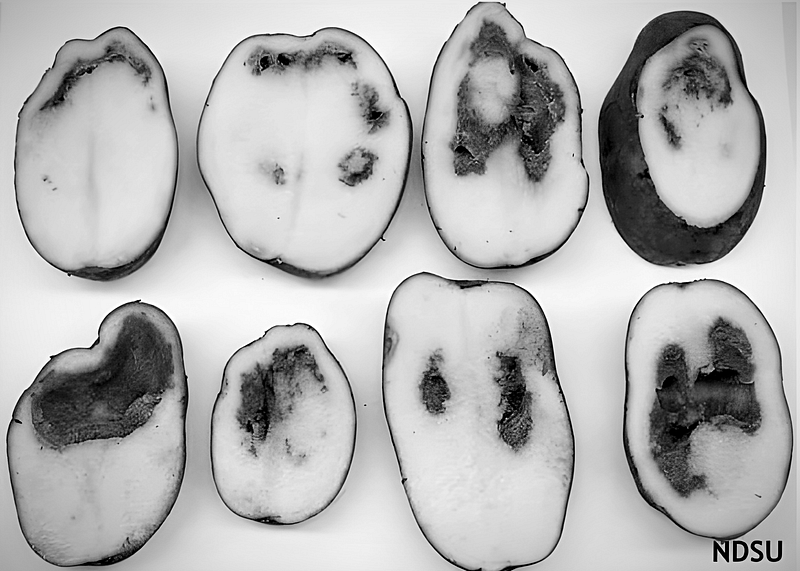
An aged farmer slices into a potato and the flesh gives way with a soft, wet sigh. The skin is perfect. Smooth, unblemished, and the colour of prairie earth after rain.
I.
But then the knife reveals something else. A hollow black core, soft to the touch, collapsing inward like a mineshaft. This is blackheart. It happens when oxygen can’t reach the centre. It doesn’t rot from bacteria or mold, not at first. It simply can’t breathe. It happens underground, in the dark, when the tuber is starved of air. The outside betrays nothing. You only discover the ruin when you split it open.
From the outside, you’d never guess the heart has gone black.
II.
May came with lilacs and a degree and the end of everything I thought I’d been building toward. I should have felt victorious. I’d survived four years of close reading and annotated biblographies, late nights in the library, the weight of expectations I’d placed on myself like stones in my pockets. But something had happened during those years, something invisible and irreversible. I missed my own convocation and felt nothing. Not relief. Not pride. A vast, echoing emptiness where my future was supposed to live.
Couldn’t get out of bed. Couldn’t eat. Couldn’t read. My thoughts congealed into a single, dull pulse: what now, what now, what now.
By the time I noticed, the rot had already set in.
I think about this often now, in November, when we’re supposed to raise awareness for men’s mental health. How many of us walk around looking fine? Skin intact, no visible wounds, while something essential has gone dark inside. We call it burnout, depression, the weight of masculinity. We, too, are stored in darkness. Airless rooms. Dead screens. The hiss of the heater trying to make the air move.
We don’t call it what it is. Suffocation. The slow death that happens when we can’t let air in. The outside looks fine. It’s only when you slice into it that the truth surfaces.
III.
Sylvia Plath wrote about a fig tree. Each branch held a different life: husband, children, poet, professor, lover, traveler. She sat in the crotch of that tree, paralyzed, watching the figs shrivel and blacken and drop. One by one. Because she couldn’t choose.
I know that tree. I’ve been sitting in it for years.
The figs are fickle things. They sour when microorganisms—bacteria, yeasts, fungi—enter through the eye, the ostiole, that small opening at the tip. They break down the flesh from the inside. No different from the potato’s blackheart. No different than the ancient Evil Eye, that blue talisman we use as an emoji now. Divorced from its original weight. The eye as entry point. The mirror we hold up that shows us what we don’t want to see.
What has entered my own eye? 🧿
I think about Robert Frost’s poem, the one everyone misunderstands. It’s not about taking the road less traveled being better—it’s just different. An alternative. The poet admits there was really no difference between the paths at all. But we tell ourselves stories about our choices because the alternative—that we could have lived a dozen other lives just as easily—is too vertiginous to face.
I could have not dropped out of high school. Could have finished polytechnic college and found myself comfortable in software development. Could have fought harder for love and relationships that ended. Could have reached out to people over the summer who felt abandoned by me when the blackheart was spreading and I couldn’t explain why I’d gone silent. Every version of myself I abandoned, each path overgrown and unreachable now.
Each of those is a fig. Each one is a life I’ll never know.
IV.
I haven’t even reached thirty. I have time (theoretically) to pursue different paths, to learn new fields, to grow and start fresh. These are not the things that haunt me. The truth is more heartbreaking and ridiculous, more selfish and self-indulgent than I’ve ever admitted.
I too, grieve all the lives I will never be able to live.
I grieve that I will never be pregnant or birth a child because of a chromosomal difference at conception. I grieve not growing up with a language other than English as my mother tongue, never fully appreciating the multitudes of poetry that exist in other languages, never fully translated. I grieve not being able to convert to every religion—to partake in every celebration, ceremony, holiday, festival, to kneel before every God in every temple, to feel the solace of every conceivable faith. I grieve the full eclipses I’ve missed and the ones that will happen after I die. I grieve every extinct animal I’ll never meet. I grieve not knowing if we make it past the next century at all.
The fig tree doesn’t care about my grief. It just drops her fruit when I wait too long.
V.
There’s a blackheart in the body, yes. But there’s also a blackheart in the body politic, in our collective epidemiology. We are tired of caring. Tired of remembering. We call it “post-pandemic,” but the virus still writes its name in wastewater, in fogged synapses, in the stillborn pulse of those who can’t get out of bed.
The still-climbing rates of ME/CFS and Long Covid. The invisible sick, the asymptomatic disabled. I think of the people—the long haulers—who beg us still to wear masks in public spaces, who feel abandoned by a world that wants to “move on”—which is to say, forget. We are in fact still in the middle of a pandemic. We have simply given up. There is a rot here we refuse to acknowledge, an oxygen debt we’re all carrying.
The surface looks fine. Productive. Moving forward. The heart has gone black.
I think about my body—beyond my physical body—my body of work. Over 170 articles I’ve written on Medium over the past decade. I keep building this corpus, adding to it, trying to breathe meaning into words. But I wonder—worry—if it too has a blackheart. If it’s all for naught. I tell myself the writing is for the sake of writing itself. But is that true? Or is this another performance, another smooth skin over a hollowing centre?
VI.
What obligation do we have as men?
I ask myself this often. I do not do enough about the violence perpetuated toward women. I think of the many microaggressions I’ve committed, the emotional labour I’ve expected from women without question. The apologies that never made it past my throat. How do I atone?
I am in hiding. Deeply mirrored without ever saying a word otherwise. I continue the performance as a cis male because it is easy and convenient and comes with so much privilege.
I don’t know if I’ll ever experience liberation or revelation. I don’t feel as though I deserve it, and I am too afraid of the consequences, especially here in Alberta, where the political climate grows colder each year toward people like whoever I might be underneath.
And yet I am painfully aware of the hypocrisy. Of the blackheart I am keeping within myself, intentionally at this point.
It’s no different from the way I have the privilege of passing as white because of my light skin instead of the shade of my father’s or my half-brother’s Indigenous dark skin. Another performance. Another unblemished surface. The world rewards surfaces, not depths.
The thing about privilege is that it’s breathable air bought at someone else’s expense. What can be done?
VII.
I’ve been a listener on 7Cups for years now, sitting with strangers in their darkest hours. I’ve seen this quiet corrosion up close. Men who type out pain at 3AM because they can’t say it out loud. Suffocating under the weight of expectations—be strong, provide, don’t cry, don’t break. The blackheart grows in silence. Spreading in the places we’re too afraid to expose.
Maybe that’s the work of November. Not awareness, but air. Creating space for the rot to be seen without shame. Admitting that we are, many of us, collapsing from the inside out.
The fig tree is still there. The branches still hold their fruit. But some of the figs have already fallen. I’m learning to let them go. I haven’t made peace with having only one life, but because the alternative—sitting paralyzed, watching everything wither—is its own kind of death. We can’t cut out the rot without first acknowledging it exists.
VIII.
The cure to blackheart begins with cutting open. You have to know it’s there in the first place. You have to be vulnerable enough to split yourself in two and show the rot to others around you.
This is the terrifying part. This is where men fail—where I have failed. Because to slice ourselves open is to admit we’ve been suffocating. That the air we were pretending to breathe was never enough. That we’ve been dying quietly while everyone around us assumed we were fine.
We talk about rock bottom, but most of us rot long before we fall. I sat in May with my degree in hand and felt the blackheart spreading. The outside of my life looked healthy. Graduated, employed, functional. But inside, the center had collapsed. No oxygen. No light. Just the slow, soft decay of a self that had been holding its breath for too long.
A blackhearted potato can’t be saved. You cut away the rot and compost what’s left. But a blackhearted person can still be breathed back to life.
I’m learning to say out loud that I am not okay. I am suffocating. I need air. I need to stop performing health and start pursuing it, even if that means cutting myself open in front of others. Even if that means admitting I don’t know which fig to choose, and I’m terrified of choosing wrong, and I’m grieving all the lives I’ll never live.
The agricultural manuals are clear, the potato in the farmer’s hand cannot be saved. But—surprisingly—I am not a potato. I am a person with one life, one fig tree, and the figs that remain are still green, still possible, still breathing.
The trick is to climb before it all withers. To let oxygen back in before the centre goes black. To stop pretending the skin is enough when the heart is dying. I am learning to breathe again.
Comments
To comment, please sign in with your website:
How it works: Your website needs to support IndieAuth. GitHub profiles work out of the box. You can also use IndieAuth.com to authenticate via GitLab, Codeberg, email, or PGP. Setup instructions.
Signed in as:
No comments yet. Be the first to share your thoughts!