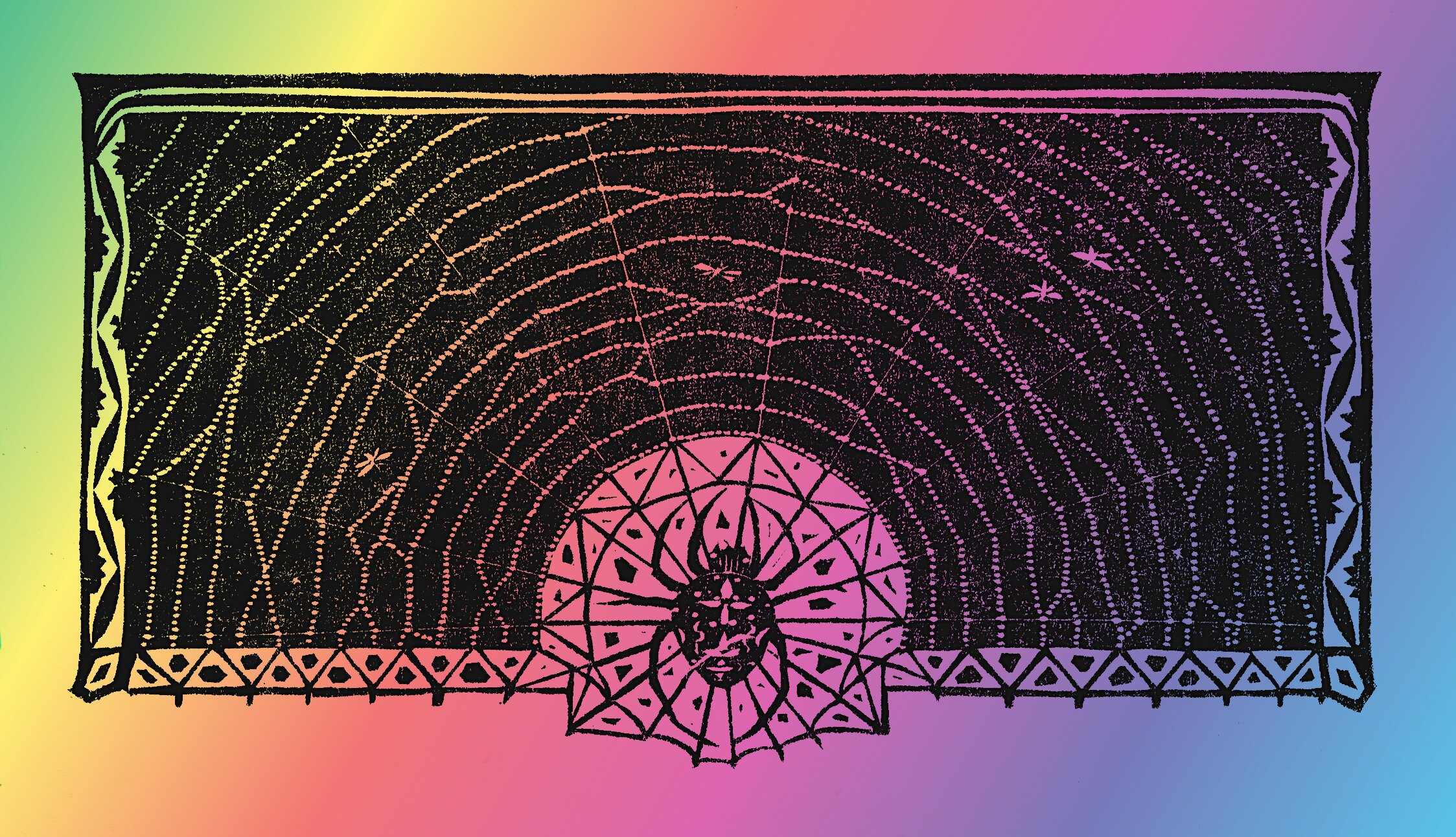
Garden spider and spider web (ca.1893–1927) print in high resolution by Gerrit Willem Dijsselhof. Original from the Rijksmuseum | Source (edited by the Author)
Trust and Faith in Our Web
It is yet another unseasonably warm day, almost +20C in the middle of March. As I've written about recently, I have found myself mulling the same ideas in different ways over and over on this blog since I began it.
Today, I find myself wondering how we can trust the humanity of others and their creations online. I am also wondering how we can successfully onboard people of all kinds to the Independent Web sustainably and have them want to stay and grow?
Shaking My Doubt; Cultivating Faith
Yesterday, I posted on Mastodon how I'm looking to commission artists to create some of the featured images of future articles I write. While it is deeply enjoyable to search the Internet for images in creative commons or public domain that I can edit and use (I've been doing this since I began blogging over ten years ago), I think it would be excellent to be able to pay real artists and give them an opportunity to show off their work.
I was completely overwhelmed with the response I got. Dozens of people boosted the post and reached out to me. I'm hoping to work with as many artists as my budget permits, but I wanted to mention every artist that reached out to me by email:
- Alison Gillespie
- Renato Zechetto
- Neal Skorpen
- Dona Vajgand
- Barbara Mathijssen
- Sarah Sammis
- Sacha Ravenda
All of these are artists that are open for commissions! Please consider them if you're looking for something like that. I'm really excited to see what is going to be in the works for the future.
One thing I noticed was that there were a couple people that raised my eyebrow (none I listed here!) who didn't email me but privately mentioned me on Mastodon. There was a bit of a pattern: their accounts only had a post or two, and the work they've done wildly varied in style and effort. And I found myself getting cautious if not outright paranoid.
And I recognized I needed to take a step back and ask myself when I became a person full of suspicion. I certainly don't like it, but I think the rise of genAI has made me unnecessarily vigilant.
I've realized one of the first things I do (unconsciously!) when I look at a piece of art (be it visual or writing) is look for tells, to see if it's genAI or not. Why the fuck do I do that? What a miserable way to interface with art! This completely violates my idea of intentional apathy. And to be honest, I don't know if I can unlearn this, I don't know if I can turn off this particular part of my perception.
Thankfully, if I don't feel as though there are any obvious tells outright then I move on rather quickly and easily. The problem is when there is something that makes me think something is genAI. A turn of phrase used over and over, or bizarre squiggly artefacts in the background of art that look so garbled I can't help but compulsively zoom in?
Sure, I can just move on and forget about it, but there's a value judgment happening there. There's a cascade of ideas and politics running through my mind as soon as I catch something like that. I automatically think differently of the creator and then have a different perception of everything else they've created. This isn't fair nor useful.
We've started looking at adding an anti-AI logo to work that's purely human-made, but I'm not sure if that's a good thing or that's part of the same paranoid impulse. Should we not automatically assume work is human-made? I don't know how I feel about the fact people have to go out of their way to state this.
There's even the organization Not By AI built around the premise of badging human-first work. The #hibadge2024 movement had illustrators around the world draw a "Created with Human Intelligence" badge in their own styles, a thousand different handmade interpretations of the same declaration. I understand, I do. But there's something that itches me wrong about it.
The open-source illustrator David Revoy wrote a piece about why he refuses to use #HumanArt or #NoAI hashtags, his argument being that the moment you ask human artists to label their work as human, you've already conceded the terrain. You've agreed that the default assumption is ambiguity. That the burden of proof is now on the creator. I keep returning to that. We're being asked to prove we're not ghosts in our own house.
Around 38% of the time, people can't reliably distinguish AI-generated art from human-made work at all. Our intuitions are suspect, our paranoia is fallible, and the harm we're doing when we get it wrong is entirely real. There is too much risk and harm in accusing people.
The experience of a painting or a poem, the moment before judgment, the moment of just being inside it. That is the entire point. And I've let paranoia colonize it.
Defer the question. When I notice the instinct to scan for tells, I try to sit with the work for a moment longer before I reach for suspicion. Cultivate faith. Start from trust rather than suspicion. Far easier said than done.
On the Issue of Onboarding
To jump topics a little, I really want to get more people on the IndieWeb. And I think that's actually the same problem, just wearing different clothes.
The paranoia within my compulsive scan for tells, the withdrawal of trust before the work even has a chance, I think that's something a lot of people do to the IndieWeb itself. They look at it and they look for the catch. Waiting to be proven wrong about their own capacity before they've even started. Both are forms of suspicion as a default setting. Both cost us something real. When I say I want to cultivate faith — I mean it as a practice, and I mean it in both directions. Faith in the humanity of what I encounter online. And faith that the people watching that OnionBoots video, all half a million of them, are more capable than the platforms they're on have taught them to believe.
YouTuber OnionBoots uploaded a video on the Old/IndieWeb revival a month ago, and it has over half a million views. While I have seen a handful of people refer to the video as their introduction to the IndieWeb who have recently joined the forums and groups I'm part of, it is a very small amount of people compared to the amount that have watched the video.
I wonder what the biggest obstacle here is. Is the ask too much? Is there too much that goes into getting started on the IndieWeb, and so people remain on corporate social media that they've become accustomed to? I wrote this on 32-bit Café and I think it's important to consider:
Programming and web development are challenging and require a lot of time and effort to learn, but so does good writing.
I think there is a learned helplessness and self-limiting beliefs about technical aptitude (eg. people who self-identify as "not being a math person").
And I think this is by design. If a large majority of people believed they had the technical capacity to be autonomous from corporate tech it would cost entire industries.
Setting up a SSG blog can be as simple as forking an already-existing theme, pressing a few buttons on Netlify, and writing out Markdown plain text posts.
Even more importantly, I'd much rather see "poorly" designed websites by humans instead of exclusively existing on the Internet only on the sterilized, boring, privacy-void accounts of social media.
The conversion gap here is staggering if you think about it. Half a million people watched that video and are presumably curious, who feel something is wrong about how we live online and are looking for a door. And a handful walked through it. What is the door made of?
The IndieWeb's own challenges wiki is honest about the problems. Jargon, outdated tutorials, the assumption of prior knowledge baked into even the "Getting Started" page.
W. Evan Sheehan wrote it plainly. The IndieWeb is for developers. Not intentionally exclusionary, but practically, structurally, still built around people who are already comfortable with a terminal. And as Giles Turnbull pointed out back when the 2024 revival conversation was at its peak, what we actually need are publishing tools that require no terminal at all. We need a whole galaxy of options, not just "install WordPress or figure out Hugo yourself."
The cost question matters too. As one commenter in that same conversation noted, the "pay for shared hosting" step alone excludes a huge number of people who will not or simply cannot spend money on this. There's more ways now than ever to mitigate and eliminate costs by using specific platforms such as NeoCities or NekoWeb, and plenty of free domain options. These options definitely give less freedom and flexibility, but free is always a good start.
Technical and economic barriers only explain part of the gap. Tracy Durnell has written thoughtfully about how the IndieWeb community has been free from corporate social media for long enough that it sometimes can't recognize how hostile and disorienting those platforms have become. We present the IndieWeb as an obvious good and then wonder why people who've spent years being algorithmically trained into passivity don't immediately pick up the tools and build. The ask is unfamiliar in a way that feels difficult. We keep designing solutions for the wrong problem.
There's also the discovery vacuum. Personal websites are hard to find from inside corporate silos. You can't accidentally stumble into a Neocities page the way you'd stumble into a TikTok. There's no algorithm serving you someone's beautifully weird blog about fountain pens and Croatian folklore at 2am. So even people who are inspired by the video, even people who build the site, can spend weeks shouting into nothing and conclude the whole thing was a mistake. The IndieWeb has a retention problem as much as it has an onboarding problem.
I don't have a fully-formed solution here. What I do know is that the answer isn't to make the IndieWeb more like the corporate web. The answer is slower and stranger. We are cultivating a community garden. I love what communities like 32-bit Café and the MelonLand forum are doing, creating onramps and invitations rather than technical assessments. The point of entry must be curiosity and welcome rather than any sort of proficiency.
The half-million people who watched that video are still out there. Some of them are still looking for the door. I want us to make it easier to find.
Comments
To comment, please sign in with your website:
How it works: Your website needs to support IndieAuth. GitHub profiles work out of the box. You can also use IndieAuth.com to authenticate via GitLab, Codeberg, email, or PGP. Setup instructions.
Signed in as:
No comments yet. Be the first to share your thoughts!