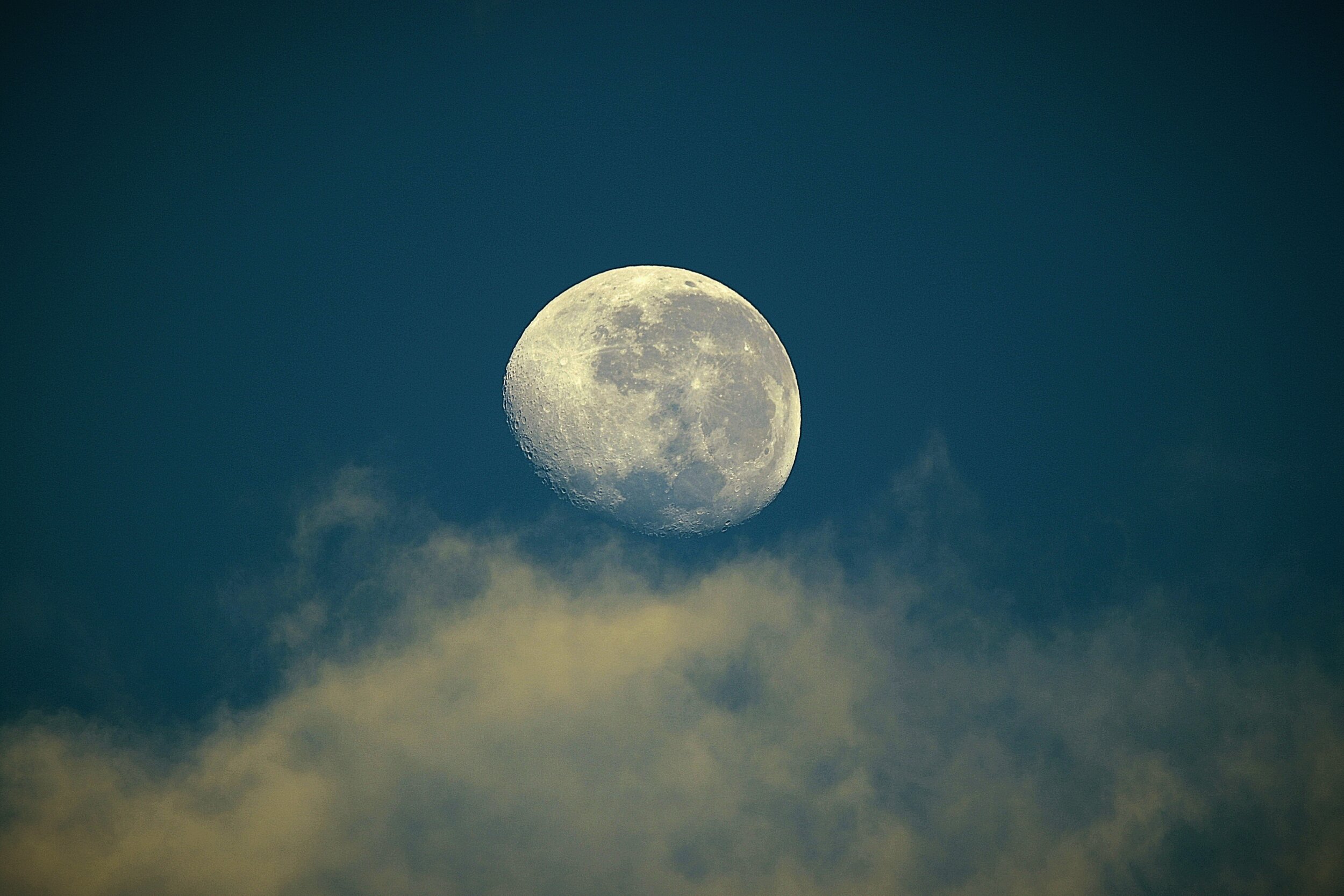
Photo taken by Marcus Dall Col | Source (edited by the Author)
THE MOON

Exactly 26 years after the failure of Apollo 13, on April 13th, I was born. The seventh crewed mission in the Apollo space program, the one that would have been the 3rd Moon landing. It didn't land. An oxygen tank exploded two days into the mission; the crew survived by hiding inside the lunar module like a lifeboat in space; the mission became famous for what it didn't do. I arrived on the same calendar square, a later April, and I have been thinking about what it means to inherit a failure. I am inextricably tied to the Moon. Maybe She is my birthright.
Today is April 5th, 2026. As I write this sentence, four astronauts are more than halfway to the Moon. Closer to Her than to us. Reid Wiseman, Victor Glover, Christina Koch, and Jeremy Hansen launched on April 1st aboard NASA's Orion spacecraft on Artemis II, the first crewed lunar mission since Apollo 17 in December 1972. Tomorrow they fly past Her. They will not land, but they will go farther than any human has ever traveled from Earth. Farther, even, than Apollo 13 managed in its disaster. Victor Glover is the first Black person to travel beyond low Earth orbit. Christina Koch is the first woman. Jeremy Hansen is the first non-American. Apollo's twenty-four lunar travelers were all white men. We have come fifty-four years and are still not landing.
Time is a straight arrow. But the Moon moves in circles.
The Outlier
There have been six successful Moon landings, all between 1969 and 1972, the most recent being Apollo 17. We are now planning a landing for 2028 with Artemis IV. It seems cruel, doesn't it? 56 years between these Moon rock footprints. But the cruelty is ours, not Hers. The Moon has been waiting. Patient, indifferent, magnificent in the old sense of the word.
She is an outlier in ways that are almost impossible to hold in the mind at once. She is far larger relative to Earth than any other moon in our solar system, possibly the result of a collision between early Earth and a Mars-sized body called Theia, which sheared off pieces of our mantle and sent them spiraling into orbit, where they cohered into the Moon we know. Without Her, there would be no rhythmic tides. Without Her gravitational braking, Earth would spin significantly faster, and a day might last only about six hours. A day on early Earth was that short, only 10 hours, and the Moon has been slowing us down ever since, at a rate of about two seconds per hundred thousand years.
She keeps us from wobbling. The Moon stabilizes Earth's axial tilt at roughly 23.5°, and the angle that gives us our seasons. Without her, that tilt could have varied between 0° and 85° over millions of years. Mars has no large stabilizing moon, and its axial tilt has ranged between 10° and 60° in the past, contributing to the enormous climate shifts which stripped away most of its atmosphere. The same planet, cycling between perpetual summer at the poles and a world lying on its side, with no fixed spring. No Worm Moon. No Pink Moon. No reason to name the moons at all.
She is moving away from us, at a rate of nearly four centimetres a year. In a few billion years, Her stabilizing effect will weaken, and our tilt will begin to drift again. But the Sun will have exploded and expanded into a Red Giant by then; the Earth will be uninhabitable regardless. Some endings arrive before you expect, others are so far off they're a comfort.
Most importantly, I think—and NASA agrees—She is our natural timekeeper. The Moon allows for the tracking of months. Migration. Navigation. Long before any calendar was scratched into clay, She was organizing human time by Her light.
Her Names
The names we give the full Moon each month are among the oldest words in North American cultural memory. The names popularized by the Old Farmer's Almanac come from the Indigenous Algonquin Tribes of New England and the Great Lakes region, adapted by Colonial Americans and then laundered through the Almanac into mainstream culture in the 1940s. They grew in popularity with little recognition to the people who used them for 13 lunar cycles annually. The names represent one narrow slice of an enormous, living, continent-wide tradition. Early Native Americans kept track of time by watching the seasons and the phases of the Moon, each tribe did so differently..
What strikes me about these names is their absolute groundedness. They are not metaphors. They are descriptions saying pay attention to what is happening right now, outside, in the world you live in.
January: the Wolf Moon. Wolves howled at the edges of villages in the long winter dark. This name may actually have Celtic and Old English roots, brought to North America by European settlers. The Wolf Moon belongs to both the Algonquin and the Scots-Irish farmer arriving on a cold coast with his own old names.
February: the Snow Moon. Other tribes called it the Hunger Moon. One is about the sky; one is about survival.
March: the Worm Moon. Traditionally named for earthworms emerging from thawing soil, though the explorer Jonathan Carver suggested in the 1760s that it may originally have referred to larvae hatching from tree bark in early spring. Or, for the Ojibwe, the Sucker Moon, named for the sucker fish that was an essential winter food source.
April: the Pink Moon. Named for the blooming of Phlox subulata—moss pink, wild ground phlox—one of the first widespread spring flowers in eastern North America. We name the light after what blooms beneath it.
May: the Flower Moon, named for what pushes up through frozen ground when the cold finally relents. June: the Strawberry Moon, which was universal to every Algonquin tribe, for the brief, intense strawberry harvest was the same everywhere. July: the Buck Moon, named for the new antlers pushing through velvet on young deer. August: the Sturgeon Moon, named for the great lake sturgeon that were most plentiful in the Great Lakes in late summer. September: the Harvest Moon, named for the extra light it provided farmers at the equinox, rising earlier than usual for several nights in a row, giving us enough light to keep working.
October: the Hunter's Moon, the time to store meat for winter. November: the Beaver Moon, for the animals building their winter dams. December: the Cold Moon, named by the Mohawk for the long nights, or, in some European traditions, the Moon Before Yule.
This is a complete taxonomy of the world. Twelve Moons, twelve ways of saying: here is what is alive right now, here is what is dying, here is what you need to do. The full Moon as a deadline.
Her Other Names
The blood moon happens during a total lunar eclipse, when Earth passes between the Sun and the Moon and blocks direct sunlight entirely. The air molecules in Earth's atmosphere scatter out the blue light; only the reds and oranges remain, bending through the atmosphere's edges and falling on the Moon's surface like a projection from every sunset and sunrise happening simultaneously around Earth. The Moon turns the colour of dried roses, of rust, of old blood on stone. The blood moon is only an omen in the way all beautiful things are.
The supermoon is technically a "perigean full moon," the Moon at its closest point in its elliptical orbit around Earth, coinciding with a full Moon. It looks up to 14% larger and 30% brighter. The difference is the size between a quarter and a nickel. The term was coined by an astrologer, not an astronomer. The technical term is perigee-syzygy, syzygy being three celestial bodies aligned.
The micromoon is the supermoon's opposite: the Moon at its furthest point, smaller and dimmer than usual. The Moon at its most receded. The Moon practicing distance.
The blue moon is not blue. It is the extra full moon—the second full Moon in a calendar month, or the third full Moon in a season that has four. It exists because the lunar cycle (29.5 days) doesn't divide evenly into the Gregorian calendar, and so every few years the arithmetic overflows. The current definition originated with an amateur astronomer named James Hugh Pruett in a 1946 issue of Sky and Telescope, who misread the original Maine Farmers' Almanac rule. The misreading spread. It is now the definition. The phrase "once in a blue moon" traces back to a sixteenth-century idiom meaning something impossible; after Krakatoa erupted in 1883, the Moon sometimes actually appeared blue due to atmospheric particulate, and "impossible" softened to "rare."
The black Moon is the inverse: a second new Moon in a calendar month. Invisible, by definition. An excess of darkness.
As astronomer Bob Berman has noted, "I emphasize these are not science terms at all; they are not used by astronomers." These are cultural objects, which means they are also poems. Pink Moon. Blood Moon. Blue Moon. Black Moon. The Moon named by what we project onto Her, what She reflects back.
The Religion & Worship
Across human history, every culture has looked up and seen Her. She is Artemis, Hecate, Diana. She is Chang'e. She is Chandra's counterpart, Selene, Luna, Ix Chel. She rules the tides of the body and the spirit, embodying goddesses of death and rebirth alike.
The Moon appears in Genesis as the lesser light, created on the Fourth Day to rule the night and mark time (1:14-18). Psalm 89:37 calls Her "a faithful witness in the sky" of God's covenant. In the book of Revelation, a darkened Moon turning to blood signals the Second Coming—the apocalyptic blood moon, coded into Christian eschatology.
In Islam, the crescent Moon marks the beginning of Ramadan; the new Moon is sighted before the fast can begin, and the crescent has become a symbol of the religion itself. In Judaism, Kiddush Levanah—the sanctification of the Moon—is a monthly ritual, recited outdoors under the moonlight as the Moon waxes, blessing the renewal of the lunar cycle. In Buddhism, full Moon days (Uposatha) mark the Buddha's birth, enlightenment, and passing; She symbolizes enlightenment, purity, and serenity, the calming nature of the Dhamma. In Hinduism, the Moon (Chandra or Soma) is a Navagraha—one of nine celestial bodies that influence human life—depicted riding a white, ten-horse chariot across the sky, controlling emotions and fertility.
Across East Asia and also within many Indigenous American cultures, people looked at the dark markings on the near side of the Moon and saw a rabbit pounding something with a mortar and pestle. In Chinese folklore, the Jade Rabbit (Yutu, 玉兔) is the companion of the Moon goddess Chang'e, pounding the elixir of immortality.
The story goes that the Jade Emperor disguised himself as a beggar and tested three animals—a monkey, a fox, and a rabbit. The monkey gathered fruit from the treetops. The fox caught fish from the river. The rabbit, having nothing to offer, leapt into the fire to offer itself as food. Moved by such sacrifice, the Jade Emperor saved the rabbit and carried it to the Moon, where it became the maker of immortality potions, working forever. During Apollo 11 in 1969, a NASA staff member joked over the radio that the astronauts should watch for Chang'e and Her rabbit. Buzz Aldrin replied that they'd "keep a close eye out for the bunny girl." In 2013, China named its lunar rover Yutu—Jade Rabbit—after the myth.
In Japan and Korea, the rabbit is pounding mochi or rice cake; in Vietnam, it brews elixirs alongside the Moon Lady. The same dark markings, the same shape, read identically across cultures that had no contact with each other. This is what Carl Jung called archetypal. A pattern too deep to be cultural borrowing, something inherited rather than learned. The Moon shows us the same rabbit regardless of where we stand on Earth. We all see the same marks.
Lunacy
When we speak of lunacy, She is in the word. Luna, the Moon Herself.
The term "lunatic" derives from the Latin word lunaticus, which originally referred mainly to epilepsy and madness, as diseases thought to be caused by the Moon. Pliny the Elder argued that the full Moon induced lunacy through effects on the brain analogous to dew falling from the night sky. The Moon working on the brain's moisture the way She works on tides. By the 4th century, astrologers were using lunaticus to refer to a whole range of neurological and psychiatric conditions. The King James Bible uses "lunatick" to describe what appears to be epilepsy. Until at least 1700, it was common medical belief that the Moon influenced fevers, rheumatism, and episodes of madness.
The word "menstruation" carries Her too. The Greek word for Moon—mene—and the Latin for month—mensis—provide the root. The average lunar cycle is 29.5 days; the average menstrual cycle is 28, the symmetry seems impossible not to notice. But an analysis of over 7.5 million menstrual cycles found no statistical correlation between lunar phases and period start dates. The similarity in length is coincidental. But Aristotle didn't know that, neither did a woman in medieval France bleeding by candlelight. The parallel felt real and generated meaning and organized knowledge. And meaning, even when it isn't true, is also real.
Of course, this is not without issue. The gendering of the Moon as feminine, and the subsequent gendering of all things cyclical, emotional, and tidal as feminine, and the subsequent pathologizing of all those things as lunar, as lunatic and unreason. Centuries ago, Victorian physicians noted correlations between what they called hysteria and the cycles of the Moon and menstruation—as though the body's rhythms were symptoms, evidence of disorder. Hysteria comes from the Greek hystera, meaning uterus. The Moon-timed, womb-bearing body read as fundamentally unstable. As fundamentally unlike the stable, solar, rational masculine.
Nature herself is gendered in Victorian thought—for Mother Nature requires taming. The feminine coding of the cyclical carries an undercurrent of danger. Something uncontrollable underneath the cultivated gardens. Gnostic traditions positioned the feminine as both creation and destruction, wisdom and deception. The complex relationship between femininity, danger, and nature bleeds through two millennia of Western thought, all the way to an apocalyptic Moon turning to blood as a sign of the end. The Moon is not divine feminine—coupling (and reducing) womanhood to the specific anatomy of menstruation is harmful. Many cis women do not have their period, or have had a hysterectomy. They are not lesser women. And transmen who get their period certainly aren't women, either. It just doesn't hold up whatsoever.
Who is drawing the invisible lines between feminine bodies and celestial movements? Who decides that the cyclic is the dangerous? "Unscientific narratives don't help to remove any shame, fear or negativity around periods." But unscientific narratives have never been about accuracy, they've been about power. Who gets to name the cycles of the body, and what those names do once they're in the world.
Poetry & the Moon
Mary Ruefle, in the opening essay of Her essential 2012 collection Madness, Rack, and Honey, writes:
"I am convinced that the first lyric poem was written at night, and that the Moon was witness to the event and that the event was witness to the Moon. For me, the Moon has always been the very embodiment of lyric poetry."
She traces the origin of lyric poetry to Sappho on the island of Lesbos in the 7th or 6th century BCE. A woman writing alone, at night, while epic poetry (the poetry of great men and great battles) was the prestige form. The lyric: personal, interior, bounded, addressed to an absent beloved. The Moon was the first poem, Ruefle argues: "an entity complete in itself, recognizable at a glance, one that played upon the emotions so strongly that the context of time and place hardly seemed to matter."
She also notes that the Moon occurs more frequently than the sun as an image in lyric poetry. The sun is everywhere, constant, unavoidable; you cannot look at it directly. The Moon can be looked at directly. She is the proper scale for looking. There is a greater contrast between the Moon and the night sky than between the Sun and the daytime sky, and this contrast is more conducive to sorrow, which always separates or isolates itself, than to happiness, which blends. The Moon is, structurally, the shape of the lyric poem. Something bright against a field of dark, complete in itself, a bounded light.
The Academy of American Poets' anthology of Moon poems runs from Sappho and Li Po to Donika Kelly and Emmy Pérez—"The Moon rose over the bay. I had a lot of feelings."—Dylan Thomas's "In my craft or sullen art," written in and about the night, by the light of a Moon illuminating every poet who ever sat up past everyone else, past the rational hours, trying to get a sentence down before the feeling dissolved.
Every poet has written a Moon poem. Critics sometimes complain about this. Ruefle, in that same essay, gently chastises those critics, giving writers full permission to keep going back to Her. We write Moon poems because we are still looking. For She is still there.
Detroit poet Peter Markus, writing in Teachers & Writers Magazine, says of the Moon and the poem: "Both the Moon and the poem make those of us who see them, who make room for them in our own little worlds, a little less alone." The Moon completes itself above you without asking for anything, and if you are alone enough to notice, it is company of a kind. The lyric poem does the same thing, as no reader is required, the poem holds light regardless.
Phases
The new Moon is nothing visible. Darkness, potential, the blank page before any mark. The condition of beginning. In many traditions, the new Moon is for setting intentions. Lots of writers think this is the hardest part. It can be, but so is the consistent sustaining, the cycle itself.
The waxing crescent is the first sliver of light after nothing. Growth. The emerging sentence. The crescent's bowl facing upward, spilling light. The draft is underway.
The first quarter Moon is split—half illuminated, half shadow. Now is the time, as one reading suggests, to be assertive and focus on making progress. You will feel the tension of the unfinished. Half of what you're trying to say is still dark.
The full Moon is culmination. High energy, the manifestation of what you have been building, and simultaneously the beginning of the wane. The full Moon is the finished draft that you immediately begin to doubt. It's never as good as it looked at full. That's the waning Moon talking. Ruefle again, on not knowing: "the difference between myself and a student is that I am better at not knowing what I am doing." The full Moon writer has made peace with the wane to come.
The waning Moon is release. Revision. Letting go of the parts of the draft that were yours but aren't the essay's. The waning Moon, in traditional symbology, is for releasing and preparing for rest. Mapping to the moment you stop tinkering because you've accepted that a piece can only be as good as it can be. Not perfect. Complete.
The dark Moon again. Send it.
The Moon is the Poem
Tonight, April 5th, 2026, Artemis II is falling toward the Moon at thousands of miles per hour. Carrying the first woman and the first Black person and the first Canadian ever to approach Her this closely.
I want to go outside. I want to stand in the cold and look up at wherever She is in Her current phase.
The Pink Moon—April's Moon, named for the moss phlox blooming across the continent—arrived April 1st. Named after something that blooms under Her light.
Regardless of where on Earth you look up, you see the same Moon. The Moon over Mohkínstsis is the same Moon that Sappho wrote beside, the same Moon that the Algonquin named for strawberries and wolves, the same Moon that a rabbit threw itself into a fire for, the same Moon that Buzz Aldrin was joked into looking for a bunny on, the same Moon the Artemis II crew photographed through their window that now hangs ahead of them like a destination.
She hasn't moved. We keep coming back. Keep returning to Her.
That's what the poem is. That's what writing is. The record of the attention we paid to what was already there, waiting for us to look up.
Comments
To comment, please sign in with your website:
How it works: Your website needs to support IndieAuth. GitHub profiles work out of the box. You can also use IndieAuth.com to authenticate via GitLab, Codeberg, email, or PGP. Setup instructions.
Signed in as:
No comments yet. Be the first to share your thoughts!