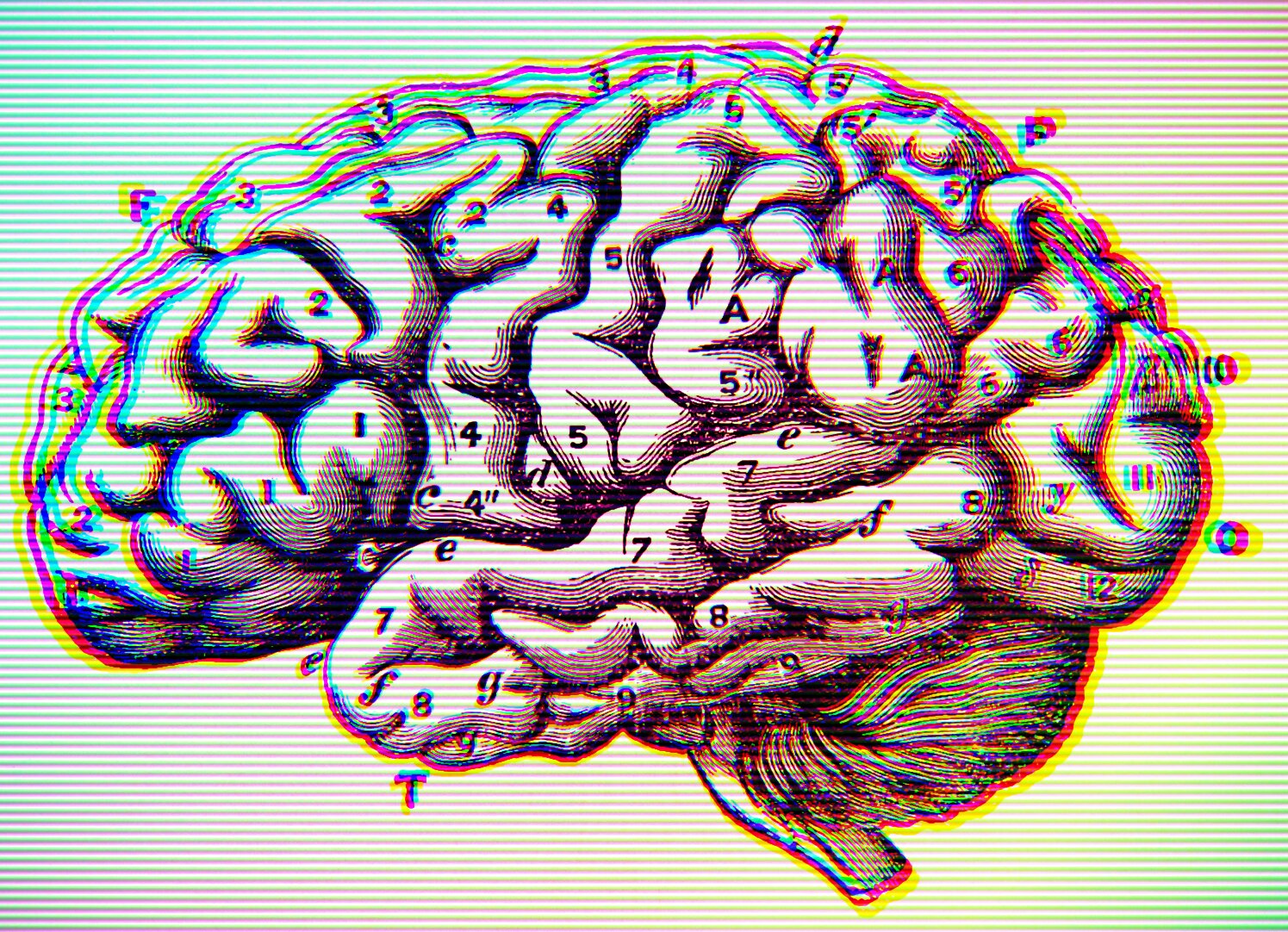
The Brain as an Organ of Mind (1896) | Source (edited by the Author)
STORYTELLING Part One: The Neurology of Narrative

Who am I writing for, and why?
I am once again mulling over this question, and I look over to my bedroom window in the dark night. A crow calls once and stops. I'm cross-legged with my keyboard resting on me, the scent of cedar surrounding me from being burnt earlier. My abalone shell is still on the bookshelf, catching the light. I type. I keep typing.
This isn't surprising for anyone who stumbles upon my work. I mean, just look at this place. I've been writing nonstop like crazy for months. 122 posts, 200,000 words, nearly a post a day since November. If you're reading this, you already know I can't help myself.
I know it sounds Pollyannaish to say I don't view the writing and editing and research as a chore. But really, it is such a gift and privilege. To start, I was born at a time where I have a platform that reaches across the world, and years ago I was fortunate enough to be placed in a public education system and learn to write, and according to my metrics on Umami and Neatstats, my work is read by hundreds of people per month.
Who would I be if I let this gift go to waste? Who would I be if I squandered the opportunity to use my voice and mind to try to do some good?
I say and believe storytelling is vital, that it is so important for our humanity and cultivating empathy and understanding of perspectives that are not our own. But that doesn't really actually explain what storytelling is, does it?
I. What Is a Story, Actually?
Everyone talks about stories and narratives, and almost no one defines them. We say children need stories. We say history is a story. We say someone is telling themselves a story when we mean they're deluding themselves. The word does a lot of work and gets no credit for it, becoming invisible.
During my last semester of university, I was lucky enough to take a course called "Hacking Neuroscience to Write More Compelling Fiction" taught by the author Dr. Randy Schroeder who has an upcoming novel coming out called Sinner's Banquet. Our textbook, Stories and the Brain: The Neuroscience of Narrative by Paul B. Armstrong, was a dense read. (I'm a writer and not a neuroscientist, after all.) I learned a lot from that class though, and I hope that I can do a good job of sharing and trying to answer that question.
A story is an account of events that generates meaning, not mere chronological information. You can give someone information about how a woman's car is blue and the sun was setting in the parking lot, you can even mention how the light is hitting the hood. The story will tell you the blue car is the first she ever drove, and sunset is about impermanence, or departure, or the way beauty keeps arriving. Information is inert. Story is metabolized.
II. The Default Story We Tell
Many people, including prominent authors and writers, believe there's a "default" story structure built into us. Joseph Campbell hero's journey. The three-act arc. The cyclical narrative rising with conflict, and falling towards resolution. The truth is, as explained in Erich Auerbach's Mimesis: The Representation of Reality in Western Literature (1946), we find this shape in Homer and the Hebrew Bible. The Aristotelian model of beginning, middle, and end. It has been deeply embedded in Western literary culture for thousands of years, to the point that we often mistake it for the nature of story itself.
The Russian Formalists gave us useful vocabulary to take a step back and understand what's actually occuring, here. They distinguished fabula (фабула), the raw chronological sequence of events as they actually occurred, from syuzhet (сюжет), the artistic arrangement and presentation of those events as structured for a reader or listener. Fabula is what happened. Syuzhet is how what happened is told. A life lived has a fabula, and our understanding of that life is always a syuzhet. Our conscious or subconscious set of choices about where to begin, what to cut, what to withhold, what to let land.
Returning back to fiction, the film Citizen Kane has a fabula (Kane's life in order) and a syuzhet (his life told backwards from death, through the investigation of a journalist who never does find his answer).
The Aristotelian arc, then, is not the nature of story. It is one syuzhet, one particular editorial philosophy about how events should be arranged for maximum cathartic effect. The hero's journey is a syuzhet that a particular culture, at a particular historical moment, decided was the most satisfying way to impose order on fabula. The assumption that it is universal is the same as mistaking one editorial tradition for the laws of physics.
It isn't.
III. Biocultural Theory, Patternicity, and Apophenia
Okay, so narrativity isn't hardwired into us. Does that mean it is a cultural construct? No, not exactly. Narrative is described as a continuous feedback loop between biology and culture. Aptly named biocultural theory. Our biology makes certain cognitive behaviours possible, and then those behaviours slowly reshape our biology over deep time and the loop runs again. You cannot separate the story-loving brain from the (many) cultures that told them. The simplest way to explain this is that it's not one or the other. It is both inert biology and relative culture, building each other for millennia.
We often describe ourselves as pattern-finding, and this is not incidental. It is the whole game. Science historian (and TERF) Michael Shermer calls this drive patternicity, the tendency to find meaningful patterns in meaningless noise. The related term, from German neurologist Klaus Conrad's 1958 work on the early stages of psychotic thought, is apophenia, the tendency to perceive meaningful connections between unrelated things. What Conrad identified as a symptom is now understood as a universal feature of human cognition. The cost of missing or ignoring a real pattern (predator in the grass) is much higher (death) than the cost of inventing a false one (being wrong). We are all running an overcautious operating system. The brain continuously matches sensory information to prior expectations. The brain is imposing cause, effect, beginning, and end. In this sense, the story is how the brain processes experience, period.
The result of this neurology is that stories (patterns) can fully engulf us. Neuroscientists call the state of absorption in which a listener/reader feels immersed in a narrative world to the point of disconnecting from their physical surroundings "narrative transportation." When you're in that state, your brain's visual and sensory cortex activates just as it would if you were actually witnessing the events with your own eyes. The hippocampus, your pattern-finding engine, starts imposing order and causality, building a mental model of a world that doesn't exist.
Synchronicity
Research at Princeton found the brain activity of a storyteller and a listener becomes synchronized. Coupled. The listener's brain starts anticipating what the speaker will do next. Their two minds begin becoming synced over nothing but language. Over symbols on a page if read, or vibrations in the air if listened. Researchers at the University of Southern California documented using fMRI scans that the posterior medial cortex and anterior insula, regions involved in meaning-making and felt experience, light up differently for people who are transported by a story vs. those who are just processing its content.
So when I write about the gleam off the blue Pontiac Firebird at sunset—a young woman standing beside it, one hand resting flat on the hood, watching the light die on the metal beneath her palm—the blood orange of that light, the warmth still in the steel, the oversaturated colour in a photograph taken of her by someone who loved that parking lot, something happens in your brain that is not just comprehension. The same regions that would fire if you were actually there fire instead. The critical-thinking prefrontal cortex quiets down. Five neurochemicals including dopamine and oxytocin flood the system. You are, briefly, inside my evening.
You could say that's what a story is. The technology for temporarily inhabiting another consciousness.
Indigenous Storytelling
Thomas King, in his previously-celebrated 2003 Massey Lectures and the book they became, The Truth About Stories: A Native Narrative, opens with a provocation, that "stories are wondrous things. And they are dangerous." He returns to this throughout as an epistemological claim. Stories are not outside of reality describing how things are. Stories constitute reality. And he gives the whole game away, "the truth about stories is, that's all we are."
I should acknowledge the scandal, here. My readers will know I've already written at length about what we knew and when we knew it regarding King's identity claims. The Pretendian controversy is real and harmful. But The Truth About Stories holds regardless of the man who wrote them, perhaps even more pointedly now, in a tragic irony. If stories are all we are, then the story King told about himself demands the same scrutiny he applied to the stories white North America told about Indians. His book has become a recursive trap.
As I've already explained, the Aristotelian arc is a cultural choice. The linear, causally driven plot marching toward resolution and catharsis? None are universal structures. It is the story a particular kind of culture tells about how stories work.
Indigenous storytelling traditions across North America, for instance, operate on different architectures. American Indian narratives begin not at a beginning but at a point, with the storyteller entering a non-linear web already existing and ongoing. The Winter Count of the Plains Nations records a tribe's year spiralling outward from a centre on buffalo hide. Pictographic histories painted on the hide, have each image representing one year's most significant event. A "mind map" of history that reads in multiple directions simultaneously.
Métis have stories of lii koont, lii atayoohkaywin, and lii zistwayr. These stories blend Cree, Ojibwa, and French-Canadian traditions with no real beginning, middle, or end. Carried over through time. Layered with meanings unfurling differently depending on the age and experience of the listener. The same story is not the same story twice. The tricksters of Wiisakaychak, Nanabush, Chi-Jean are not heroes in the Western sense, but rather, mirrors.
On the other side of the world, Australian Aboriginal storytelling has preserved culture and knowledge for over 60,000 years without resolving into the linear arc. The Dreamtime operates outside of chronology entirely, and is a dimension where time is perpetually present. For First Nations Australians, stories and lifecycles happen continuously in circles and patterns: no matter where you start, eventually you will hear the whole story. The question of where to enter the narrative depends entirely on the perspective and context of the storyteller.
IV. Non-Narratives and Anti-Narratives
What does it look like to process the world without narrative at all?
Philosopher Galen Strawson argued against the universality of the narrative self, claiming that some people, he calls them "Episodic" rather than "Diachronic," genuinely do not experience their lives as a continuous story and live perfectly valid, fully human lives without the sense of being a character moving through a plot. He calls the assumption that everyone narrativizes their experience a kind of category error, an imposition of one type of consciousness onto all types.
I find this compelling even as I cannot stop narrating. I am narrating right now. The point lands, regardless. Narrative is not the only mode of consciousness. Non-narrative and anti-narrative literature exists to interrupt this. Just take a look at Beckett's Waiting for Godot which refuses to move or Robbe-Grillet's Jealousy which circles obsessively without catharsis. In my class Hacking Neurology for Fiction, I found myself writing a fragmented lyric essay form refusing to settle into argument. These are all accurate depictions of consciousness which the conventional arc cannot hold.
The Question of Will
In the early 1980's, neurologist Benjamin Libet conducted a now-infamous set of experiments in which he asked participants to perform a voluntary wrist movement whenever they chose. The moment they consciously decided to act was recorded in conjunction with their brain activity being measured.
Libet discovered the brain's "readiness potential" (the electrical buildup preceding movement) began roughly 350 to 550 milliseconds before the subject was consciously aware of having decided to move. The conscious "decision" arrived after. The Libet gap, as it's come to be called, demonstrates that what we experience as a decision is just a retrospective narration. The conscious mind constructing an account of what the brain was already doing.
It goes without saying this disturbed philosophers and cognitive scientists alike. The implications for storytelling are vertiginous. If the narrative self is itself, in part, a retrospective construction—if we are always narrating our own actions back to ourselves after the fact—then we are not the authors of our stories. We are, to borrow Dennett's image again, the virtuoso novelists of our own consciousness, but writing in real time from behind a half-second delay. The self that narrates is always catching up.
This (thankfully?) doesn't resolve neatly. Libet himself pointed out that conscious awareness may still retain a kind of "veto power". The ability to halt what the brain has already set in motion. It goes without saying that the research has since then been substantially complicated and contested. Regardless, anti-narrative literature lends itself to the self arriving just behind the action, narrating, trying to make meaning from what it has already done. Less author, more amanuensis.
The Narrator Who Wasn't There
Our brains have a powerful, magical ability to create narratives and stories from nothing. Earlier, in the 1970s, neurologist Michael Gazzaniga was studying patients who had undergone corpus callosotomy, which is the surgical severing of the bridge between the brain's hemispheres, performed to control severe epilepsy. With the two halves disconnected, Gazzaniga could feed information to one hemisphere without the other knowing. And what he found was that the left hemisphere, unable to access what the right had perceived or done, would simply invent an explanation. Fluent, confident, and wholly fabricated.
A patient's right hemisphere was shown the word smile and the left was shown face. Asked to draw what they'd seen, the right hand drew a smiling face. Asked why, a question that only the language-capable left hemisphere could answer, the patient said, cheerfully, "who wants a sad face around?" He had no idea why he'd drawn it, he came up with a narrative that fit, and he believed it.
Gazzaniga called this the interpreter. A left-hemisphere module whose job is to take whatever the brain has already done and weave it into a causal story. It doesn't have access to most of the actual processing. It only receives the output. The behaviour, the feeling, the choice already made, and then constructs a narrative justification in real time. The story sounds like insight, or self-knowledge. It's neither.
We all have the interpreter, running continuously, generating our sense of being the deliberate authors of our own lives.
The choice blindness experiments conducted by Petter Johansson and Lars Hall in 2005 proved this in neurologically intact people. Participants were shown pairs of faces and asked to choose which they found more attractive. Then, using a sleight-of-hand card swap, they were handed the face they hadn't chosen and asked to explain their decision. In 87% of trials, participants didn't notice the switch. They explained, in detail, why they preferred the face in front of them. I liked her smile. She looks more confident. I'm usually attracted to blondes. Coherent, believed, and confabulated.
The introspective reports for manipulated choices were statistically indistinguishable from reports for genuine ones. The explanations offered for a choice you never made sound exactly like the explanations offered for a choice you did. This raises the question whether any introspective account of a choice is genuine. Is there a real signal in there at all, or the interpreter all the way down?
We don't experience ourselves as confabulating. We experience ourselves as reasoning. The narrator has no access to the archive. It just keeps talking.
V. All We Are Is Our Narrative Self
And yet. Here I am, arguing for the narrative self anyway.
French philosopher Paul Ricoeur argued personal identity is inseparable from narrative identity. The self comes into being only in the act of telling a life story. Not because the story is true, but because the act of emplotment. Defined as drawing disparate events into a meaningful whole, establishing causal and emotional connections between them is what makes experience legible, to others and to ourselves. The past, for Ricoeur, demands narrativization. We cannot hold it in any other form.
Psychologist Dan McAdams spent decades empirically documenting this. Narrative identity is the internalized, evolving story a person invents to explain how they have become who they are. It combines the selective reconstruction of the past with an imagined anticipated future, and provides human lives with a sense of unity and moral purpose. Jerome Bruner wrote that the "self is a perpetually rewritten story." And cognitive philosopher Daniel Dennett said we are all virtuoso novelists, constructing coherence from everything that's happened to us, and the fictional character at the centre of that novel is what we call our self. Terrifying and liberating.
The past is a story I'm telling myself. The future is a story I'm telling myself. My identity of being the Métis, Queer, writer, thirty-year-old who moved his entire life onto the web is a story I am actively narrating, every time I sit down to write. There are gradual shifts and changes. The character develops. Plot points are retroactively meaningful in ways they weren't when I lived through them.
And when I write here, and you read here? The story becomes, briefly, a shared one. Two minds, synchronized.
Stay tuned for part two, where I get into the magic (literal magic) of writing-as-medium for narrative and storytelling. Thanks for reading!
Comments
To comment, please sign in with your website:
How it works: Your website needs to support IndieAuth. GitHub profiles work out of the box. You can also use IndieAuth.com to authenticate via GitLab, Codeberg, email, or PGP. Setup instructions.
Signed in as:
No comments yet. Be the first to share your thoughts!