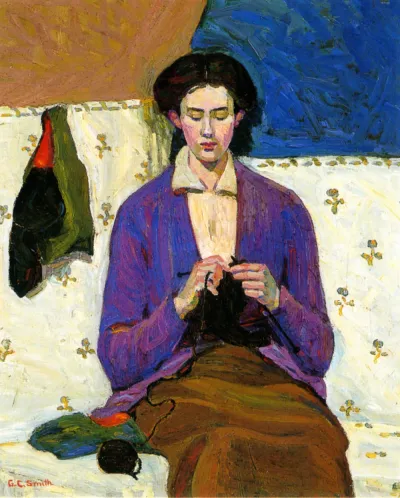
'The Sock Knitter' by Grace Cossington Smith. 1915. | Wikimedia Commons (edited by Julia Ritson)
issue #240 of brennan.day
Knitting the Web: We Need Interlinkers!

brennan.day — issue #240
Publisher: Brennan Kenneth Brown
Place of publication: Calgary, Alberta, Canada
Available at: https://brennan.day
Contact: mail@brennanbrown.ca
Yesterday, Coyote wrote about the problems with Bubbles.town and more generally, feed aggregators that sort by popular vote. Coyote uses the metaphor of nature here—Bubbles being a “bioindicator for the local ecosystem” and its “popularity [telling] us about the state of things in its region of the blogosphere.”
Coyote isn't the first to reach for the natural world to describe how we read and write online. A decade earlier, Mike Caulfield described two competing modes of the web as the garden and the stream: the garden being the integrative, revisitable web of cross-linked ideas, the stream being the one-way, chronological rush of social media that vanishes the moment it passes you by. A few years after that, Tom Critchlow proposed a third mode to sit alongside them, the campfire—the smaller, cozier gathering of blogs-in-conversation, somewhere between the private and the broadcast. Coyote's bioindicator is in that lineage, not only describing the kind of space the web is, but what its current condition might be telling us about the region around it.
While I disagree with certain criticisms about the site, I do agree it’s important to figure out how to cultivate and sustain a healthy, thriving culture and community for the IndieWeb.
And this system is a web. And a web becomes stronger and more durable the more interlinking threads and strands there are. In other words, when we link to each other in a way that meaningfully synthesizes, the web gets stronger and the ecosystem of the blogosphere improves. This is a solution that Coyote has written about previously:
Linking out to other blogs is the oldest way of making the blogosphere traversable. Not just blogrolls, button walls, and bookmarks, but link-rich text in the posts themselves as well, surfacing in feed readers and presenting long-time readers with new pathways to explore. If readers are not experiencing the blogs they follow as themselves a gateway to more blogs, then that's an indicator of a lack of link culture.
This touches on something important, and what I mean by meaningful synthesis. I know quite a few bloggers who do linkdumps—the act of sharing various links you’ve encountered over the past week. Sometimes, it's just the links themselves, other times there is at least a sentence or two by the collector with their own thoughts.
A blogger I read, Unstory, wrote briefly about writing that serves the writer, rather than the reader, and I think linkdumps are an example of this kind of writing (though they were talking more about post length, a little ironic since all I do is write long jeremiads like this).
What we need is "link-rich text in the posts themselves," to weave the thoughts of others with your own thoughts, and further enmesh the ideas from multiple people. Honestly, this doesn't need to be complex, it can be as simple as giving a shout-out or acknowledgements, as Melo did in her most recent blog post.
Really, I think writing longform posts that incorporate the works of others also does more benefit for the writer than a linkdump does as well. There are concepts from personal knowledge management about how there should be no orphan notes—notes that lack links to any other notes.
“The decision where to place what in the file can involve a great deal of randomness as long as I add references linking the other options” (Luhmann, 1987, p. 143, quoted in Schmidt, 58)
—from Richard Griffith's Writing Slowly
Notes with no links are just a pile; a rough linked note beats a perfect orphan.
Similarly, Bob Doto wrote about how Matuschak's vocabulary relates to Luhmann's original method. The link itself carries meaning, and how it's embedded in a sentence explains why the two notes relate. Andy Matuschak also writes about how notes should be densely linked.
While these concepts are designed for personal knowledge management systems, it's clear how important they are for the public, personal sites of everyone.
On Metablogging
Another issue Coyote brings up is how Bubbles.town's userbase will disproportionately upvote posts about Bubbles itself, in other words, metablogging.
If we want to avoid the banal fields of metablogging, a great way to do that is by reading the work of others, as well as books and news and scholarly articles, or even watching films, or visiting museums or listening to music—the more exposure we have to art and good work is an important part to this. If you want to be interesting, surround yourself with interesting ideas.
It doesn't even need to be explicit pieces of culture—anything in the world has merit to write about if you have enough curiosity and imagination. Nicholson Baker wrote the novel The Mezzanine which never leaves a single escalator ride back to the office, spending its pages on shoelaces, milk cartons, and paper straws and somehow making all of it riveting. Georges Perec wrote An Attempt at Exhausting a Place in Paris, sitting in a café window for three days just to record the buses and pigeons and passersby of one ordinary square. And my favourite example is James Ward's blog, I Like Boring Things. Stationery, beige carpet, and the number of pens a shop sells in a day are all worth writing about if you're willing to actually look at them.
The other important part is confidence. Confidence to write is what Robert Birming, a popular Bear blogger, posts about often, to the ire of Scholarch—and the complaint is chiefly because Birming encourages people to blog when they don't have anything specific to blog about.
I agree that can be irritating, even though I myself am no better, and write often about the craft of writing itself. But I do try to incorporate the concepts of others and offer depth and variety.
The confidence should be realigned towards "your voice and thoughts and opinions on things is worth sharing" rather than "just write about how you have nothing to write about."
But confidence in isolation just causes more disconnected voices shouting past each other. This is where interlinking comes in. Synthesizing the writing of others means combining multiple sources to create a stronger, vibrant version of the idea than that exists within each individual source by itself. This term sounds academic because I admittedly am borrowing it from academia (which itself could be argued as being a bastardized version of Hegelian dialectics).
I detest the gatekeeping elitism within academia, and I believe a powerful vehicle to counteract this is to liberate and democratize concepts like this for everyone to use. You certainly do not need years of expensive education to have a voice.
Justin's Links
No one proved that earlier than Justin Hall. Justin's Links from the Underground is one of the earliest personal websites, launched in 1994 by Hall. While early websites like his were dismissed as amateur, they were among the first flowering of democratic digital literature. The Internet has shown us anyone could share anything with anyone. Free and without restraint.
Justin chronicled his life, relationship, struggles, all long before the term "blog" existed. In an interview, he said that "[t]he best use of our technology enhances our humanity. It lets us shape our narrative and share our story and connect us.". This is the IndieWeb's transformative power, isn't it? The ability to create spaces where traditional barriers to literary production fall away.
We are makers of digital literature. Sacredness wrapped in HTML. Ceremony in the act of blogging. For some people, each post is both therapy and proof of existence. A seed planted in soil, which might one day grow into something more.
I am a child of the Internet's Wild West, and I witnessed the revolution of who gets to create and whose voice is heard. I was born on the cusp between Millennial and Generation Z—too young for LiveJournal, too old for TikTok.
When I was younger, I watched sites and communities rise and fall like Atlantis, always standing at the shore, words caught in my throat, believing I had nothing worth saying. But a throat full of unspoken words is still thread—coiled and waiting and needing only a hand willing to cast it on.
This is what I mean when I say we need interlinkers. A single strand is not fabric. Threads on their own fray. A single thread will snap under its own tension, as it was never built to hold a shape by itself. Textiles and fabric only happen when countless single threads agree to hold each other up—warp crossing weft, over and under.
Every link out is a stitch. We are hands pulling a needle back through, binding one piece of the pattern to the next.
The web needs more hands on the loom. Every link I've shared in this post is purling a blog into being. And I am so thankful for other bloggers providing thread. I'm trying to cast it on. I would rather help make something whole and a little uneven, dropped stitches and all, than leave my length of yarn perfectly coiled up, admired only for a colour it never got the chance to become.
Update, October 20, 2026: Unstory has since shut down his site, so any links to unstory.eu in this post no longer work. They are preserved on the Wayback Machine, though: you can browse the last snapshot of his homepage or all archived pages of his site.


Comments
To comment, please sign in with your website:
How it works: Enter your website URL. IndieLogin signs you in through your site's IndieAuth server if it has one (e.g. indieauth.com), or checks your rel="me" links on GitHub, GitLab, Codeberg, and email. Setup instructions.
Signed in as: