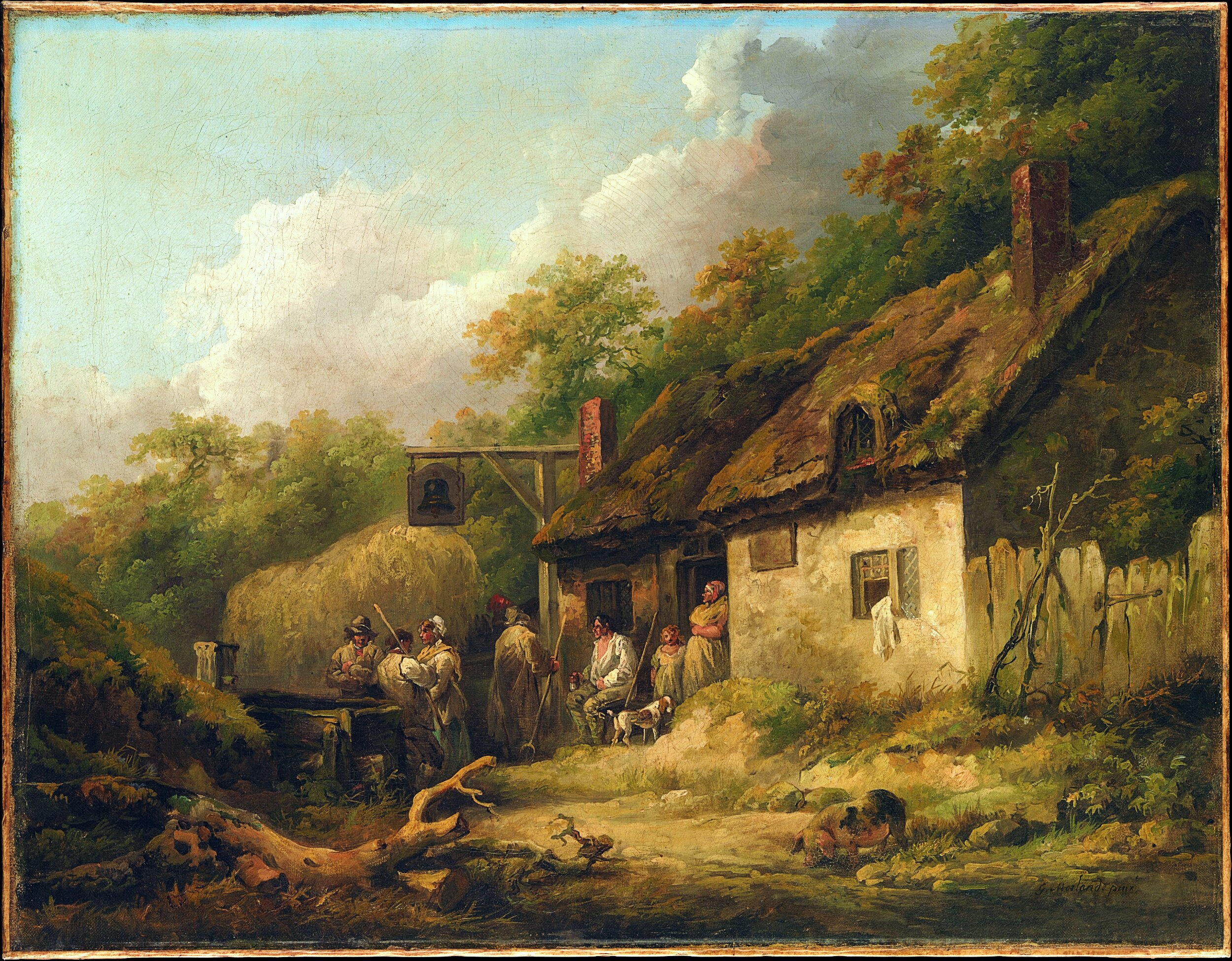
'The Bell Inn' by George Morland, late 1780s | Source (edited by the Author)
Earning My Keep

In the past few days, snowfall outside has landed softly in the evenings, only to melt away each morning after, arriving as a grace note, disappearing before you can begin to take it for granted. I've been waking earlier than usual, drawn to my window by something I can hear before I can see it. Birdsong. The Red-breasted Nuthatches come first, their tiny tin-horn calls—yank, yank, yank—a cartoon argument happening six inches from your ear. Then the House Finches, males rosy-chested and singing in long, warbling runs that end on an ascending note, each song a question they're too delighted to wait for an answer to. I've set up a feeder in the tree right outside my bedroom window, so morning begins with small warm bodies against bare branches, creatures who wedge seeds into bark crevices and work at them with their bills, earning their keep.
What does it mean to earn something? To deserve a meal, a morning, a life.
In the past few days, my most recent article, "That's Home. That's Us", was not only selected for Medium's Staff Picks, but was also featured in the most recent Medium newsletter, where the editor wrote that the piece offered "a rally cry for responsibility, not nihilism." I have vertigo of good fortune.
I have been thinking, in the past few days, about unearned grace. So I turn to poetry—my innkeeper.
The Poetry of Earning Your Keep
Korean poet Jeong Ho-Seung wrote a poem in which the speaker announces they are going to Hell—setting off in the morning like any other workday, promising their mother not to skip meals, not to worry, to turn off the gas. Hell too must be a place where people live, the speaker says. So if I go to Hell to earn my keep / at last I'll be able to become a human being. There's the kireji—the twist, the cut. The speaker isn't going to Hell as punishment, but going to earn the right to call themselves human. There's something in the poem that understands humility not as self-erasure but as dues. As the work of being accountable to something larger than yourself. To earn your keep, in the deepest sense, is to become.
Bertolt Brecht arrives at the same phrase from a different direction, [i]t is true I still earn my keep, he writes in To Those Born Later, but, believe me, that is only an accident. Nothing / I do gives me the right to eat my fill. Brecht was writing in exile during what he called the finsteren Zeiten. The dark times. People were being sectioned into zones of acceptable and unacceptable personhood across Europe, while his friends were disappearing. And still he ate. Still he drank. He couldn't explain it. The luck of it—the sheer, arbitrary luck—sat in his chest like a stone. To eat while others starved was a kind of moral embarrassment that no amount of awareness could resolve. And yet I eat and drink, he admits. And yet. His poem is addressed to those who come after—you, perhaps, reading this now—and it asks for forbearance. I don't think I need to remind anybody of how relatable this is for us today. We wanted to prepare the ground for friendliness but could not ourselves be friendly. The hatred required to fight injustice corrodes the face; the anger required to resist power hoarsens the voice. He wanted wisdom, and instead he got time, a different thing entirely.
Heather McHugh in Debtor's Prison Road arrives at the phrase with her characteristic crackling syntax: I don't count, / who cannot earn my keep. The confession of someone released at night, minus her timepiece, into a field of cicadas, stars she cannot claim. Her words are always abandoning her—my alwaysing and my. McHugh's "earning" is not economic but existential: the inability to make good on the fundamental debt of being alive. The relationship between worth and visibility. If you're not producing, if you're not earning, do you count? The brutal capitalist logic is everywhere. The repossessors are coming. Nothing lasts. And the speaker is rendered small and countable-downward by an economy they can't opt out of, a ledger they can't balance.
Kim Hyesoon's Lord No shouts Earn your keep! as a form of violence, a command that strips the self of its own autonomy. Her poem's recursive, glitching logic—Lord No who is not Lord No is never Lord No thus Lord No is Lord No of Lord No—enacts, in its very syntax, the way authoritarian grace becomes incoherent when examined. A gift that shouts at you is not a gift. A grace that shames you is not grace.
All four poets arrive at the same phrase finding different horrors within. I keep reading them because, underneath the horror, there is something resembling the question what would it mean to deserve this?
Unearned Grace
I am a four-leaf clover, the wishbone and the horseshoe. I am the rabbit's foot and snake eyes. I get to write—that alone is a deep gift. Then, I get to share my writing with you, and with anyone else who happens to wander toward it online. But not only that, this is my job. I make a living with the craft I have been practicing and working on for fifteen years, half of my life now. This gratitude is spiritual, for me, reaching beyond words and understanding.
So I turn to God—my innkeeper.
In certain sects of Christianity, grace is entirely unearned—sola fide, faith alone. Salvation cannot be earned at all; it is given freely, imputed from outside, a verdict that has nothing to do with anything you have done or left undone. Martin Luther called this the central pillar of the Reformation. The righteousness of Christ is credited to the sinner without condition.
In others—the Catholic and Orthodox traditions, and many Wesleyan strands—salvation is by grace but humans must cooperate with that grace. Good works, repentance, prayer, and the sacraments are part of our healing and transformation. Real faith must produce holiness. As the Council of Trent put it, justification establishes cooperation between God's grace and human freedom.
I find myself embodied inside the argument, wrestling between.
I am trying my best to cooperate with the grace I have been given—with the gift of this particular life I've received, the specific allotment of ability and time and luck that has landed me here, writing to you, alive, singing birds outside my window. But it is not cooperation for the sake of salvation or redemption or forgiveness. I do not believe in an afterlife. Or, more accurately, I am not holding my breath for anything existing beyond this one brief, absurd life. If this life has taught me anything, it's that the slate is wiped wholly clean. No trace of memory of what came before.
I am also not cooperating with grace for the sake of redemption in this life, though. If I'm being honest, I do not believe I'm a good person by my own value system and understanding of ethics. It is easy to architect your image in the public sphere, especially online, but the truth is that I've hurt people. As I've written about before, I've come to realize I'm asocial, and I've lost connection to people who wanted to be closer to me. There are mistakes and regrets I cannot rectify or repair within this single lifetime, and attempting to reach redemption is an endless, pitiful task. Attempting it as a performance is even worse.
I am trying to interface with the world through love. Not love as sentiment, but love as what Paulo Freire calls the precondition for genuine encounter: "If I do not love the world," he writes in Pedagogy of the Oppressed, "if I do not love life, if I do not love people, I cannot enter into dialogue." Dialogue—real dialogue transforming both parties—cannot exist without it. And Freire links this love explicitly to humility: someone who cannot acknowledge themselves to be as mortal as everyone else still has a long way to go before they can reach the point of encounter. Which is to say: you cannot earn your place in conversation by being right. You earn it by being present, and by remaining willing to be changed.
I am at peace with who I am, imperfectly and incrementally. I meet myself where I am, the way I try to meet others where they are. I do not subscribe to the self-flagellation and corruption-and-sin framework of certain Christianities. I do not think shame and guilt are healthy or productive or enjoyable ways of living. The opposite is true: all are worthy of life and grace, of love and joy. And yet, a spade is a spade. Accountability without self-punishment is the difficult, narrow road I am trying to walk.
Life Expectancy
I am turning thirty years old.
In many other lifetimes, this would be my life expectancy. Medieval Europe, Ancient Greece and Egypt and Rome. Or every single hunter-gatherer generation from ten thousand years ago all the way back to three hundred thousand years ago, when Homo sapiens first emerged, life expectancy at birth averaging around 30 years, driven down most brutally not by the aging of adults but by the staggering mortality of children who never made it to five. I think about that often. I am, biologically speaking, in the borrowed time that used to belong to no one. Everything from here is, in a real sense, profit.
Funnily enough, I feel as though I have already lived so much life, and feel at peace with my own mortality. Everything feels like icing on the cake at this point. Bonus content. An epilogue. Robert Frost understood this, I think—the pull of the woods that are lovely, dark and deep, the horses' harness bells shaking in the frozen dark, the temptation to simply stand there and let the snow come down. And yet I have promises to keep, / And miles to go before I sleep. The promises are not to anyone watching, no, they're to the craft, to the reader, to the future that does not yet exist. They are the work of cooperation with the grace you have been given.
Of course I am going to spend my remaining time trying to make good things for others, with the skills I have. What else would I do with it?
The world would be in a far calmer, more stable place if people surrendered to who they truly are instead of constantly maintaining a façade, instead of performing the daily gymnastics of cognitive dissonance. A willingness to know thyself, and to let that knowing be the ground from which you act. A bruising sense of radical honesty. To earn your keep not through performance but through presence.
The nuthatches are back. I can hear them through the glass—the urgent, high-pitched call, yank-yank-yank. Small tin horns insisting on themselves against the morning frost. They go headfirst down the trunk of a spruce tree, which no other bird can do, gripping the bark with their feet and trusting in a way that looks, from outside, like pure confidence but is probably just necessity. They do not know they are being watched. They do not know that I set out the feeder for them.
You just keep moving through the bark, hunting for what you need, and someone you don't know has arranged the seeds.
It would be obscene not to sing.
Comments
To comment, please sign in with your website:
How it works: Your website needs to support IndieAuth. GitHub profiles work out of the box. You can also use IndieAuth.com to authenticate via GitLab, Codeberg, email, or PGP. Setup instructions.
Signed in as:
No comments yet. Be the first to share your thoughts!