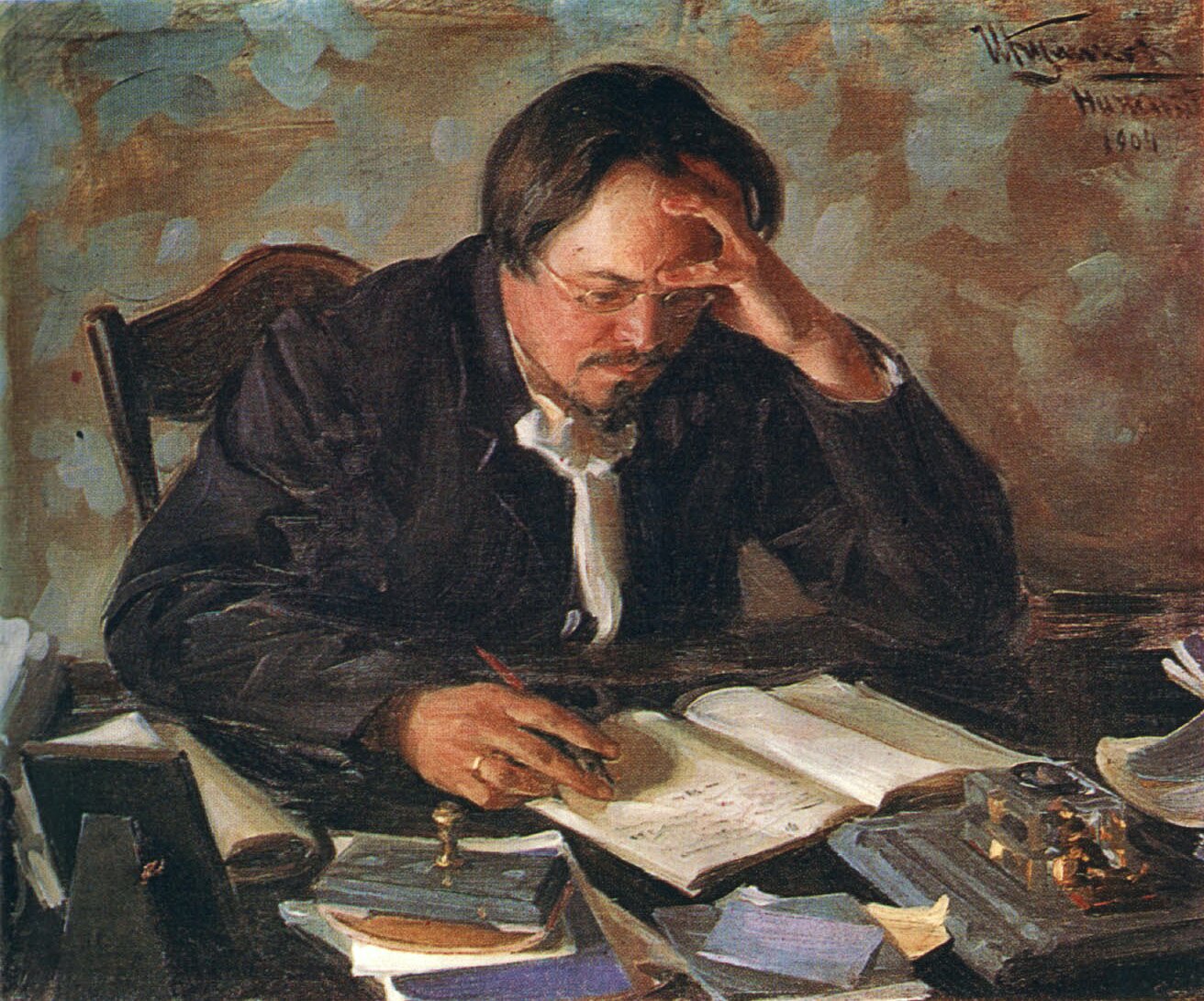
Painting of Russian writer Evgeny Chirikov by Ivan Kulikov, 1904 | Source (edited by the Author)
Being Taken Seriously as a Writer
I've been thinking about my site's custom cursor. It's chubby, cute and funny. It's called Tomatic Cursor by JefTriforceTomatic, the name is a Nahuatl word that means "fat". I added it because it made me happy and I could.
Then, a couple of my articles gained a lot of traction on Reddit and Lobsters and a surprising amount of comments were not about my writing or the topic at hand, but rather how distracting the custom cursor is.
I've been quietly anxious about it ever since. I'm uncertain what's signalled to someone who, say, arrives from my interview in Le Monde expecting to meet an independent publication and instead finds a lucky cat doodle, rainbows, and a chubby cursor.
This is the strange balancing act I've found myself playing now. brennan.day started as a side project, a cozy little corner of the IndieWeb where I could tinker and write whatever, without pressure. But somewhere along the way, it became my primary publication. My main thing.
There are times I think I should migrate to something like Ghost. Clean it up. Present myself in a more professional manner. I've been a fan of Ghost since their Kickstarter in 2013, positioning themselves as "just a blogging platform." The typography, the membership architecture, the way it makes independent publications look like "real" publications. There are a lot of writers I admire who use it.
But then I ask myself, what is seriousness, exactly? Really, professionalism is colonization by another name. The demand that creative and intellectual work submit itself to the aesthetic standards of capital before it can be admitted as legitimate. Several times in my life, I've been on the receiving end of institutions who implicitly told me the price of admission was looking a certain way, speaking a certain way, presenting my work as though it emerged from nowhere and owes nothing to where it actually came from. I've paid that toll before and I know what it costs.
So, I keep the rainbow colour scheme. I keep the cursor. I keep the guestbook and the webrings and the easter eggs scattered throughout. These things bring me joy, isn't that enough of a reason?
And yet, I want to be taken seriously. In a material sense. I don't care about impressiveness or prestige, but I do not want to squander what I've accidentally built here through carelessness or false modesty. Writing is my full-time work, and I love doing it. I don't want to ruin it by not respecting it.
Substack-Brained (or, Being Insufferable)
I'm not sure I actually belong in the IndieWeb. I have webmentions and microformats and IndieAuth and webrings, the whole infrastructure. I've written extensively about building this place. I believe in the philosophy without reservation.
But culturally? I'm not so sure.
Almost everyone I've encountered in this space is doing something that I would describe (with full affection) as classic blogging. Sharing what they're reading. Posting updates about their garden or their home server or D&D campaign. Linking to things they find interesting with a paragraph of reaction. Living their life in public in the most low-stakes, generous, genuinely human way. It's my favourite thing. What the web was before it became an astroturf'd monetization engine. I love it, and I love the people doing it.
And then there's me, posting 2,000-word cultural criticism essays with section headers and citations, writing about colonialism, or the philosophy of evil, or the enshittification of open-source tooling. Treating my personal website like it's auditioning for a byline at The Walrus. (I'm doing it right now with this post!)
I feel as though I have a Substack brain. Ambitiously wanting to be taken seriously as a voice, wanting readers to arrive with a kind of readerly attention. Caring about being cited and discussed and argued with. That is not the IndieWeb's native mode. The IndieWeb is small and cozy and intentionally low-stakes. I feel as though I showed up to the potluck with a twelve-course tasting menu and a opinion about the wine pairing.
The Substack-brained writer and the IndieWeb blogger share no cultural DNA, even when running the same kind of site. One is trying to build an audience; the other is just living in public. One wants to be important; the other has the great good sense that importance is not the point. These are different orientations toward what writing on the internet is for and I straddle them in a way that makes me feel fraudulent in both directions.
Too earnest and too weird to succeed on the platforms that reward Substack-brain. Too ambitious and too loud to fully belong to the small, quiet, sustainable world I want to live in. I'm not resolving this. I'm just naming it. Pretending the tension isn't there would be dishonest.
Where I Currently Stand
I don't like to boast. I would rather undersell than oversell, a reflex I've developed for a multitude of reasons. Let me say this, then move on. brennan.day is an impressive project. I know who I am and what I create. It's interesting, sure, but it isn't going to be winning a Pulitzer anytime soon. There is a tangible ceiling for me, especially because I refuse to play the particular games required to go any further. But it still stands that I built this entire site from scratch and I've written over 140 posts totalling over 270,000 words since the start of 2025, the majority of that being done since November 2025. Six months.
I don't want praise for that. I'm doing it for me.
There is something paradoxical and contradictory I want to try to explain. I create selfishly. For my own interests and curiosity and my own need to think something through in public. What ends up happening is I end up consistently producing work that is more pro-social and more widely received than if I were to attempt to create for an audience. The pieces that have pulled thousands of readers are not written with them in mind. They're the pieces I wrote because I couldn't stop thinking about something and needed to externalize my thoughts. "The End of Eleventy" was me processing the change of the engine running my site, and it got 5,000 views in a month.
Now, this isn't to say I don't think about the audience. For instance, just a few days ago I added like buttons to my posts via Iine. A tiny, privacy-first, zero-tracking appreciation counter built for the small web. I've added plenty of social features like a guestbook and a comment section. But I've also added a bunch of functionality that has nothing to do with audience metrics. I just want my site to feel alive. I want it to have the kind of interactivity that emerges from genuine care rather than conversion optimization.
But you have to be earnest about not caring about the audience. That's the rub. As soon as it becomes performance, it hollows out. I continue to post consistently whether a piece I spent six hours on gets a couple views and no comments, or whether it gets 5,000 views and a Reddit thread. I've had dozens of essays never reach more than 30 readers.
I really do it for the love of the game. If the external reception became my primary motivation, I would stop being able to do this. The audience is volatile and outside my control. Once the locus of motivation shifts from internal to external, consistency becomes contingent on other people's responses. That's a terrible way to run a creative practice.
The Rain Ritual
Tlaloc was the Aztec rain God, and is one of the oldest and most widely worshipped deities in Mesoamerica. His priests developed an elaborate theology of sacrifice to ensure the rains would come. Children were specifically chosen for these rituals because their tears were thought to represent rain; their weeping was believed to propitiate water. The Aztec calendar organized monthly ceremonies around the agricultural season. Sowing, harvest, renewal. Each requiring offerings to Gods in precise quantities. The direct causal relationship between what you offered and what you received.
The crops did sometimes come after the sacrifices. Rains followed, yes, but because the rains follow the season. But the ritual made sense of the pattern, gave agency in the face of conditions that were actually uncontrollable, provided the comfort of feeling like there was something you could do.
Content advice operates on this theology. Post consistently and the algorithm will reward you. Optimize your titles. Hit the trending audio. Make six TikToks before your label will release your music. We have replaced the ritual calendar with a Content Calendar, and we are sacrificing our goats with the same faith and the same fundamental misunderstanding of causation. A 2025 academic study of TikTok music creators found that the lifespan of virality on TikTok has become increasingly short and operates at a steadily smaller scale as the platform fragments. What looks like a viral moment is increasingly just simultaneous micro-adoptions across fragmented taste communities. There's no monoculture broadcasting to everyone; only the targeting hundreds of small clusters that respond similarly to the same content. Trying to engineer a repeat of a viral moment is like trying to reproduce a weather event. The conditions are never the same twice.
Think about the short-form video creators who went viral once and have since uploaded slightly different versions of the same video. It's one of the more depressing patterns the Internet creates.
This is no way to create. We know this. Chasing metrics doesn't work. It hollows out the creator and the metrics themselves are not knowable in advance. You are, in the oldest sense, sacrificing to a god you cannot see.
The rain comes when the rain comes. Or it doesn't.
Constitutionally Incapable of Not Writing
Our language in creating is borrowed wholesale from capital and business. It is not called art, it is called content. We optimize, maximize, retain, convert. The audience is a resource to be extracted, not people to have conversation with. Our creative practices are about efficiency and growth. These words carry an ideology about what creation is for.
I'm not trying to maximize anything. I'm trying to write, and to share the writing.
And I think this means letting go of a particular fantasy about what seriousness looks like. No professional aesthetic, no optimized funnel, no monetization architecture, no scalable systems, no Ghost newsletter, a site that doesn't look like The Atlantic on mobile. That fantasy functions as a way to make me feel like I'm closer to running a real operation, not merely a blog with a cute cursor. I feel the pull, but I reject it.
The way I'm doing things now, on my own terms? 25,000 views in a single month from over 100 countries. I write things that were worth reading to people. brennan.day is not the product of a content strategy. It's the ongoing act of me being relentlessly interested in things and constitutionally incapable of not writing about them. The rain comes when the rain comes. In the meantime, I'm going to keep writing.
That can't be manufactured.


Comments
To comment, please sign in with your website:
How it works: Your website needs to support IndieAuth. GitHub profiles work out of the box. You can also use IndieAuth.com to authenticate via GitLab, Codeberg, email, or PGP. Setup instructions.
Signed in as: