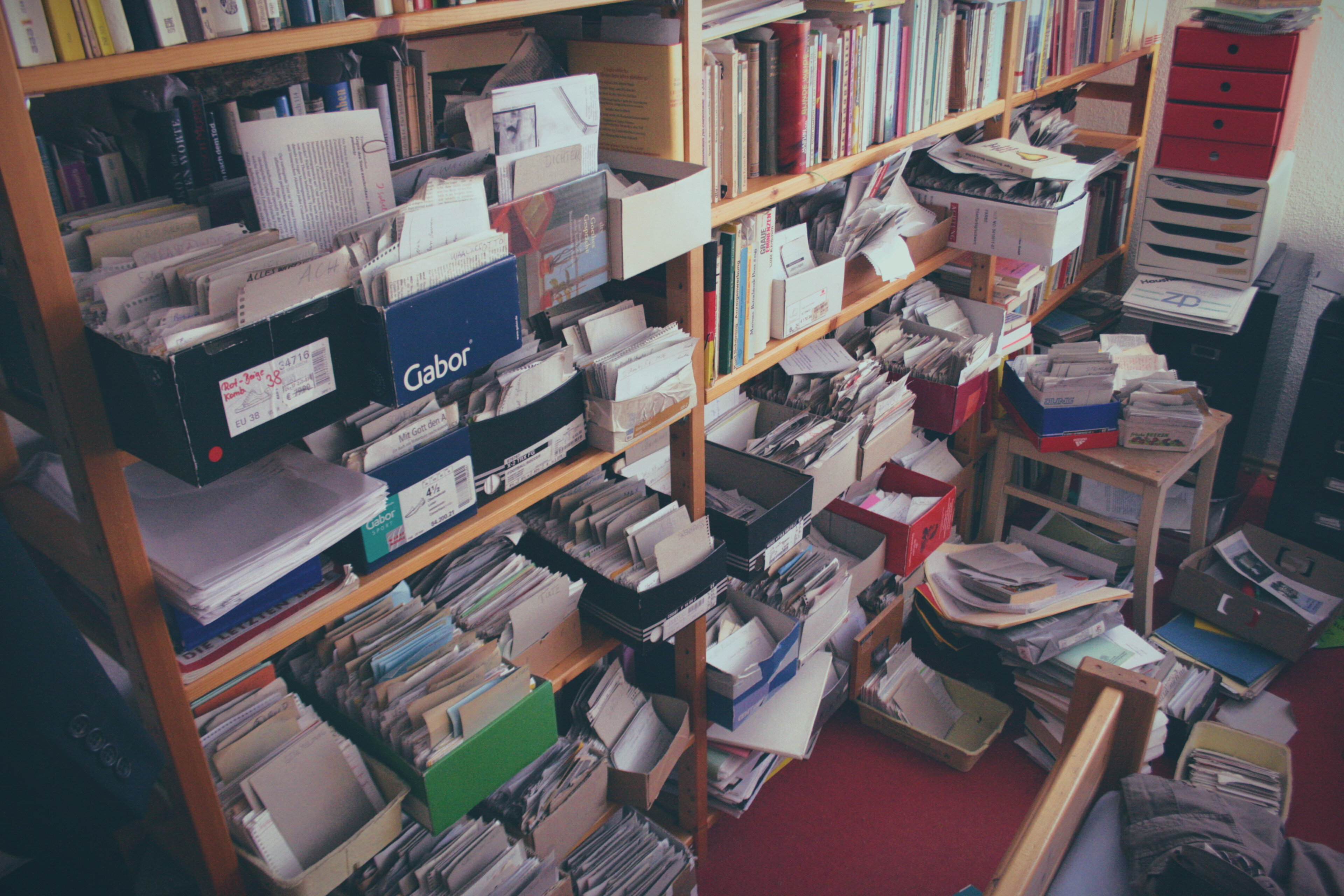
Zettlekasten, by Kai Schreiber in Münster, Germany | Source
The Work Isn't Finished, It's Abandoned: Thoughts on WIP Pages

I want to write a bit of a response post of sorts to two comments I received on a previous blog post where I spoke of WIP pages as a jumping off point to talk about web relations and networks. Luckily, it is all actually wonderfully connected, pun intended.
I'm writing this post instead of replying directly to the comments because... that functionality doesn't actually yet exist on my site, and I'm too worried I'll break the working comment system I already have. 😅 But also I have a lot to say on this matter.
First, I'm responding to Anthony's comment from February 25, 2026. He runs the site The Paper Pilot's Digital Garden
I don't agree with your position on WIP pages. I am a (practicing) fan of digital gardens, which I've found to be weirdly controversial on the indieweb. I think getting our ideas down and cultivating them later is fine, and for some having to find some new angle for a new blog post every time they want to update their views on some subject can be quite limiting. It also adds pressure, perhaps phantom obligations to hit a certain posting cadence or to fully flesh out an idea before being able to talk about it online (which can lead to burnout). I find a digital garden very liberating, as I don't need to make something perfect or even good before allowing it to exist online. Sure it's possible I won't get around to updating it in the future, if my passion and interests and motivation are focused on other topics, but I don't think there's any harm in having a WIP and it's not like that WIP being public took away from other parts of the site - a private WIP that I lose motivation working on before finishing takes the same amount of time away.
Now, I want to clarify I don't think there's anything wrong with having works-in-progress (actually, looking at this comment, maybe it's more a response to Dale, which I'll get to later). There is a quote with many attributions that I've carried around with me for a long while: A work of art is never finished, merely abandoned.
I am also well-versed in the idea of digital gardens. Starting all the way back in 1998 with Mark Bernstein's work Hypertext Gardens, and Mike Caulfield's The Garden and The Stream, to the more recent History & Ethos of the Digital Garden by Maggie Appleton. Heck, one of the sites I have linked in my sidebar is Gavin Arturo Gamboa's wonderfully dense digital garden.
I've actually tried for a long while to start a digital garden of my own. I researched the Zettelkasten, a note-taking method popularized by the German sociologist Niklas Luhmann who used it to write over 60 books and 400 scholarly articles. I've watched hours of tutorials on Obsidian and read (and took notes on) How to Take Smart Notes by Sönke Ahrens.
The issue for me, personally, is executive dysfunction and akrasia, the ancient Greek philosophical concept dating back to Plato and Aristotle, describing the paradox of acting against one's own better judgment. I have an inability to atomize my thinking and my work, and return to build upon it. This is why I use Beeminder to externalize my willpower and get me to perform my daily tasks rather than trying to rely on self-discipline alone.[1]
What works for me? Surprisingly, the beginning: the blank canvas and the present moment. I arrive at 750words each day and write three pages worth of a draft on an idea I've been mulling, sprinkling in the TKs where I need to do further research, and then I publish it and move onto the next blog post the next day.
Similarly, nearly all of the projects I've put out, whether blog themes or FOSS tools, were nearly all completed to a point of being good-enough and made public, and then rarely touched on again.
Why? I enjoy novelty, sure. But much more importantly, I can only keep a plate spinning for so long. If I'm working on a project that takes longer than a few days, it either becomes overwhelming or I become disinterested. I certainly wish this wasn't the case, I would absolutely love to have a digital garden instead of a blog.
It's far too easy for me to get caught up in planning paralysis, and to trick myself into thinking I'm doing work and making progress just by planning, when in reality I'm standing still. I've written about this before, I call it the Inertia Effect. Objects in motion tend to stay in motion, and vice versa. Even when I do long-term, larger projects like books, they're still just a collection of poems or essays.
I suppose an exception to this rule is my site itself, https://brennan.day, because I am adding functionality and features to it, but this is actually a clever workaround trick: procrastination for when I'm supposed to be writing or doing something else.
And really, that's all this boils down to: working with the limitations, capacities, and capabilities I naturally have. Someone could see the amount I've been writing since November and think I have an insanely good work ethic, but the truth is I am just doing what works for my brain, which is to never see more than five feet ahead of me in my work. As E.L. Doctorow[2] put it,
Writing is like driving at night in the fog. You can only see as far as your headlights, but you can make the whole trip that way.
I'd love to be more organized and relational with my work, and take in many of the other principles of digital gardening, but traditional blogging seems to be what works best for me: a messy blog post touching on several ideas, sometimes totally half-baked, often abandoned immediately afterwards. That's also how I write my poems and how I code my projects.
Because I do absolutely agree that "I don't need to make something perfect or even good before allowing it to exist online". Perfect is the enemy of good, a saying Voltaire popularized from an old Italian proverb in 1770. I'd even go further than that and say "good-but-not-made-public is the enemy of bad-but-public."
But if I need something done, then I need to get it done today, or else it'll fall into the abyss with a million other things. I wish that it was as simple as being able to rely on my "passion and interests and motivation," but I've learned to work with what I have and who I am instead of trying to wrestle myself into the version I want to be.
Okay, that was a lot longer than I expected. Oh well! Let's continue with the rest of Anthony's comment:
And for slash pages, you're in this awkward position where it's not a publish and forget page, so you're expected to keep it up to date, but the rest of your site being exclusively "published" pages gives you the pressure of feeling like the slash pages can't ever be stale or incomplete, and that just sounds like pressure I wouldn't want to willingly submit myself to.
I think there is a spectrum to how often Slash Pages need to be updated. Your /now page definitely has to be updated frequently, by design. But interest-based pages like /uses or /interests or /idea only need to be updated when you have something new to add to them.
And personally, pages like /values or /why never really have to be updated because they're so ingrained and foundational for me.
But I do enjoy updating these pages, and I should figure out a better way to visualize their changes over time to see how I grow and change.
And Now For Something Completely Different
We're finally to the second comment, which interestingly has a completely opposite opinion from Anthony. I will be responding to Dale Mellor's comment, posted on February 22, 2026, who runs his own blog:
I actually dislike people (sorry to take it personally) who let
work in progresspages be seen on the Internet, especially in their early stages. To me, the point of the wordpublishis that an article is deemed to be of publishable quality and is let out into the world, and then that article should be regarded as cast in stone, in my opinion. If there are amendments or alterations of facts to be made later, this can always be done by posting a follow-up publication, pushed-back as a comment on the original. But original posts have unique identifiers, and I would like to think that that means I will always see the /same/ original post under that identifier.
I disagree with this. I don't think there's any reason specific URLs with specific identifiers owe the Internet permanency nor a static nature. In fact, I think the entire point of the Internet is that it isn't cast in stone. It is malleable and flexible and ever-so dynamic. That's part of what makes it so interesting and fantastic. The IndieWeb movement itself is built on the idea that the web should belong to individuals — people who are free to change, grow, and iterate on what they publish, on their own terms.
Also, what exactly is "publishable quality"? I'd much rather see people frequently post or update or even change their site rather than working in private, until their work is of "publishable quality". All my writing is writing done in public, another reason why I love blogging! It holds me accountable and makes me transparent and adds a social aspect I wouldn't have if I was working away privately.
Anyways, like I already clarified, I think it's totally okay for someone to have a WIP page (or many), I just know for me personally, that most likely means that it'll stay a WIP page forever.
What I want to see on the IndieWeb, and what I think it needs, is growth. I want to see people maintain and check in on their little indieweb/smallweb/human web sites. Not for posting cadence or anything silly like that, but because it's a fun hobby and connects us to one another in a fun way.
I believe we ought to be on the IndieWeb for the sake of being on the IndieWeb, first and foremost. It's just for fun! Any sort of pressure or rigidity is self-imposed and maybe even antithetical.
Conclusion
Wow, that was a lot more words than I thought I would have to say about this! If you want to chime in, feel free to leave a comment below, or send me an email, or reply to me on Mastodon, or make a thread somewhere online about it, or write your own blog post in response, whatever you enjoy the most!
If you're interested in learning more, I kept a journal recording my usage of Beeminder for over a year straight. ↩︎
This quote is commonly misattributed to Stephen King, but it is in fact from Doctorow, as recorded in the Paris Review interviews. ↩︎


.jpg)
Comments
To comment, please sign in with your website:
How it works: Your website needs to support IndieAuth. GitHub profiles work out of the box. You can also use IndieAuth.com to authenticate via GitLab, Codeberg, email, or PGP. Setup instructions.
Signed in as: