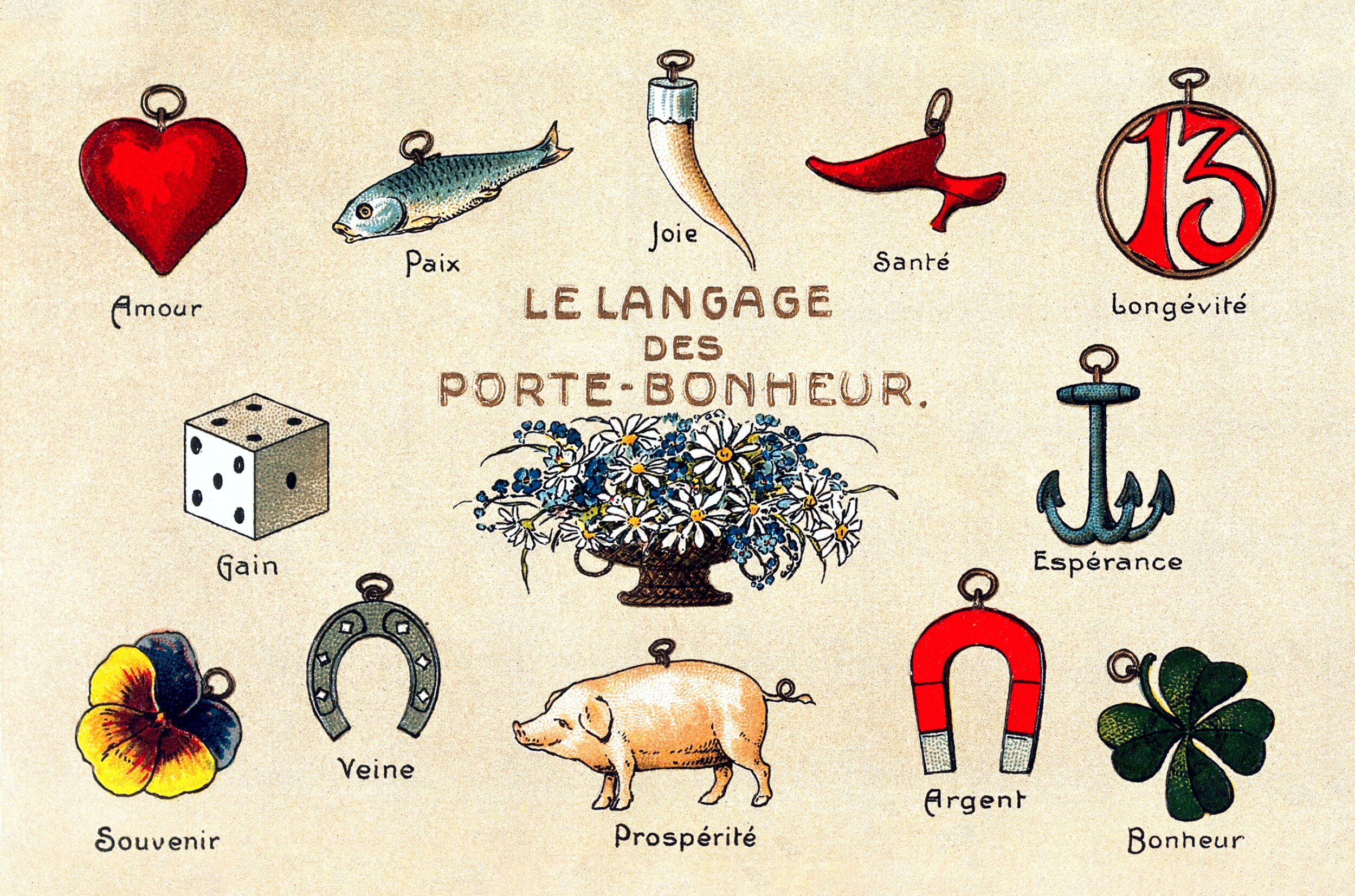
A postcard illustrating a variety of good luck charms. Chromolithograph. H. Guggenheim & Co. | Source (edited by the Author)
The Blogging Übermensch, or, Being the Luckiest Person on Earth
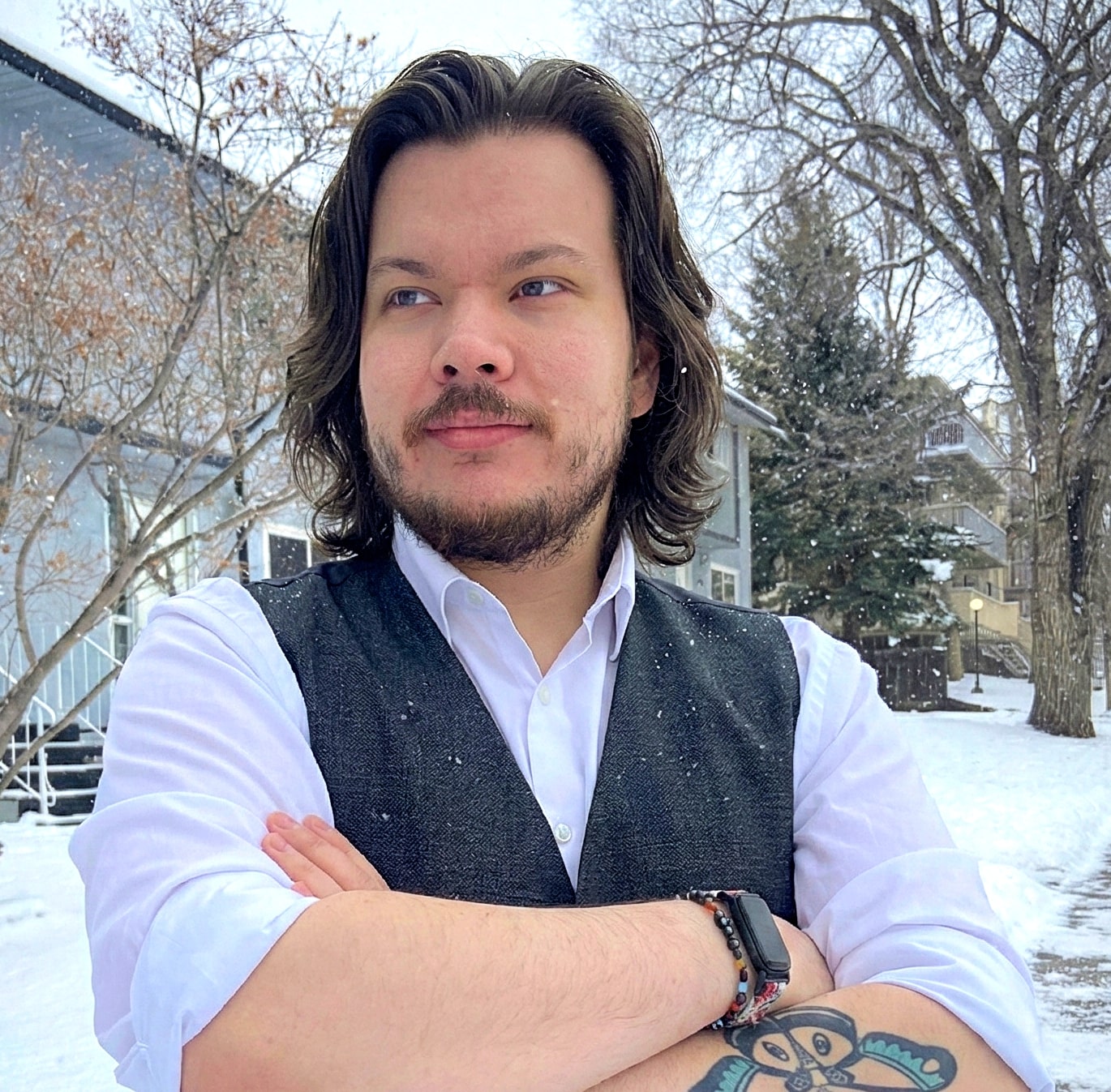
I am the luckiest person that's ever lived. I do not say that in hyperbole, nor am I trying to make a rhetorical point. I sincerely believe this. Even before I had the opportunity to become an independent writer full-time, I believed this to be true.
There are specifics in my life I can point to which affirm this for me. I am able-bodied. I am educated, holding one degree and beginning another. My basic needs are always met. I have a loving family and support system. I live on Treaty 7 territory, in the shadow of the Rockies, in a city. I have built community, a web studio, and I am beginning an online writing school. I've published nine books. I write poetry and play chess almost every day. I have created things that exist in the world now, and hopefully will outlast me. I write every day for the love of writing. I have had profound, transcendental spiritual experiences. I get to do this. I get to do all of this.
But these are not the reasons alone. What I really want to talk about is the recursive gratitude I have, which could also be described as constitutive moral luck.
Moral Luck
Let me explain. In 1976 and 1979, Thomas Nagel and Bernard Williams published a pair of papers on moral luck. Williams coined the phrase himself, and noted pointedly that he "expected to suggest an oxymoron." Nagel identifies four distinct types:
- Resultant luck is luck in how your actions turn out. A drunk driver who runs a red light and strikes a pedestrian vs. the one who runs the same red light and gets home safely. The action is identical. The moral weight isn't.
- Circumstantial luck is luck in what situations you find yourself in. Consider, as Nagel does, the ordinary German citizen in the 1930s who stays and commits atrocities—and someone with identical character who moved abroad before the war. Same person. Radically different moral life.
- Causal luck is the luck of how you are determined by prior events. The chain of cause and effect that led to you making any particular choice. The whole problem of free will.
- And then there is constitutive luck. Constitutive luck is luck in who one is, in the traits and dispositions that one has. Since our genes, caregivers, peers, and other environmental influences all contribute to making us who we are—and since we have no control over these—who we are is at least largely a matter of luck.
The key passage, from Nagel's original 1979 paper, defines it as luck in "the kind of person you are, where this is not just a question of what you deliberately do, but of your inclinations, capacities, and temperament." And you cannot accept some kinds of moral luck without accepting all of them. The categories bleed into each other.
The more cotemporary vocabulary for this would be "privilege" a word that is misunderstood, and I don't think in good faith. Some see the term as radioactive and culture-war coded. Capable of ending conversation before they start. And I believe that [moral luck is a way of understanding what privilege really is](https://www.skeptic.org.uk/2021/09/we-can-understand-the-effect-of-privilege-better-when-we-consider-it-in-terms-of-moral-luck/.
I was born with the capacity to recognize how lucky and rare my situation is. I have a natural temperament towards optimism. My will has an inclination towards the light. This is immense privilege, I did not earn nor work for it. I am constitutively wired this way. The wiring is itself a form of luck.
If who we are, and therefore our choice of actions, themselves subject to luck, then according to the Control Principle, we cannot be properly assessed even for those things. There is nowhere further to retreat when we are at the level of moral character. As Nagel puts it, "the area of genuine agency, and therefore of legitimate moral judgment, seems to shrink under this scrutiny to an extensionless point." The ground disappears under self-authorship.
But I am inverting the frame, here. The philosophical literature on moral luck is almost entirely about blame and responsibility — about whether we can be held accountable for what we couldn't control.
Nagel asks: "can we be blamed for who we are?" I am asking something different:
Can we be grateful for who we are?
And the answer, philosophically, is yes. It is the more coherent response, because gratitude doesn't require the Control Principle that blame does. You don't need to have earned something to feel wonder at it. You don't need agency to feel awe.
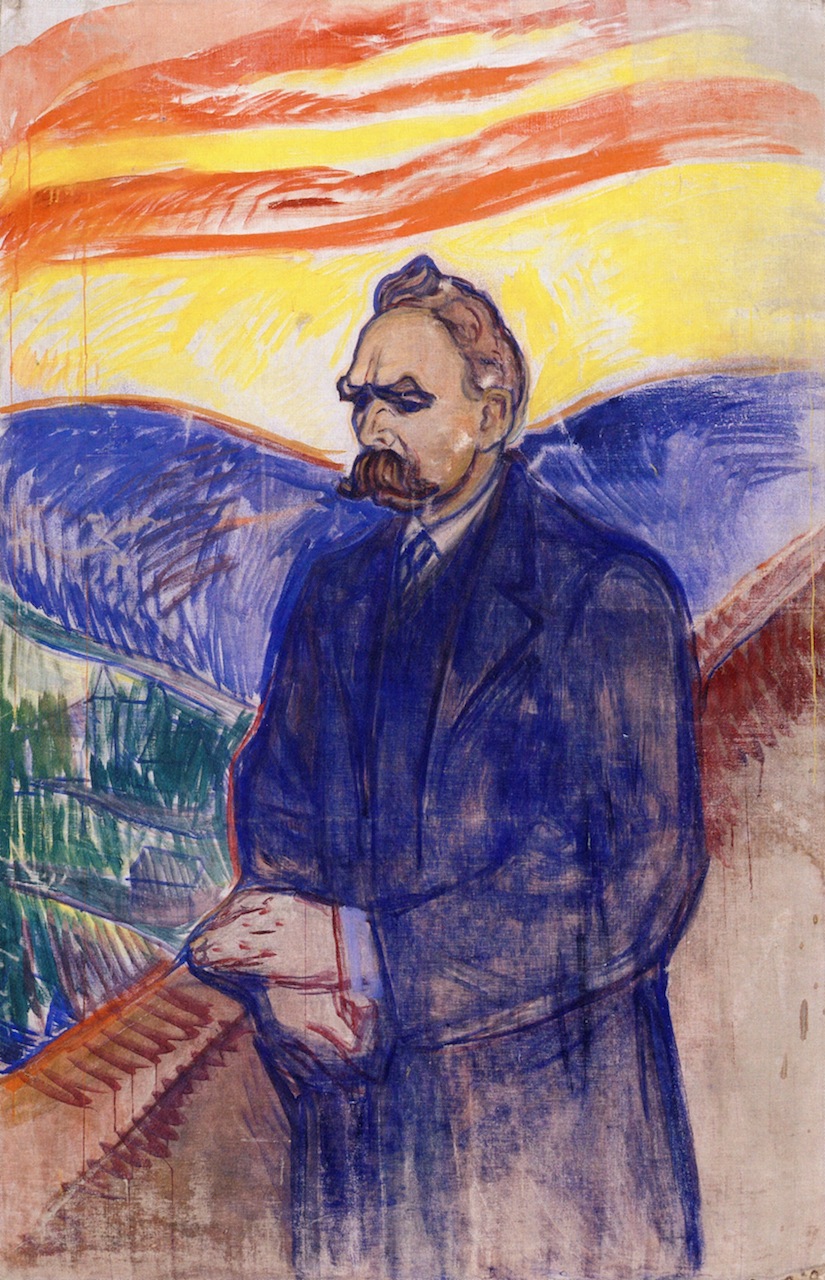

Enter Nietzsche's Übermensch
This brings me to Nietzsche. For a lot of people, invoking Nietzschean philosophy opens a can of worms. Much of the problematic interpretations of his work is due to his sister Elisabeth's manipulations of his manuscripts after his death. After her death, scholars reedited his writings and found her versions distorted and spurious. She forged nearly 30 letters and often rewrote passages.
In reality, Nietzsche's Übermensch was largely designed to counteract the intense nationalism that underpinned fascist ideologies—the philosopher's legacy tainted by erroneous readings and misappropriation of his ideas. Nietzsche himself, in letters written months before his collapse, called antisemitism "canaille" and said it would be "blasphemy against my divinity" to be associated with it. He knew what was happening and hated it.
In its original definition, the Übermensch is a call for personal self-discovery and self-overcoming. In Nietzsche's metaphysics of value, will to power is his response to nihilism—grounding value in drives rather than transcendent authority. You don't need God or tradition to validate your values if your values emerge from who you constitutively are. The Übermensch, then, is not a destination. It is a practice. A direction of travel.
When I think about the place I am—and who I am—it is the only term that comes close to explaining how I feel.
I love the totality of what I am, including the specific instruments I have been given to experience it with. I would not be who I am without every experience I've had throughout my life, including suffering. I don't seek to erase anything of my past. I'm complicated and contradictory, and I am not interested in resolving my contradictions into something clean and displayable. The tension is part of the instrument. Strings do not make music without tension.
I believe I have a steadfast duty to others to use my skills and capacities to do as much good as I can. Blogging is "a particular kind of practice of philosophy"—something one does, an activity, rather than something one is, an identity. One has to do philosophy, and that activity has to be constantly enriched and transformed by engagement with the outside world. Every morning I sit down at this desk in Mohkínstsis, open a draft, and try to make something true. That is the practice.
Daniel Conway argues in Parrhesia that Nietzsche sees self-overcoming as "a complex process of destruction and creation" — generative, not merely self-negating. That is what I am trying to do with blogging. Every post is a small act of self-overcoming, destroying yesterday's draft to make today's essay. The post you are reading right now is evidence of the thing it describes.
Joy and Amor Fati
"Joy is the emotional expression of the courageous Yes to one's own true being." I have written before about the need to sustain hope—that protecting and cultivating our joy is an ethical stance, not a luxury. But I want to go further.
Nietzsche first introduced the concept of amor fati almost as a New Year's resolution in The Gay Science in 1882, then didn't return to it explicitly until Ecce Homo in 1888, his final productive year. Amor fati is "the best expression we have of what it means to say Yes! to life." The love in amor fati isn't eros (pursuit of the beautiful) nor agape (free bestowal of grace) but something closer to Heimat: coming to be at home with something. Nietzsche defines it as love for "the world as it is, without subtraction, exception or selection."
Prairie wind whistling through my window at 6 AM. The radiator humming as the end of March brings snowfall. The unread messages I look over again and again. The grief I carry from people I've lost. The scent of air when the streets smell of dirt and possibility. All of it. Without subtraction.
Everything does not happen for a reason. Nietzsche is asking us to acknowledge that the cosmos has no purpose, and to love our lives all the same. That is a much harder ask than the Stoic version which at least gives you a rationally ordered universe to reconcile yourself to. Nietzsche gives you nothing to lean on, telling us the cosmos have no purpose, and to love our lives all the same.
What the Demon Asks
Consider the thought experiment of the Eternal Recurrence: A demon appears in your loneliest solitude and tells you this life will recur infinitely, every pain, every joy, every moment, unchanged.
I already know my answer. I would absolutely repeat the life I have over and over again. Not because it has been easy. This life I have, my specific life, is a gift beyond comprehension.
Nietzsche does not offer reasons to convince us of the desirability of loving fate, but a reflective description of how things appear to someone who is in such a state. This reflects his conviction that philosophy is a way of life rather than a theory about life. It has to be lived through to be genuinely understood.
For my life, too, has caused harm. I must also repeat the wreckage left in my wake. Towards others that I have loved and continue to love. Relationships I have damaged by being careless or selfish or afraid. Failures of presence and attention. Moments where I chose my own interiority over someone else's need. Words I said that I cannot unsay.
Affirming the eternal recurrence "is not a response to selected experiences, but rather a love of life in its totality." A positive response must integrate every experience—"joyful and sorrowful, proud and shameful, loving and hateful—for one can only accept a particular experience if one accepts all the events and experiences of one's life." Those I've hurt don't get to choose their loop either. The harm I caused them recurs too, in the logic of the experiment. I cannot affirm my life while pretending that my life was an innocent one. Affirming eternal recurrence both tempers the demand to hold individuals responsible. Agency is bound to, and conditioned by, all of existence at all times. Simultaneously expanding one's sense of responsibility toward the enduring world.
Nietzsche's Zarathustra himself initially reacted to the eternal recurrence with horror, struggling specifically to accept the recurrence of all bad things, the suffering his existence entailed for others. The affirmation is not cheap. Zarathustra had to earn it, and Nietzsche thought the test would be "very difficult, perhaps impossible" even for great individuals to pass. I have not looked away. John Kaag's in Hiking with Nietzsche wrote about "owning up: to recollect, to regret, to be responsible, ultimately to forgive and love." That's what self-overcoming means.
I find myself, like many others at this given moment in history, confronting the death of inherited meaning systems—religious, national, ideological—and I am trying to build something rather than collapsing into nihilism or nostalgia and reject all cheap, easy substitutes. I have developed my own value system over more than half my life. I am trying to work outside the approval economies of this culture and I am genuinely indifferent to whether the culture catches up. I am practising self-authorship for the love of the game.
I think the Blogging Übermensch is a person who shows up—to the blank page, to the recursive question, to the morning—and says yes.
Nietzsche does not offer reasons to convince us of the desirability of loving fate, but a reflective description of how things appear to someone who is in such a state. I hope I did that with this blog post.
I am the luckiest person that's ever lived. I say it as an invitation. Go look at your own life with the same instrument. You might surprise yourself.
Comments
To comment, please sign in with your website:
How it works: Your website needs to support IndieAuth. GitHub profiles work out of the box. You can also use IndieAuth.com to authenticate via GitLab, Codeberg, email, or PGP. Setup instructions.
Signed in as:
No comments yet. Be the first to share your thoughts!