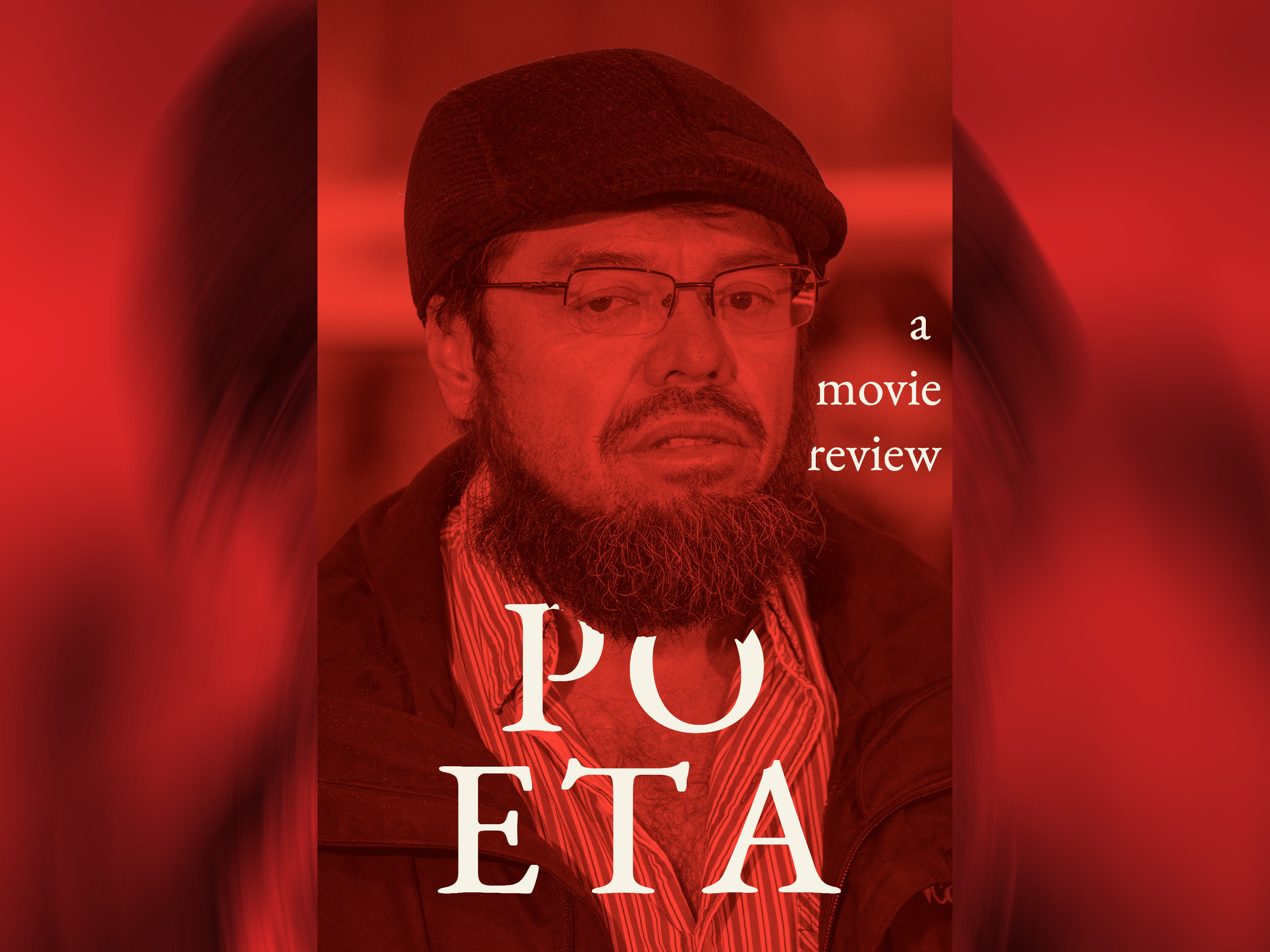
Ubeimar Rios at 2025 Cannes Un Poeta Photocall. | Source (edited by the Author)
REVIEW: To be Un Poeta (2025, dir. Simón Mesa Soto)


When I started watching Un Poeta, I was bracing for a middle-aged drunk trying to claw his way back to the art he'd surrendered in his youth. A man reclaiming his poetic voice. I was excited for this! As a poet myself, I have a hunger for the rare film that takes poetry seriously, holding a pen the way other films hold a gun. My favourites: The Kindergarten Teacher (2018), Paterson (2016), Kill Your Darlings (2013), Poetry (2010, the Korean one, Lee Chang-dong's quiet devastation), Howl (2010). There are so few. I find and hold them closely.
I was partially right about Oscar. But Un Poeta is about far more, and far less, than poetry.
The Director's Vision
Director Simón Mesa Soto shot the film on Super 16mm in Medellín, Colombia. There is a grain to everything, a texture and uneven rebate border around every shot. The film won the Un Certain Regard Jury Prize at the 2025 Cannes Film Festival. Mesa Soto is no newcomer to Cannes, his thesis short Leidi won the Palme d'Or there in 2014, and his first feature Amparo premiered at Critics' Week in 2021. He knows what he is doing. He created the most pathetic poet I have ever seen on screen. Maybe the most pathetic protagonist I've encountered.
Oscar is played by first-time actor Ubeimar Ríos, he was discovered through his nephew's Facebook profile, a literature professor in real life. Oscar is a fifty-year-old man living off his aging mother's pension. Drunk in the street. Clutching a beer bottle. Washed-up and once award-winning, he wanders Medellín lamenting the state of literature in his home country. He throws tantrums. He owes everyone money. His daughter, Daniela, pities him openly. "You're a child," she tells him. He tells her he's changing.
What's remarkable about Ríos is his face. It's a memorable face. Yurlady's younger sisters remark, unprompted, that they think he is ugly. He absorbs this without flinching. I disagree, rather, I think there is a near-permanent scowl and defeated stance that excellently sells Oscar's character.
Mesa Soto has said in interviews that he began writing Un Poeta to avoid becoming the worst version of himself: a professor who had a flash of genius in his youth and is now a frustrated old-timer living off his memories.
There is a jarring formal choice throughout the film. Anytime we approach a moment where Oscar might actually perform a poem, in full and with authority, Mesa Soto cuts. We are suddenly in the next scene. It happens again and again. The film refuses to give us Oscar as poet. Instead, we get Oscar drunk in the street, or Oscar reluctantly teaching a class of high schoolers, mumbling verses about half-light and melancholy, poems arriving sideways. The film's structure withholds the very thing Oscar believes himself to be.
He is an archetypal has-been. A man for whom the best work, and by extension the best life, is already behind him. He has a framed picture of José Asunción Silva on his wall.
Then he meets Yurlady.
Yurlady
She is fifteen. She is one of his students at the high school where Oscar has reluctantly taken work to ease increasingly dire finances. She writes soft poems that are nothing like Oscar's. She writes about giants. She notices the light and texture of surfaces, playing with shadows. She doesn't eat her meals so she can save them for her nephew.
Oscar sees in her the thing he failed to become. He takes her journal and reads it often. He bribes her with groceries for her family, encyclopedias bought off her father, and sparkling purple nail polish. He sees her poverty and her darker skin as material, a kind of capital. The poetry school's white and foreign patrons use Yurlady as their progressive mascot, generating publicity and donations from her Blackness and her poverty. Skewering the literary world's racial economy. The film has an unflinching eye for who gets to write about oppression, and who profits from being seen to witness it. Yurlady is compelled to write a specific poem in order to present at a poetry festival:
What would I be if I were less black?
If I were less hungry?
If my future was secure?
If peace reigned in my neighbourhood?
The poem brings the festival audience to its feet. Oscar doesn't clap. He is condescending in the way only the genuinely well-meaning can be. The other teachers at the poetry school calls her his best poem. His magnum opus.
And then at the poetry festival, in celebration of Yurlady's poetry debut, he gets drunk.
The Poetry Festival
This is the film's hinge. Oscar, who had tried to stay sober, capitulates. Drunk, he begins to orate that finding poetry is the hard part, "under the stones, in the street. It's harder than writing it."
Yurlady, fifteen years old, ends up vomiting in a toilet. The grown men around her cannot take her to the hospital, lest they be implicated. Oscar, in what the film renders as genuinely tragically comic rather than sinister, carries her to his car. Drags her to her home. And finally abandons her, unconscious, for her family to find. She has bruises from being manhandled.
The reckoning is thorough. He is fired. Yurlady's family believes he assaulted her. He is beaten by her brother. His daughter wants nothing to do with him. Students call him a misogynist and a rapist—he had, blackout drunk, showed off his ass at the poetry event.
The other poetry teachers pay Yurlady's family a million pesos to get a recorded statement that nothing happened. Oscar objects to this coercion—stubbornly, stupidly—and grabs the phone mid-recording, demanding the family be paid without the admission. The other teachers relent. One looks at him and says he is the most mediocre poet he has ever met. Oscar replies that he hopes this man goes on to write the most beautiful verses in all of Colombia.
The Reckoning
Perhaps the genuinely unusual thing about Un Poeta is that you believe Oscar. You believe, earnestly, that he is naïve enough to think he could mentor a fifteen-year-old girl appropriately. That he really did only want to help her become a great poet, even if his entire motivation is projection. The unsuccessful artist trying to reclaim, through her, the success he never found. As another poet remarks, “poets like Oscar only hurt themselves.”
Oscar reminds me of another figure from another poetry film, Lisa Spinelli in The Kindergarten Teacher. Lisa discovers a five-year-old student with a prodigious gift for poetry, becomes convinced she's the only person able to recognize his genius, and kidnaps him. She persuades herself she only wants the best for Jimmy, raised by an indifferent family uninterested in his talents and that is the precise shape of Oscar's self-deception too. Both fit the de facto "stage mother" archetype, projecting their own unfulfilled artistic dreams onto their students, pushing them to develop and showcase their talent even when those students haven't asked to be saved.
In both cases, these mentors are so intensely obsessed with art, and so egotistically convinced of their unique capacity to nurture the younger artist, that they become completely blind to how immoral and irresponsible they have become. Or perhaps it isn't blindness. Perhaps it's a knowing. An awareness of the consequences, the wrongdoing, and a decision to continue anyway. For the sake of art, for the sake of the mentee, for the sake of some story they are telling themselves about what kind of person they are.
El Arte Nos Salvará
The third part of Un Poeta is titled El Arte Nos Salvará. Art Will Save Us.
Yurlady writes a letter to Daniela. She explains that Oscar didn't assault her. That he just wanted her to be a good poet. But that was his dream, not hers. And she tries to tell Daniela that men like Oscar, and her own absent father, are a burden women like them carry. For their whole lives. She tells Daniela that Oscar loves her and is, in fact, changing into a better person.
Daniela goes to a library and finds one of her father's poems. Her mother gives her one of his chapbooks. She reads a poem Oscar wrote while she was pregnant with Daniela:
My beautiful little flower
That I planted in the garden
I want to protect and love you
But without water and without soil
I am afraid of ruining you.
Daniela meets with Oscar. She tells him that he's a good poet but she doesn't care. She just wants him to be a good person. She wants distance. But she finds she doesn't actually hate him. Oscar uses the notebook she gives him to write a finally letter to Yurlady, thanking her for changing her daughter's mind about him. He takes the José Asunción Silva photo off his wall. He writes Yurlady a poem:
Here I am
A man
An old-fashioned dinosaur
Carrier of grievances
Deserving condemnation
Fragile dreamer
But don't lose faith yet
In this sad poet
Who is trying to write
A joyous poem.
His mother then dies. His stability evaporates. The film ends.
On Artistic Dedication
The films Un Poeta and The Kindergarten Teacher both present characters who are obsessed with poetry to the point of self-annihilation. And when I watch them, a small part of me wonders if I am dedicated enough to the craft. Wonders if I am too careful, too sane, too self-preserving to be a real poet.
But a larger part of me recognizes this for what it is, masochistic epistemology. The logical fallacy where a person believes that the more painful something is, the more true it is. The more destruction, the more authentic. The artist does not need to suffer for brilliance, but perhaps the artist does need to sacrifice. And it is far more sensible to sacrifice the ego, the pretense, the arrogance, all the things the artist believes they are entitled to in exchange for their suffering. The entitlement is the problem, not the poetry.
Oscar can't see clearly. Though at one point, waiting outside while the poetry school teachers broker their ugly deal with Yurlady's family, he notices a torn yellow flower on the concrete. Just for a moment. And then moves on.
The artist (and men in general) ought not to receive a free pass to keep failing simply because of our collective imagination for their capacity to change. Oscar's daughter is better off keeping herself distant from him. Nothing is gained by continuing to allow the same disappointments and failures. For that is not compassionate forgiveness, that is complicit enabling.
Yurlady already knows this. "I expect nothing," she says about her own father, "and it doesn't even make me angry." Oscar, hearing this, most likely projects. He asks if she would love her father again if he returned. She replies, no.
Comments
To comment, please sign in with your website:
How it works: Your website needs to support IndieAuth. GitHub profiles work out of the box. You can also use IndieAuth.com to authenticate via GitLab, Codeberg, email, or PGP. Setup instructions.
Signed in as:
No comments yet. Be the first to share your thoughts!