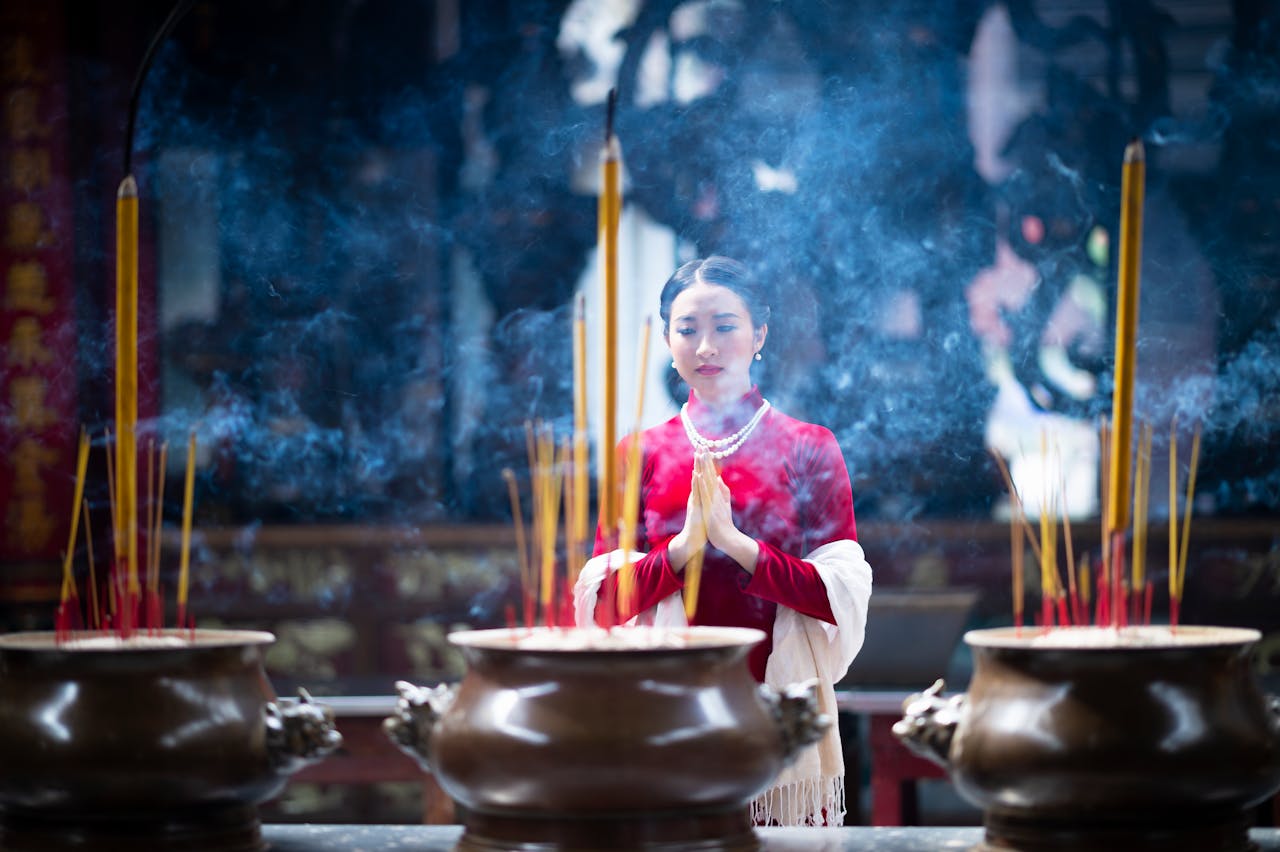
A woman praying in shrine near burning incense sticks, photo taken by Tiểu Bảo Trương | Source
More Than One Way: On Ritual, Morality, and the Darkness Beyond Knowing
There's more than one way to skin a cat. That's a dreadfully horrific saying, isn't it? But while the expression is unnecessarily violent, by the time you finish this essay, you'll understand why I think the sentiment behind it is incredibly important.
Prologue: An Odd Expression
The earliest version of the phrase appears in 1678 in John Ray's collection of English proverbs, the equally horrible-and-bizarre "there are more ways to kill a dog than hanging." By the early 1700s, the British were saying "there are more ways of killing a cat than choking it with cream," a delightfully absurd image if you think about it, as if choking a cat with dairy were the default method anyone would consider. The modern American version first appeared in print around 1840 in Seba Smith's "The Money Diggers," where he wrote
"This is a money digging world of ours; and, as it is said, 'there are more ways than one to skin a cat,' so are there more ways than one of digging for money."
Smith wrote as though everyone already knew the phrase. Mark Twain used it in 1889 in A Connecticut Yankee in King Arthur's Court:
"She was wise, subtle, and knew more than one way to skin a cat"
Meaning she knew multiple strategies to get what she wanted. Some optimistically claim the "cat" is actually short for catfish, which must be skinned before cooking since they lack scales. But the phrase's evolution from dogs to cats, from hanging to choking to skinning, suggests this is regional reinterpretation of a much older proverbial pattern.
Before cats entered the picture at all, the English said:
"There are more ways to the wood than one."
A gentler metaphor about reaching a destination via different paths. That isn't what stuck, though. Somewhere along the way, we traded walking peacefully to the forest for the visceral, violent image of removing an animal's pelt.
The violence makes it memorable. Makes us wince. The discomfort is why the saying has endured.
We are forced to reckon with the fact that solutions to problems, even when they achieve the same end, can look radically, disturbingly different from one another.
I invoke this phrase now, despite its grimness, because I am trying to articulate what has been gnawing at me. How we live in a world demanding singular answers. One right way, one true path, one correct interpretation. But this expression suggests the opposite.
There are profound truths we all reach for, but we reach in such different ways, we kill and wage war with one another over this. The conclusions we come to are not only incorrect, but will damn us eternally.
I believe the opposite. The multiplicity doesn't diminish the truth; it confirms it.
Multiple ritual and moral languages may be different ways of touching the same 'more-than-material' reality (or at least the same human recognition of meaning). There are things we cannot prove, but universally recognize. The materialist explanation for human behaviours: the reduction of love to oxytocin, how grief to neural firing patterns, how the sacred to adaptive evolutionary behaviour. Both true and utterly insufficient.
Different paths can lead to the same human end—if the end is earnest, and pursued in good faith And what I'm trying to say is this: maybe the goal we're all reaching for, across every culture and century, is to acknowledge that the material world is not all there is. We are surrounded by mystery. Something beyond the measurable shapes everything we are.
And there are more ways than one to reach toward that mystery correctly.
Part One: Beauty of the Dead and Rituals
There are more ways than one to respect the dead.

The Toraja people in the highlands of Sulawesi, Indonesia, build elaborate tongkonan houses with distinctive boat-shaped roofs pointed toward the sky. Here, death is not a single moment but a slow unfurling across days, weeks, years. Families practice funeral ceremonies lasting 3-10 days where deceased members are kept at home, dressed, given food. For they are not dead until buried properly. The journey to Puya is gradual, the afterlife waiting beyond the mountains. The air fills with the sound of drums and the bellowing of water buffaloes, sometimes fifty, sometimes a hundred, whose sacrifice marks the status of the departed.
Every few years comes Ma'nene, when families climb to ancient cliff-face vaults, bring down their ancestors, wash their bones, dress them in fresh silk and batik, brush their hair. Photographs are taken in modern times, the living holding the mummified dead, smiling.
If any of this feels strange, it's worth remembering how strange our own burial norms would look to an outsider.

Travel west and north to the Himalayas, to designated mountaintops across Tibet, Mongolia where vultures circle the high plateaus. Sky burial (jhator) give offering to the hungry birds. Pogyapas, body breakers, perform sacred work in the thin, cold air. The deceased is dismembered, bones crushed and mixed with tsampa flour, every part given to the waiting, patient vulture.
The body is an empty vessel after the consciousness has departed in Vajrayana Buddhist. The practice is a final act of generosity. Flesh feeding wings, the body sustaining life even after death.About 80% of Tibetans choose this path, making it more common than burial or cremation. The vultures rise on thermals, carrying what remains toward the sun.

Southwest across the Indian Ocean to Madagascar, Famadihana, translating to the "turning of the bones", is practiced every five to seven years. Families descend on ancestral tombs with bands playing salegy music, horns bright in the tropical air. Crypts are opened, unwrapping the bundled dead from old shrouds. Handling bones that have been slowly giving back to earth with grace. Fresh silk, handwoven and perfumed, are wrapped around each ancestor while families dance, lifting bodies above their heads, circling the tomb seven times.
The Malagasy believe the dead appreciate celebration and joy. Remembering the music they once danced to. Spirits don't ascend to join ancestors until fully decomposed, and until then, they deserve parties. Expecting women take fragments of ancestral shrouds, believing the blessing of the dead can quicken new life.

In Ghana, master carpenters build fantasy coffins shaped like Mercedes-Benzes for businessmen, oversized fish for fishermen, enormous Bibles for the devout—believing the dead continue their professions in the afterlife, buried to honour their earthly work. In Aboriginal Australia, bodies are placed on tall platforms covered in leaves and left for months to decompose, the spirit returning to the land before being reborn. In New Orleans, jazz bands lead funeral processions, playing dirges until the dead are buried, then shifting to jubilant music, dancing through the streets to celebrate the life that was lived.
And so I ask, is only one tradition correct? A single path to salvation? That seems like such a narrow and ridiculous question to ask. It is perhaps more logical to say, simply, none of them are correct. That none of this is actually respecting the dead because there is no actual way for us to communicate with those who have died, and that all we have is this one finite, brief, and absurd life.
This thinking can be applied to a lot of things, can't it? It is easy to succumb to this conclusion and to perceive the universe as cold and mechanical, and that there is no meaning or purpose for any particular thing, and that it is all for naught.
Part Two: Our Inherent Nature
Babies born blind smile. Babies born deaf laugh. When researchers at the University of Geneva analyzed 21 scientific studies from 1932 to 2015, they found that people born blind spontaneously produce the same facial expressions as sighted people when experiencing genuine emotions. Those born both deaf and blind display expressions of happiness identical to those who can see and hear. The same muscles activate. The same joy radiates from faces that have never witnessed another human smile. Studies of blind athletes at the 2004 Paralympic Games showed they articulated happiness and disappointment in the same ways as sighted competitors, including the forced smiles of those who finished second, so achingly close to their goal.
These expressions emerge from something deeper than imitation, something encoded in our very bones.

Here in Calgary, when the warm Chinook winds blow down from the Rockies, they create what's called a Chinook arch, a long band of stationary clouds stretching parallel to the mountains, the clear western sky meeting the clouded east. Colours change throughout the day. Yellow, orange, red, and pink in the morning as the sun rises, grey at midday, then pink and red again, finally orange and yellow as the sun descends. When conditions align at sunset, the sun's rays illuminate the underside of the arch, and the entire sky ignites. Shades of red, pink, and orange bleeding across hundreds of kilometers of clouds. The sight stops people mid-stride on frozen sidewalks, makes them pull their cars to the shoulder, stand transfixed as the heavens burn. Something in us recognizes this as beautiful and meaningful, without anyone teaching us to feel this way.
We find beauty in things. We fall in love with people and the sky above us.
Inversely, there is a universal recognition of horror and immoral atrocity.
After the Holocaust, the world struggled to establish universal moral criteria, standards for right and wrong that could prevent such atrocities from recurring. Philosopher Zygmunt Bauman argued that the Holocaust proves societal rules and norms cannot be the only source of morality. Perpetrators argued in court they were only following the laws of their country. How can we judge them if morals are products of relative social context? Bauman proposed instead that morality originates in a fundamental responsibility to another person in proximity. Unconditional, preceding knowledge, language, culture, and norms. When rescuers during the Holocaust encountered someone in need, someone who needed a hiding place, food, false documents, many described feeling they had no choice, that they had to act. "What else could I do?" they asked. This is not learned. This was something deeper.
We have an innate ability to recognize a morality that is not wholly subjective nor relative.
Even if evolution explains the mechanism, it doesn't settle the question of meaning or why these experiences feel like more than just biology. The fact that our brains are wired for certain responses doesn't eliminate the mystery of why those responses exist at all, or why they carry the weight of significance they do.
Part Three: The Foundation
And these are the simple facts of which we must build a foundation of understanding: that there is perhaps a meaning that is not derived from the naïve, coping philosopher who is desperately trying to point to something to distract himself from oblivion.
Instead, rather, there is something beyond the material and beyond what we can actually observe with any sort of sensory instruments. And I do not think of this as pointing to any particular religion, but it is perhaps something extranatural.
Maybe I am just repeating sentiments that have already been declared, such as "all roads lead to God" and that there is a universalism within our spirituality. There is truth to that, but it is not precise to what I am trying to articulate here.
What I am saying here, rather, is that there's more than one way to skin a cat.
We do not know the exact rules for this universe that we were spontaneously born into. We do not know the laws of our physical being. But we do know how to love, and we do know how to take care of one another, and we know how to forge community, and we know how to exist, and we know how to grow medicine. and we know how to heal other living things. Just to give an example of the wide range of the spectrum of our competency and knowledge.
And from this spectrum arise our perplexing habits that we separate from the profane and declare sacred, and that are most often times so intricate and colourful and woven with rare and highly valuable objects, where we recite beautiful poetry in languages that we have long forgotten.
And the anthropologist truly can give a rational explanation for these habits that is satisfactory to the materialist, who does not subscribe to a world beyond the world we know.
Part Four: The Anthropologist's Predicament
Not to single out a particular field, but when looking at how humanity has reckoned with our greatest questions, the anthropologist has an answer for everything. Clifford Geertz, who spent years living among the Javanese and Balinese, who documented their rituals with meticulous care, defined religion as:
"A system of symbols which acts to establish powerful, pervasive, and long-lasting moods and motivations in men by formulating conceptions of a general order of existence."
He argued that in ritual, the world as lived and the world as imagined fuse together under symbolic forms, producing a transformation in one's sense of reality. Sacred symbols, he observed, provide blueprints for social existence, shaping the quality of human experience by inducing states transcending ordinary awareness.
Victor Turner, who lived with the Ndembu people of Zambia, introduced the concept of liminality. Turner thought of the threshold space in ritual where participants are "betwixt and between," stripped of their usual social identities, existing in a state of ambiguity and potentiality. In these liminal phases, Turner argued, people experience communitas, defined as a spontaneous sense of connection and co-humanity which both violate and transcend typical hierarchies. Ritual serves to challenge and transform social norms through sacred transgression, carving out new space.
For the anthropologist, when the Malagasy dance with their exhumed ancestors they are reinforcing kinship bonds and maintaining social continuity across generations. When Tibetan monks perform sky burials, they're enacting Buddhist beliefs about the impermanence of the body and the continuation of consciousness. When Catholics recite Latin prayers over ash, they're participating in a 2,000-year-old symbolic system that structures relationship to suffering, mortality, and the divine.
The anthropologist documents. Rituals embody worldviews, the sacred is an altered state of consciousness. Our traditions are transitions between social statuses. Synchronized ritual movements trigger neurobiological responses promoting social bonding. And emotionally intense rituals create indelible episodic memories which then become part of participants' essential autobiographical selves.
The evolutionary advantages of ritual behaviour are easily traced. The adaptive benefits of group cohesion are explained through the biochemistry of shared transcendent experience. Every gesture has a function. Every symbol serves a purpose. Everything can be catalogued, analyzed, understood.
Hm, what does this anthropologist think of sunsets and their parents' funeral?
What happens when the anthropologist goes home for the holidays and sits at the table where their grandmother used to sit, now empty? When they light the candles on their own child's birthday cake? When they stand at their father's grave and cannot speak?

In 1981, anthropologist Renato Rosaldo and his wife Michelle were conducting fieldwork with the Ilongot of Northern Luzon in the Philippines. For years, Rosaldo tried to understand the Ilongot practice of headhunting, a cultural tradition where men would kill enemies and take their heads after experiencing a significant loss, like the death of a loved one. Ilongots explained grief created an overwhelming rage in the heart, a weight which could only be lifted by literally taking another's head. Rosaldo listened, took notes, analyzed the practice through theoretical frameworks. Structural, symbolic, psychoanalytic. But he could not understand. He could not grasp the emotional force driving someone to such an act.
Then, Michelle Rosaldo fell to her death during their fieldwork. She slipped from a cliff edge, sixty-five feet down onto rocks below. She died instantly.
Only through this devastating personal experience---the overwhelming and otherworldly rage arriving with sudden, meaningless loss---did Rosaldo finally understand the headhunters. Not intellectually. Not theoretically. But within his body, and in his bones. In a howling void where his wife used to be. The rancour and rage of grief was no longer abstract and in theory. It wasn't data. There was only fire and suffocation. The world became meaningless and needing—needing—a violent release just to survive the next hour.
The result was influential ethnographic account, sure. But it was also an acknowledgment of the limits of detached observation. Ethnographers keep personal journals of emotions during fieldwork, recognizing their own humanity and personal responses are not separate from research, but integral to it. Ethnography is not an objective science. There is no objective science. Everything researchers experience in the field is filtered through their personal humanity.
And so, I think about the anthropologist and the cynical nihilist. Do they get along? Are they roommates?
Perhaps they are. Perhaps the anthropologist explains to the nihilist how all rituals are adaptive behaviors and social constructs serving evolutionary functions. How the sense of the sacred is simply how our pattern-seeking brains interpret synchronized group activities. That grief is mere neurochemistry, love is mere oxytocin and dopamine, and transcendence is merely the prefrontal cortex going quiet.
And the nihilist nods, satisfied. Yes. Exactly! Just mechanisms. Just meat and electricity. Nothing more. But, then, what leads them to get out of bed every day?
Surely, the answer cannot simply be to work to pay for a roof over their head? A declaration that we must simply work for livelihood to sustain ourselves, and to exist for the sake of its own existence? It is a ridiculous circular logic.
The anthropologist, perhaps more than most, has stood in sacred space. She's participated in a ritual not as impartial neutral observer, but as a mourner and celebrant. As human being marked by transition. Feeling her throat tighten when the bell rings or the incense curls or the prayer begins. She's discovered, despite years of training in cultural relativism and symbolic analysis, that some things feel different even when they shouldn't, even when there's no rational reason they should.
Geertz himself acknowledged people do not live in the world of religious symbols all the time. Most live in it only at moments. The everyday world of practical acts is paramount. But in those moments when ritual draws us in, when we're caught in what Turner called the liminal space between states, something happens that analysis cannot fully capture.
The anthropologist explains why rituals create meaning and how they function. But when their own mother dies, when they stand at the graveside and the rabbi recites Kaddish or the priest says the final blessing or the rainset family pours Holy Water over the body wrapped in white cloth, the categorical difference between "interesting cultural practice" and "this is my mother, this is unbearable, feelings-beyond-words are all I have" collapses. It has always been collapsed.
What does the anthropologist think when asked to come home for the holidays? Is the symbolic significance of the family gathering analyzed? Or the ritual exchange of gifts and repeated narratives at the dinner table? Or do they just... go home? Because it is home.
What does the anthropologist think when she leans in for a kiss for the first time? The pair-bonding strategies and oxytocin release? Or is the chest hammering as the world narrows to a single point of contact. Unnamed in any theoretical framework ever studied?

Part Five: The 95% We Cannot See
I think when we burn incense at a shrine, I think when we ring the heavy century-old bell, I think when we rub ash on our forehead with our fingertips, I think when we fall to our knees and recite Latin or Hebrew or Arabic, there is something there.
There is the 95% of the universe's mass and energy that we call dark matter and dark energy that we have not yet measured. Everything anyone has ever seen or will ever see? Every face, every mountain, every star, every person, all make up less than 5% of what exists.
The rest is invisible. Mysterious. Everywhere.
Dark energy fills my room right now, and yours, coursing through us like a river or blood. The universe is driven to expand faster and faster against all expectations by dark energy. Dark matter provides the gravitational scaffolding for structure formation, though we haven't directly detected it in the lab. Imperceptible. We only know there's something because galaxies move differently than they ought to. The universe expands faster than our equations predict and light bends around invisible mass. Something unknown is shaping the cosmic web on which everything hangs.
We know it's there only by its effects, by the ripples it leaves, by what it does to things we can see. Like seeing disturbances in a tranquil pond and to never glimpse what caused them.
Perhaps our rituals are ripples. Our inexplicable sense of the sacred are ripples. Our innate recognition of beauty and horror, perhaps these too, are ripples. Evidence of something totally unobservable yet shaping everything.
The materialist can catalogue every neuron firing when we witness injustice, every hormone released when we love, and can explain the evolutionary advantages of cooperation and the biochemistry of grief. The anthropologist, too, knows all this. Has written papers about it. Has published books analyzing how different cultures construct meaning from the raw ore and material of human experience.
But the fact that we can describe how a sunset scatters light through atmospheric particles doesn't stop the way it stops our breath. Understanding the adaptive benefits of altruism doesn't make sacrifice less profound. Knowing that facial expressions are partly innate doesn't explain why joy feels the way it feels when it breaks across a child's face who has never seen their own reflection.
We are luminous beings in a universe of darkness. The ordinary matter making up our bodies, our world, and everything we touch and taste and smell is 5% of existence. We will always be the rare exception, the strange bright things drifting through an invisible sea.
And somehow, across this vast darkness, separated by culture and language and centuries and mountain ranges, we have all independently decided certain things are sacred. Death deserves ceremony. Love matters. Beauty means something.
We all sense something beyond the material, we all create rituals to try to honour the liminal spaces where life touches death, we all recognize the difference between right and wrong even when it contradicts our culture's rules, we all stop to watch the sky burn orange and pink above the mountains even when we're late, even when we're cold, even when it makes no practical sense—
Maybe the consensus across every human society that has ever existed is itself the evidence. Not proof. But evidence. A ripple in the pond. The 95% of reality we cannot see, making itself known through what it does to us.
There is more than one way to honour the dead, to mark the sacred, to reach toward the transcendent. The Malagasy dance with their ancestors. The Tibetans return bodies to the sky. The Catholics recite Latin over ash. The Jews sit shiva. The Muslims turn toward Mecca. The Buddhists light incense. The Indigenous Peoples of countless traditions have countless ways of acknowledging that the material world is not the only world.
Perhaps they're all correct. There is something beyond what we can measure. The darkness is not empty. We are surrounded by mystery, and our rituals are how we mark its presence and honour what we cannot know, but still somehow recognize.
Conclusion: The Art of Reaching
More than one way to skin a cat. More than one way to reach the unreachable.
We live immersed in what we cannot comprehend, and still we insist on meaning. Still we create beauty. Still we recognize injustice. Still we love. Still we gather to mark the sacred transitions, acknowledging that birth and death and transformation mean something, even if we don't know the exactitude of the what.
The universal human insistence across every culture that has ever lived declares we are more than matter in motion. Perhaps the insistence is, itself, the evidence we seek. The ripple revealing the invisible stone. The bending of light around an unseeable mass.
Through dance or prayer or silence or song, our reaching is how we acknowledge we are small bright things in an infinite darkness, surrounded by mystery, part of something vast we will never fully understand. But we sense it. All of us. In every culture. In every time. We sense it, and we reach.
More than one way to reach. But the reaching? That is what we share. That is what we're capable of. Written into our very faces before we ever learn to see.



Comments
To comment, please sign in with your website:
How it works: Your website needs to support IndieAuth. GitHub profiles work out of the box. You can also use IndieAuth.com to authenticate via GitLab, Codeberg, email, or PGP. Setup instructions.
Signed in as:
No comments yet. Be the first to share your thoughts!