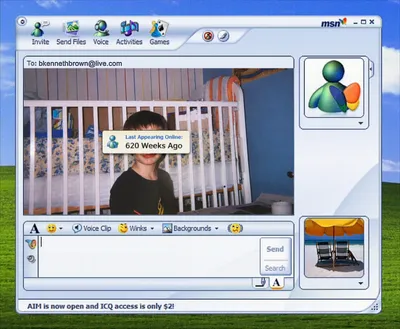
Background: Screenshot taken by Jean-Pierre Lesueur | Medium // Foreground: Childhood image of Author (original)
issue #181 of brennan.day
Last Online 620 Weeks Ago: Why I'm Loyal to the IndieWeb
brennan.day — issue #181
Publisher: Brennan Kenneth Brown
Place of publication: Calgary, Alberta, Canada
Available at: https://brennan.day
Contact: mail@brennanbrown.ca
You visit your parent's house and find your white Xbox 360 in your childhood bedroom.
The tri-coloured composite cables are still stuffed behind the nightstand where you left them, tangled the way you left them, and when you plug them in you hear the ambient glow of the logo as the system boots up—you hear the fan pitch and wait patiently at the boot screen. You're presented with a vibrant, extinct design language and a friends list full of gamertags that haven't booted up their own console in hundreds of weeks. You hover the cursor over a name and the tooltip reads: Last Online: 640 Weeks Ago. Twelve years and you hadn't thought of him in eleven.
You read an article in a physical, ink-printed newspaper in 2012 discussing how Microsoft is announcing the shutdown of MSN Messenger next year. You hurry home and try to remember the password to the Hotmail account you had in middle school. You look through a plastic binder full of polynomials and chemistry-balancing exercises and find the credentials written on a pink sticky note, your twelve-year-old handwriting still round, the looping letters you don't recognize as yours anymore. Once again, you're presented with an already-aging design language and two lists of people you used to love: "Not Online (52)" and "Online (0)".
It's only a couple years ago, and instead of sleeping you are replaying the most embarrassing moments from high school in your head. You decide to keep yourself up for a few more hours by looking up the usernames you remember on Instagram. You find accounts, and some are even public and full of posts. But then you look at the most recent photos posted. The metadata at the bottom reads "July 2nd, 2020." You look at the posts before that, and there's nearly one per day before the silence of the past six years. What happened? You search their full name with "obituary" added as a rueful suffix. Nothing comes up. It's just a ghost town mystery.
It's sometime in 2019, and you're reading a short news item about MySpace. Oh, that still exists? Yes, but they just admitted to losing everything uploaded to the platform between 2003 and 2015. Not misplacing. Not taking offline temporarily. Gone forever. Fifty million songs from fourteen million artists. A server migration the company described as an inconvenience, with an apology statement already half-buried. The music was the point of MySpace, you know? Bedroom recordings that no label ever touched, local bands that found their first fifty listeners through a blue-and-white grid of blinking GIFs and Top 8s. The audio of the Internet at the time. The developer and blogger Andy Baio was openly skeptical it was an accident, noting that flagrant incompetence might make for worse press than admitting they simply couldn't be bothered to migrate 50 million old files. You think about those songs, suspended in no air.
Oxford University's Internet Institute projects that dead Facebook users will outnumber the living by 2070. By 2100, up to 4.9 billion accounts will belong to people no longer able to log in. Right now, 8,000 Facebook users die every single day. There are already 107 million deceased users across social platforms. Profiles frozen mid-sentence, birthday notifications still firing into the feeds of people who don't know what to feel when they arrive, tagged memories resurfacing in timelines like letters returned to sender. Twitter deleted fifteen million inactive accounts in December 2025. The platforms maintain these presences reluctantly, and then delete them erratically. Logic shifts with each new executive and earnings call.
An account stopped in time feels different from a deleted one, different again from a memorialized one, and different still from accounts belonging to people who are alive somewhere and simply stopped, for reasons you aren't sure of.
Examples like the ones I've shared above are why I have found myself with a deep, irrational loyalty to the IndieWeb. I know as well as anybody the heartbreak of losing total contact with someone, whether they were an online friend or someone in real life. Even if you only had a couple of back-and-forth correspondences, it sticks in your mind with the roots of a blooming flower. We remember the kind and the considerate, regardless of whether they were schoolmates or anonymous screen names and cartoon avatars. We are not often enough kind and considerate to one another. We are not often enough brave enough to reach out spontaneously.
Nearly everyone in your life will be a season. There are undefined start dates and end dates, and the seasons don't announce themselves. You only recognize, in retrospect, who was summer and who was the long grey middle of February. Who you were present for and who you slept through.
And I also need to confess that throughout my life, I've been flaky and unreliable. I've gone dark. I've been impossible to contact for months at a time during the worst periods. This has been detrimental, obviously, because relationships are built on a foundation of trust and faith. Ghosting is pouring accelerant on the end-date—the opposite of fertilizer for the blooming flowers. Often in-person, there is an established social contract. But online, unless you specifically ask, nobody is obligated to continue a sustained connection. Netizens come and go with a far more ephemeral, transient nature than people you see face-to-face. The seasons end faster. The silences are easier to maintain.
But I don't want that for myself, anymore. I want to be someone reliable and easy to contact, both in-person and online.[1] This is in conjunction with my commitment to building for the long web. My domain https://brennan.day is owned by me for the next decade, which means you'll be able to comment on my posts and write in my guestbook and email me for the next decade, minimum. And I'll get back to you.
I don't want to be yet another ship passing through the night. I don't want to be a perpendicular line intersecting once and significantly with other perpendicular lines. I want to consistently comment on the same other active blogs for as long as they're active. I don't want anybody wondering what happened to me.
I think this is a promise to be more proactive about checking in. To sustain a continued and legible presence. These are important principles for the future of the human web. There are thousands of inactive corporate social media accounts, thousands of blogs that haven't had a post in years, and fifty million songs that are simply gone. I don't want to contribute to the accumulation of started things and the dusty shelves of interrupted selves. The best parts of the Internet you love are made by people who kept showing up. I want to be someone who keeps showing up.
Which isn't to say I'll respond immediately—I want to return to an internet that is a place we visit periodically instead of where we're permanently stuck in. ↩︎


Comments
To comment, please sign in with your website:
How it works: Enter your website URL. IndieLogin checks your rel="me" links on GitHub, GitLab, Codeberg, and email. Setup instructions.
Signed in as:
No comments yet. Be the first to share your thoughts!