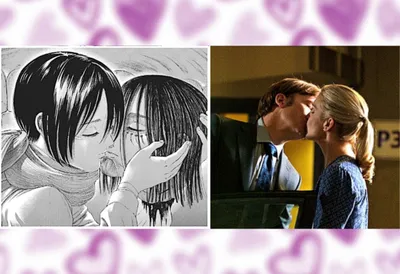
Left: Mikasa Ackerman and Eren Yeager, Attack on Titan (進撃の巨人, Shingeki no Kyojin), manga by Hajime Isayama, © Kodansha. Right: Jimmy McGill and Kim Wexler, Better Call Saul, created by Vince Gilligan & Peter Gould, © AMC/Sony Pictures Television. Composite/comparison image assembled for commentary purposes; all rights to original works belong to their respective copyright holders.
issue #236 of brennan.day
It Was Always a Love Story, Actually

brennan.day — issue #236
Publisher: Brennan Kenneth Brown
Place of publication: Calgary, Alberta, Canada
Available at: https://brennan.day
Contact: mail@brennanbrown.ca
🚨 MAJOR SPOILERS for Better Call Saul and Attack on Titan.
Japanese Manga artist Hajime Isayama always has been a magpie for pop culture. He sneaks Game of Thrones cameos, silly Internet memes, and whatever crosses his desk that week into his acclaimed series Attack on Titan.
There's one reference I want to point out. Somewhere in the back half of the Attack on Titan manga, tucked into a panel, Isayama drew a Titan with a side part and a cheap suit.
It is an unmistakable cameo of Saul Goodman.
And I'm thankful for this. The two universes I'm about to discuss together have already touched. A cartoonist drawing the end of the world looked up from his desk, and thought of the sad attorney in the back of a nail salon.
I can't imagine how thin the Venn diagram is of people who will appreciate this analysis, but I feel compelled to write it nonetheless.
You see, I can't stop thinking about the parallels between the ending of Attack on Titan and Better Call Saul.
I already know what you're thinking, these two pieces of media could not be further apart, could they? A fourteen-year shonen epic about giants eating the world, and a six-season slow-burn about a strip-mall lawyer talking his way into Hell.
Yet, they converge at the end. The blood and bodies and legal paperwork and monsters are all secondary. You see, these both are love stories.
I. The Mirrors
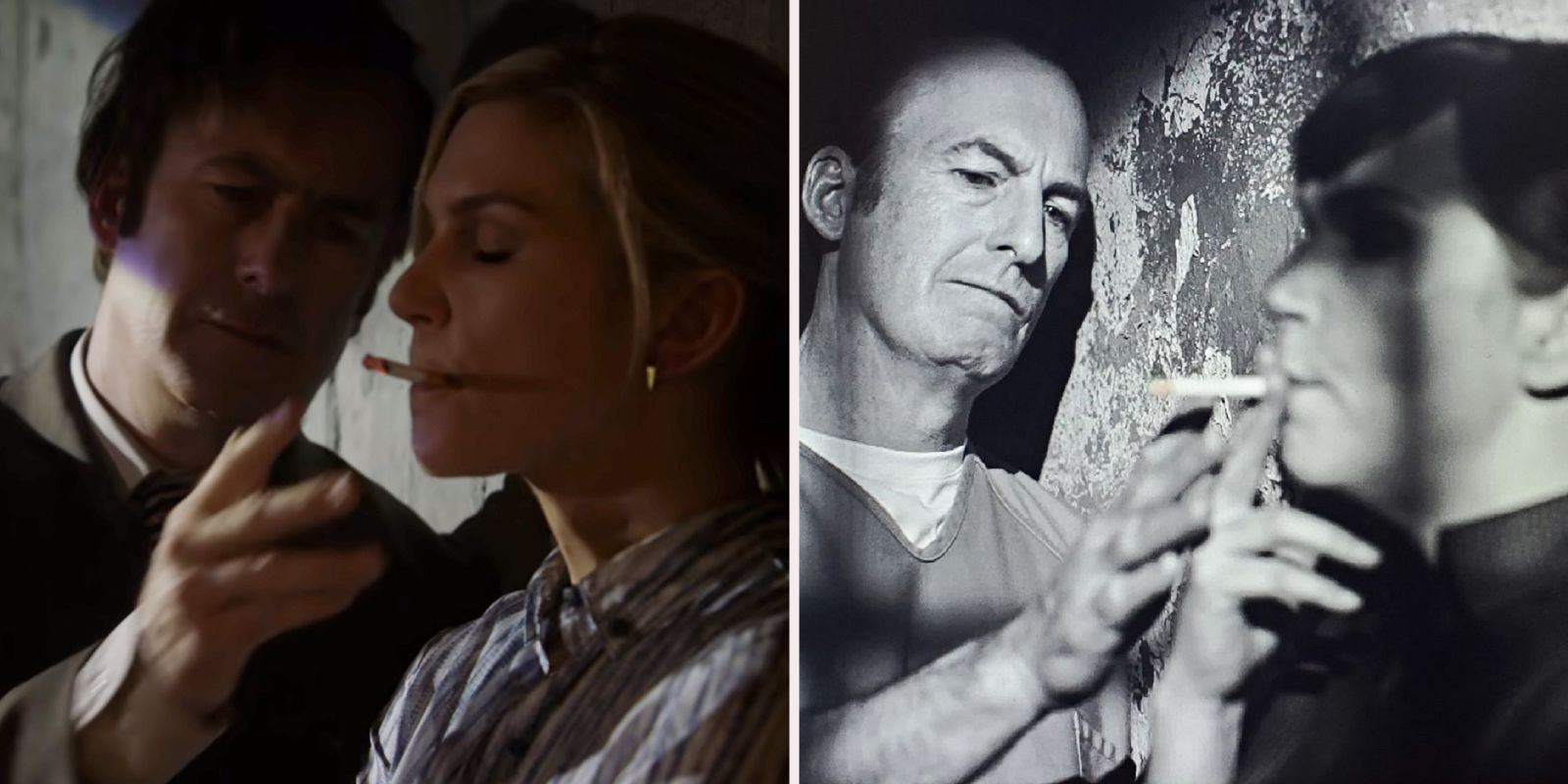
In the finale episode of the crime drama spin-off Better Call Saul, Kim Wexler visits Jimmy McGill (Saul Goodman) in prison. The two intimately share a cigarette leaning against a wall, identical to the framing of the first episode. A callback bordering on liturgy. Slippin' Jimmy first successfully talked down his sentence to seven years, a plea deal in a minimum-security facility with a golf program. An ending Saul Goodman would have crawled through glass for.
Then, he completely rejects it. He stands up in court and confesses on the record to Chuck, to Howard, to how drug kingpin Walter White couldn't have done it without him. He ensures Kim is there in the pews to witness it. He asks the judge to call him James McGill, not Saul Goodman. And he is rewarded (if that's the right word) with eighty-six years in a supermax ADX Montrose To eighty-six means to strike it from the menu, to be done with it for good. A life sentence. Saul Goodman is 86'd. Only Jimmy is left. The finale is titled "Saul Gone.".
And then, at the final scene, with Jimmy standing in the prison yard, he finger-guns Kim goodbye through two fences. A weighted gesture the couple has done towards each other twice previously.
Rhea Seehorn shot a version where Kim returns the gesture fully to Jimmy, and the writers cut it. Co-creator Peter Gould said they didn't want to imply she was "back in the game." What we see instead is a flicker of her hand at her side as she walks away, ambiguous. The full reciprocity was filmed, and the writers chose a more ambiguous cut that respects Kim’s interiority. A fully returned gesture would be answering the man who ruined her life, reading as endorsement rather than grief. What we get instead is private, her hand moving imperceptibly at her side, a gesture with meaning that belongs to her alone.
Meanwhile, Mikasa's last act, after three thousand pages and two thousand year mythology, is to defy her love for Eren in order to kill him and save the world. What does she do the instant after separating his head from his spine? She kisses him. The first kiss of the entire series. Isayama has since said he wanted their kiss years earlier, in chapter 50, but lost his nerve out of shyness. It instead comes at the end, after it's too late for it to change anything, offered to a corpse.
And I can't help but be reminded of Jimmy finally saying "I love you" to Kim in the middle of her leaving him in the ninth episode of the last season. The only time in six seasons it's said between them. And she replies, "I love you too. But so what?"
Both endings, in completely different ways, are about a deep love arriving when time had already come to pass. On time for everyone except the two people who needed it to.
Mikasa carries Eren's severed head as the Founding Titan collapses behind her, and buries it beneath the tree where Ymir first received her curse and power two thousand years earlier. She lets herself sob without restraint. She saved the world from the man she loved.
II. Deep Time
Who is the original Founding Titan? Ymir. A girl, and a slave. Granted the power to sculpt Titans from her own hands, to flatten cities on command, and kept for two thousand years inside the indentured servitude of a cruel, small king who never regarded her personhood. After years of clearing roads and cultivating wilderness for his empire, he forces her to bear his children and pass on the Titan curse, starting the cycle. "Giving her his seed," as though pregnancy were a wage. She bears him three daughters. Those daughters become the Walls, Maria, Rose, Sina—the architecture that protects the last of humanity for the next two millennia. A civilization built out of the bodies of a woman and her children.
Why does Ymir serve him, across two thousand years of imprisoned consciousness, long after death should have released her? Isayama's answer is love. Not compulsion. Not a curse she can't escape. Love for the man who enslaved her and murdered her parents.
Ymir is a girl who never knew love outside her captor, and taught herself to call captivity love. A widely-shared critique goes so far as to call the framing misogynistic "even by anime standards," pointing out that the text never really interrogates the abuse. Ymir is freed because she witnesses another woman, Mikasa, making the "correct" choice to relinquish a man rather than serve him forever. Her liberation is granted to her by proxy, through someone else's grief, rather than claimed on her own account.
How much good faith are you willing to extend? Is the story critiquing the cycle, or unconsciously repeating it?
Rejection of Isayama’s “she loved him” explanation is understandable, it is a failure of imagination—a story reaching for the language of love to give horrifying trauma bond the shape of romance.
Ymir’s enslavement masquerading as love is a poisoned well; Mikasa’s genuine and agonized love is cleansed water drawn from it. Mikasa makes a choice Ymir never could: to kill the man she loves in order to end a cycle of violence. A woman who loves without losing herself.
III. Is This Actually Feminist?
Better Call Saul is an improvement on the show it spun off from. Skyler White and Marie Schrader spent Breaking Bad absorbing a level of audience hatred that had nothing to do with what they did on screen, only that they stood between a man and his self-actualization through brutal crimes. Anna Gunn, who played Skyler, wrote about the misogyny of that reception herself.
Kim Wexler doesn't get that treatment. She's given interiority the predecessor show's women rarely were, entire episodes alone with her own ambition, a career she built without Jimmy's help and very nearly loses because of him. The episode most quoted for Kim's independence ends with her telling Jimmy "you don't save me, I save me," written by a woman, Ann Cherkis.
Attack on Titan has Mikasa, Hange, Annie, Historia, Pieck, and Sasha. All of which are never framed as spectacle, never designed to be looked at rather than to look. The smartest person in the room across the series is as likely to be a woman as not.
But what do both shows actually centre? At the end of the day, this is still about Jimmy and Eren. The women survive into an epilogue treated as optional, a few pages or a few moments of screen time tacked onto the man's ending.
Mikasa's entire remaining life of decades is compressed into a handful of wordless panels: a bird retying her scarf, an implied husband no one in the story ever names or confirms (the official guidebook pointedly declines to call the man in her epilogue a spouse at all, which fans still argue about). Then a child, old age, and a grave beside his.
Kim Wexler gets one scene. A cigarette, a fence, a walking away all standing in for whatever the rest of her life is, which we are simply asked to trust continues somewhere off-screen.
The man is dead, or imprisoned for life. And so the story considers itself finished. Whatever these women do with the fifty years still ahead of them is not plot.
Who gets the epilogue? Whose interiority does the camera trust us to sit inside? Is there a limit of what even well-intentioned stories can imagine when the genre itself was built with a man's transformation? Prestige antihero drama; shonen apocalypse epic.
IV. Emotional Labour
These women deal with the damage and wreckage, and forgive without being asked to. They absorb the fallout of a man's self-mythologizing without becoming bitter or resentful.
Arlie Hochschild coined the term emotional labour in 1983, in The Managed Heart, to describe a transaction. Flight attendants and waitresses and receptionists all trained to manufacture warmth on command for a wage.
Decades later, Hochschild said the term has become blurry. She's uneasy about how "emotional labour" is used now in modernity. Marriages, friendships, the work of those who remember birthdays and smooths the arguments at home. A useful concept stretched ubiquitous, now meaning any invisible caretaking a woman performs.
What Kim and Mikasa do isn't labour for a wage, and it isn't the offstage domestic labour Hochschild's critics have in mind, either. It's affective labor: the work of producing and absorbing feeling itself as the actual product, not a byproduct of some other job.
Kim's labour across six seasons is the maintenance of Jimmy's conscience, right up until they find themselves responsible for Howard's death. Mikasa's labour, across a war and a genocide and the end of a world, is the maintenance of Eren's humanity long after he stopped trying to maintain it himself, right up until she's the only person who can hold both his love and his death in the same hand.
The women are the ones left standing closest to the damage when the story needs someone to survive, and keep feeling something on the audience's behalf.
V. Tenderness
There is true and earned catharsis in both of these finales. I don't want to lose that in all the analysis and interrogating.
Both shows admirably demonstrate love in its purest form. Despite everything—the corpse, the eighty-six year life sentence, the two thousand years of servitude standing behind Mikasa's choice—neither Kim nor Mikasa lose their love or trade it for resentment. A resentment that would be more than earned and justified.
Instead, there is still a kiss, still a shared cigarette. Tenderness is held onto because the world, unjust and cruel, gave every reason to discard it.
The tenderness of Kim and Mikasa is not a service performed for the men. Tenderness is chosen for themselves, a refusal to let the world’s brutality dictate their own hearts. Kim visits Jimmy no longer as his conscience’s keeper, but as someone finally free to face him without the roles they played. Mikasa buries Eren and then lives beyond the story’s frame.
But a stance the audience is invited to admire is not the same as a debt the story pays back. So I keep asking myself: is the weight finally felt? Do we move past the mere acknowledgement?
These were love stories from the beginning. Not romances—neither show is interested in courtship—but love as the engine, powering every decision the man makes, even the monstrous ones.
Eren spends the final arc of Attack on Titan convincing the world he is irredeemable. He tells Mikasa he has always hated her and marches an army of Colossal Titans across the ocean to end humanity. From the moment he touched Historia’s hand and saw the future, his every action was aimed at one outcome: Mikasa’s choice to kill him. All the deaths and betrayals, and his performance of heartlessness. All for her to act without hesitation, to break the Titan curse by severing his head. Eren’s love for Mikasa is not a subplot. It drives the mythology towards resolution. Ymir watches Mikasa, not Eren. The Founding Titan’s two-thousand-year imprisonment ends due to what passes between two people who love each other and could never say it.
On the surface, Jimmy's tragedy is fraternal. Chuck’s rejection drives him into becoming Saul Goodman. But the compass was always Kim. From the mailroom to the courtroom to the back of a nail salon, Jimmy wants to be Kim Wexler’s equal. He tries to play it straight—the job at Davis & Main, the elder law practice—because Kim’s approval anchors his better self. And they end up pulling each other into pranks and schemes, and eventually the destruction of Howard Hamlin, because the thrill of shared transgression is the only language of intimacy they have. Jimmy performs every version of himself for Kim. When she leaves, the man who remains is hollow. His final confession in the courtroom was a declaration aimed across the room at her, the one person who always knew him. He throws away a seven-year plea deal for a life sentence to reclaim Kim’s regard. That's worth more than freedom.
These are both love stories, full stop.
I haven't told you anything yet
まだ何も伝えてない
Watching the newly opened flowers fall
開いたばかりの花が散るのをI wonder if the grove of trees I was looking at was filled with snow.
見ていた木立の遣る瀬無きかな
No matter how scary I am, I won't look away
どんなに怖くたって目を逸らさないよIf there's love at the end of everything
全ての終わりに愛があるなら—宇多田ヒカル (Hikaru Utada), 桜流し (Sakura Nagashi)

Comments
To comment, please sign in with your website:
How it works: Enter your website URL. IndieLogin signs you in through your site's IndieAuth server if it has one (e.g. indieauth.com), or checks your rel="me" links on GitHub, GitLab, Codeberg, and email. Setup instructions.
Signed in as:
No comments yet. Be the first to share your thoughts!