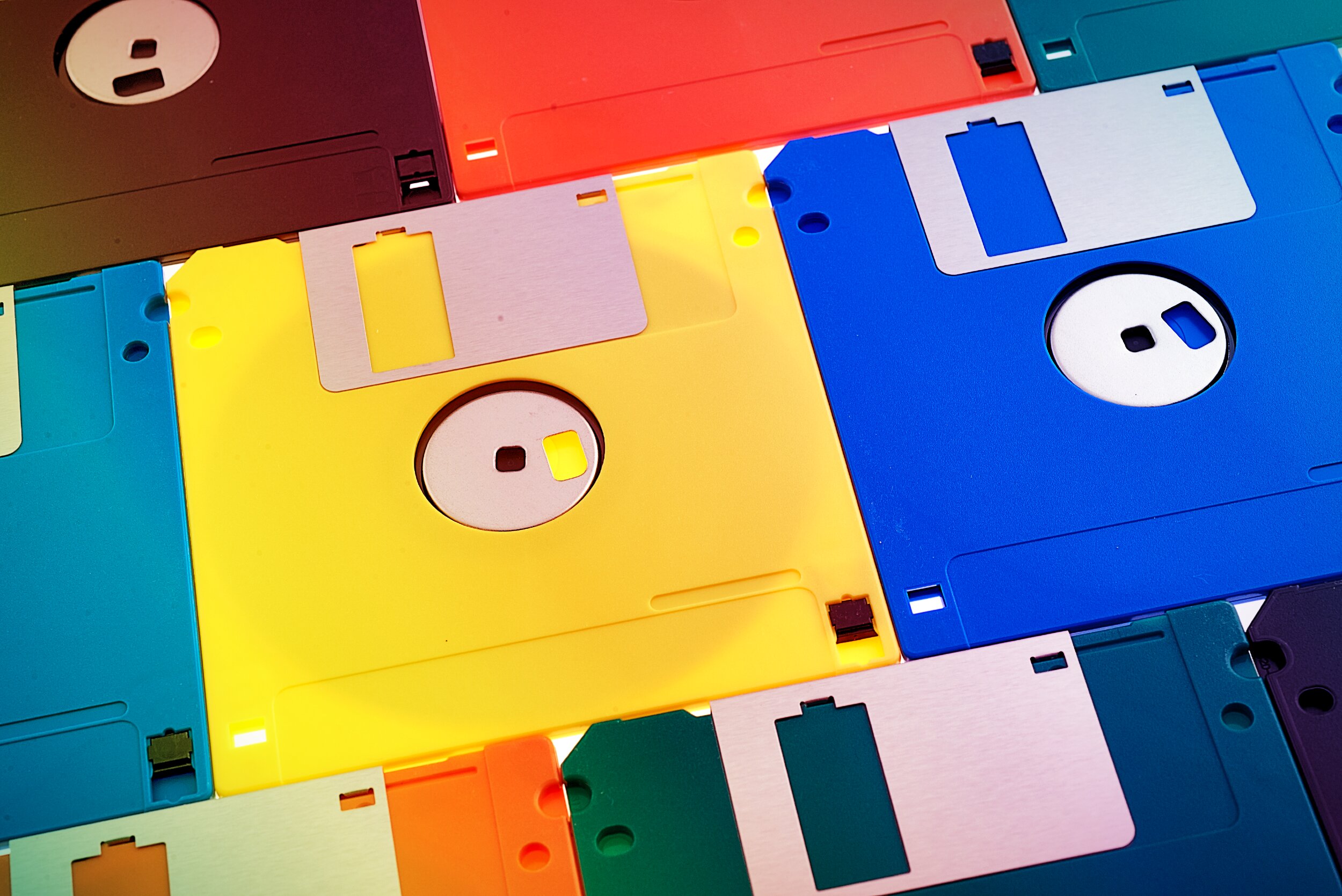
Floppy Disks by Lenharth Systems on StockSnap (edited by the Author)
How has a lack of ownership changed art?

I know I don't need to tell you that everything is now rented instead of owned.
You stream music instead of having a collection of CDs or vinyls. You stream movies and television instead of owning boxed DVD collections as the platforms keep raising prices. You digitally download games which can become unplayable if the developers decide to kill a server. Your operating system displays advertisements and generative AI features you never wanted.
88% of American households hold at least one video streaming subscription, but the average household has between three and six services simultaneously. A quarter of U.S. households spend over $100/month on streaming alone. The subscription economy was valued at $3 trillion dollars in 2024, growing three times faster than S&P 500 companies over the last decade. 41% of consumers have subscription fatigue, and yet the number of subscriptions per household keeps climbing. We are exhausted and we are still subscribing, looking at the trap in front of us and stepping in it anyways.
I've been thinking about what this change from ownership to streaming and subscriptions means. Not the economics, but how it changes our relations with art itself. How does our understanding of art change when we no longer have ownership or permanence?
Art and Aura
Walter Benjamin wrote about this in 1935, from exile in Paris, under the shadow of the Third Reich. His essay "The Work of Art in the Age of Mechanical Reproduction" argued that what gets lost in reproduction is the aura (yes, aura) of an artwork, which he defined as the unique existence in a specific time and place. A painting has aura. A photograph of the painting begins to erode that aura. Film, as a medium that requires reproduction to exist, and destroys the aura almost entirely.
Streaming, then, is the logical endpoint of this process: the artwork becomes wholly severed from any particular location or moment. It exists only as a license, a stream of data. Playing on your screen, and then vanishing. John Berger, building on Benjamin in his television series Ways of Seeing in 1972, argued the modern means of reproduction have made images of art "ephemeral, ubiquitous, insubstantial, available, valueless, free."
That was in 1972. He hadn't seen anything yet. What Benjamin called aura, a later critic writing about his legacy wrote, "in place of aura, there is buzz." The cultural zeitgeist endlessly yapping about the thing, rather than the thing itself.
I am not interested in being nostalgic here or romanticizing ownership. Ownership is not a pure good, which I'll get to in my next section.
What I want to ask is what happens to our relationship with art when our access is always conditional, always revocable, and always mediated by a corporate intermediary? A corporation that decides the price of your subscription renewal, if they're going to keep the content in their library, or if they shareholders want their servers kept online at all.
All that said, the lack of ownership isn't really the issue, though. The entire concept of the public library is to have the ability to lend and borrow books and media, from a shared, fixed amount spread across your local community. Of course, the difference there is that lack of ownership is in exchange for the media to be free. And by free, I mean an incredibly small portion of your taxes goes into ensuring the public library's survival. A lack of ownership is actually wonderful if resources are freely and equally shared and distributed. But digital streaming practices, as they are now, want to have their cake and eat it too. You pay, yet you also do not own.
Grown Men as Scalpers
Going in the total opposite direction with ownership isn't helpful or healthy, either. People who centre their consumption and consumerism as their identity are prioritizing the commodification and product identity of whatever they collect over the experience they have with the art itself.
Want an example?
The Pokémon trading card game is designed to be played. Cards drawn, decks built, matches won and lost across a kitchen table or during a school lunch break. In reality, Pokémon-as-a-card-game has been entirely eclipsed by the speculative economy surrounding it.
Scalpers using bots clear entire online inventories within seconds of a new set's release, then go on to list the products on eBay and Facebook Marketplace at two to three times retail price. Fights have broken out in Costco aisles as grown adults stampede over cardboard. Small independent card shops have received actual threats from scalpers demanding their stock. In Tokyo, police arrested someone who had used over 500 fake accounts to bypass purchase limits on the Pokémon Center website.
This is a children's card game. Designed to be played. A game with illustrated creatures with silly names and numbers printed on little rectangles of cardstock. An entire malicious economy of scalpers and grifters emerged from this. How? Perceived speculative value.
And I wonder, how many of these grown adult scalpers have ever sat down and actually played? The cards are cynically regarded solely as financial instruments. The art on them—and some have beautiful art and full-bleed illustrations that deserve to be seen, handled, and loved—is irrelevant to their transaction. The social experience of playing the game as intended—the joy of winning and tragedy of losing—is annihilated. The things written on those cards, the actual game, have been described by one critic as nothing more than "making the pictures harder to enjoy." It is clear when ownership and commodity become the point, art disappears into the asset.
The Decay
Physical media is not immortal. Whether it's digital or analog, it rots.
- Magnetic tape—VHS, cassette, reel-to-reel—have lifespans of 10 to 30 years under typical conditions. If it's instead exposed to a hot attic or damp basement it begins to shed magnetic particles, a phenomenon archivists call sticky-shed syndrome. The tape's binder dissolving and literally leaving a trail of dust behind the playhead. VHS tapes degrade at a rate of 10% to 20% percent every 10 to 25 years.
- Vinyl warps in heat and accumulates damage in the microscopic grooves with every play. Thankfully, a well-maintained pressing can last a 100 years or more, which is why the format has survived to now.
- CDs were marketed in the 1980s as virtually indestructible, but that was just marketing. Oxidation creeps in at the edges, lacquer breaks down, the aluminum reflective layer corrodes, and the phenomenon disc rot renders them unreadable. The National Archives estimates their conservative lifespan at 2 to 5 years under poor conditions, though the published range extends up to a hundred years if handled well and stored properly. The Canadian Conservation Institute reports recordable optical discs can fail in under a year.
- Celluloid film can last a century if properly preserved. Salt mines are naturally dry and cool, though any climate-controlled vault will do. But nitrate film fades and becomes sticky. Acetate turns brittle and shrinks. Everything is in the process of becoming unreadable.
Digital media doesn't rot in the same tactile, chemical sense. Instead, it catastrophically fails. A hard drive clicking is a hard drive dying. Corrupted bit-strings, failed servers, or a company going under and liquidating. The work is simply gone, no brown smear of magnetic dust to show for it, no visible evidence of loss. Disappearance is clean and total.
I want to stress how the idea of "digital vs. physical" is a wholly false dichotomy. You may remember, for a brief time, that when you bought a physical DVD or Blu-ray, you also got a digital download of the same film! This "digital copy" practice began in the late 2000s, with studios like Fox and Lionsgate including a second disc or a printed redemption code in their combo packs, giving buyers access to both a physical disc and a downloadable file. By 2012, it was commonplace for major releases to include Blu-ray, DVD, and an authorized digital copy in a single package. The technology and the will to do this existed for years.
And then studios quietly began phasing the practice out, or tying the digital copy to expiring codes, or locking it to a proprietary platform that would later be shut down. Fred von Lohmann of the Electronic Frontier Foundation described the practice as "stealing your fair use rights and selling them back to you piecemeal"—because you were paying for something you already had a right to. There has always been the ability to give consumers both options. The choice not to is a financial one, not a technological one.
The Playback and Creation
I haven't even addressed the issue of the media playback device itself. DVD players and VCRs are cheap and in abundance at thrift shops, or otherwise contributing to our pollutive e-waste. McGill University's Office for Science and Society wrote that "your DVD collection may outlive the availability of DVD players.".
But which independent artists have the capacity and capability of manufacturing physical media? The infrastructure required to press vinyl, manufacture CDs, stamp game cartridges, or produce a Blu-ray is not accessible to a solo creator.
For example, for vinyl you need pressing plants, and as of 2025, only about thirty vinyl pressing plants operate in the entire United States. There are significant backlogs and high minimum-order requirements as a result. You need blank media, hardware, manufacturing software, distribution networks, and capital. A solo musician cannot manufacture her own vinyl. A two-person game studio cannot stamp cartridges. A filmmaker working out of his spare room cannot press Blu-rays.
And so, the solo game developer simply uploads their work digitally to itch.io—a platform that takes a fraction of the revenue and requires no minimum run. And so, the independent musician simply uploads their work to Bandcamp, where they can offer digital and set their own prices. The economics of physical manufacturing are brutal for mid-sized operations; for independent artists, they're entirely out of reach unless you're lucky and successful enough to build partnerships with established physical media companies.
Companies like Limited Run Games emerged to solve this problem in the video game space. Founded in 2015 with the express purpose of preserving digitally released games as physical media, they've now published over a thousand games. Their motto is "Forever Physical." But even here the situation is complicated—their business model is built on FOMO, limited pre-order windows, and collector editions, which means they're also participating in the same speculative-collectible dynamics as the Pokémon scalpers. Boutique physical game publishers like Special Reserve, Strictly Limited, and Super Rare Games have all faced similar criticisms. The scarcity is partly artificial, preservation and profit are in tension, and the physical object has once again become the commodity rather than the art.
The Solution is DIY
One of the best examples I've seen of counterculture against this subscription-based intake of art is the resurgence of zines. A simple way to create art and share and spread ideas. Noncommercial, homemade, and made with love and intention.
Zines began in the 1930s as science fiction fanzines, self-published magazines by fans who wanted to discuss theories and share ideas outside of official channels. The form exploded in the 1970s alongside punk—the DIY ethos of punk translated almost directly into the cut-and-paste aesthetic of the zine, that visual chaos of hand-scrawled notations and badly cropped photographs and different typefaces all jostling on the same page, the look of Mark Perry's Sniffin' Glue from 1976, of V. Vale's Search and Destroy from 1977 to 1979. In the late 1980s the Riot grrrl movement found in the zine a mode of resistance—a place to express what mainstream music media couldn't or wouldn't carry. The fanzine was a photocopy machine and a stapler and something you pressed into someone's hands. It was anti-distribution and anti-scalable.
The internet threatened this. In the late 1990s and early 2000s, blogs and online forums absorbed much of the energy that had once gone into zines. Many believed print was dying. But then it wasn't.
Beginning in the 2010s, zine culture began a visible resurgence, with zine festivals proliferating globally—the San Francisco Zine Fest now hosts over 200 exhibitors; the Los Angeles Zine Fest launched in 2012 and has grown to the same size. The resurgence has been fueled in part by digital fatigue. Online content is endless and weightless, arriving and vanishing without leaving a mark on the body or the room. A zine is the opposite of this. It has weight. You cannot auto-play your way past it. You slow down. You have art in your hands.
The zine revival is not alone. Across every medium, there are people building back toward the physical.
In 2024, the U.S. music industry sold 43.6 million vinyl records—the eighteenth consecutive year of growth. In 2020, vinyl outsold CDs for the first time since the 1980s. Revenue from vinyl reached 1.4 billion dollars in 2024, accounting for 71% of all physical music sales in America. By 2025, vinyl was outselling CDs by more than three to one. Gen Z is the largest single demographic driving this, accounting for 27% of all vinyl purchases, the generation of digital natives choosing analog media because it gives them presence in time and space. The ritual of standing in front of the record player, lifting the needle, placing it down, and hearing the warm crackle of the groove before the music begins. Independent record stores now account for 40% of all vinyl album sales.
Cassette tapes are back too. Indie musicians and small labels have rediscovered the cassette as the cheapest possible physical format—a way to give a listener something they can hold. The cassette requires almost nothing to produce, and even less to distribute out of a tote bag at a show.
In games, beyond the boutique publishers, there are independent developers releasing their work on actual cartridges for retro consoles—literally manufacturing new NES and Game Boy games in 2026. Whether that's ROM hacks, bootlegs, or entirely original games.
What connects all of these—the zine, the pressing plant, the hand-stamped cassette, the physical cartridge—is the insistence on making the artwork exist in the same world as your body. Not behind glass. Not streaming through a server you don't own into a device you can't repair, playing content you cannot keep.
Really, though, there is no clean resolution to this. The infrastructure for large-scale physical media distribution still mostly requires capital and corporate intermediaries that individual artists lack access to. And the subscription economy is unlikely to collapse; its incentives are too well-aligned with the platforms that benefit from it. Physical media is expensive to produce, expensive to store, and still subject to rot. Streaming will continue to raise its prices. Games will continue to become unplayable when servers go dark.
The Zine Maker
But I still think about the person at the photocopier. The off-white fluorescent hum of the copy shop at 9pm, a greenish cast thrown over everything. The smell of hot toner, living in the atavistic corner of the brain alongside other childhood scents: rubber cement, mimeograph ink, fresh gasoline, the interior of a school locker. The rhythmic thunk-slide-thunk of the platen moving across the glass. Each page comes out warm, curled at the corners, carrying a residual heat like freshly-baked cookies.
The zine-maker feeds in the main page—off-centre with a smudge in the upper third that she's decided to live with—and the machine begins patient work. She collates the pages by hand, making little stacks on the counter, moving her lips as she counts. Paper cheap and thin. Chalky on the surface, with a resistance when you drag a fingernail across it, like running your thumb over a dried watercolour wash. She folds the pages in half and creases the spine with the heel of her hand, pressing firmly, the bone of the wrist white with the pressure. Then the stapler—one of those long-armed saddle-stitch staplers, orange and industrial, the kind you rent—driven down through the fold with a two-handed slam biting through all twenty pages at once and the staple clicks home sounding like a small, definitive argument. She peels back the inside cover to fold the staple legs flat.
She does this 40 times. Or 70. Or however many can be afforded.
The zine is titled "Permission Slip // You Can Do This Too!", with her name in capital letters above a hand-drawn heart. On one level, it's a how-to guide—how to make a zine, step-by-step annotated diagrams of the saddle stitch and a glossary of terms like bleed and master copy and risograph. On another level, it is more urgent. Between the instructions and diagrams, she has written about her body and love and liberation. About the exhaustion of moving through the world in a body keeps being asked to explain itself. About community. About the first time she saw herself reflected in something handmade and distributed outside of any institution that required her to justify her own existence. The instructions and the liberation are inseparable—because the point of the how-to is not craft. It is permission. She writes you can make the thing that shows you to yourself. Nobody can stop you. Here is how.
The cover is a linocut, ink uneven in the valleys of the block, the image blurry at the edges. A photocopied collage of faces with halftone dots blown up to the size of sand, cut-out letters from different magazines making a ransom note of the title. Elmer's glue still raised where it wasn't pressed down all the way, creating a topography you can feel with your fingertips in the dark. Text in a typeface she downloaded for free, printed too dark, too beautiful for the grubby context.
She carefully puts the copies in a canvas tote with a screen-printed logo from some other show, another artist's work carrying this artist's work. She gets on the bus then walks six blocks through a cold night, breath a brief white ghost. She lays the zines out on a table at a festival in a community space. Her table has a paper tablecloth this time. There are other tables around, other people doing the same thing, smelling of cheap coffee and sawdust and the staleness of a church hall and arts centre pressed into unusual service. People are moving between the tables. Some of them pick up the zine and leaf through it and put it down. Some of them pick it up and hold it, weighing it. Some of them hand over a five-dollar bill or drop a toonie into a jar without being asked.
Some of them trade—here, I made this, do you want to trade?—and the zine leaves the table, leaves the room, leaves the city eventually, carried in someone's bag next to their keys and their transit card and their phone, warm and rectangular and containing ten hundred thousand pieces of content that will evaporate and vanish.
The zine doesn't vanish. It will accumulate a coffee ring. It will get slightly bent in someone's back pocket. It will live on a shelf, then in a box, then maybe in the hands of a stranger at a thrift store who opens it and reads the first page and says huh, and buys it for a dollar.
Then, a teenager finds it tucked inside a secondhand copy of Stone Butch Blues and reads it cover to cover on a bus home. It makes him pick up a pencil and he will write zine on a piece of paper and feel the word in his mouth for the first time. He finds a stapler. He writes down a truth about himself that he never told anyone before. He decides in a small and world-altering way that it is worth reproducing. Someone else might need it, he thinks. The how-to instructions will teach him the mechanics; the Queer liberation teaches him the why. And he will stand at a photocopier for the first time.
The toner is bonded to the fibre of the page. The staple is a small bright seam in the spine.
The subscription model cannot touch any of this. That's a claim about what art is for—and what we are for. Making and holding and pressing things into each other's hands.

Comments
To comment, please sign in with your website:
How it works: Your website needs to support IndieAuth. GitHub profiles work out of the box. You can also use IndieAuth.com to authenticate via GitLab, Codeberg, email, or PGP. Setup instructions.
Signed in as:
No comments yet. Be the first to share your thoughts!