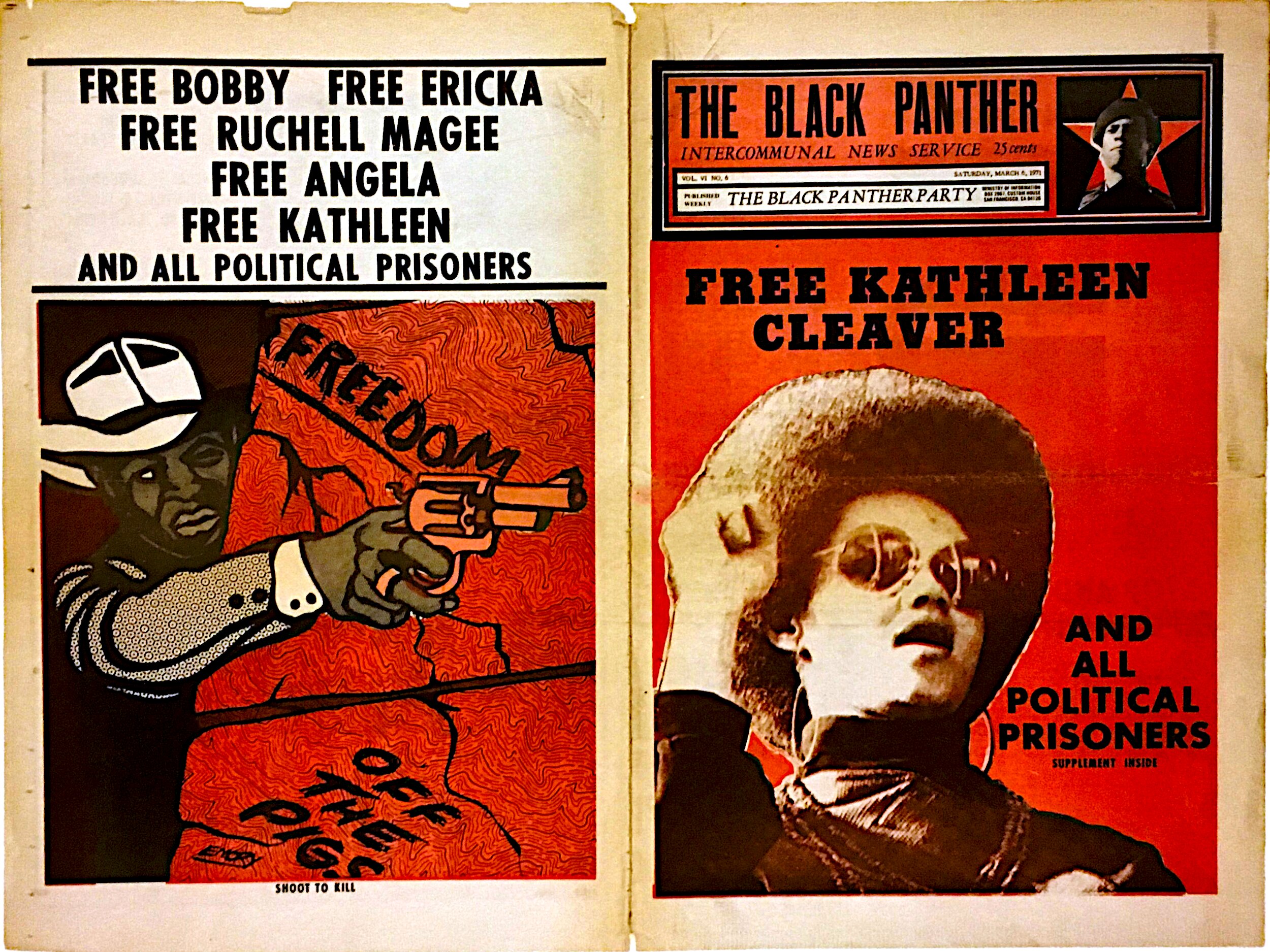
'Black Panthers @ 50 exhibition at Oakland Museum of California' photograph taken by Timothy Vollmer. | Flickr (edited by the Author)
Deeds, Not Words: The Myth of Polite Revolution
Last night, a man named Cole Tomas Allen walked into the Washington Hilton with a shotgun, a handgun, and multiple knives, and charged a Secret Service checkpoint while Donald Trump sat forty feet away eating dinner. He's thirty-one years old and from Torrance, California. He was tackled. One agent took a round to the vest. Trump went home and gave a press conference. By tomorrow the news cycle will have metabolized it, filed it under lone wolf, moved on.
What was your reaction to this?
Note: this essay is not a defense of the man with the shotgun, and it is not a call to violence. It is a refusal of the sanitized history we are handed about how rights were won, and a refusal to perform appropriate shock at one failed assassination attempt while forty-six people have died in ICE detention this year without anyone being charged.
We know what the answer to the question of political violence is. But accepting the acceptable answer without interrogating is complicity with the harm our institutions are enacting on their most vulnerable, marginalized peoples. I'm here to say the things that people with institutional affiliations and mainstream platforms don't say—the people who are privileged enough to still find comfort in the status quo we have now, or cannot risk speaking truth to power. I'm here because someone has to be. The people making purely moral arguments against violence are never themselves the ones in danger.
Murderous assassins with no theory of change will end up just being used to consolidate sympathy for a man who has overseen the deaths of dozens in detention, the disappearance of hundreds into foreign prisons, and the systematic dismantling of due process for millions. But the story does not end there.
We are told and taught our rights were won with patient organizing, strategic nonviolence, moral suasion, and the slow grinding work of changing hearts and minds. This is what we teach our children, the history on the posters, ending with a march and a speech and a law. The oppressed asked nicely, and eventually the powerful were persuaded.
This story is a lie. It is a retroactive construction assembled after the fact, making the past palatable and delegitimizing our present resistance.
Between 1912 and 1914, the Women's Social and Political Union orchestrated more than three hundred documented bombings and arson attacks across Britain and Ireland. They bombed the Theatre Royal in Dublin during a performance the Prime Minister attended. They bombed Westminster Abbey, damaging the Coronation Chair. They planted a device outside the Bank of England. They burned down cotton mills, railway stations, the mansions of politicians, the second homes of the wealthy, churches, golf courses, cricket pavilions. They invented the letter bomb. Emily Wilding Davison is a woman we remember as a martyr for throwing herself under the King's horse, and she had been bombing pillar boxes for a year before her death. Emmeline Pankhurst declared guerrilla warfare. The campaign's motto was not a catchy slogan. Deeds, not words was operational directive.
We put their faces on tote bags now. We call them brave. We do not call them what they were: a terrorist organization killing at least four people and injuring dozens more in a sustained campaign of property destruction and targeted violence. The sanitizing of their history allows us to celebrate their outcome while foreclosing the question of whether their methods were necessary.
The Haymarket affair is a similar ghost. On May 4, 1886, in Chicago's Haymarket Square, an unknown person threw a dynamite bomb at police attempting to disperse a workers' rally. Seven officers died. Several civilians died. Eight anarchists were charged, most of them nowhere near the square when the bomb exploded. Four were hanged and killed. The trial was a farce. The jury was packed. The Chicago Tribune offered to pay jurors if they found the men guilty. August Spies's last words, from the scaffold: The time will come when our silence will be more powerful than the voices you strangle today.
The eight-hour workday you enjoy, if your employer respects it, was built on the bodies of men who were executed for a bombing they probably didn't commit, in service of a movement that the ruling class was determined to crush. Petitions and strongly-worded letters didn't win the eight-hour day. What won it was mass organization, sustained strike action, economic disruption, and the constant threat—made credible by history—that the alternative to negotiation was fire and fury.
And then there is the happy-go-lucky version of the civil rights movement. Martin Luther King Jr., non-violence, the long arc of the moral universe. What that story consistently omits is the Deacons for Defense and Justice, the armed Black militia that stood guard over civil rights workers in Louisiana, that accompanied CORE organizers, that guarded King himself during the March Against Fear. Malcolm X is omitted, whose presence created the space for negotiation that would not have existed without the implied alternative. The Black Panthers are omitted, whose breakfast programs and community organizing existed alongside their guns and their stated willingness to use them. Herbert Haines's research found that moderate Black organizations actually saw increased funding as the radical Black movement emerged. The radical flank made negotiation with moderates more attractive to the establishment. The movement did not succeed despite its radical wing. It succeeded because of it.
This is the radical flank effect. A documented phenomenon in the sociology of social movements, the presence of a radical and violent wing can increase public support for moderate factions within the same movement. A 2022 study published in PNAS Nexus found causal evidence that radical tactics by one movement faction increased support for moderate factions, not because people endorsed the violence, but because the contrast makes the moderates seem more reasonable. The radical flank shifts the Overton window, moving the goalposts of acceptable demand back towards the people.
The ANC understood this. For decades, the African National Congress pursued nonviolent resistance against apartheid. When that failed—when the state responded with massacre at Sharpeville, when organizing was criminalized, and when leaders were imprisoned or killed—the movement created Umkhonto we Sizwe, the armed wing.
Nelson Mandela, whose birthday we celebrate with the sentimental gauze of retrospective comfort, was on the U.S. terrorist watch list until 2008. He helped plan bombings. The ANC's own analysis concluded that both nonviolence and armed conflict were necessary to ending apartheid.
Frantz Fanon, writing from inside the Algerian Revolution in The Wretched of the Earth, argued that for the colonized, violence is psychologically necessary. This is certainly something that polite, neoliberal discourse does not want to hear. Violence is the act by which the colonized person refuses the identity of victim, refuses the passivity that the colonizer requires, reclaims their own agency in the most visceral possible register. If you are honest about the psychology of people who have been systematically dehumanized, this is not an argument easily dismissed.
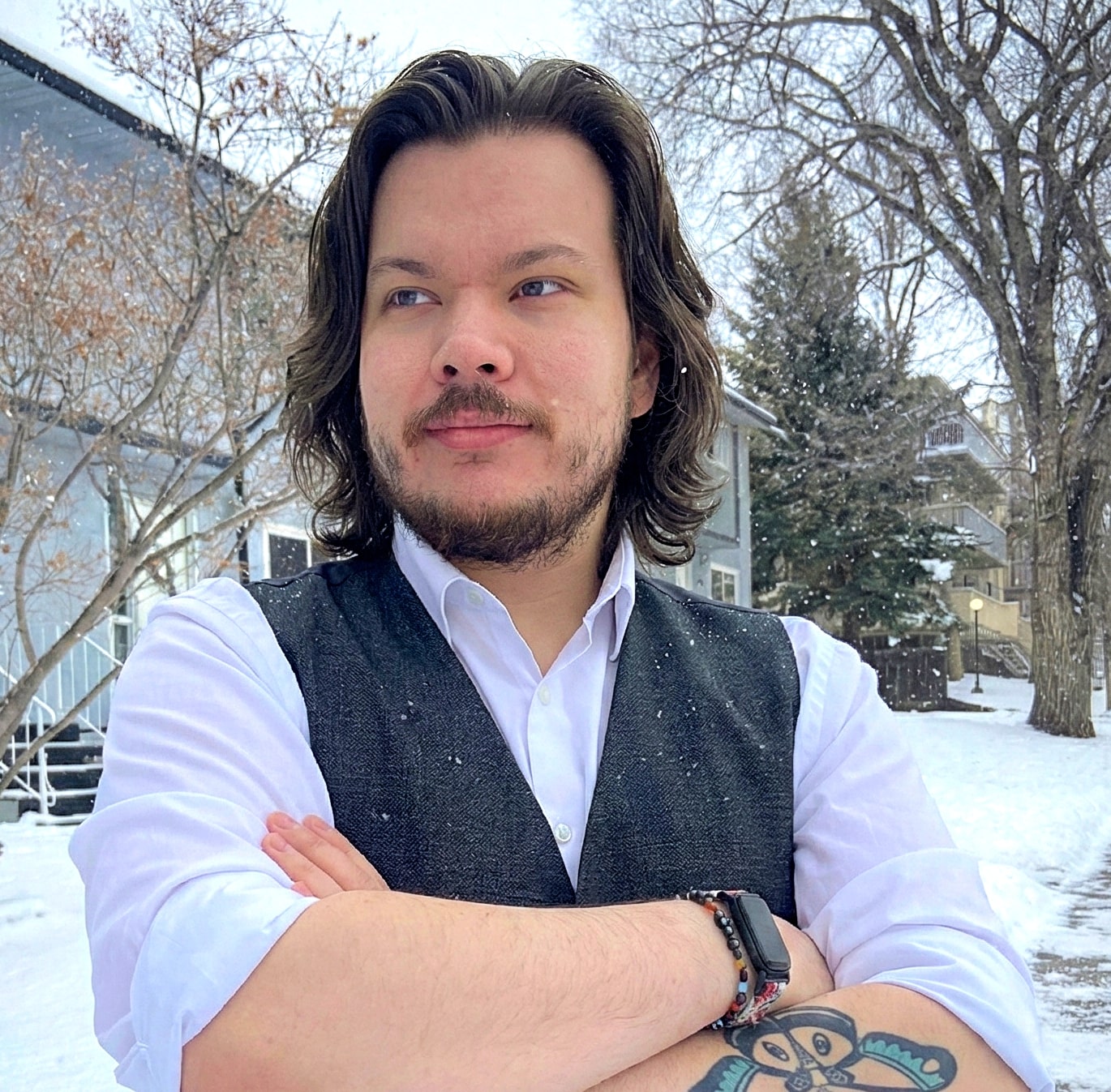
I am not Fanon. I am a Red River Métis writer in Calgary, watching from across the border as a state systematically disappears people into prisons in El Salvador, tests thirteen-year-old rape survivors for pregnancy in Texas detention facilities, shoots nurses in the back on Minneapolis streets, and calls the victims domestic terrorists. I have no standing to tell the people closest to that violence what forms of resistance are and are not acceptable.
Now.
Eight thousand student visas have been revoked. SEVIS records have been terminated for minor infractions: a speeding ticket, an expunged charge, proximity to a (Palestinian) protest. A biochemist learned her visa was revoked the same week she was selected for an H-1B. The administration has set a quota of denaturalizing up to two hundred U.S. citizens per month in 2026.
The malicious actions of the current federal United States government and administration are far more insidious than this, though.
Renée Good was driving home after dropping her child off at school on January 7, 2026, when a federal ICE agent shot her through her windshield. She was a legal observer, and not a threat. The Department of Homeland Security called her a domestic terrorist. Her car is currently shrink-wrapped in an FBI warehouse, unexamined, evidence withheld from the state investigators who have been trying to understand how she died.
Alex Pretti was an ICU nurse at the Minneapolis VA and thirty-seven years old. He spent his days keeping veterans alive. On January 24, 2026, he was filming federal agents when he stepped between an officer and a woman who had been shoved to the ground. Bystander video reviewed by Reuters, the BBC, the Wall Street Journal, and the Associated Press shows an agent removing a gun from Pretti's holster and moving away before he was shot multiple times. ICE agents fired at least ten shots in five seconds, rattling his body with bullets, including in the back. The federal government labeled him a domestic terrorist. The FBI refused to share evidence with state investigators.
As of this writing, no one has been charged.
Forty-six people have died in ICE detention since January 2025, the highest number in over two decades and on track to break its own record in 2026. One death in El Paso was ruled a homicide by the county medical examiner. ICE reported it as a suicide. People are disappearing for days as the detainee locator system fails and phone access becomes uncertain. The word "disappearing" is a documented operational reality.
Girls between thirteen and seventeen years old are being held in immigration detention, roughly half of them pregnant as a result of rape. They are being tested for pregnancy and then, in some cases, denied reproductive care. Women are being shackled at the ankles and wrists during transport while actively miscarrying. One woman was deported to Honduras with an undiagnosed missed miscarriage; she required emergency hospitalization upon arrival. Another bled for days in detention, requested medical attention repeatedly, received none, and arrived in Honduras in emergency condition.
The Trump administration used the Alien Enemies Act, a 1798 wartime authority invoked only three times in American history, and only during declared wars, to disappear people to CECOT. This is a Salvadoran mega-prison where deported men vanish into incommunicado detention, their families unable to locate them, habeas corpus petitions refused, the Ombudsperson's Office citing a state of emergency as reason to provide no information. Some of those disappeared had pending asylum cases. Some had protected legal status. At least one was sent there by the administration's own admitted administrative error, and the administration has refused any responsibility to return him to his family.
What ARE the appropriate channels here?
I want to interrogate the function of the insistence on nonviolence. When the acceptable response to enforced disappearance is a strongly worded op-ed—when the institutional channels have been tried and tried and tried, when two elections and two impeachments and a hundred lawsuits have failed to check what is happening, when courts are being packed and congressional oversight is being blocked and evidence is being hidden in FBI warehouses—who does the rule of nonviolent resistance protect?
It protects the state's monopoly on legitimate violence. That is its primary function. This is not a radical claim, it is Max Weber's definition of the state. The state holds the exclusive legitimate use of physical force. State-appointed police officers and federally-appointed agents are free to act as violently as they deem necessary. And our protest MUST remain nonviolent. The compliance to this demand is how the monopoly remains intact.
The suffragettes understood this. When constitutional channels failed—when the Franchise Bill amendments were ruled out of order, when the government refused to introduce legislation, when women who went on hunger strike in prison were force-fed for years—Christabel Pankhurst wrote:
If men use explosives and bombs for their own purpose they call it war, and the throwing of a bomb that destroys other people is then described as a glorious and heroic deed. Why should a woman not make use of the same weapons as men? It is not only war we have declared. We are fighting for a revolution.
The academic literature on violent flanks is inconclusive on whether armed wings help or hurt movements overall. But the evidence that helps exists almost entirely in contexts where the violence is organized, disciplined, and politically legible—connected to a movement that can use the contrast. Isolated acts of political violence, historically, tend to increase repression and decrease mobilization. They give the state permission to crack down on everyone. They make the work of organizing harder, not easier.
There is a meaningful distinction between violence that is organized, strategic, and connected to a political project and violence that is chaotic, isolated, and disconnected from any theory of change. John Brown at Harpers Ferry was not winning, but he was connected to a movement that would eventually become a war that ended slavery. The WSPU bombings were connected to a broader suffrage movement with mass membership and constitutional as well as militant wings working in parallel. The Deacons for Defense existed in service of a nonviolent organizing project, protecting the people doing that organizing. These are not the same as a man with a shotgun at a press dinner.
This essay is not a call to violence. It is a refusal of the lie that violence has never been part of how oppressed people have won their rights. It is a refusal of the retroactive sanitizing that turns bombers into heroines on tote bags while denying the same complexity to people acting in the present. It is a refusal to perform appropriate shock at a failed assassination attempt while 46 people have died in detention without anyone being held accountable.
Mohammad Nazeer Paktiawal was from Afghanistan, forty-one years old, and fought alongside U.S. forces for over a decade before entering the United States on humanitarian parole in 2021. He applied for asylum, was then detained, and died in ICE custody in a Dallas hospital less than a day after being detained. He had no known underlying health conditions. The official ICE website labels him a "criminal illegal alien" arrested for "SNAP fraud."
There are pregnant girls in Texas, thirteen years old, who were raped in federal custody. Alex Pretti's body was rattled with ten bullets in five seconds, falling in a Minneapolis street while bystanders filmed. Renée Good's car is still shrink-wrapped in an FBI warehouse while her autopsy found three clear gunshot wounds, including one to her head.
These people did not die because the system malfunctioned. They died because the system is working as intended.
The suffragettes were called terrorists. They are now called brave. Categories shift, but the state's monopoly on defining them does not. Deeds, not words was the slogan of women who burned things down to win the right to vote. It's a tote bag now. Make of that what you will.


Comments
To comment, please sign in with your website:
How it works: Your website needs to support IndieAuth. GitHub profiles work out of the box. You can also use IndieAuth.com to authenticate via GitLab, Codeberg, email, or PGP. Setup instructions.
Signed in as:
No comments yet. Be the first to share your thoughts!