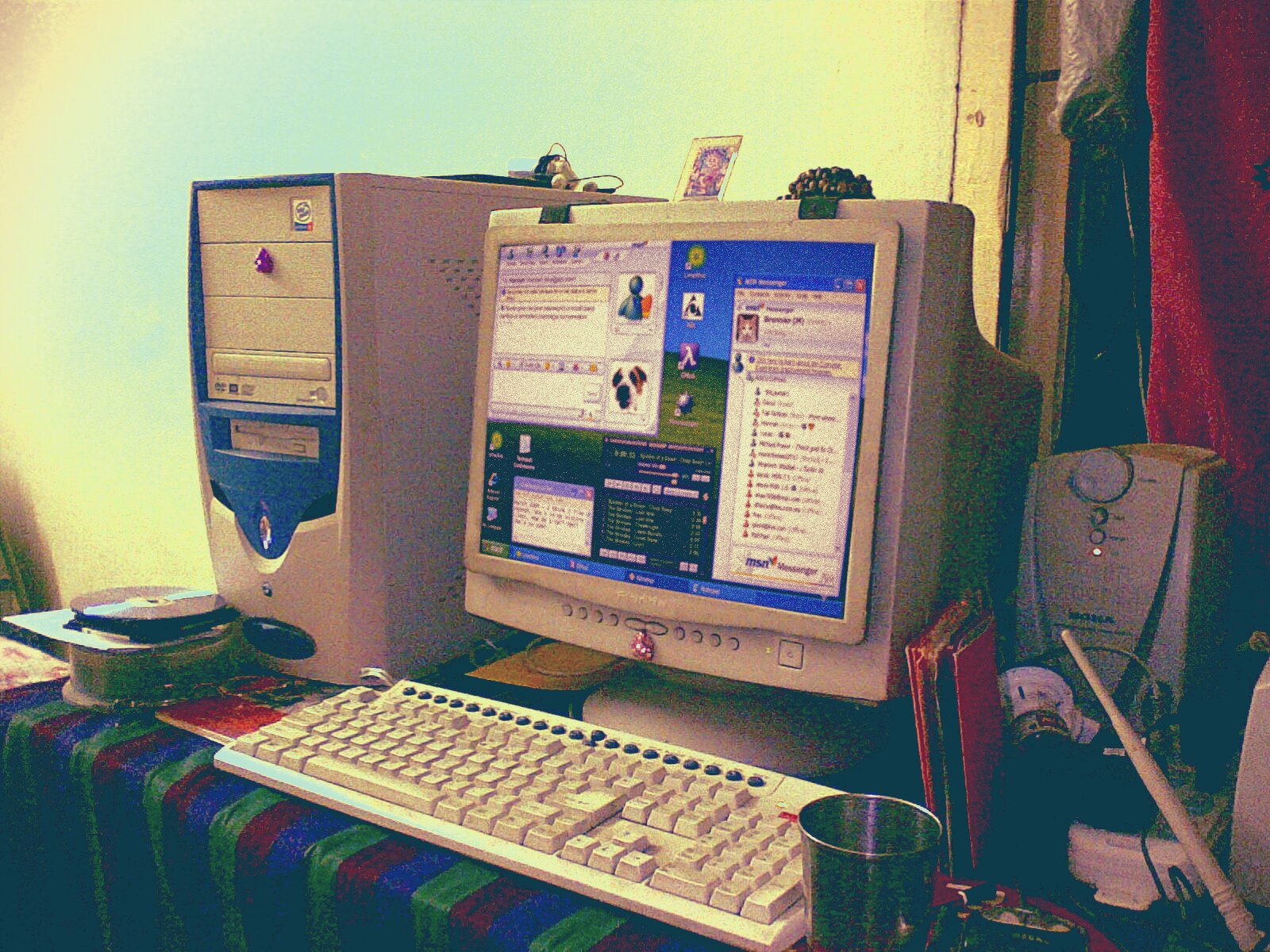
What did we find on here? | Source 1 Source 2 (edited by the Author)
CHILDHOOD: Hypercapitalist Nostalgia & Unsupervised Internet Access

Lunch was often Kraft Dinner and cut-up hotdog, drenched in Heinz ketchup. I lived close enough to my elementary school that I could walk home from school. In order to watch television when we didn't have cable, my family would conjure aluminum foil on rabbit ears. A clothes hanger bent at a precise angle discovered through trial and error. The grainy, colourful static snow of CBC was watchable enough, as well as PBS Kids via KSPS Public Television from nearby Spokane. But not CTV or Global or CityTV. The screen snow is dandruff for the television.
On weekends, between Saturday morning cartoons and fuzz lived a hippo.
Not a behemoth wading through African rivers, but the North American House Hippo. I learned from television he was no bigger than a mouse, gathering dryer lint and lost mittens for nesting in the bedroom closet, favouring chips, raisins, and the crumbs from peanut butter on toast. This was, in reality, a PSA produced by Concerned Children's Advertisers in May 1999, styled after a Hinterland Who's Who wildlife documentary that aired for years. The PSA meant to teach us media literacy. Instead, we yearned for these impossible pets as children.
The Concerned Children's Advertisers logo is burned into my retinas as ghost image. The organization founded in 1990, made over thirty PSAs, ranging from drug abuse and self-esteem and bullying, each one interrupting the commercials interrupting the cartoons, a hall of mirrors of intervention. Smart As You, The Chase, What's Your Thing?.
I hunt for reuploads of commercials like these on YouTube at 3 in the morning as an adult, the VHS tracking lines acting as a warm comfort blanket on the archived footage. I search for these early 2000s advertisements because they were played over and over into the soft tissue of childhood. I remember them better than the actual television shows I was supposed to be watching.
The House Hippo won the golden marble for best PSA in North America but that was less interesting to me than the quality of light in that fictional kitchen at night, less than the sound of a cat padding across linoleum toward a creature that does not exist and never did. The PSA was trying to make me critical of media—a skeptic. It made me a sentimentalist instead. But I'm not sure those are different.
Once in awhile, we had enough money to go out for fast food, and it was such an occasion. The wonderfully-textured, multicoloured jungle gym of the McDonald's PlayPlace. The plasticky ball pit which even then was a documented biohazard of stranger-children's germs, the GameCube kiosks manufactured by Kidzpace running Mario Kart: Double Dash on screens bolted inside the play structure, installed across North America in the early 2000s, a corporation licensing joy from another corporation. I stood there in my socks on sticky carpet and played them and felt, in the specific way of being nine years old, that the world was abundant and permanent. Every memory of childhood is product placement. My joy is branded™.
And the Internet? In Calgary in the early 2000s, the cartel duopoly was Shaw vs. Telus. A 56k modem maxed out at roughly 5.6 Kb/s on a good connection. A 3MB mp3 took 9 minutes. A game demo could be 2 hours. The 2100Hz song of the handshake sound would ring. The negotiation squall and then the moment it resolved into silence. The threshold between my world and another world.
After I got home from school, I would log into MSN Messenger on a Pentium 4 desktop running Windows XP. The login screen was the beginning of a specific aesthetic that designers would later retroactively name Frutiger Aero. Glassy, biomorphic, blue-green. Both nature and technology were on your side. The visual style was called Luna at Microsoft. The desktop wallpaper Bliss with its rolling green hill under saturated sky was a photograph, taken by Charles O'Rear in 1996 in Sonoma County wine country. The most-viewed image in human history was someone else's afternoon. We lived inside it like it was ours.
MSN taught us how to construct public selves from the raw materials of favourite bands and inside jokes and strategically-chosen profile pictures compressed to 96×96 pixels, compression artifacts smoothing everything over. You wrote song lyrics under your display name. You hoped the right person would read them from their friends list and understand. They never said they understood. That was part of the grammar.
The NUDGE! didn't exist until MSN Messenger 7.0, released April 2005. Before that, you'd spam messages or exploit the "send file" popup to force a notification window onto someone's screen. What you really remember, though, is the door. The wooden creak of a contact signing in. The matching click of the door closing when they left. You learned to feel the room change without looking up from your homework. Someone arrived. Someone left. The sound made an emotion you didn't have a name for yet.
At its peak in 2009, MSN had 330 million active monthly users (the population of the United States). Microsoft killed it in 2013. I could only mourn it as something I had already stopped using years before. A secondary grief, the loss of the losslessness of it.
When we did have cable, I watched the over-the-top, bizarre YTV bumpers. The PJ Fresh Phil era. Phil Guerrero was the first host of The Zone, with his Snit co-host (an animatronic television set with dentures). He had plastic Elvis heads and Grogs puppets. The Zone's anarchic between-show interstitials were developed as a CRTC workaround because imported American programming ran short on ad time, and something had to fill the gap.
Missing childhood means missing the commercials that interrupted our youth. The local car dealership jingle that outlived the salesman. The cereal spokesperson who turned out to be a company mascot and not, as I had somehow believed, a real person.
My generation is the last to remember the grief of the VHS tape eating our favourite recordings, the staticky consolation of adjusting tracking on a second-hand cathode-ray television, the low-resolution glimpses of an era that had already passed before we'd been born into it. My fondest memories are impossible to decouple from the corporations that produced the materials they're built out of. The corporations produced me. I learned what wanting felt like. My nostalgia is hypercapitalist.
Unsupervised Internet Access
Beyond hypercapitalist nostalgia, there's the weird. Liminal nostalgia. Otherworldly in the way that only bad Internet can be. Another place. Off-centre outlands.
Getting permanently banned from a forum powered by phpBB, or maybe it was vBulletin, or Invision Power Board. I do know it was about a video game I no longer remember, and I got banned because I was a child lacking emotional regulation with no social understanding of what was acceptable to write. The moderator's message was formal and final and I eyed it for a long time. I understand now that this was my introduction to sociality and consequence. That forum is gone. It is nowhere and unarchived. I was the thing that happened there that has no record.
My dad's computer was compromised by pornographic pop-up ads after I downloaded the wrong file on LimeWire, the P2P software created by Mark Gorton in 2000 that was once installed on 1-in-3 PCs worldwide, and around 30% downloaded files contained malware. In .exe files specifically, one study put that figure at 68%. The search was mere keyword matching across whatever filenames other nodes had chosen to use. You were trusting a stranger's naming convention. GTA_Vice_City_FULL.exe would appear twelve times in results, all different file sizes. The real installer was hundreds of megabytes. The malware was 100-300 kilobytes. If you knew to look at file size, you might catch it.
I was eleven. I did not know to look at file size.
Vice City required a GeForce 3 or Radeon 8500-class GPU. The integrated chip on our Pentium 4 was the Intel 845G "Extreme Graphics", and it carved a slice out of your system RAM for video memory. Set 64MB aside and your programs were competing for whatever remained. The machine was one shared pool pretending to be two things. Everything was like that. Everything was one shared pool. It didn't support hardware T&L at all; if I downloaded the right file, the game would have just refused to launch.
Still, I would scour forums for minimum requirements. Download obscure demos. Adjust graphics settings down and down until the world looked like its own shadow. There was a specific high when you finally got something running on hardware that wasn't supposed to be able to run it. A broken, stuttering version of a game designed for someone else's machine. You made it work, barely, and that was enough.
When I felt lonely, I would hop onto a Garry's Mod DarkRP server, where the rules were usually incoherent and the other players were either children or adults performing children. I never really knew which and neither did they. There was an entire taxonomy of dark spaces opening themselves to me at ages I hadn't finished becoming. What sort of flesh was I exposed to on Omegle, a platform launched in 2009 by Leif K-Brooks, an eighteen-year-old from Vermont, that finally shut down in November 2023 after years of documented child exploitation and abuse, citing the legal and financial burden of fighting the harm it had enabled. The harm I was inside of as a child, pressing next and next and next. I ask myself in retrospect what kind of vile predators was I unknowingly speaking to on Chatango. When I was feeling particularly morbid, I would visit LiveLeaks to witness the worst of humanity. The low hum of my PC whirring in the background, and the lower hum of masochistic hunger for danger I had no vocabulary for.
And then, I would wake up the next day and the computer would be gone. We would need to pawn it to make rent that month. The laptop, the game, save files not backed up anywhere.
I hold all of this. The GameCube kiosk sticky with child-germs. The violence of the unregulated Internet. All made me.
What Gets Preserved?
Nostalgia was originally classified as a medical condition. Swiss physician Johannes Hofer coined the term in 1688 from the Greek nostos (homecoming) and algos (pain), describing soldiers who fell ill from longing for home. A pathology of the body: headaches, irregular heartbeat, fever, an inwardly turned gaze. The cure? Return. You got better when you went home.
We have no such cure. The home does not exist. The family computer with the wrong file on it, the PlayPlace with its primary-coloured tubes, the specific weight of my brother's hand adjusting the rabbit ears. None are places we can return to. What made them place was not coordinates, but the age and newness, the raw ore of being someone who had not yet been formed. You cannot go back to not-yet-being-formed.
Our nostalgia is a mourning of the loss of our own open-endedness. The self that had not yet closed around its wounds. The world was so much bigger than its disappointments.
And the corporations knew this, long before we did. McDonald's first PlayPlace opened in 1987 in order to turn children into lifelong customers. Joy was a loyalty program, a vector for brand attachment. And yet the joy was real and the instrumentality of it doesn't undo the reality of that joy. Both are true.
My childhood memories are manufactured. Warmth is a successful marketing strategy. I am the product. And yet, knowing this changes nothing about the warmth. The house hippo still wanders through a kitchen that looks like ours, making a nest from lost mittens, and I still want it to be real.
The Present
I'm made out of the texture of scarcity, cultivating joy inside limitations tight. I found wonder inside the experience of having nothing reliable to return to. Home is not a fixed address when the address keeps changing. For me, it was the Internet. Even the bad parts of it.
There's so much work left undone, so many stories still banking in my blood. I want to live long enough to write it all down. But I also want to live for the selfish miracle of morning light through stained glass, for the way certain songs sound at 3AM, for the specific shade of purple the sky turns before snow, for the VHS tracking lines that meant something was there. Real and recorded, imperfect, belonging. Even if that something was always a house hippo: not real, not coming home. The thing the ad actually said it was.
The rabbit ears picked up the signal or they didn't. We adjusted the foil. We tried different angles. We found the one that worked, or something close enough and ate KD with tomato-covered hotdogs as we did. That's all any of this has ever been.


Comments
To comment, please sign in with your website:
How it works: Your website needs to support IndieAuth. GitHub profiles work out of the box. You can also use IndieAuth.com to authenticate via GitLab, Codeberg, email, or PGP. Setup instructions.
Signed in as:
No comments yet. Be the first to share your thoughts!