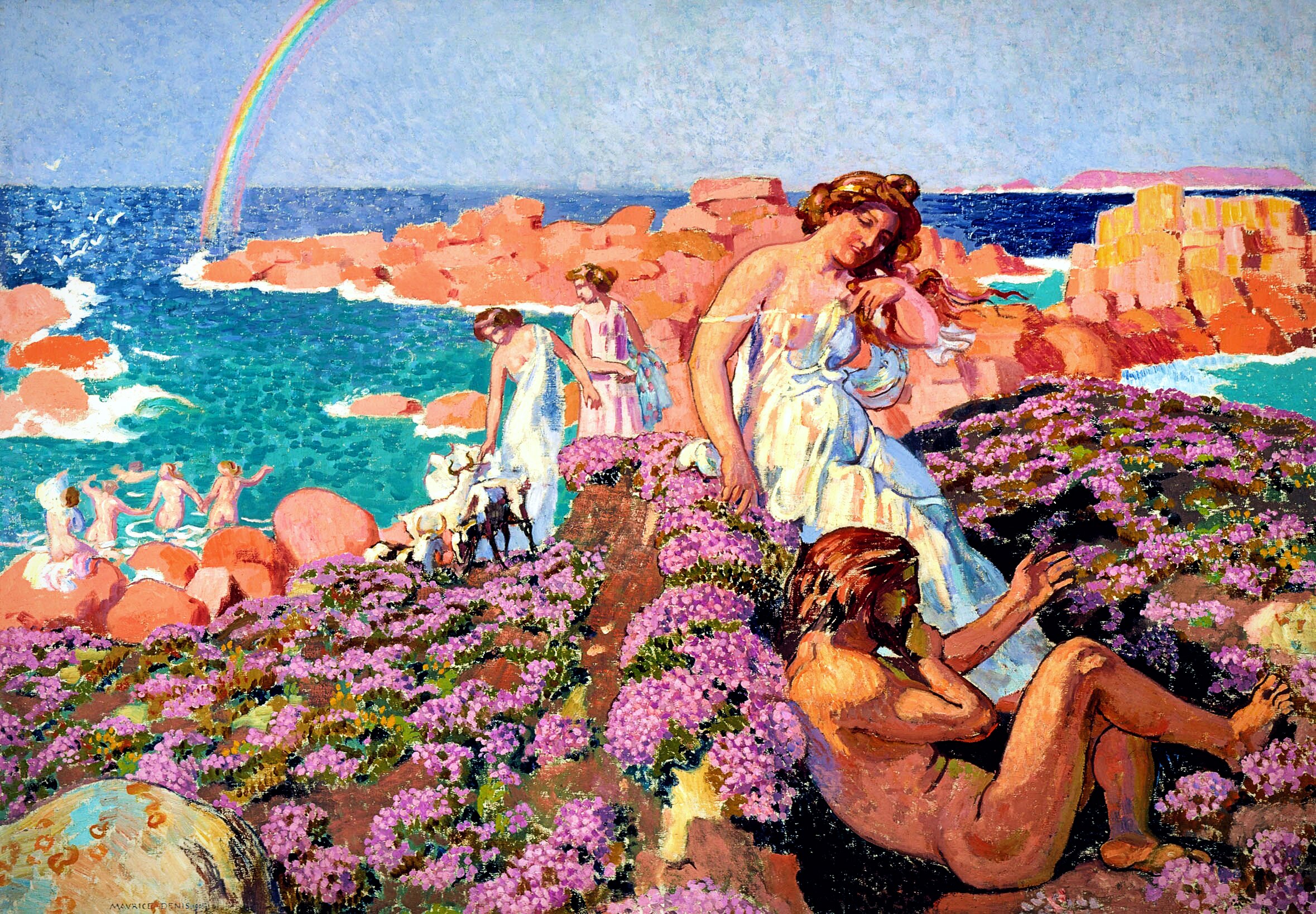
Ulysses with Calypso (1905) by Maurice Denis. Original from The Finnish National Gallery. | Source (edited by the Author)
Building the Good Web

On 32-bit Café, the wonderful Coyote made a thread about my previous article, "Trust and Faith in Our Web". I am so jazzed and grateful by all the feedback I received! It was such an unexpected surprise.
First off, I think I did a bad job of communicating some of my ideas in my original post that was shared and discussed, and that's on me. My definitions of IndieWeb were "unduly narrow" as Coyote pointed out. I did a much better job at synthesizing my values and goals in a recent article, "Constellation of Living Stars".
I also want to state that I don't really think I'm someone whose opinion matters much about "the IndieWeb." Really! I only made my website https://brennan.day and joined the IndieWeb proper in December 2025. While I have been a web developer unintentionally creating assets for the IndieWeb for over a decade, there is a lot about the specifics of the subculture and hobby that I am earnestly ignorant about.
What do I know? Prior to getting into the IndieWeb, I ran a creative writing collective called Write Club for three years while in university and really got into figuring out how to make a sustainable and healthy community. And it is really hard! But it's also the most important and rewarding work I can think of. I'm so driven to meet people where they are and offer a big tent that can include as many different kinds of (good faith) folks as possible.
For sake of clarity, I am going to (annoyingly) coin a different term for what I'm going to be writing about. The Good Web. As in, the web created in good faith, which I believe is an incredibly important foundation of the IndieWeb. But really, I'm talking about so much more than the IndieWeb, here.
Let me try to define the Good Web. The Good Web is any part of the internet built in good faith, which I mean in the specific, contractual sense. The maker is not optimizing against the user. No dark patterns. No retention schemes. No bloated scripts designed to keep you scrolling past the point of nourishment into the territory of compulsion. Nobody on a bbCode forum is selling your reading habits to an insurance company. The Good Web is not a technology, not a protocol, not even a community—though it contains all of those things. It's a disposition toward the person on the other end of the connection. It's the difference between a neighbour who bakes you bread and a supermarket that puts the bread at the back of the store because they know you'll buy chips on the way. Both are offering you something. Only one of them gives a shit whether you leave full.
The Good Web is, also, not innocent, not pure, not without its own failures and gatekeeping and sometimes exhausting in-group dynamics. I've been in good-faith communities long enough to know that. But the failure mode of the Good Web is human failure. Thoughtlessness, clique-formation, accessibility gaps. Not structural failure. Nobody built the Good Web to extract from you.
My Actual Goals
I will be explicit with what I want, and what I'm talking about:
- I want a better, more just future for everyone.
- I believe the commons are sacred.
- I believe community is the answer to the question how will civilization survive?
- More than anything, I want to answer the question: What do we owe each other, and how do we build the infrastructure to actually pay it?
If pursuing the answer to that question, or my beliefs in general aren't relevant to you, that's okay! But these are where I am focused.
Moreover, digital culture (eg. what we are looking at and interacting with consistently on our screens) plays an incredibly important factor in this, because so much of our lives are embedded within the digital. This is absolutely not the only dimension at play, or the most important, but it is where I'm currently focusing my efforts.
I believe we have collectively become complicit in how extractive digital culture has become. We have surrendered and sacrificed so much of our autonomy, privacy, and imagination in exchange for convenience and expediency.
When I say I want to onboard people, I don't mean I want them to get into the specific, niche hobby of webweaving and webcrafting.*
What I mean is that I want to have people digitally exist places that are built in good faith. And there is social media created in good faith! Just as an example, I want people to use PixelFed and Mastodon instead of Instagram and Twitter, respectively.
Alternative (and often decentralized) platforms are not without their faults, but they are created in good faith. Your well-being, your humanity, your connection to other people? None of that is actually relevant to corporate social media designed to extract for a capital bottom line. Only your retention and information and attention are.
The Adoption Problem
I am completely sympathetic to the fact that people are still on corporate social media because all of their friends and connections still are. I myself am still on Instagram and other corporate social media platforms because I am trying to onboard people as much as possible before I permanently leave.
...But what got everyone there in the first place?
Coyote wrote that "persuading people to do anything is hard." And I question how people were persuaded into the current state of things as they are. If you ask the majority of people, especially younger people, they fucking hate social media as it is. The 2024 Pew Research Center survey found that 48% of US teens now say social media has a mostly negative effect on people their age (up from 32% just two years earlier). Among college students, a 2023 study found that 58% would prefer a world without Instagram, and 57% without TikTok and they'd willingly pay someone to help them and their peers get off these apps entirely. In the UK, More in Common found that 62% of young people aged 16 to 24 believe social media does more harm than good.
There is so much to dislike about the status quo and people don't like it. And yet a lot of this dissonance and lack of contentment is not channelled into creating or finding something better. Of course it isn't, that's by design! Learned helplessness and a false belief that it would take too much time and effort to integrate into a healthier, more positive alternative.
Maybe there is too much paradox and contradiction to what I'm trying to articulate here. Maybe widespread adoption of any social media platform will lead to extractive, bad-faith monetization efforts.
But I don't think so. I believe in the power of organized people. I believe that, if done right, we can prop each other up with donations and mutual aid to keep the infrastructure alive without the well being poisoned.
But that does require sacrifice and friction. Yes, you will lose the easy ability to communicate with people who are only on corporate social media, and sometimes these are extremely important communications. Amelia McNamara wrote a great essay about the difficulties in deleting her Facebook.
Just Trying
I am not an absolutist. I believe in harm reduction. I believe in meeting people where they are. I think it's unreasonable to ask somebody to completely migrate over their digital life simply because of a blog post or video essay. But people need to try, and we need to encourage them to try. Here is what trying can actually look like, in increasing order of effort:
Start somewhere easy. Mastodon has a good instance picker that makes choosing a community server fairly straightforward, and Pixelfed is as simple as Instagram was in 2012. Fedi.Tips is an excellent non-technical guide to getting oriented. You don't have to leave corporate platforms first. Exist in both places for a while and see where you feel better.
Try RSS. Readers like NetNewsWire, Feedly, or the built-in reader in Firefox let you follow hundreds of personal sites, journalists, and newsletters without giving a platform your attention. It is one of the simplest acts of digital self-determination available.
Leave a comment. If you read a personal blog post that meant something to you, tell them. Click through, scroll to the bottom, leave a note. This is how community actually forms on the Good Web, through the specific act of one person saying to another: I was here and this mattered.
Join a forum. 32-bit Café, MelonLand, Tildes, Lemmy. These are spaces where conversation is the point, not the product. Lurk for a while. Introduce yourself.
Help one person. If you do have the technical capacity for any of this, use it in service of someone who doesn't. Walk a friend through setting up a Mastodon account. Help your community organization get off Facebook Groups. That's just being a good neighbour.
And how can those of us already on the Good Web help? We can make ourselves findable. We can write beginner-friendly posts. We can respond when strangers reach out. Remember what it felt like before we knew any of this, for the initial opacity is real, and the way to reduce it is warmth.
Balm and Salve
Here is where I get opinionated.
1. Get a Hobby
As I wrote earlier, I don't think people need to get into the IndieWeb/webweaving as a hobby. But I do think people need a hobby.
Mindlessly consuming content and not creating something on a daily, consistent basis is harmful. It is an erosion of the psyche. Passive social media use is more strongly associated with depression than active participation. A meta-analysis of 141 studies found that consumption-without-engagement reliably tracks with lower wellbeing across age groups. When you only consume, you're constantly comparing yourself to curated versions of other people's lives with no output of your own to counter the weight of it.
The antidote is making something. Anything.
And I mean anything. A hobby doesn't have to look like hobbies. It doesn't have to be woodworking or knitting — though those are wonderful. It can be urban sketching. It can be foraging, which requires nothing but curiosity about what grows between the sidewalk cracks. It can be fermenting and making kombucha, sourdough, kimchi, vinegar from scraps. It can be amateur radio, an entire subculture of people who communicate across continents using self-built equipment. Bookbinding. Seed saving. Zine-making. Embroidery. Amateur astronomy. Learning to identify birds by their calls. Building a terrarium. Pressing flowers. Keeping bees.
The point is not the specific activity. The point is that you are making something that belongs entirely to you. And I think social media on the Good Web is a wonderful place to find others who share this hobby. The Good Web is built by people who make things!
2. Start Organizing
Next, I think people need to organize. People need to get involved in their local politics, events, and neighbourhoods. Good Web social media is a fantastic place for that!
I am wary of organization that happens on corporate social media because it is structurally compromised in ways that matter. Law enforcement used corporate social media data to surveil and track protesters, with 70% of police departments claiming they use social media for evidence collection.
It is true corporate social media platforms have also facilitated real and important organizing. But the point is that the infrastructure isn't yours, the moderation isn't yours, the data isn't yours, and when it becomes useful for someone with more power than you to compromise your organizing, they can and they already have.
3. Connect with Humanity
Finally, I think people need to reconnect to their humanity. People need to have conversations with others that are grounded in good faith, not in paranoid arguments or debates or transactional exchanges. We need community.
A lot of this goes far beyond the screen. It requires showing up. Attend a city council meeting, even once, and you will realize that the people making decisions about your neighbourhood are just people. Rooms can be changed by whoever shows up consistently. Join a mutual aid network in your city (Mutual Aid Hub is a good starting place for finding one near you). Go to a potluck with strangers. Learn your neighbour's name. Participate in a community garden. Join a reading group at your local library; the library itself is one of the last good-faith public institutions we have, and it needs your presence as much as you need its books. Volunteer somewhere that requires your body in a room.
These acts of showing up are what makes community. Not posting about community. The Good Web can supplement this and point you toward it, but it cannot replace it.
Sovereignty, Ownership, and Living
I said that my intentions are not to get people into the specific, niche hobby of webweaving and webcrafting, but there was an asterisk. We are living in an increasingly extractive world. Corporate social media is only a small domain in this. We are increasingly expected to rent everything, pay for everything via subscription, own nothing and... well, you know the rest.
I think it's extremely important we ask ourselves what we are capable of owning and what we can fully control. What can we reclaim and take back?
At the very least, I ask that you export your data regularly. Every major corporate platform (Instagram, Twitter, Facebook) has a data export feature buried somewhere in settings. Use it. Your own memories and connections should not be exclusively in someone else's hands.
If you want to get started beyond that, I wrote up a guide for the IndieWeb for non-technical people. The learning curve is real, but so is the ownership.
The Good Web already exists. It is full of people who built something rather than waited for permission. All of this—every personal blog, every federated timeline, every webring, every forum thread where strangers are kind to one another—is an argument made in practice that a better internet is possible. You don't have to build it yourself, you just have to show up.
And the truth is, I don't care what you reclaim, I just want you to reclaim it for yourself. I don't care what that looks like, I don't care what you contribute back to the commons, I don't care how you do so. But I do want you to do it.
I want you to recognize your voice and mind and thoughts have value. A value that cannot be merely extracted or exploited. I want you to recognize you have control and agency and don't have to settle for how things are. I want you to know that hard things are worth the time and effort. I want you to remember you are loved and have worth that other good-faith people will recognize and prop up.
Comments
To comment, please sign in with your website:
How it works: Your website needs to support IndieAuth. GitHub profiles work out of the box. You can also use IndieAuth.com to authenticate via GitLab, Codeberg, email, or PGP. Setup instructions.
Signed in as:
No comments yet. Be the first to share your thoughts!