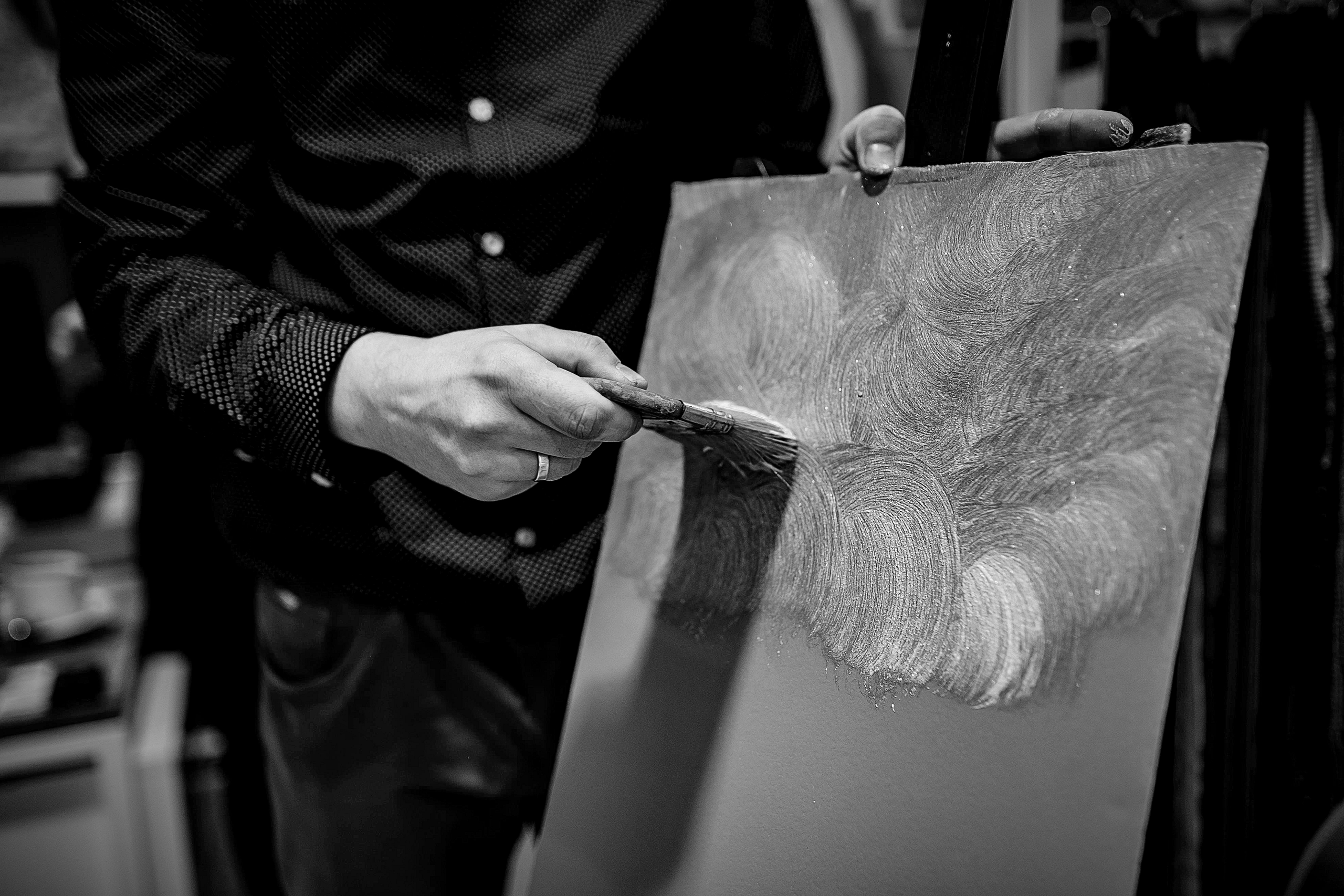
The work you make is so much more important than you realize. | Source
Your Civic Duty to Make Art
Soft humming of the radiator is all I hear as the fire glow of sunrise bleeds through the window. I’m awake too early to write this. Eating Mediterranean crackers between paragraphs. Lighting the vanilla incense from the Tibetan shop in Inglewood. Light on my desk from green tea candle my girlfriend let me have because she has too many.
Prelude
The black plastic Sony stereo to my right, CBC Radio One on low. I fret about them losing funding even though they don’t fairly report on the Gaza genocide. The blue Compliments water bottle re-used out of executive dysfunction, filling me with microplastics. A Rexall receipt. The stack of Field Notes. Metal lamps. The watercolour painting of the wolf and the lamb. Japanese erasers shaped like apple juice and milk cartons. The tick tick tick of the analog clock. The sunlight slowly turning sky blue as I keep writing.
I. NaNoWriMo & Rejections
This is my November 2025. I’ve been writing nearly an article a day. Two to three thousand words per article, fact-checked, with actionable steps for readers. A spin-off experiment from the now-defunct NaNoWriMo.
You might have heard about their spectacular implosion. In August 2024, the organization, which for 25 years encouraged writers to draft 50,000 words in November, announced they wouldn’t condemn the use of AI in their writing challenge. Worse, they claimed that opposing AI was “classist and ableist.”
Four board members resigned immediately. Their major sponsor, Ellipsus, withdrew. Authors like Erin Morgenstern, whose The Night Circus began as a NaNoWriMo project, publicly distanced themselves. Chuck Wendig put it best:
“The privileged viewpoint is the viewpoint in favour of generative AI. The intrusion of generative artificial intelligence into art and writing suits one group and one group only: the fucking tech companies.” But this controversy was merely the visible rot. The organization had been crumbling for years with problematic publisher partnerships, accusations regarding moderator misconduct toward younger participants, and a fundamental shift from hands-on literary support to hands-out donation begging. NaNoWriMo died not because of AI. It died because it stopped believing that the work itself mattered.
So here I am, doing my own version. Writing every day. For almost no one.
My stats page tells me twenty to thirty people will read this. Maybe more if I’m lucky and get boosted. That’s the reality of writing online in 2025. Let me give you the broader picture. The typical self-published print-on-demand book sells fewer than 200 physical copies. Half of all published books are self-published and only sell a handful of copies. A significant portion of self-published authors earn less than $1,000 annually from book sales.
The chances of getting traditionally published? Between 1% and 2%. Over 95% of manuscripts received by publishers are below the standard required. And even if you write something brilliant, most of those quality manuscripts still get rejected simply because you aren’t the right fit.
In 2023, an estimated 500,000 new books were self-published in the United States alone. That’s 500,000 people pouring their hearts onto pages that, statistically, almost no one will read.
Stephen King’s Carrie was rejected 30 times. J.K. Rowling’s Harry Potter was rejected over 10 times. Chicken Soup for the Soul suffered 144 rejections. Rejections happen because people kept writing. Kept showing up. Kept believing the work mattered even when the market said it didn’t.
The question I keep circling back to: Where do we pour ourselves? Not just time, though that’s part of it. But our attention. Our care. Our irreplaceable human capacity to notice things and make meaning from them.
We live overextended. Most of us work day jobs. Sixty-six percent of emerging authors work day jobs to support their income. We’re exhausted. We have families, obligations, a world that keeps demanding we prove we deserve to exist by constantly being productive in ways that can be monetized.
And into this exhaustion, I’m suggesting you add more work. Unpaid work. Work that will likely never be widely read. Work that statistics say will fail.
I know how this sounds. Masochistic. Delusional. Self-indulgent. But I’m going to argue something more radical. Making art is not self-indulgence. It’s civic duty.
II. Creativity in Democracy
John Dewey wrote in 1939, while witnessing the rise of fascism in Europe:
“The task of democracy is forever that of the creation of a freer and more human experience in which all share and to which all contribute.” Democracy as creative practice. Not democracy as voting every four years and then checking out. Democracy as an ongoing, participatory act of imagination. Democracy, the value and its practice, requires constant nurturing, widespread participation, regular renewal, visible processes, and meaningful outcomes.
It is not a given nor a natural state of human affairs.
When you write, or when you paint, compose, dance, build, you are participating in the collective imagination of what’s possible. You are adding your voice to the ongoing conversation about what it means to be human.
Arts-based civic practices have transformed juvenile justice systems, made streets safer for women and girls, turned community organizing into visible, tangible change. Theatre of the Oppressed and Legislative Theatre bring public servants, constituents, and activists into creative spaces to brainstorm, test, deliberate and enact new policies. Augusto Boal, creator of Theatre of the Oppressed, said:
“We are all actors: being a citizen is not living in society, it is changing it.” To make art is to say I notice things. I have perspective. I refuse to let the dominant narrative be the only narrative. Creative practice runs through everything. Community gardens, affordable housing, historic preservation, community organizing, economic development, sustainability, politics and policy. It’s the warp to democracy’s weft.
You think you’re just writing a poem about your grandmother’s hands. But you’re also documenting a particular kind of immigrant labour, a particular kind of love, a particular way of being in the world that the algorithm doesn’t care about and the market won’t reward but that matters because it happened and you witnessed it.
III. Radical Freedom
There’s this meme that’s been circulating, where people commenting on videos of others doing absurd, silly things with “what a way to exercise free will.” The joke captures how we have radical freedom that most of us never touch.
We’re so colonized by capitalist logic that we can’t imagine doing something that doesn’t serve our career or brand or monetization strategy. We’ve internalized the question “What’s it for?” so deeply that we’ve forgotten acts can exist for their own sake.
Shave your head. Move to a different state. Change your name. Register a KDP account and independently publish a book. Join a new Meetup group. Volunteer for a local organization. Life is far, far too short to not indulge in the optional, in the absurdity.
We have a civic duty to use our talents for a greater good. But first we must care for and tend those talents, or they’ll rot and waste away. Self-punishment and pity do no good. If ridicule made us more productive, it would have worked already.
Stand in front of the mirror every morning. Hand on chest. Say good morning. Proclaim you love yourself. Eventually the sentiment will become honest and genuine. Ask more of yourself. Ask less of the world. Deny what you think you’re obligated to do.
How awake are you right now, truly?
How aware are you of the body you inhabit? Think of the oxygenation, the pulse, the blinking and weight and location. We sleepwalk. Most of us, most of the time. We scroll. We consume. We numb.
Consistent writing practice trains your brain to respond and engage more creatively. Writing regularly helps you tap into the phenomenon of ‘flow’. A state of deep immersion where creativity and productivity peak.
When you make writing a daily habit, it becomes less intimidating. You’re more likely to push through periods of creative drought. Habits create neural pathways that strengthen with repetition. The more you write, the easier it becomes to overcome initial resistance.
Hemingway once compared his writing content to water in a well. When you write, you’re drawing from that well. If you drain it completely, it takes longer to refill. Regular, measured writing sessions allow the creative well to replenish naturally. This is waking up. Paying attention. Refusing numbness.
We require heat, acid, fat and salt. We need nourishment and balm. We are gentle creatures, inherently. I know this much to be true.
IV. The Bread We Bake
The why is what I always circle back to. I recognize that I’m still mostly just soapboxing out into the void. How I can look at my stats page and see only twenty or thirty people will ever read this.
But this is the surrender. This is where we put our faith and grace. We must practice repeatability. We must write every day the way bread is baked every day, even if it’s sadly discarded after a stale week.
You show up anyway. You write the bad draft. You make the terrible painting. You sing off-key. You dance awkwardly. You do it badly until you do it less badly and then one day you look up and realize you’ve made something that matters.
The best part of writing isn’t publishing. It isn’t the readers or the accolades or even finishing the damn thing.
The best part is the practice itself. The showing up. The two hours before dawn when it’s just you and the page and the radiator humming and the sky slowly turning blue. E.B. White said:
“A writer who waits for ideal conditions under which to work will die without putting a word on paper.”
V. Dichotomy
There’s a false dichotomy between the textbook and real life, theory and practice. This has always been a clever way of pitting us against one another.
People say “that’s just academic” or “that’s not how the real world works.” As if thinking deeply about something makes it less valid. As if the real world doesn’t need people who’ve spent time considering how things could be different.
Curiosity is the antidote. To interrogate what is considered default and de facto, whether in the world or in our own mind. We must meet challenges with questions rather than accusations or surrender.
The only thing we ought to surrender to is what we cannot change. The immovable static. But wisdom comes in knowing what that is and isn’t. Most of what we think is immovable isn’t. We’ve just never tried to move it.
This essay will reach twenty people. Maybe thirty. Maybe, if I’m very lucky, a hundred.
Those are terrible numbers if I’m treating writing as marketing. If this is lead generation or brand building or any of the other phrases we use to pretend we’re not just trying to be heard. But what if those twenty people are exactly who need to read this?
What if one of them is standing in their kitchen at 5 AM, staring at their laptop, wondering if it’s worth it to keep going? What if another is on the edge of quitting because they’ve been rejected again and the statistics say it’s pointless?
What if the twenty people who read this are the twenty people who needed to know they’re not alone in pouring themselves into work that won’t be rewarded?
Postlude
Show up because democracy requires imagination and you have a perspective no one else has. Show up because being a citizen means changing society, not just living in it. Show up because we need your weird specific observations about light through windows or the way your grandmother’s voice changed when she lied or the precise shade of blue the sky turns at 6:47 AM in November in Calgary.
Show up because the alternative is sleepwalking through the one absurd miraculous life you get.
The radiator still hums. The sun has fully risen now. The incense has burned down to ash. The candle flickers. I’ve written another article almost no one will read. And tomorrow I’ll do it again. And the day after that. I refuse to waste the time I have left waiting for permission that’s never coming.
NaNoWriMo died because it stopped believing the work mattered. I’m here in November 2025 doing my own version because I refuse to stop believing. Not fifty thousand words of a novel, but thousands of words a day poured into essays almost no one will read. The metrics don’t justify it. The market doesn’t reward it. I’m doing it anyway.
Your civic duty isn’t to be successful. It’s to pay attention. To notice. To make. The work itself is the point. Everything else is just commentary.
Now go. Write your twenty people their message. Trust me, they need it.
Brennan Kenneth Brown is a Queer Métis author and web developer based in Calgary, Alberta. He founded Write Club, a creative collective that has raised funds for literacy nonprofits. His work spans poetry, literary criticism, and independent journalism, with over a decade of writing publicly on Medium and nine published books. He runs Berry House, a values-driven studio building accessible JAMstack websites while offering pro bono support to marginalized communities.
Support my work: Ko-fi | Patreon | GitHub Sponsors | Gumroad | Amazon Author Page. Find more at blog.brennanbrown.ca.
Comments
To comment, please sign in with your website:
How it works: Your website needs to support IndieAuth. GitHub profiles work out of the box. You can also use IndieAuth.com to authenticate via GitLab, Codeberg, email, or PGP. Setup instructions.
Signed in as:
No comments yet. Be the first to share your thoughts!