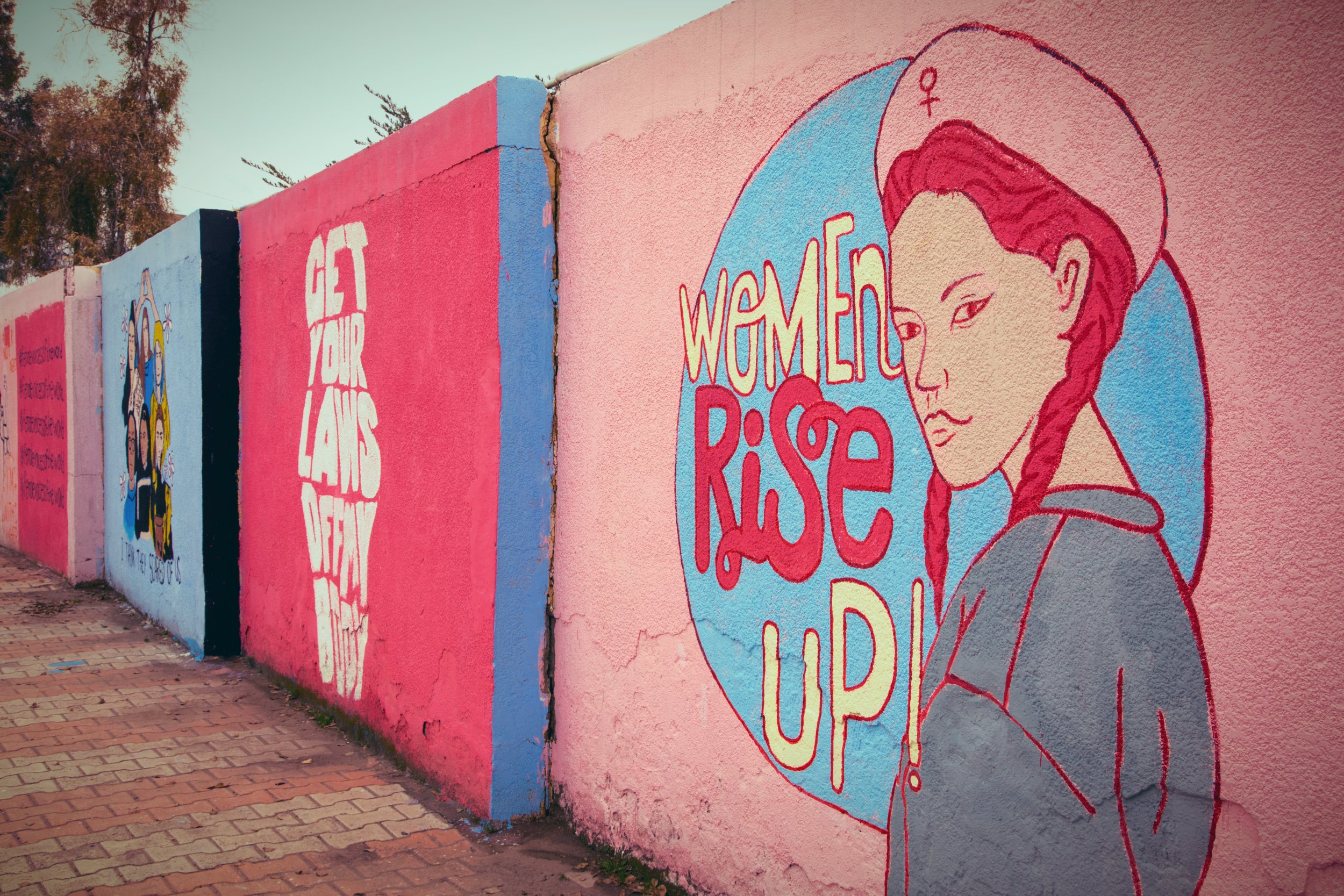
Mural created by Iraqi/Kurdish artists and activists in Erbil, photograph taken by Spc. Angel Ruszkiewicz, Feb. 22, 2020. | Source (edited by the Author)
We As Men Must Do More, and We Must Do Better
Yesterday was International Women's Day, but that does not mean we suddenly stop thinking about gender politics the day after.
I.
Women have been subjugated, objectified, dehumanized, and subjected to violence throughout all of human history. We as men[1] have failed women time and time again. I know I have personally failed the women in my own life—through the exploitation of emotional labour, through microaggressions, through not doing enough when I witnessed other men causing harm.
And that's exactly why I'm writing this toward other men: I don't know where you are along your journey of understanding gender or sociology, but I ask that you read with an open mind regardless. I will try to meet you where you are.
We, as men, always have a responsibility and duty—both to women and to one another. Some of the most effective ways we can improve is by decentering ourselves and performing the work that is typically offloaded onto women.
Think deeply about the women in your life. Think deeply about the other men you know, and whether you need to have a hard conversation about their treatment of women, and about their ignorance of subjugation and violence. It should not require you to imagine a woman as your daughter, or mother, or sister in order to humanize her. Women are not extensions of your relationships to them. They are human beings.
The gravity and multitude of issues faced by women are not possible for us to fully appreciate or comprehend.
II.
Emotional labour disproportionately falls on women, driven by cultural expectations that women are more empathetic and accommodating by nature, a construction conveniently turning women's labour into a personality trait so that it doesn't have to be compensated or even acknowledged. For women of colour, the burden is compounded, as they must also manage the emotional labour of navigating racial microaggressions while remaining "professional", a double tax levied by both gender and race.
Research published in 2025 in Archives of Sexual Behavior found that women regularly perform what researchers call "sexual emotional labour": faking orgasms, tolerating pain or discomfort, framing their own satisfaction in terms of their partner's pleasure, engaging in sex without genuine desire.
There, too, is hermeneutic labour. The work of understanding and coherently expressing feelings, discerning the feelings of others, and inventing solutions for relational problems. The work of translating the emotional world into legible terms so it can be processed. In heterosexual relationships, this work falls entirely on women, who become the relationship's expert, therapist, and interpreter simultaneously, often for partners who have never been expected to develop the same skills.
III.
I think about the recent research indicating Gen Z men are more likely than Baby Boomers to believe feminism has done more harm than good. A King's College London study of 3,600 people, which found that one in four UK males aged 16 to 29 believe it is harder to be a man than a woman. A 23-country study of 23,000 people found that 57% of Gen Z men said we've gone so far to promote women's rights that we've become sexist toward men compared to 42% of Boomer men. Thankfully, at least, the same YouGov research found that only 6% of Gen Z men report actually disliking women, and 71% hold an unfavourable view of Andrew Tate. There is a consistent, significant minority that is being actively recruited.
I think of teachers and school workers who are watching boys being pulled into the Manosphere and the toxic, violent, dangerous rhetoric of men like Andrew Tate. A Hope not Hate poll found that 80% of 16 and 17-year-old British boys had consumed content created by Andrew Tate, more than the 60% who had heard of the British Prime Minister. A University of York study found that 76% of secondary school teachers are extremely concerned about the influence of online misogyny on their pupils, with teachers describing boys making misogynistic comments, disrespecting female staff, and referencing Tate directly when challenged on their behaviour. A Canadian study conducted in Ontario found that boys shape their sense of masculine identity by emulating these pathetic manfluencers, with narratives of male victimhood, where boys view themselves as oppressed and blame women for their perceived injuries, becoming common in schools.
This is not a phase that will sort itself out. Decades of feminist progress and personal sacrifice seem so effortless to dissolve in a matter of years. All we have in its place is the weight of grief.
IV.
The so-called male loneliness epidemic is a problem created by us, and a problem that can only be solved by us—by brotherhood. Brotherhood as in men learning to do their own emotional work. Building the capacity for vulnerability and self-knowledge that means we are not constantly presenting ourselves to women as half-finished projects in need of completion. For we must expect more from one another. We must hold a much higher standard of what is acceptable behaviour and communicate that clearly and often. We must show up for one another instead of consistently offloading to women and expecting them to be responsible for our emotional well-being—whether that's in a romantic context, familial, or platonic.
I know I need to be careful here, as this idea can be co-opted easily. The Manosphere uses the very real problem of male loneliness and alienation as a recruitment tool by offering lonely boys and young men a sense of belonging, identity, and meaning, then filling that void with misogyny and conspiracy. The solution to male loneliness is men learning to sincerely be present for one another.
15% of men now report having no close friends, quintupling since 1990. 74% of men report turning first to a spouse or romantic partner for emotional support, compared to far lower rates among women who distribute support-seeking across a broader network. Men are four times more likely than women to die by suicide. Something is genuinely wrong.
But the framing of a uniquely "male" loneliness epidemic is actually imprecise. A 2025 Pew Research study found no statistically significant gender disparity in loneliness. 16% of men and 15% of women report feeling lonely all or most of the time. The loneliness epidemic is, as the U.S. Surgeon General declared in 2023, a universal crisis. The reason it disproportionately manifests as catastrophe in men's lives is because men have been culturally conditioned since boyhood to equate vulnerability with weakness, leaving them without the relational infrastructure to survive normal life hardship, and then offloading what remains onto the women closest to them.
If we frame this as a uniquely male crisis, we risk allowing the Manosphere to take ownership of the issue and entrench its misogynistic framework further. Men's relational poverty is a problem created by the same patriarchal norms that harm women, and can only be solved by dismantling them.
V.
With all of that out of the way, I now have a question for you:
Where do you think the most dangerous place on Earth is for a woman?
Her home.
This is data, and has been for as long as we have been keeping records. One woman or girl is killed by an intimate partner or family member every ten minutes. That's 137 per day. 50,000 in 2024 alone, according to the most recent joint UNODC and UN Women femicide report. Of all the women and girls intentionally killed last year, 60% were murdered by someone in their own family. Only 11% of male homicides were committed by family or intimate partners.
Roughly one in three women globally has experienced physical or sexual violence in her lifetime, a figure unchanged in two decades, declining by only 0.2% annually. The true scale is almost certainly higher, because fewer than one in three sexual assaults is ever reported to police, research from Canada suggests the real reporting rate may be below 5%. Survivors fear retaliation, or not being believed, or carry unwarranted shame, or simply the well-founded expectation that nothing would be done. One in five sexual assault cases reported to police in Canada are classified as "unfounded", dismissed without investigation. Because someone decided they didn't count.
Women in the MENA region face systemic legal discrimination, with marital rape still not criminalized in many countries, honour crimes continuing with lenient sentences, and girls remaining at risk of child marriage in Egypt, Jordan, Lebanon, and others. Many countries in the region still prevent women from traveling abroad without the permission of a male guardian. The global south is certainly not a monolith, and I want to be careful not to flatten the diversity of women's experiences across it. There are genuine, hard-fought gains in places like Rwanda and Senegal alongside profound ongoing failures. The material reality, though, is that being a woman in many parts of the world still means living inside a legal framework designed to constrain you.
In my homeland, Indigenous women and girls are still going missing. Still not believed when they report violence. Disappearing into a silence that most people in this country have chosen to maintain. For Indigenous women and girls are 12 times more likely to go missing or be murdered than non-Indigenous women in so-called Canada. They're 16% of all female homicide victims and only 4.3% of the Canadian population. These are names, not numbers. Names that families have been carrying for years, waiting for an accounting that has not come. The National Inquiry's 231 Calls for Justice remain largely unimplemented. The Red Dress Alert, a pilot system announced in 2024 to locate missing Indigenous women, is still being developed. The crisis is ongoing and the political will has been, by any honest measure, completely insufficient.
VI.
There are no easy answers here.
I have witnessed the same oppression and violence dressed in different language and rhetoric for the entire time I've been alive. I think about how my own father treated my own mother. I think of the personal failures and harms I've committed and collected over the years.
I want to end on something honest, because I am so full of heartbreak. In truth, I wish for only unconditional love to find all women. I hope liberation can somehow be found despite the steepest incline of the uphill still present. I hope trans rights become not a matter of political debate but a given—a basic recognition of humanity—globally.
Men need to start doing more of the hard, difficult work. Men must come to understand the ongoing violence and oppression toward women, while also understanding that it is beyond our comprehension to fully appreciate. Men must shake off the arrogance of performative allyship and instead quietly, consistently, do the work.
ACTION
Give money, time, and effort. Especially to marginalized women. Allyship that costs you nothing is not allyship. Find organizations led by and for women of colour, Indigenous women, trans women, disabled women, and women in the global south and support them materially. The Native Women's Association of Canada, Trans Lifeline, Women's Earth Alliance, and your local women's shelter are places to start. Volunteer your time. Show up to the fundraiser. Give a recurring donation, even a small one. The women doing the most essential work are consistently the most underfunded. That is not an accident, nor is it their problem to solve.
Listen. Not to respond. Not to fix. Just to understand. Listen to women with the intent to understand. Ask the women in your life what they need from you. Then, believe them when they tell you.
Learn on your own time. Read books. Read essays. Read the research. Don't make the women in your life responsible for your education about their own oppression. bell hooks' The Will To Change: Men, Masculinity and Love is a good place to start, as is Reni Eddo-Lodge's Why I'm No Longer Talking to White Men About Race for understanding how structures of oppression interlock. The UN's HeForShe initiative has a freely available Male Allyship Toolkit if you want scaffolding.
Intervene. When you hear a sexist joke, a dismissive comment, a demeaning remark? Say something. By intervening, you establish that it is okay to speak up, and you create a handhold for other men to grasp onto. Silence is complicity. You already know that.
Carry your damn weight. Reframe household and emotional labour as shared human work, not gendered obligation. If you are in a relationship, look honestly at the distribution of invisible labour. Who manages the social calendar, who remembers appointments, who carries the worry? If you live alone, learn to carry your own.
Have harder conversations with men. The people most capable of shifting other men's behaviour are men. If someone you know is treating women badly, say something. To them. Directly. It is necessary.
Support Indigenous women and girls. In Canada, that means supporting the implementation of the MMIWG National Inquiry's 231 Calls for Justice. Pay attention to the Red Dress movement. Donate to organizations like the Native Women's Association of Canada. Understand the crisis of missing and murdered Indigenous women and girls is ongoing, and it is in part a product of the same patriarchal structures harming all women.
Do the work without asking for recognition. That's the whole thing, really. The work is in doing it when no one is watching, when there is no applause, when it costs you something. That's when it starts to mean anything at all.
I need to be frank. I do not know what positive masculinity looks like. I have thought about this a lot and I still do not know how masculinity can be fully decoupled from hegemonic violence. But I know that it's up to men to demonstrate that what is, in fact, a possibility. For I know what the first steps look like, even if the destination is unclear.
I am someone who has exploited the privilege of being male-presenting my entire life, and this is no different to how I've exploited the privilege of being a white-presenting Indigenous person as well. This is not actually accurate to my identity, but that is wholly irrelevant to the conversation at hand. ↩︎
Comments
To comment, please sign in with your website:
How it works: Your website needs to support IndieAuth. GitHub profiles work out of the box. You can also use IndieAuth.com to authenticate via GitLab, Codeberg, email, or PGP. Setup instructions.
Signed in as:
No comments yet. Be the first to share your thoughts!