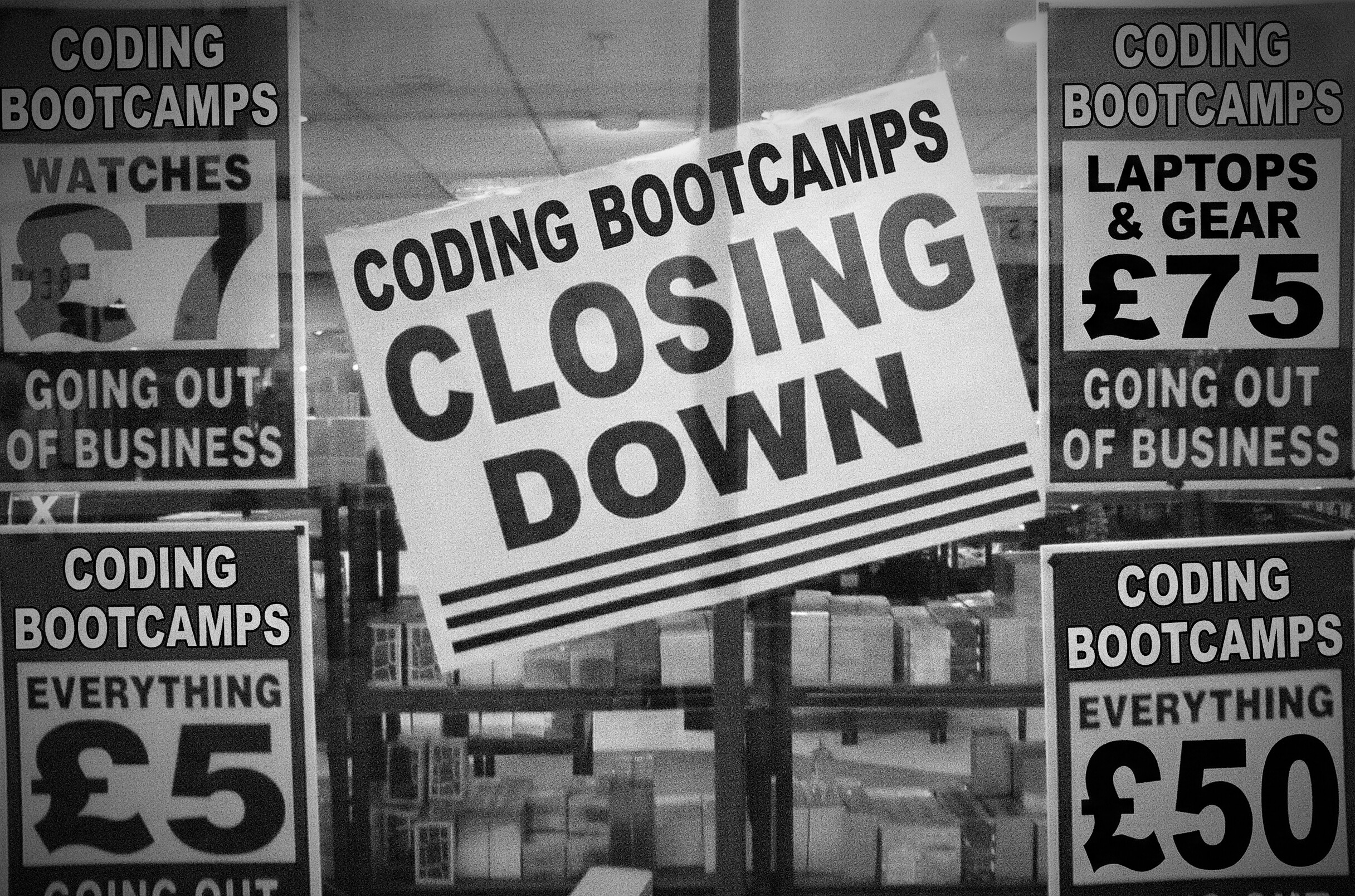
"Closing Down" Sale 2 by John Thurm(edited by the author)
The Final Coding Bootcamp: A Eulogy for Lighthouse Labs

On a damp October evening in 2013, a handful of developers in Vancouver's Gastown gathered around folding tables. It was a wonderful, ideal concept they discussed as their MacBook screens glowed. What if you didn't need four years and six figures of debt to become a programmer? Launch Academy, now known as Lighthouse Labs, was founded.
The idea was already in the process of picking up momentum elsewhere, with the first coding bootcamps beginning in 2011. The idea was to take the disruption of Silicon Valley to the education that would teach their future developers: 12 weeks of sprinting and distilled focus, alchemizing baristas and accountants and oil workers facing layoffs all into employable web and software developers
That idea was good enough to hold for over a decade. Lighthouse Labs became Canada's flagship coding bootcamp, training an impressive 40,000 students across six cities in Canada. Cohorts graduated every few months, with students walking out as "junior developers," GitHub portfolios brimming with green tiles indicating hard work done with React components and Flask APIs.
And the stats coming out of these bootcamps were impressive, weren't they? 80% placement rates with six-figure starting salaries. Pipelines straight into Google and Shopify and hundreds of venture-backed startups raising millions.
Let me ask you reader, where do you think this story goes from here?
The Acquisition
Last year, on January 14, 2025, Lighthouse Labs announced its acquisition by Uvaro, a workforce development company.
The press release had the usual corporate euphemisms. It was a "strategic expansion" with "Canada's largest workforce development organization" ensuring "future-ready skills for an AI-augmented economy."
Jeremy Shaki, Lighthouse Labs' co-founder and CEO, engineered the sale after two previous failed attempts to find a buyer of the bootcamp. The writing, he said later, had been on the wall for months.
"All the headwinds are coming against us," Shaki told an audience at Toronto's MaRS Discovery District in October, describing the company's final year. There were layoffs, the existential collapse of the entry-level job market.
And, of course, AI. The posthuman spectre controlling what a junior developer was worth, now.
Uvaro raised capital to fund the acquisition. They were planning to integrate Lighthouse Labs' technical training with Uvaro's sale and customer success programs to create a "full-spectrum" workforce platform. For seven months, classes continued as normal. Students showed up and instructors taught. The lights stayed on.
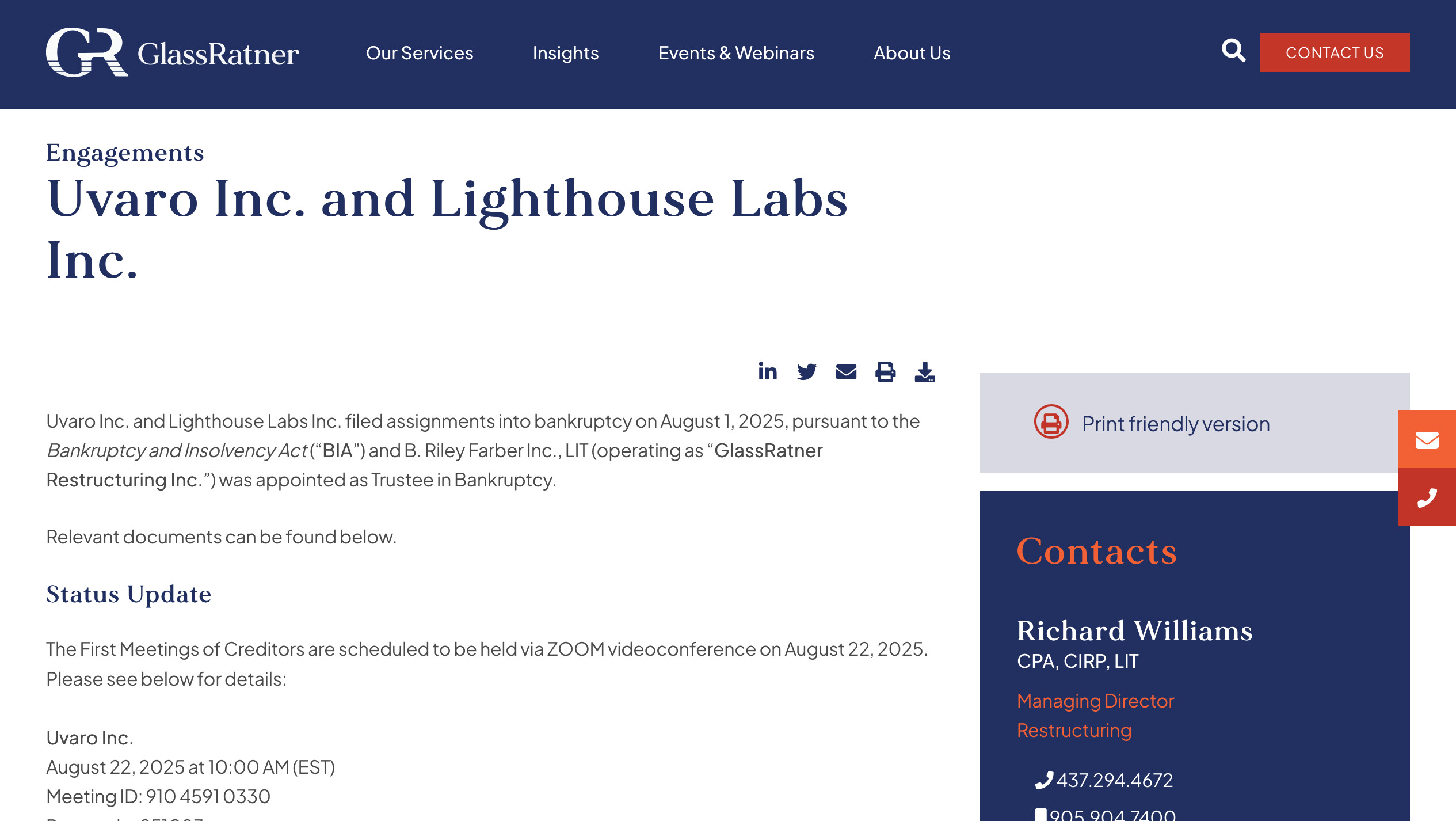
On August 1, 2025, both companies filed for bankruptcy. All employees from both companies were terminated immediately.
Digital skills courses already in session stopped instantly. Students had course access revoked mid-program.
The trustee's bankruptcy documents explained how Lighthouse Labs had approximately $230,000 in assets against liabilities exceeding $3 million. And Uvaro listed $1.6 million in assets against $5.7 million in liabilities.
The collapse was as sudden as it was total. Websites redirected to bankruptcy trustees. Phone lines went dead. Slack channels where thousands of alumni chatted were shuttering.
"I watched someone for six months who ran it with really good intentions and strong vision, strong capabilities, make mistakes that I didn't have the control over," Shaki reflected months later, still processing. He acknowledged the toll:
"Nobody called me an asshole, but [I] felt like one because [I] walked away with an exit and [I] gave the pieces to somebody, and now they did something with it... and it ended in the antithesis of what I had tried to build for 12 years."
The proximate cause was prosaic enough. Uvaro's "forecasted sales pipeline and government contract awards didn't come to fruition within its predicted timeline." Companies run out of cash. It happens.
The end of Lighthouse Labs was not an isolated failure. It was a canary in the coal mine.
The Great Bootcamp Die-Off
In the past few years, a dozen prominent North American coding bootcamps shut down. San Antonio's Codeup suddenly ceased operations in late December 2023. Indianapolis-based Kenzie Academy stopped accepting new enrollees. Raleigh's Momentum Learning cited the rise of AI when it closed after six years and over 400 graduates. California's Rithm School halted applications. Massachusetts's Launch Academy paused its immersive program. Oregon's Epicodus, Washington's Code Fellows, and Toronto's Juno College of Technology all followed suit.
Southern New Hampshire University shut down its coding bootcamp in 2023, citing "low-cost competition and the broad adoption of AI tools." Women Who Code shuttered, citing lack of funding. Viking Code School, Telegraph Academy, Orange Code School, Alchemy Code Lab.
A roll-call of closures reading like an obituary page.
In December 2024, 2U, the online program management giant that had partnered with over 50 universities to run coding bootcamps, announced it was exiting the bootcamp sector entirely. No selling the business or exiting. Shutting it down. Their $750 million investment held, as one education sector banker noted, "little or no market value." The business line wasn't even worth selling.
The economics here are brutal. Bootcamps were thriving in the 2010's, and it made sense. You pay a mere twenty grand, study for four months, and suddenly you're landing a job that pays a salary of $70,000/year. Of course enrollment exploded. At its peak in 2017 there were over 90 full-time bootcamps operating in the United States and Canada. The industry was unstoppable.
Except it wasn't, at all. There was a fragility baked-in to the model. Bootcamps relied heavily on government subsidies and corporate partnerships.
When Lighthouse Labs received $21.2 million from the Canadian government in February 2023, it was really a lifeline. Many students paid little or nothing out of pocket since governments covered the bill.
Then, the funding dried up. Without subsidies, the full $15,000-$20,000 sticker price became the burden of the students. Enrollment collapsed. Bootcamps hemorrhaged cash. And the jobs those graduates were supposed to land? Oh yeah, those were vanishing, too.
Vibe Coding
In a glowing 2023 anniversary interview, Khurram Virani, Lighthouse Labs' co-founder and Head of Technology, acknowledged AI's impact but remained optimistic.
"Makers and technologists will be able to build more amazing things faster by leveraging generative AI," he said. "It's an exciting time."
Do you think it was an exciting time, reader?
Coined by AI expert Andrej Karpathy, vibe coding described the use of AI tools to handle the heavy lifting of code generation, while the "developer" processes things with natural, English language. Tools like Cursor, Replit, and Windsurf let anyone—designers, product managers, even complete non-coders—build (seemingly) functional applications by describing what they wanted.
Replit's CEO noted that 75% of Replit customers never write a single line of code. They describe what they want, and the AI generates it.
The "grunt work" once served as training ground for junior developers—writing boilerplate code, setting up APIs, debugging basic syntax errors. That was all automated, now. The entry-level ladder was collapsing.
Daniel Pianko, managing director of Achieve, an education-focused private equity firm, put it bluntly:
"Ten years ago, employers wanted people who could convert business practices into programming languages. But in 2025, AI-powered machines can do much of that programming, which has elevated demand for higher-level workers who have an understanding of the specific business problems you want to solve rather than specific coding skills."
Coding bootcamps taught JavaScript fundamentals, React components, and REST APIs. This is what AI-only coding could now replicate. Not perfectly, but well enough.
AI never asked for benefits and never called in sick. A compliant, obedient servant.
An Entry-Level Apocalypse
According to Stanford Digital Economy Lab analysis, U.S. entry-level tech job postings dropped 67% between 2023 and 2024. Entry-level hiring at the 15 biggest tech firms fell 25% from 2023 to 2024.
Google and Meta are hiring roughly 50% fewer new grads compared to 2021. Salesforce CEO Marc Benioff announced the company would hire no new software engineers in 2025, citing AI-driven productivity gains.
Job listings for software developers are down approximately 70% from their 2022 peak, according to Indeed data. Computer science graduates face a 6% unemployment rate, while computer engineers are at 7.5% which is nearly double the general unemployment rate.
Programmer employment fell 27% between 2023 and 2025, according to U.S. Bureau of Labor Statistics data. Internship postings on Handshake, a recruitment platform, dropped 30% for tech roles since 2023.
And 70% of hiring managers surveyed said they believe AI can do the jobs of interns, and 57% said they trust AI's work more than that of interns or recent grads.
If you are a junior developer in 2025, you were now competing with not just other jr. devs, but GitHub Copilot, ChatGPT, and Claude Sonnet.
Bootcamp graduates had invested months of their lives and thousands of dollars to acquire skills that employers no longer valued. Reddit threads filled with despair. "Bootcamps will not get you a job right now. Stop asking," read one popular post.
A student named Tim Lum, featured on an EdSurge podcast, described haphazard classroom environments with widely varying skill levels. Students essentially taught themselves using the bootcamp's curriculum. He ultimately decided a traditional computer science degree was necessary, and enrolled in community college.
It's a cruel irony that bootcamp students had often come from dying industries, themselves. Oil workers laid off in Calgary's downturn. Retail employees fleeing automation. Journalists watching newsrooms shutter.
They were told they could retrain and pivot into tech because that was a future-proof safe bet of a career.
The Calgary Canary
Two thousand kilometers from Vancouver, in a back-of-house space on Level 3 of Calgary's Central Library, there's another coding bootcamp still operating.
InceptionU had been born in 2017 from the same optimistic fervor as Lighthouse Labs. Three Calgary professionals—Margo Purcell, Jill Langer, and Greg Hart—witnessed the city's economy crater with oil prices and decided the narrative needed to change. They founded InceptionU (originally with the full-stack programmed called EvolveU) to retrain Albertans for the digital economy.
The "Full Stack Developer" bootcamp was a flagship six-month immersive course. Beyond just coding, InceptionU emphasized they taught "MetaSkills like critical thinking, systems thinking, design thinking." Project-based learning with students building real applications for real clients.
There was funding from the Hunter Family Foundation, and later the Alberta government covered most tuition costs. Over 230 learners completed the program; most found employment in Calgary's growing tech sector.
For over a dozen consecutive cohorts, InceptionU ran back-to-back. Every few months, a new class began learning JavaScript, React, Flask, MongoDB, and PostgreSQL. They debugged together, built together, celebrated together.
I would know because I was a member of Cohort 4 in 2020.
Then, in the past few months, the government funding ended.
InceptionU's Full Stack Developer program cost $19,000 out of pocket. In a city still reeling from oil industry contraction, in an economy where tech jobs are now evaporating, that price is prohibitive.
Instead of naming a fixed starting date, InceptionU's website now simply says the next cohort is "coming soon".
In January 2026, InceptionU's leadership sent an email to alumni. A 90% discount on new short courses. "AI in the Wild" (18 hours, normally $2,900, now $290) and "Cybersecurity Launchpad" (18 hours, normally $1,099, now $109.90). Limited seats. First-come, first-served. It was, in the parlance of dying industries, a liquidation sale.
What We Lost
It's too easy to dismiss coding bootcamps as simply part of the larger collapse of Silicon Valley's unicorn ventures. For a decade there was a rapid, accelerating demand for software developers as hundreds of companies were raising millions. You know these companies. Uber. AirBnB, Slack, Pinterest. Where do they stand, now?
I think this narrative is too neat and tidy, though, actually.
At their best, bootcamps democratized access to tech. People overlooked by traditional compsci were recruited. The mid-career professionals, the parents returning to work, the people without the time or money for four-year degrees. A lot were immigrants or newcomers, I saw that first-hand myself. There was a community proving programming was actually not exclusive to 22-year-olds with Stanford degrees.
Lighthouse Labs' 40,000 graduates include people who rebuilt their lives. Oil workers who became full-stack developers. Teachers who pivoted to data analytics. Single mothers who found flexibility and dignity in remote work.
These were not grifts. These were real transformations.
The instructors were experienced developers who loved teaching and believed in mentorship. They lost their livelihoods, as well. When Uvaro and Lighthouse Labs filed for bankruptcy, every employee was terminated immediately. Years of curriculum development, pedagogical innovation, relationship-building with employers. All vaporized.
The Future That Isn't Coming
There are, of course, optimists. AWS CEO Matt Garman argues that juniors are affordable, quick to adopt AI tools, and essential for long-term growth. Former GitHub CEO Thomas Dohmke calls fears of junior developer obsolescence "overblown", noting that juniors bring fresh thinking and diverse backgrounds.
Google's Sundar Pichai sees AI as a productivity booster, not a replacement, and says Google will hire more engineers in 2025 because AI-powered productivity lets them do more with the same workforce.
I think it's a pipe dream to think this is merely a painful transition and not an ending.
People are now sending out hundreds of applications and getting automated rejections. People are now competing for roles that expect "3-5 years of experience" for "entry-level" positions. People are now watching LinkedIn posts where senior developers complain about burnout while companies refuse to hire juniors.
Companies are foolishly optimizing for short-term cost savings by refusing to train the next generation. There is going to be a catastrophic leadership vacuum in the next five years.
Eulogy
When Lighthouse Labs filed for bankruptcy, I think an era ended.
Whiteboards covered in JavaScript. Midnight debugging sessions and stale coffee, leading to demo days of nervous students presenting capstone projects to future employers. Slack channels buzzing with job leads and code reviews and meme .GIFs and inside jokes. Of a future and a possibility that technology could save us.
That era is over.
Rest in peace, Lighthouse Labs. You lit the way for 40,000 people. The darkness that follows your extinguishing is deeper than you knew.
Disclosure: The author was a member of InceptionU Cohort 4 in 2020. His documentation from that experience can be viewed at brennan-evolveu.netlify.app.


Comments
To comment, please sign in with your website:
How it works: Your website needs to support IndieAuth. GitHub profiles work out of the box. You can also use IndieAuth.com to authenticate via GitLab, Codeberg, email, or PGP. Setup instructions.
Signed in as:
No comments yet. Be the first to share your thoughts!