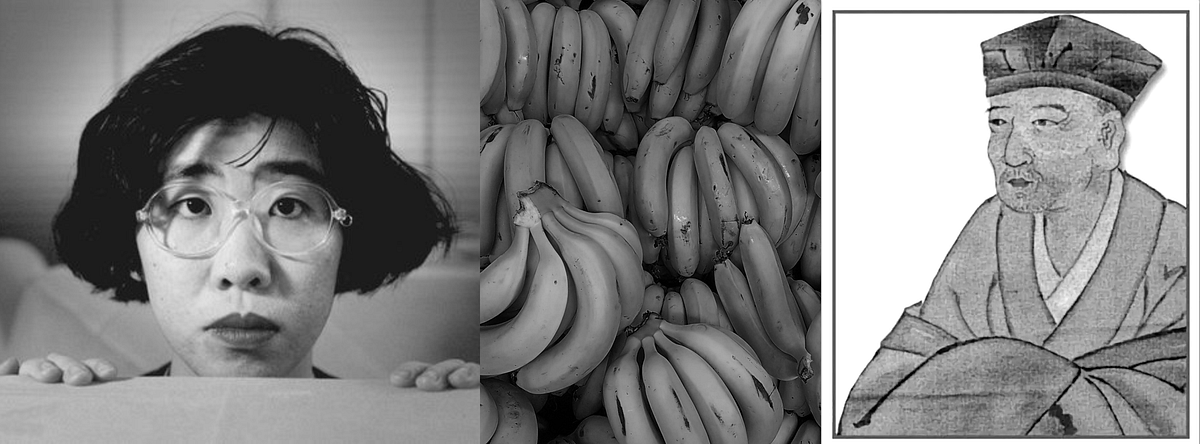
From left to right: Banana Yoshimoto, a pile of bananas, and Matsuo Bashō
THE BANANA MYSTERY

There’s a moment in every reader’s life when they stumble upon a connection and it feels like uncovering a secret message. Mine came while researching Banana Yoshimoto, the contemporary Japanese novelist whose dreamy prose has captivated readers worldwide since her debut with Kitchen in 1988.
Her pen name, Banana, has always intrigued people. Playfully androgynous, deliberately memorable, and utterly unconventional for a Japanese writer. When asked about it, Yoshimoto has explained that she chose it because she loved banana flowers, those deep purple blossoms that emerge from the heart of the plant. She found the name cute. Modern. A departure from tradition. But then there’s the other name.
The Hermit and His Plant
In 1680, a wandering haiku master named Matsuo received a gift from his disciples: a small hut and, planted beside it, known as a bashō—a Japanese banana plant. The poet, already in his thirties and seeking simplicity, took the plant’s name as his own. Bashō (芭蕉) literally means “banana plant,” though it refers specifically to the ornamental variety, not the fruit-bearing kind. He wrote:
芭蕉野分して盥に雨を聞く夜かな Bashō nowaki shite
tarai ni ame wo
kiku yo kana Banana plant in the autumn gale—
I listen to the dripping of rain
into a basin at night.
The plant became inseparable from his identity. When storms tattered the broad leaves, he saw impermanence. When the bark stood resilient, he found strength. His pen name became legendary, synonymous with the haiku form itself, with wandering, with seeing the extraordinary in the mundane.
So here we are, two of Japan’s most beloved literary figures, separated by three hundred years, both named for banana plants. One chose it for its flowers hidden deep in the stem. The other for the actual plant swaying outside his window.
The parallels multiply when you look closer. Both writers emerged during periods of cultural transformation. Bashō wrote as Japan moved from warfare toward Edo-period peace; Yoshimoto came of age as Japan processed its postwar identity and economic bubble. Both crafted prose that felt simultaneously ancient and startlingly new. Both understood loneliness not as isolation but as a kind of clarity.
And both, crucially, were literature students deeply versed in their country’s literary tradition. Yoshimoto studied at Nihon University’s College of Art, majoring in literature. Her father was the renowned poet and critic Takaaki Yoshimoto. She would have known Bashō the way American writers know Whitman—intimately and unavoidably. Surely.
The Unsaid Thing
Here’s what haunts me, though. Yoshimoto has never, in any interview I can find, mentioned Bashō as an influence on her pen name choice. She talks about the flowers. The cuteness. The androgyny. The memorability of the English loanword banana (バナナ) written in katakana rather than the traditional Chinese characters of bashō (芭蕉).
Is the silence meaningful? Or is it simply that the connection is so obvious to Japanese readers it doesn’t need stating—the way an American writer named Walden wouldn’t need to explain the Thoreau reference?
Perhaps the homage lives in the deliberate difference. Where Bashō chose the Chinese characters that anchor his name in classical poetry and Buddhist Philosophy, Yoshimoto chose the foreign katakana signalling modernity and global culture. Where he took the name from a plant given by disciples, symbolizing community and tradition, she chose it alone as an art student asserting her identity.
Maybe the mystery itself is the point. Maybe what matters isn’t whether Yoshimoto consciously nodded to Bashō but that readers across cultures can discover the connection and feel that spark of recognition. Literary tradition doesn’t always announce itself. Instead growing quietly as flower deep within a stem, waiting to be noticed.
Both writers understood something essential about names. Bashō knew that taking his name from a plant would bind him to nature’s rhythms, to vulnerability, to the poignancy of things that bend but don’t break. Yoshimoto knew Banana, foreign and unexpected, would mark her as outside the mainstream while remaining utterly herself.
How beautiful that in choosing a name from her heart, for reasons entirely her own, Yoshimoto found herself walking a path a great master had walked before her? Both carrying names that bloom and fade. Both writing themselves into permanence through impermanence. The banana plant outside Bashō’s hut is long gone. But the name remains, green and reaching, sheltering new writers in its shade.
SOURCES
- Banana Writers—“Banana Yoshimoto Interview”—https://www.bananawriters.com/interviewbananayoshimoto
- Matsuo Bashō Haiku Blog—“Why I am called Bashō”—https://matsuobashohaiku.home.blog/2019/12/26/why-i-am-called-basho/
- Hermitary—“Donald H. Shively: Basho—The Man and the Plant”—https://www.hermitary.com/articlereviews/shively.html
- Yokogao Magazine—“The Freedom to Grieve in Banana Yoshimoto’s Writing”—https://www.yokogaomag.com/editorial/banana-yoshimoto-japanese-author-grieve
- Matsuo Bashō Haiku Blog—“Banana”—https://matsuobashohaiku.home.blog/category/banana/
- Masterpieces of Japanese Culture—“Matsuo Basho’s biography”—https://www.masterpiece-of-japanese-culture.com/literatures-and-poems/matsuo-bashos-biography
Comments
To comment, please sign in with your website:
How it works: Your website needs to support IndieAuth. GitHub profiles work out of the box. You can also use IndieAuth.com to authenticate via GitLab, Codeberg, email, or PGP. Setup instructions.
Signed in as:
No comments yet. Be the first to share your thoughts!