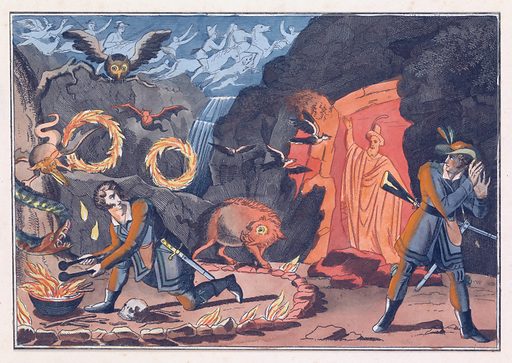
Coloured engraving with gouache of a man conducting magic rites and a hunter cowering in terror, nineteenth century. | Source
REVIEW: Light Joy Writing, On Elizabeth Gilbert's Big Magic

Perhaps like most people, my only exposure to Elizabeth Gilbert was knowing that she was the author of the very famous memoir with the eye-rolling title Eat, Pray, Love. I did not think she was a serious author, or someone I ought to read. And it's interesting—where does this instinct arise from? Simply because the title of her most well-known book so closely resembles live, laugh, love?
That is embarrassingly shallow of me. And truth be told, the only reason I decided to try to read Big Magic was because I read how Gilbert wrote about fantasizing about murdering her cancer-ridden girlfriend (after making her relapse into her addiction) in her newest book, All the Way to the River: Love, Loss, and Liberation. That, too, is still shallow.
Gilbert is, in reality, a literary figure. She has written several rich novels taught in classrooms. She has, in fact, devoted herself to the craft of writing. And with that, I will say how delightfully surprising Big Magic was.
It could be argued the thesis of this book is that ideas and creativity are transcendental, ethereal, not-of-this-world. I have personally found myself becoming increasingly religious over the years myself, and do not subscribe to the idea that the truth of reality can be known by only its material or my mere biological substrate. So already, off to a good start of mutual understanding, there.
I do disagree with Gilbert's notion that ideas have consciousness—the way she describes them as sprites that want so badly to manifest as real, and are always on the lookout for an artist to materialize them. And yet it is a wonderful way of operating.
And I certainly do believe creativity is sacred—and also, as she writes— simultaneously not sacred. There are a lot of contradictions to hold in understanding Gilbert's perception of creativity. And the paradoxes are deeply enjoyable and understandable.
Paraphrasing her friend and brilliant writer Robin Wall Kimmerer, Gilbert notes how we have lost touch with our relationship with nature. We love nature, but we do not believe nature loves us in return. And yet gardens can only be grown by us. We must choose to believe nature loves us, to no longer be deaf and blind to our reciprocal relationship with our surroundings.
And, Gilbert tells us, we must believe writing loves us the way we love writing. I believe this is the true thesis of the book, and it is so brilliant. The myth of the tortured artist—of suffering and martyrdom—is not only toxic but simply untrue.
When she was only a teenager, Gilbert made vows that she would do the work to be a writer for her entire life, and in exchange she just wanted the ability to write her entire life. She did not ask for success, she did not ask to produce good work. She asked merely to be able to work.
Because she loves the work. And it is so obvious yet so elusive. Creativity resembles religion because, in the idealised form, we surrender and have faith. We write and then we write more. The muse—whether sprite ideas or otherwise—are not cruel harsh creatures. Creativity finds us out of love.
Gilbert tells us there's a duality, a choice we can make: suffering or love. To have the dark, machismo death instinct of suffering is to be anti-creative. You will hoard the few ideas you have and treat them so, so seriously. Your works are not your babies—you are creativity's baby. Every piece you bring into the world matures you, makes you understand things a little better. You will be eaten alive by your own ego.
The alternative is light. A lightness, a playfulness. A gentle curiosity towards experiment. We must be the trickster instead of the martyr. And I think it is so telling that "silly," once meant "holy," "blessed," or "innocent" in Old English. The holy fool is so full of wonder and curiosity. Creativity is joy!
We can try to divine creativity's motives, but they will remain occult. Our creations are best when we shrug our shoulders at the outcome but fiercely work at ensuring we finish the damn thing to a good enough state. And then, after that, we must keep writing. Going onward and wayward ever, never backward, onto the next thing.
The frustration, the disillusionment and disappointment we will inevitably face? They are not obstacles from the work and art. They are the work, just as much as the (many fewer) rancorous highs are.
Perhaps Gilbert is preaching to the choir here, perhaps I already write for the sake of writing. I have made it a promise to write 750 words a day, and I've kept that promise to myself for over a year now. Nonetheless, I think it was important for me to take a writer seriously who I previously scoffed at. Nonetheless, it is validating to see such a famous writer reject suffering and substitute it instead for the life instinct.

Comments
To comment, please sign in with your website:
Signed in as:
No comments yet. Be the first to share your thoughts!