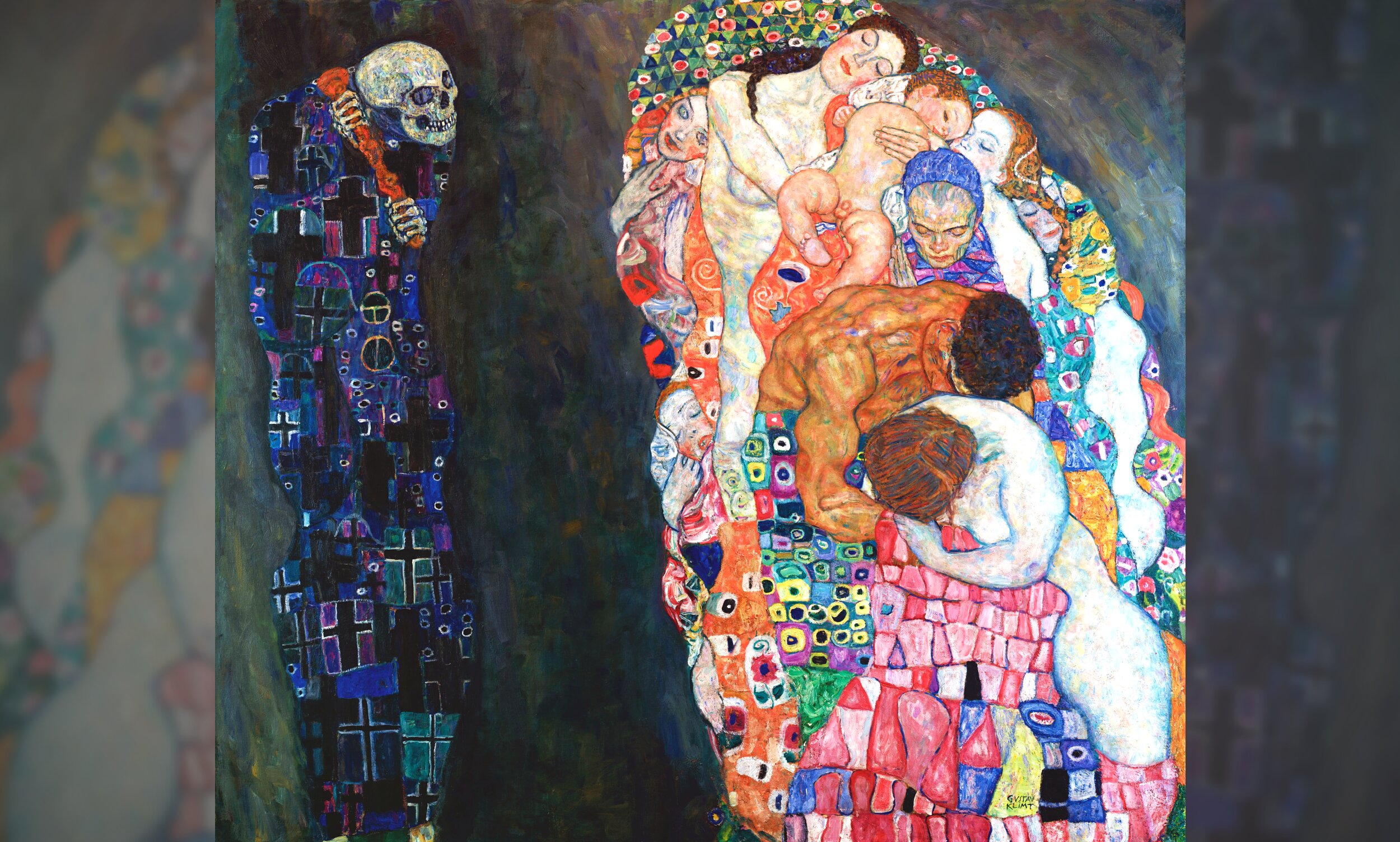
'Death and Life' ('Tod und Leben') by Gustav Klimt, oil on canvas, 1910/1915.| Source (edited by the Author)
Loss, and Loss, and Loss: A Eulogy


Life is a series of impossible losses and grief. There is no getting around this. In Buddhism, suffering is not a pessimistic statement that life is only misery, but rather a central, realistic observation that life is fundamentally impermanent and therefore "unsatisfactory" (dukkha). The impermanence is most felt when we lose those we love. For my 23rd birthday, I wrote a meditation exactly on this, "Dying Without Seeing You Again". I wrote this after finding the obituary of someone I went to elementary school with who passed from drug intoxication.
But, really, I have always been like this. My first journal entries written back when I was 15 years old—half my lifetime ago—are specifically about this:
Sunday, October 16, 2011
Well, I sit here today, dear reader. As thoughts circle and entrance me. I think of death, my death. Even if I am only fifteen years young. The majority of great people in the world have always been vitally aware of their deaths, and acting in life to make sure that they do not have to avoid it, but instead able to use it as a tool to help drive you. I would say that this is because when I think about my death, I do not think I have not yet made any impact on this planet or anyone on it. I want a legacy. I want to do something that would remembered. Even more important than that, I want to leave an impact on Earth, I want to leave this planet better than I found it. I want to be able to say that I did something, I want other people to be able to say this too. I wish this wasn't such a selfish task, but I know in a way that it is. So I come here and write to you about it and hopefully untangle myself.
Fifteen years old and already obsessed with the knot. Already convinced that writing was the only tool small enough to fit the lock. Pema Chödrön says in When Things Fall Apart that "things falling apart is a kind of testing and also a kind of healing. We think the point is to pass the test or to overcome the problem, but the truth is that things don't really get solved. They come together and they fall apart. Then they come together again and fall apart again. It's just like that." I've been sitting with the refusal of narrative progress. Grief is not a problem with a solution. Grief is a weather system you live inside.
C.S. Lewis figured this out in his own notebooks after his wife Joy died, in the same fumbling way—writing it down late at night and seeing what came out. "I thought I could describe a state; make a map of sorrow. Sorrow, however, turns out to be not a state but a process. It needs not a map but a history." For a map implies you can find a way through, but a history just means it happened, and you keep writing. That fifteen-year-old writing in his journal about death and legacy—he wasn't making a map, no. He was beginning the history.
Ira
Joan Didion opens The Year of Magical Thinking with "life changes in the instant. The ordinary instant."
It was during my early 20's that I met Ira. She found me when I was still at the hospice, and we met on one of those eye-roll worthy "make friends" apps. She was my age and we had a shared interest in poetry, in art, a mutual determination to live deep and suck out all the marrow of life. She scolded me about honey oat bread at Subway — reminding me that specific bread wasn't vegan. Her voice full of righteousness and light. We watched Breakfast at Tiffany's at my house, the computer monitor making shadows dance across her face. She always did the most amazing winged eyeliner. She was so careful and intentional with every text message that they looked like stanzas. Her little sister was the same age as my little brother. I knew about her mother in fragments, in text messages sent at 3 AM. She often had plans of running away, and I always said I would help. I meant it. But at some point, she stopped messaging me entirely. Disappeared. I understood this.
Then, her friend request appeared on Facebook just last year—a ghost tapping my shoulder. That Facebook notification was the ordinary instant for me. A small white number in a red circle in the corner of the screen. The world doesn't announce its pivots. She was dying of stage four stomach cancer. She began the conversation by sending me proof—scans, reports, hospital bracelets—thinking I wouldn't believe her. But I knew the language of illness by then, after working at the hospice for four years, and could read death between the lines of labs.
We only had one phone call. She had poetry she wanted to show me. I imagined visiting her in the hospital, bringing her vegan sandwiches with the right kind of bread, reading her verses back to her. But she still didn't trust men. She said she was still unsure about a friendship with me, even with her prognosis. I respected her wishes and we didn't have another conversation again after that.
I learned months later of her passing through a Catholic church newsletter. Black text on white paper announcing her passing. Another poet gone. Her name needs to be more than an obituary, please. This year, I was the only person that wished her a happy birthday on her inactive Facebook profile. Dear God, it kills me. I stay up many nights wondering if I should have tried harder to stay in contact — would I have more memories to cherish if I did? I want to start a scholarship for writers in her name. I want her words to live on in other young writers' mouths. I want her memory to feed poetry the way composted flowers feed next season's gardens. I want to believe that the bread, the movies, the midnight texts, the cancer, the poems she never showed me—all mean something more than just another story about death and disappeared girls. But maybe that's the wrong medicine. Maybe all I can do is write her name here. Ira. And hope that someone else will speak it aloud, will taste its poetry on their tongue, will understand that she lived and wrote and mattered. That she was here.
Didion writes about keeping her husband's shoes after he died—not throwing them away, because if she threw them away, he couldn't come back and need them. "I know why we try to keep the dead alive," she writes, "we try to keep them alive in order to keep them with us." The birthday wish on an inactive Facebook profile. The scholarship I'll start in her name someday. The poems I imagine existed, that I'm still somehow expecting to read. All my versions of keeping the shoes. And Didion also says there comes a point when you have to relinquish and surrender, "let them go, keep them dead." That the holding-on, however necessary, however human, is not the same as keeping them.
This is what Roland Barthes understood when he began his Mourning Diary the day after his mother died. Writing is the only way to become fluent in the impossible language of grief. "I transform 'work' in the psychoanalytic sense—the work of mourning, the dream-work—into the real work of writing," he said. The writing is not therapy, it isn't release, it is an attempt at getting close enough to the truth.
He wrote on index cards, scattered and chaotic, because grief is scattered and chaotic—it doesn't resolve into chapters. What Barthes understood, what I keep learning again and again, is that the work of mourning is accomplished through language, or not at all. You write the name. You taste it. You insist it meant something. That is the whole of it.
Loss Still Alive
Have you ever had a conversation where you're aware it's the last time you're ever going to talk to someone? There's a quiver of certitude, a shade fatal and inevitable. As though, no matter what you say, you both are now on two diverging branches which will never intersect again.
The last time it happened to me was yesterday. I was in bed, a cool Friday night. One of those nights where the dark comes early and the sleepy city goes quiet quickly. My phone was face-up on the mattress beside me, and I watched the messages come in the way you watch a tide recede. Knowing you can't stop it, noting each stone it uncovers. The glow of the screen in the dark room. The long pauses between their messages. The way the sentences got shorter. And then, nothing. The three dots appeared once more, then vanished. I stared at the ceiling.
I have lost a good number of people throughout my life like this. There's a heavy vocabulary of cut, severed, blocked, message failed to send. Over.
This is never spontaneous, of course. It is typically the weight of many small things, many unspoken issues, the fermentation and cultivation of resentment like bitter fruits into rich wine. You most likely had ample time to uncork the bioreactor, and breathe in oxygen to halt the process. I know this is the case for me, at least. The mismanagement of time and effort, or neglect, or pain inflicted. Death by a thousand cuts. I'm usually naïve enough to think things can be mended and patched; I can usually see the shape of reconciliation looking forward where others cannot.
This kind of loss is both more painful and less. A different flavour of grief. For the person still exists, is still alive, just entirely elsewhere. But, too, it is a choice.
Lewis had an image for the grief that keeps recurring, the one that doesn't stay in the past where you've filed it, "the same leg is cut off time after time," he wrote. "The first plunge of the knife into the flesh is felt again and again."
In the living loss, the diverged branch, the message that went unanswered and then permanently unavailable—the grief doesn't happen once. You lose them again every time you almost text them something funny. Every time you're at a party and think they would love this person. Every time you run out of people to tell about your life and realize the gap is exactly their shape. The sensation, Lewis says elsewhere, is less like sadness and more like fear. "The same fluttering in the stomach, the same restlessness, the yawning." The leg is already gone and your body keeps forgetting.
Family researcher Pauline Boss calls this an ambiguous loss—a loss that remains unconfirmed, without ritual, without a clear-cut name. Boss spent 50 years studying why some losses leave us frozen. "You don't know if that person is alive or dead," she says of the most extreme cases.
Estrangement, ghosting, silence calcifying into the weight of untraversable distance. The person is physically absent but psychologically present. Or they are psychologically absent while still technically here, posting on Instagram, going to work, breathing the same city air. According to Boss, the most stressful quality of this grief is lack of resolution. There is no funeral. No announcement in a newsletter. No one sends you flowers. The culture offers no ritual, no sanctioned language for the mourning of someone who still exists. You are simply supposed to move on. You were never supposed to be grieving at all.
But you are. I am.
I would ruminate on this kind of thing when I was a lot younger—I think I had a particular fixation with trying to repair the irreparable, of neat and tidy resolutions with sunkissed forgiveness and greeting card sentiments. My first journal entries are specifically about this:
Friday, January 6th, 2012
I was so pissed off I blindly called off our friendship, something that I regret very much so. I had heard that she was saddened, upset at the whole event. But whenver [sic] I talked to her, or tried to apologize, she just seemed ... angry.
For some reason, instead of dying down, it grew in me ... I have no idea why, but the fact that this girl wasn't talking to me, wasn't friends with me anymore almost drove me insane. I wasn't a very good friend to her though, I must admit. I wasn't to anyone. I was never sincere or legitimate. I am deathly afriad [sic] of what people might think of me if I actually act like me, so instead I put on this mask, thinking that if they hate it, they don't actually hate me. It was completely foolish. And I infact [sic] only realized it after being alone, having time for solace and solitude.
Hm. Time is an arrow, and yet time is a circle.
Fourteen years between that journal entry and the Friday night with the phone face-up on the mattress. What have I learned in the interval? I've gotten better at the language of grief. I've gotten better at understanding that the mask-wearing that fifteen-year-old was so ashamed of is also just—the ordinary terror of being known. The ambiguity isn't a flaw in the relationship. It's a flaw in being a person.
Chödrön wrote about uncomfortably returning to a bruise. Permission to stay in the mess of it. "To stay with that shakiness—to stay with a broken heart, with a rumbling stomach—that is the path of true awakening," she writes. Not through it, in it. That distinction used to infuriate me. I wanted a procedure, a timeline, a clear exit. I am slowly starting to understand.
Conclusion? (On Writing Names Down)
There's one last journal entry I want to share from around this time:
Tuesday, May 22nd, 2012
You're holding me down as a loaded pistol, I feel damned in my own existance [sic]. So paralyzed and forgotten, I can only hold on to the feeling of being freezing cold ... There once was a time where you'd come into these yellow-wooden doors and hold my hand the way I held yours ... Inside the mythology bears only a single apology that allows the rest to survive. We'll hold here and crash here and die here and love here and bear arms and fruits as the same. There isn't a single match or confront that could have changed this ... But the messenger's been shot dead, and I find myself in place, talking to where God should be.
...I once gave you a swan song, a place for you to belong, but you pushed, pushed it away ... the days where I go blind and hungry and latch onto your spine. Where I planted the seeds of wings and the rings to grow, and in the sweet wind chime. ... But in the meantime why don't you, go out to the fields, and catch me, a few lilacs? For I'll most likely need them for a death-bed I'm building underneath, where your footprints once met. ... You aren't even there now, I'm absent in dreaming the way I was with you. But I guess I'll just take it for granted that I had at least had met you. Had met you. ... these words are digressing like birds in their dressing on top of forest fires and sweet humming electrical wires ... at least I'll know in my heart, that I am worthy of love. The love that stems out from verbs ... I'm sorry, and I've been in love with you since the day we have met.
Plant the trees, if you wish. Pull out the lilacs, play the pedals tunes ... I pour it all out to see the autumn leaves fall upon it. Experimented with falling stars and breaths of air ,,, before the turmoil and fallout. Pretend the way we stand is [the] hold of a slow dance to the music being hummed far away and sought after ... I'm sick of pretending without you. No matter how much I hold or stand or break nothing will come back to life.
I was sixteen. I am thirty now. And reading that— plant the trees, if you wish, pull out the lilacs— what strikes me is that I was already doing it. Already trying to make grief into something that lives.
Didion writes that when we mourn our losses, we also mourn ourselves "as we were. As we are no longer. As we will one day not be at all." Reading these old journal entries is mourning that sixteen-year-old boy as much as it is mourning the people he was writing about. He is gone too. Not dead, elsewhere, in the way the living can be. I can no more go back to him than I can knock on Ira's door. What I have are the notes he left. The history, not the map. And I find I want to be tender with him, that kid writing about lilacs and footprints and being worthy of love, the same way I want to be tender with Ira—with careful attention, with the understanding that they were here, that they were trying, that the trying mattered even when nothing came of it.
Barthes wrote in his diary that he was afraid of making literature out of his mother's death. I have the same conflict and uncertainty. He wrote anyway. He wrote, "I don't want to talk about it, for fear of making literature" and then, in the same diary, admitted "[n]o doubt I will be unwell until I write something having to do with her." The fear of aestheticizing grief and the necessity of aestheticizing grief are the same. There is no other way through. You make the lilacs into a poem and you lose the lilacs a second time and you do it anyway.
I wanted conclusions when I was fifteen, neat and tied and pointed toward legacy. The losses I've written about here are not resolved. The classmate from elementary school. Ira, whose poetry I never got to read. The people I've lost to silence and time and the slow accumulation of things we didn't say. None of them have endings. Pauline Boss is right that closure is a myth. What we build instead of closure is something more like a tolerance—a widening of the self to hold what cannot be put down.
Healing comes from letting there be room. Room for grief, for relief, for misery, for joy. I read that and I think how much room? How much of my life becomes a memorial? Maybe I have been building it since I was fifteen, writing to an imaginary reader about death and legacy and lilacs I was not yet old enough to have earned.
I write the names down. Benjamin. Ira. Jo. Clare. Ryan. Nina. Anise. Danaë. Christina. Emma. I write them down because Barthes was right, the work of mourning is accomplished through writing or not at all. Because a name written down is a name not forgotten. Because, as that sixteen-year-old knew without knowing he knew—at least I'll know in my heart, that I am worthy of love. The love that stems out from verbs.
It does. It does stem out from verbs. From was, and met, and loved, and lost, and — still, always, this—
wrote.
Comments
To comment, please sign in with your website:
How it works: Your website needs to support IndieAuth. GitHub profiles work out of the box. You can also use IndieAuth.com to authenticate via GitLab, Codeberg, email, or PGP. Setup instructions.
Signed in as:
No comments yet. Be the first to share your thoughts!