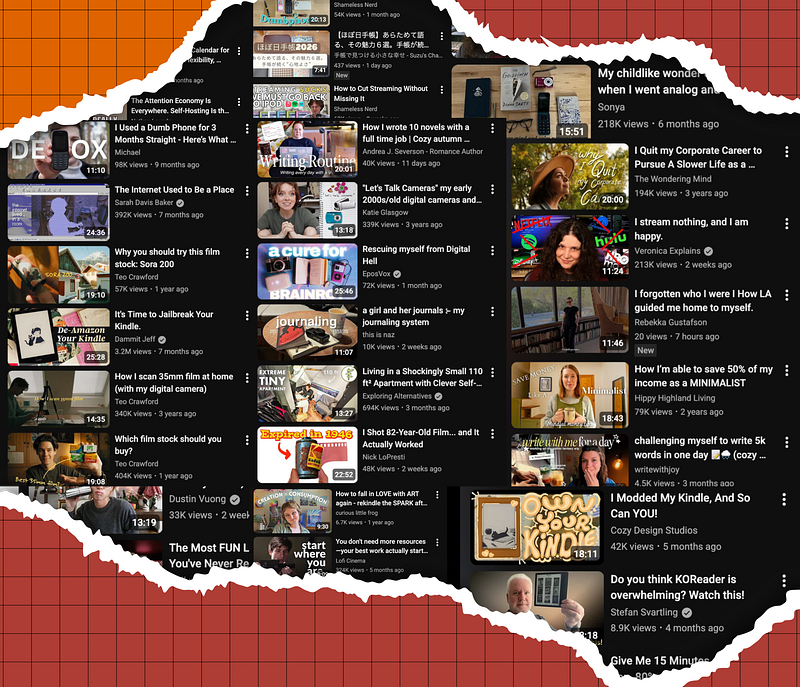
What I see on a consistent basis on YouTube.
Gen-Z love dumb phones, the analog, e-ink screens, slow living, community, and longform work.

There’s a confession I have to make, and maybe it’s a lifehack: I maintain two YouTube accounts. The first is for the usual guilty pleasures. You know, messy vlogs where people dissect their relationships in real-time, creator drama that makes soap operas look Shakespearean, influencer gossip, bizarre video game analysis. Digital junk food and garbage fire I can’t look away from.
The Kids Who Chose the Long Way Home
The second account tells a different story.
On that one, I watch Odysseas explore lifelong learning and knowledge management with the dedication of a Renaissance scholar. jvscholz, a computer engineering student, breaking down low-tech productivity systems and demonstrating how he studied 12 hours a day through sheer discipline and analog tools. IzzyBizzy’s Beehive documenting her journey from homelessness as a teen to building a life and business with faith and resilience. I watch Bread on Penguins demystify Linux and terminal workflows as literacy for anyone who wants to understand their computer. Anna Howard and her Wild Geese podcast exploring digital gardening, creativity, and how to fall down thoughtful rabbit holes instead of algorithmic ones. And angieblah and lrnjulie, championing the indie web and personal websites and reminding us the internet was built to be weird, personal, and decentralized.
And when I open that second account, I see these creators are younger than I am now. Dear God.
The generation everyone swears has an attention span measured in TikTok seconds is actually replacing doomscrolling with analog journal ecosystems. Building genuine community both online and in their local third places. Creating high-quality, well-researched video essays on slow living and Philosophy that run an hour or longer. Sharing how they construct meaning in a world designed to fragment it.
This is not what your parents’ rebellion looked like. This is much more strange and necessary.
Let’s establish the baseline of catastrophe first.
Anxiety among young adults almost tripled between 2019 and 2023 in the United States, from 8% to 22%. 53% of Gen Z regularly doomscroll, which is higher than any other demographic,spending over 128 minutes daily on social media, which is a 7% increase year-over-year, nearly ten minutes more than the previous year.
Excessive exposure to distressing online content contributes to emotional detachment, attentional fatigue, and a gradual weakening of identity clarity. Doomscrolling correlates significantly with anxiety, depression, and stress due to the excessive consumption of negative information.
But the story pivots.
46% of Gen Zers are actively taking steps to limit their screen time, according to an ExpressVPN survey. Searches for “digital detox vision board” have surged 273%, while “digital detox ideas” climbed 72%. And 38% of Gen Z adults believe that platforms and not just personal willpower are to blame for doomscrolling behaviour.
An exit is being organized.
BRICKS.
From 2021 to 2024, brick phone purchases among 18-to-24-year-olds surged 148%, while smartphone use in the same age group dropped 12%. Google searches for “dumbphones” rose 89% between 2018 and 2021. We’re talking about Motorola Razrs, Nokia 3310s, BlackBerrys with their beloved physical keyboards. The Light Phone 2 markets itself as a minimalist device with no social media, just essential functions.
“I’ve always hated being available to everyone,” music producer Rana Ali, who performs as Surya Sen, told Washington Times. “The idea that if you send a WhatsApp to someone and they don’t respond immediately, then something’s wrong.”
More than one-fifth of Gen Z say they wish smartphones had never been invented, according to a 2024 Harris Poll. Nearly half wish TikTok (47%), Snapchat (43%), or X (50%) didn’t exist.
Nineteen-year-old Caleb from Iowa explained, “I put my smartphone in a cardboard box, wrapped it in three layers of duct tape and said goodbye to it for a week.” He got used to it. Now he carries a flip phone, a notebook, and an MP3 player. “I’d much rather write about my experiences in a journal, because it feels so much more personal and emotionally driven.”
VIDEO ESSAYS.
While everyone panics about diminished attention spans, something curious is happening on YouTube. Video essays, which typically run 25 minutes to an hour long (although some are over five hours) are surging in popularity. Google data shows consistent growth over three years in searches for “video essay” content, with people clamouring for in-depth information about subjects they’re passionate about.
Mia Cole uploaded a deep exploration of core anxieties facing anyone who cares about humanity called “gen z & politics.” F.D. Signifier and Kat Blaque create researched video essays from Black leftist perspectives , tackling everything from the manosphere to to gender to Black media representation. CJ the X creates chaotic philosophical essays questioning the very notion of “bad art.” pagemelt dropped "be your own algorithm," exploring how scrolling affects our relationship to art and whether we can reclaim agency from the feed. Noah Samsen crafts leftist commentary that’s both satirical and substantive, with his "Practical Guide to Leftist YouTube" becoming a roadmap for an entire generation seeking political education. They’re dissertations that feel like conversations, with humour and warmth.
And Gen Z loves it. Research from Think with Google found that 59% of Gen Z watch longer versions of videos they discover on short-form apps. They use TikTok as a gateway drug to substance, not a substitute for it.
“Gen Z has a long attention span for in-depth video content on YouTube,” confirms one analysis. “They’re not just watching; they’re engaging, discussing, and sharing.”
ATTENTION SPANS.
Here’s where it gets complicated, because I’m nothing if not committed to contradictions. 90% of Gen Z and millennials binge-watch regularly. 86% of Gen Z binge-watch monthly, averaging 5.5 episodes over 4.1 hours in one session. Steam users spent more than 25 billion hours playing games in 2024 which is equivalent to 2.85 million years. People have Steam accounts showing thousands of hours in single games.
So what’s the difference between watching six episodes of a prestige drama and six hours of doomscrolling rage bait? Intent. Structure. Beginning, middle, end.
When you binge-watch you’re committing to a narrative arc. Doomscrolling is subjecting yourself to an infinite slot machine of cortisol spikes with no resolution.
Gen Z doesn’t have an irreversibly ruined attention span. Nobody does. When there’s something captivating and worthwhile, we can pour ourselves into it completely.
NO-BUY.
While influencers hawk endless consumption the “No Buy 2025” challenge explodes across TikTok, with searches for “no spend challenges” reaching all-time highs, up 40% year-over-year. Last year, 20% of Americans participated. The movement gained 270% growth between Christmas and the end of 2024.
Elysia Berman, 35, documented her journey on TikTok. Her breaking point came in December 2023 when she ducked into a store for gloves and emerged with a $600 coat she didn’t need and couldn’t afford. By September 2024, she’d saved tens of thousands of dollars and paid down a quarter of her debt. “Essentially, I had gone through detox and withdrawal from the dopamine you get from shopping.”
Twenty-six-year-old Mia Westrap saved around £7,000 through a no-buy year in 2024, skipping new clothes, accessories, and home decor but allowing occasional thrifting. “At university, I got into £3,000 worth of debt in my overdraft,” she explained. “What I’m doing with this no-buy year is using it as a tool to really understand my finances.”
“You’ve been targeted based on your own preferences,” as financial expert Terry Savage explains. There’s warfare against your autonomy and Gen Z is fighting back by saying no.
THIRD PLACES.
Ray Oldenburg coined the term “third place” in the 1980s to describe informal spaces, outside of home and work , where people gather, socialize, and build community. Cafés. Libraries. Parks. Bookstores. The places where democracy breathes.
Gen Z came of age during a pandemic that shuttered most of those spaces. Isolation was felt acutely. High school years locked in bedrooms. And now they’re creating new ones, often in the most unexpected ways.
There’s “Pudding Mit Gabel,” a German phrase meaning “Pudding with Fork” where young people gather in public parks to literally eat pudding with forks. It started in Karlsruhe in August 2025, spread across Germany, hit the UK and US. Absurd? Absolutely. But also cheap, silly, and genuinely connecting people in physical space.
Or “Performative Male Contests,” another hilarious phenomenon taking over college campuses where young people gather en masse. Importantly, these are low-cost activities.
Board game cafés are reopening. Restaurants hosting themed nights. People rediscovering that face-to-face interaction in safe, low-pressure spaces significantly enhances mental well-being.
“We felt this strong sense of community before even opening the doors,” one Atlanta business owner said about their Gen Z-focused space. “We knew there was this need more than ever coming out of the pandemic.”
The internet is how they’re organizing these gatherings. Technology can be a tool for good in the right hands.
LONGFORM.
All of this to say that I think longform writing is going to have a renaissance. I’ve recently written 3,000-word articles analyzing the crisis of artificial intelligence, dark themes of animated television, and defending poetry that everyone loves to hate. Marketers would never think of trying to pull young people off addictive platforms and onto sites full of words and no videos. But I think they have it wrong. I think everyone has it wrong.
Maybe it won’t be my work specifically that resonates with this generation, but I know that longform writing itself is going to start thriving again. There’s a massive void in journalism as countless local papers no longer operating, with massive syndicates with biases and profit-over-truth reigning. People need stories. All we are is storytelling creatures.
This generation, the one supposedly incapable of reading more than 280 characters, is proving that when given something actually worth reading, every word will be devoured by them.
OPTIMISM.
I’m hopeful and optimistic for the future. Of course, it absolutely should not be the responsibility of young people to save the world. But I really think they’re going to, regardless.
These are the people practicing buy-nothing years and plant-based diets and ethical boycotting. Canceling subscriptions to learn how to use technology from my era: iPods with wired headphones, torrenting, building home servers, setting up personal sites on Neocities, getting books off Anna’s Archive and Libgen.
When Amazon removed the ability to download your own purchased books via USB, they started jailbreaking their Kindles to remove DRM, and read EPUBs without Amazon’s permission. You paid for the device, you paid for the books, so why should a corporation decide what you can do with them? These are people who understand that ownership means nothing if you don’t have control.
They’re creating analog journal ecosystems not as aesthetic performance but as genuine practice. Even making their own DIY traveler’s notebooks inspired by Louise Carmen, crafting leather journal covers by hand because the act of making the vessel matters as much as filling it.
The nihilism that comes with doomscrolling is manufactured. Social media platforms want you to believe it’s impossible to get off their apps, that doom is the path of least resistance. It isn’t.
I see a generation sick and tired of screens that isolate. Fatigued with fragmenting habits. These digital natives, the people you’d expect to be most stuck on their phones, demonstrate the opposite. There’s a greater sense of disillusion in their zeitgeist, yes. But disillusion is the first step toward building something real.
I’m not worried about attention spans, but I am worried about the systems designed to fragment them. And I’m hopeful about the people learning to resist.
There will be a renaissance for longform writing. Not might be. Will be. When something is captivating and worthwhile, we can still pour ourselves into it completely.
The generation born into constant connection is choosing disconnection, raised on algorithms yet are learning to build their own paths. The generation everyone said couldn’t focus for more than eight seconds is watching three-hour video essays and reading novels and filling notebooks with actual ink.
The digital world is being reclaimed. The Internet is being used as a tool for coordination and creation rather than consumption and isolation. We are being taught that human attention is not an extractable resource. Meaningful work takes time, and that’s where the attention economy is headed.
Comments
To comment, please sign in with your website:
How it works: Your website needs to support IndieAuth. GitHub profiles work out of the box. You can also use IndieAuth.com to authenticate via GitLab, Codeberg, email, or PGP. Setup instructions.
Signed in as:
No comments yet. Be the first to share your thoughts!