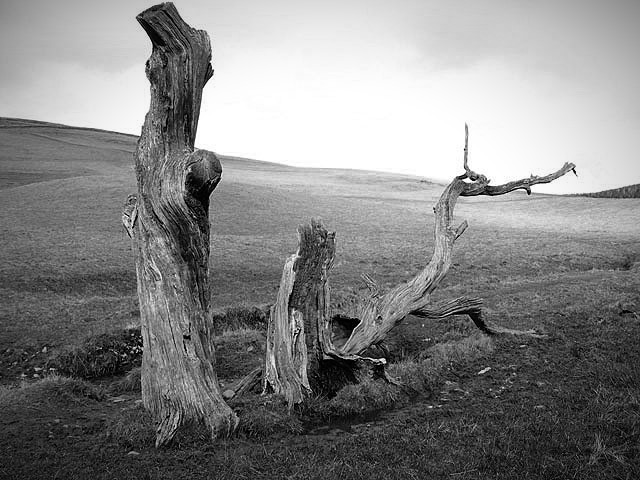
Walter Baxter / Dead and decaying trees by the Ladhope Burn / CC BY-SA 2.0.
Do It Ugly: On Bad Art and Civic Duty
Creation does not need to be productive. Art does not need to be good. Your first draft, your ugly website, your clashing colours or broken layouts are not a moral failing. These are all needed beginnings that start every worthwhile thing ever made.
This is a lie designed to keep you silent. To keep you consuming instead of creating. To keep you scrolling instead of building. To keep you buying instead of making.
It's Boxing Day here in Canada, and after celebrating Christmas with my family I am now I'm writing this. Another silly article. The act of showing up to write this silly article is the point. Not whether it's good. Not whether anyone reads it. The showing up itself is the civic duty, the spiritual practice, the resistance against a world that wants you to believe your worth is tied to your productivity.
There are a few things that stop people from starting. The biggest one? The taste gap. This concept, popularized by Ira Glass, host of This American Life, describes the painful reality every beginner faces:
"Nobody tells this to people who are beginners, I wish someone told me. All of us who do creative work, we get into it because we have good taste. But there is this gap. For the first couple years you make stuff, it's just not that good. It's trying to be good, it has potential, but it's not. But your taste, the thing that got you into the game, is still killer. And your taste is why your work disappoints you."
A lot of people have much better taste in things than they're capable of executing and creating. They're disappointed that the thing they've created is no comparison to their favorite artist/creator/dev. Or even what's in their mind's eye.
There's a common platitude that you need to be bad for awhile at something before you're good at it.
But, really, who cares?
Your bad is not a universal bad. "Bad" is not a moral failure or a waste of time. There is inherent worth to any human creation, especially moreso now in an age where anybody can effortlessly produce AI slop that superficially surpasses a human's first attempt at something.
Start ugly. Do it ugly. Make conventionally "bad" art. Fill up sketchbooks with drawings nobody would buy or double-tap. Make confusing websites, use clashing colors, violate norms, <marquee> everything. What's stopping you?
The creation of art is, largely, liberation. Untethering yourself from the ego and (usually extremely loud) inner-critic that holds you back often. There is a spiritual component to this.
The propagation of self-worth being intrinsically tied to socially-approved merit and capability is a deeply capitalist, conservative mindset. Many of the ideas and excuses holding would-be artists back are by design, manufactured carefully in order to subdue the consciousness of the working class.
When you make art that serves no market, generates no profit, optimizes for no algorithm, you are performing an act of resistance. Existence and expression have value independent of their commodification.
This is why showing up matters more than the output. This is why the practice itself is revolutionary.
Next, I am going to talk about love. I believe love is the basis for any successful, examined life. If we are to be successful artists or devs, we need to care about what we do personally. We need to love ourselves.
There is, too, the neurological formation of habit. A lot of times, I see blogs and personal sites that were clearly hand-coded with care, but only a handful of posts are on the site before it was largely abandoned. If I'm lucky, I'll see additional posts, years later, remarking about a return.
I think this comes down to purpose, to carving out time for the act and process of creation. We need to think that the work we're doing is worth the commitment. We have to hold ourselves and our personal ambitions to the same level that we hold our professional, money-earning obligations.
This shifting of mindset and the elevation of our personal (perhaps bad, ugly) art? That's the crux. We have to care about the promises we make to ourselves as much as we make to others. We have to care for ourselves as though we are our best friends.
If you were to frame the creation of your ugly, bad site or ugly, bad art as your best friend's creation, surely you would use different words, and see it entirely differently. Does it make more sense now?
My 2026 Commitment
I am somebody who tries my best to walk the walk that I talk (and I talk often). I have many plans for 2026, and they are ambitious in how unambitious they are.
As you can see at the bottom of the homepage of this blog, I am using Robb Knight's Post Graph, a GitHub-style contribution graph for blog posts. I would love to light up this graph like a Christmas tree by the end of next year.
And the way I do this is by showing my work; by thinking by writing publicly. By letting my silly monkeyweasel brain spew whatever thoughts it has every single day.
This habit comes from Julia Cameron's The Artist's Way, specifically, the practice of Morning Pages. Cameron describes them as:
"Three pages of longhand, stream of consciousness writing, done first thing in the morning. There is no wrong way to do Morning Pages—they are not high art. They are not even 'writing.' They are about anything and everything that crosses your mind—and they are for your eyes only."
I've been using Morning Pages since 2011 for my personal, private journals on 750 Words. The practice has been transformative for countless creatives, Elizabeth Gilbert (who recently wrote a new book about how she nearly killed her girlfriend, but that's beside the point) credits The Artist's Way with leading to Eat, Pray, Love.
I believe, though, after a certain amount of time and deliberate effort, these morning pages can produce something of value. And, as I've already established, if they don't, then who cares?
We are always building sandcastles. All the work we do is always only temporarily useful, at best. The tide always inevitably comes in. This is why we ought to focus on the process rather than the outcome and output.
I write and I create as evidence and proof of life. I act and archive for the sake of having a memory. I've existed over 10,000 days. How many do I remember? How much of my existence has been meaningful, or at the very least, examined?
As Glass continued: "The most important thing you can do is do a lot of work. Do a huge volume of work. Put yourself on a deadline so that every week or every month you know you're going to finish one story. It is only by going through a volume of work that you're going to catch up and close that gap."
I don't mean to become so existential about the craft, about silly writing and art, but this has always been such an effective motivator for me. Working in a hospice has taught me how fragile and finite this bizarre existence is, how short the human lifespan is compared to the age of the universe.
I feel immense gratitude and luck for this arbitrary, random hairless ape body I've been born into, and that I continue to be bound to and reside in, for whatever reason. I have a /death page because of this.
Many would consider this morbid, or even worrying. It is sad to me how taboo the concept of death itself is within western culture. People avoid the topic and inevitable phenomenon to the point of having no plans for when the inevitable arrives. I plan to live to 100 years old, but everybody has a plan until they get punched in the face, as Mike Tyson said.
How many sunsets will you witness? How many words will you write?
Perhaps these are different categories of questions, but I really don't think so. They're both about the same thing: the conscious choice to be present in your finite existence.
It is our civic duty to contribute to open-source projects and the greater free and open community. Not because we'll be good at it immediately. Not because our contributions will be perfect. But because the act of contributing, of showing up, of making something and sharing it. That's what keeps the commons alive.
Grow. Like a seed.
You don't apologize for being a seedling. You don't wait until you're a tree to take root. You start where you are, ugly and incomplete, and you grow.
Start ugly. Do it ugly. Make bad art.
The world needs more human things. It needs your weird, messy, imperfect contributions. It needs you to show up before you're ready.
It needs you to believe in the act of creation itself. Independent of its quality, independent of its reception, and independent of its market value. There is value because you are valuable.
Make something today. Make something bad. Make something embarrassing. Make something that disappoints you. And then show up tomorrow and do it again. That's the work. That's the practice. That's the liberation.


Comments
To comment, please sign in with your website:
How it works: Your website needs to support IndieAuth. GitHub profiles work out of the box. You can also use IndieAuth.com to authenticate via GitLab, Codeberg, email, or PGP. Setup instructions.
Signed in as:
No comments yet. Be the first to share your thoughts!