What Can We Give One Another? On Public Domain, Preservation, and Living Without Copyright
Here's an idea. What if everything you consumed was freely available? Not pirated. Not "technically legal." Actually, genuinely free. Public domain. Creative Commons. Open source. Free software. Free culture.
News came out in the past few days about the fact that the largest shadow library on the Internet, Anna's Archive, has successfully scraped Spotify's music catalog and is planning on releasing it to the public in whole. 256 million tracks of metadata, 86 million audio files, nearly 300 terabytes of data, representing 99.6% of all listens on Spotify.
Spotify is furious, calling Anna's Archive "anti-copyright extremists" and shutting down the user accounts involved. But Anna's Archive frames it differently: "preserving humanity's knowledge and culture." Creating "the world's first 'preservation archive' for music which is fully open."
I think about the illegal-yet-morally-grey work such as this. The preservation of our art and culture seem far more important than copyright law. And perhaps it is a worthwhile trade-off.
In Which I Consider a Year of Only Free Culture
But it makes me wonder (and this is something I've been mulling for a very long while) how much of culture could I partake in if I limited myself to only works in the public domain or that fall under Creative Commons use?
I already actively engage with non-copyrighted work often. All of my book covers are of public domain artwork. I typically use images in the creative commons for my articles, such as this one. My own writing on this site is actually under Creative Commons BY-SA 4.0 and all of my code on GitLab is under an MIT license for the most part.
But I'm not talking about covering my ass legally with what I publish and use, here. I'm talking about my own personal consumption. Films, music, television, software. Everything but the kitchen sink (which, sure, could have open-source CAD schematics, but that isn't free as in free beer. Ever.)
It actually sounds like a rather fun challenge for 2026.
The Orthodox Approach is Going Full FOSS Puritan
First, I need to list out all the possible resources to make this happen. I would have to retire my MacBook and my iPhone and return to my trusty ThinkPad with libreboot to start.
Regarding media, it actually is fairly easy. The fact the work is public domain means it's widely available and immediate. But how do I find it? I feel as though I certainly couldn't be using Google for my searches.
If I'm orthodox about this, like a genuine FOSS puritan, there are actually many different steps I need to take into consideration. I'm reminded of Carl Sagan's quote,
"If you wish to make an apple pie from scratch, you must first invent the universe."
From his 1980 series Cosmos, Sagan meant that nothing exists in isolation. Every ingredient in an apple pie — the flour, sugar, cinnamon, even the apples themselves — can be traced back through an unbroken chain of cause and effect to the Big Bang. To truly make something "from scratch," you'd need to start with hydrogen atoms and 13.8 billion years.
The same logic applies here. To consume only free culture, you must first build free infrastructure. Free operating system. Free browser. Free search engine. Free video player. Free music player. Free everything.
Which means (on a surface-level):
- OS: Debian, Arch Linux, or Trisquel GNU/Linux (FSF-endorsed)
- Browser: Firefox or GNU IceCat
- Search: DuckDuckGo, Searx, or Mojeek
- Music: VLC or Audacious
- Video: mpv or VLC
- Office: LibreOffice
- Graphics: GIMP, Inkscape, Krita
- Code: VS Code (MIT licensed) or VSCodium (telemetry-free fork)
The infrastructure exists. The question is whether you'd have the discipline to use it exclusively.
What's Entering Public Domain in 2026
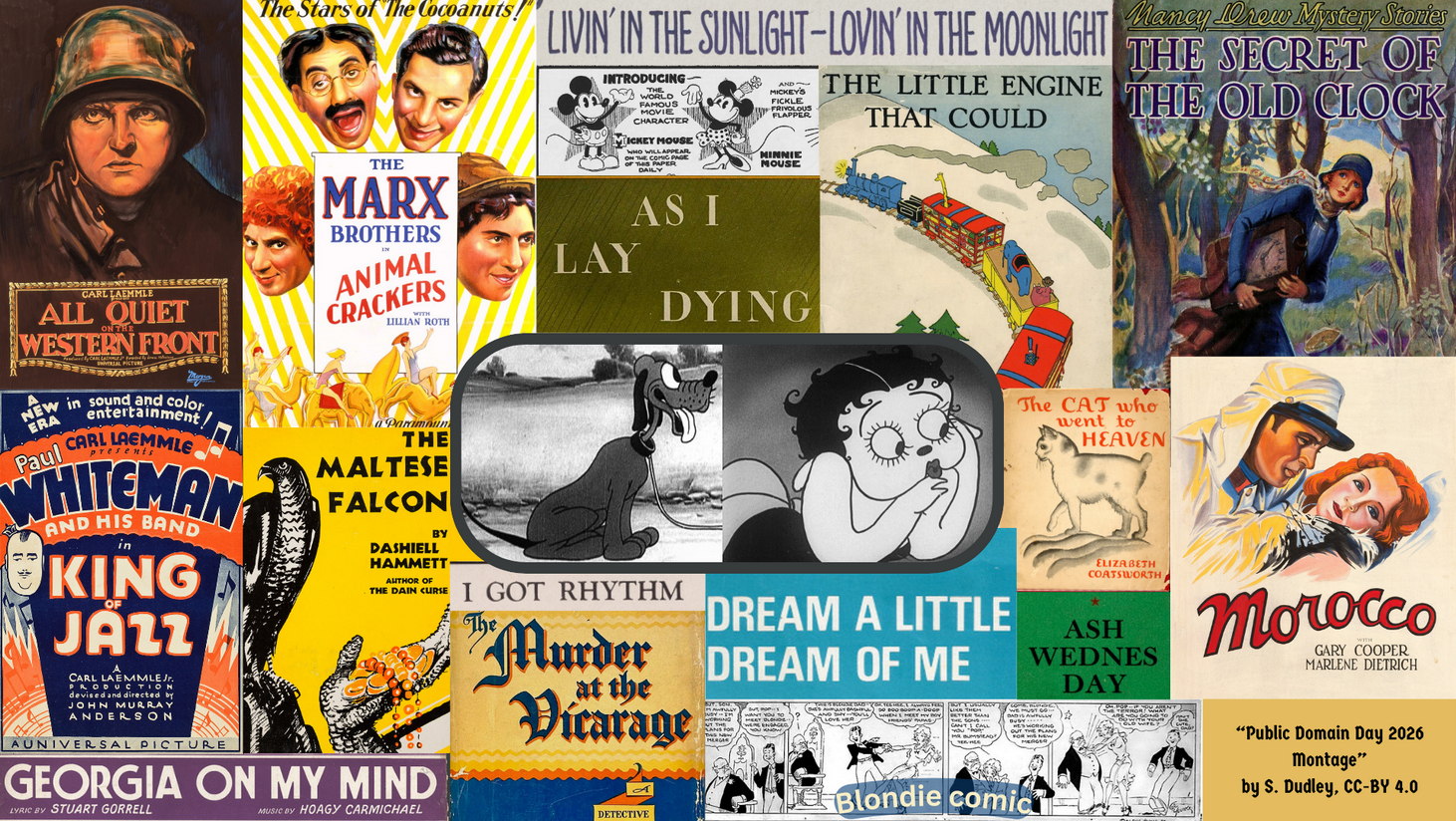
But the real fun part? In a few days on January 1st, 2026, thousands of works from 1930 enter the US public domain.
According to Duke Law's Center for the Study of the Public Domain, this year's haul includes:
Characters & Cartoons:
- Betty Boop (original 1930 version from Dizzy Dishes) — though Fleischer Studios is disputing this
- Pluto (originally named Rover, from Disney's The Chain Gang)
- Blondie and Dagwood (from the comic strip)
- Mickey Mouse (1930 cartoons)
- Bimbo (Betty Boop's boyfriend)
Literature:
- William Faulkner's As I Lay Dying
- Dashiell Hammett's The Maltese Falcon (complete novel)
- Agatha Christie's The Murder at the Vicarage (first Miss Marple mystery)
- The first four Nancy Drew novels
- The Little Engine That Could by Watty Piper
- T.S. Eliot's poem "Ash Wednesday"
- Evelyn Waugh's Vile Bodies
Films:
- All Quiet on the Western Front (1930 Best Picture winner)
- Animal Crackers (Marx Brothers)
- Anna Christie (Greta Garbo's first talkie)
- The Big Trail (John Wayne's first lead role)
- Morocco (Marlene Dietrich)
Music:
- "I Got Rhythm" (George & Ira Gershwin)
- "Georgia on My Mind" (Hoagy Carmichael & Stuart Gorrell)
- "Dream a Little Dream of Me"
- "Body and Soul"
And as Jennifer Jenkins notes, anyone can adapt these works without permission or payment. You and I could make a Betty Boop musical. A Nancy Drew horror film. A Faulkner graphic novel. Whatever we want.
A Betty Boop horror movie is already in production, following the trend of 2025's Winnie-the-Pooh, Steamboat Willie, and Bambi slashers.
Of course, there are specific intellectual properties that explicitly become public domain on January 1st. Nancy Drew, Betty Boop, the Maltese Falcon, Animal Crackers. It'll probably be similar to how everyone made a stir when Steamboat Willie and Winnie the Pooh entered the public domain not so long ago.
But I'm not actually interested in this aspect of it. These are the works that are still lingering in the cultural zeitgeist. The artifacts of another age that haven't yet passed. I'm interested in performing archaeology, in the unearthing of what has been completely forgotten.
Public Domain Resources
Where do you find public domain works that (nearly) nobody remembers?
Books & Text:
- Project Gutenberg — 70,000+ free ebooks, mostly pre-1928
- Internet Archive — 20+ million books, plus the Wayback Machine
- HathiTrust — 17+ million digitized items
- Google Books Advanced Search — limit to pre-1923 with
date:1790-1922 - Library of Congress Digital Collections — maps, manuscripts, photos, recordings
- Wikisource — free library of source texts
Films:
- Internet Archive Moving Image Archive — ephemeral films, newsreels, cartoons
- Prelinger Archives — advertising, educational, industrial films
- Public Domain Movies — curated list of films
- Library of Congress National Screening Room — historically significant films
Music:
- Internet Archive Audio — 78rpm records, wax cylinders, live concerts
- Musopen — royalty-free recordings of classical music
- International Music Score Library Project (IMSLP) — 600,000+ scores
- Library of Congress National Jukebox — historical recordings
- Free Music Archive — Creative Commons music
Images & Art:
- The Metropolitan Museum of Art — 492,000+ images under CC0
- Rijksmuseum — 700,000+ images under CC0
- Smithsonian Open Access — 4.5 million images under CC0
- National Gallery of Art — 55,000+ open access images
- Wikimedia Commons — 100+ million freely usable media files
- The Public Domain Review — curated essays on public domain works
The resources exist. The infrastructure exists. The culture exists, freely available to anyone who wants it.
Consumption vs. Creation
Completely worry-free remixing and output. I could start doing livestreams watching full-length film watchalongs on Twitch.tv or YouTube without any worry of DMCA claims (if only those were FOSS, hm.)
I think this idea actually has a lot of meat on its bone. It's the equivalent of getting a massive stack of old magazines from the attic and starting to make zines. There's so much raw material to work with, long-forgotten art that people really poured themselves into from another time. Art where everybody involved has most likely passed away.
The Internet Archive's Public Domain Film Remix Contest invites filmmakers to create 2-3 minute shorts using newly liberated works. Duke Law hosts annual events celebrating Public Domain Day. Communities gather around this stuff.
Remix culture thrives on the commons. Girl Talk's mashups. Everything is a Remix. Hip-hop sampling. Fan fiction. Vidding. The entire web was built on people taking what came before and making it new.
But when everything is copyrighted for 95 years after publication (or life of author plus 70 years), remix culture suffocates. We're left with a 20-year gap where almost nothing new enters the public domain, from 1998-2018, thanks to the Sonny Bono Copyright Term Extension Act.
As Lawrence Lessig argues in Free Culture, copyright was meant to be a temporary monopoly to incentivize creation, not a perpetual lock on culture itself.
The Second Death
I can't move the needle of culture. Even if I were to really make compelling art with completely obscure public domain work, my work too is obscure. But they say you die twice, and the second time is when someone says your name for the last time.
This is what is so puzzling to me about today's state of copyright. There is white-knuckle hoarding of great works and characters and franchises. So much is going to end up being totally forgotten because nobody is allowed to use what came before. We need to be allowed to stand on the shoulders of giants.
Orphan works — works where the copyright holder can't be found — make up an estimated 70-80% of all works under copyright. Books, films, music, photographs that legally cannot be used because nobody knows who owns them. The Copyright Office estimates that millions of works are locked away, culturally dead despite being legally alive.
Compare this to the aggressive preservation work of Anna's Archive, which has 61+ million books and 95+ million papers freely available. Google removed nearly 800 million links to Anna's Archive after publisher takedown requests. Copyright holders are fighting tooth and nail to keep culture locked up.
Meanwhile, culture rots. Nitrate film deteriorates. Master tapes degrade. Books yellow and crumble. Digital formats become obsolete. And copyright law says: let it rot. Better that than let someone preserve it without permission.
The Internet Archive's lawsuit over digital book lending shows the stakes. Publishers sued because the Archive let people borrow digitized books during the pandemic. The Archive lost. Preservation without permission is theft. Allowing culture to die because someone might theoretically profit from it someday is the real crime.
What Can We Give One Another?
This is the question I keep coming back to. What can we give one another?
Copyright says: nothing. Everything is owned. Everything is locked. Wait 95 years and maybe, maybe, you can have it.
Public domain says: everything. All of human culture before 1930 is yours. Adapt it. Remix it. Build on it. Make it new.
Creative Commons says: here's a middle ground. Use my work, but give credit. Or don't make money from it. Or share your changes. Six licenses, six different ways to share.
Open source says: here's the code. Fork it. Improve it. Make it yours. Just keep it free.
FOSS says: freedom means freedom. Not just "free as in free beer" but "free as in freedom." The freedom to run, study, modify, and distribute.
What we give one another is permission to build on what came before. Permission to remember. Permission to remix. Permission to make culture instead of just consuming it.
The 2026 Challenge
So here's my challenge to myself. Live on public domain and open culture for a year.
Rules:
- All new media consumption must be public domain, Creative Commons, or open source
- Exception: Works I already own physically (books, records, etc.) are grandfathered in
- Exception: Live performances and in-person art exhibitions (you can't pirate being there)
- Hardware: Use FOSS-compatible hardware where possible, but don't replace working devices wastefully
- Track everything: Document what I consume, where I find it, what's missing
What this means:
- Reading Project Gutenberg instead of new releases
- Watching films from Internet Archive instead of streaming services
- Listening to classical music, old jazz, field recordings instead of Spotify
- Using only FOSS software for all creative work
- Writing everything under Creative Commons BY-SA
- Releasing all code under GPL or MIT
Can I live a rich cultural life entirely on the commons? Or will I discover that modern culture is locked so tightly behind paywalls and copyright that opting out means cultural death?
Anna's Archive preserves 61+ million books. Internet Archive has 20+ million texts. Project Gutenberg has 70,000+ ebooks. Culture wants to be shared. Stories want to be told and retold. Songs want to be sung and remixed. Images want to be seen and reimagined.
Copyright says wait 95 years. Public domain says it's already yours. Creative Commons says take it, with conditions. FOSS says here's how it's made, make it better. What can we give one another? Everything. If we choose to.
Further Reading
Finding Public Domain Works:
- Duke Law's Public Domain Day 2026
- Public Domain Review's Guide
- Internet Archive
- Project Gutenberg
- Wikimedia Commons
- HathiTrust
Creative Commons Resources:
- Creative Commons Search
- Free Music Archive
- Pixabay
- Unsplash (not all CC, check licenses)
FOSS Software:
- Free Software Foundation
- GNU Project
- F-Droid (Android FOSS apps)
- AlternativeTo (find FOSS alternatives)
On Copyright & Culture:
- Lawrence Lessig's Free Culture
- Copyright Term Extension Act (Wikipedia)
- Orphan Works (Copyright Office)
On Anna's Archive & Spotify: