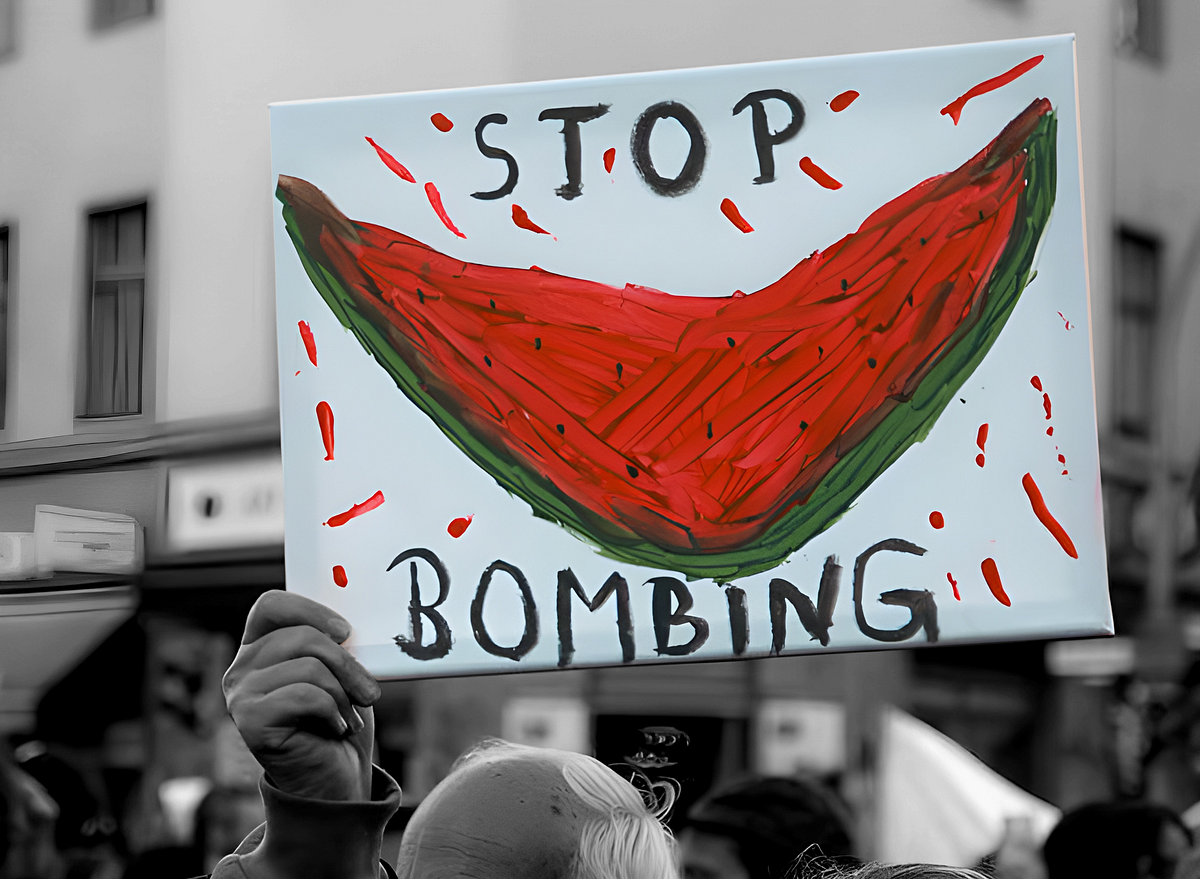
Witnessing Palestine & the United States
Most Indigenous folks know and will tell you plainly that our world already ended. Nick Estes (Lower Brule Sioux) stated in a 2019 Dissent Magazine interview: “Indigenous people are post-apocalyptic. In some cases, we have undergone several apocalypses.” He cited the destruction of buffalo herds, animal relatives, and river homelands as distinct catastrophes his community survived. Leanne Betasamosake Simpson (Michi Saagiig Nishnaabeg) writes “Indigenous peoples have been engaged in over 4 centuries of resistance against a violent backdrop of conquest, genocide, expansive dispossession, unfettered capitalist exploitation, heteropatriarchy, white supremacy and environmental apocalypse.” Our ways of living and knowing already ended centuries ago, with unflinching brutality.
Windows down, scream along
To some America First rap, country song
A slaughterhouse, an outlet mall
Slot machines, fear of God.—Phoebe Bridgers, “I Know the End”
You say the ocean’s rising like I give a shit
You say the whole world’s ending, honey, it already did
You’re not gonna slow it, Heaven knows you tried.—Bo Burnham, “All Eyes on Me”
And, funnily enough, most Westerners are people who yearn for such a way of living, to be off-grid, untethered to having their worth and survival directly attached to wage and labour. Harbinger Journal’s analysis reveals, “the homesteader fantasy of living outside of the capitalist system is in fact impossible; it rests on the benefits of Indigenous land dispossession, racist implementation of land policies, and ongoing state subsidies.” The pastoral fantasy, the commune, the gatherer—they all become increasingly distant in our peripheral, available only to those with the privilege to opt out.
But I have seen, throughout my life, how even these distant fantasies recede further still.
The past couple years have been explicit in atrocity unique compared to the past few decades. We have witnessed what has been categorically and formally labelled a genocide. The UN Independent International Commission of Inquiry concluded in September 2025 that Israel has committed genocide against Palestinians in the Gaza Strip. Commission Chair Navi Pillay stated how the “international community cannot stay silent on the genocidal campaign launched by Israel against the Palestinian people in Gaza. When clear signs and evidence of genocide emerge, the absence of action to stop it amounts to complicity.”
Between October 7, 2023 and July 31, 2025, 60,199 Palestinians were killed including 18,430 children and 9,735 women. Life expectancy in Gaza decreased from 75.5 years to 40.5 years—a 46.3% decline. UNICEF reported that more than 50,000 children have been killed or injured, with at least 100 children killed or injured every day since the ceasefire breakdown. Human Rights Watch’s 179-page December 2024 report concluded Israeli authorities committed “crime against humanity of extermination” and “acts of genocide.” Amnesty International’s 296-page report stated there is “sufficient basis to conclude that Israel has committed and is continuing to commit genocide.”
And yet supposedly intellectual and moral people still go up to bat for an apartheid state that has claimed the lives of thousands of children.
As the United States—a supposedly first-world nation—has had people of all ages flailing and screaming as plain-clothed masked men allegedly working for a just government disappears these individuals—some citizens, some with cancer—without any due process whatsoever. In April 2025, ICE deported a 4-year-old U.S. citizen child with Stage 4 kidney cancer to Honduras after arresting the mother. The ACLU lawsuit states: “U.S. citizen child suffering from a rare form of metastatic cancer was deported without medication or the ability to consult with their treating physicians–despite ICE being notified in advance of the child’s urgent medical needs.”
The ACLU’s 2024 report “Deadly Failures” found that 95% of deaths examined from 2017–2021 were deemed preventable or possibly preventable with adequate medical care. The study found 88% of deaths involved incorrect or incomplete diagnoses, and 61% had falsified or insufficient medical documentation.
And in the dozens of videos of these people being disappeared, there are countless unharmed citizens on the sidelines doing nothing. Witnesses first-hand to atrocities committed. I think of what Einstein wrote in his March 30, 1953 letter: “The world is in greater peril from those who tolerate or encourage evil than from those who actually commit it.”
This is not even to mention the genocides occurring in Sudan and the Congo. In Sudan, the US Senate estimated that actual deaths could reach 150,000—ten to fifteen times higher than official counts. The Yale Humanitarian Research Lab documented 31+ clusters of objects consistent with human bodies (1.3–2 meters in length) in El-Fasher, with red discoloration visible from space around body clusters—blood visible from orbit. They documented 43+ villages burned near El Fasher by June 2024, with over 100 predominantly Masalit and Zaghawa communities destroyed across Darfur. The US State Department formally determined on January 7, 2025 that the Rapid Support Forces committed genocide in Darfur.
In the Democratic Republic of Congo, Prime Minister Judith Suminwa reported on February 24, 2025 that 7,000+ people were killed since January 2025 alone, including 3,000 deaths in Goma. The UN Human Rights Office documented at least 319 civilians killed by M23 between July 9–21, 2025 in 14 villages near Virunga National Park. The historic death toll since the conflict began exceeds 6 million lives—one of deadliest conflicts since WWII. Currently 7.8 million are internally displaced and 28 million face food insecurity.
These conflicts have become so violent that the blood of the innocent is visible from space.
Are we doing anything?
Complicit.
This essay is not finger-wagging or pearl-clutching. I am as complicit as everybody else not risking their lives to save others. The most I can say I’ve done is that I created 🍉 Watermelon Club as a way for Canadian students to start activism initiatives, I’ve attended protests, I’ve practised boycotting. So what?
I think of the moral framework that is systematic to all of us, and that I write about often—of sin, corruption, the tainting of the innocent, what salvation means and how one can achieve it. We must somehow, collectively, figure a way to reckon with our complicity. With the horrors that are so easy to find and witness and caused by those who are supposed to be responsible for justice.
One of my favourite books on the topic is succinctly titled One Day, Everyone Will Have Always Been Against This by Omar El Akkad. Omar El Akkad’s viral October 25, 2023 tweet captured the phenomenon of retroactive moral revisionism: “One day, when it’s safe, when there’s no personal downside to calling a thing what it is, when it’s too late to hold anyone accountable, everyone will have always been against this.” Posted after three weeks of Gaza bombardment, the tweet received over 10 million views and became the title of his first nonfiction book. In a Literary Hub interview, El Akkad explained: “I’m just so preemptively furious at the moment, many years from now, when we’re gonna get all of those, you know, ‘Hiroshima’-type stories. The after-the-fact shared grief, the how-could-we-let-this-happen type stuff. I’m just so furious that we’re going to do it again.”
I think of how these past few years in particular will be washed and retroactively made clean. How the protests against South Africa apartheid or the Vietnam war or the invasion of Iraq have already had such rebranding. For the Iraq War, 72% of Americans supported it when it began in March 2003, but by 2015 only 38% admitted they supported sending troops. A 2015 YouGov poll found that while more than 60% actually favored sending ground troops in February 2003, most Americans now remember themselves as opposed. The memory gap is most severe among Democrats: in 2003, more than half of Democrats supported the war, but today only 19% admit they supported it while two-thirds remember themselves as anti-war.
For Vietnam, in August 1965, 60% said it was not a mistake to send troops, with only 24% saying it was a mistake. A 1968 Gallup poll found 56% approved of Chicago police beating anti-war protesters. Yet by November 2000, 69% believed sending troops to Vietnam was a mistake. The complete reversal from majority support to majority opposition happened gradually, but today’s memory suggests everyone was always against it.
The Neoliberal Dream.
I was born in 1996, I was eleven-years-old when Barack Obama was elected president. My parents vote NDP. I was raised with this surrounding and culture of progressive neoliberal idealism. We were told to foster empathy for others unlike us. Every school I attended was inundated with posters of multi-racial utopias telling us love is love. That things were only going to get just and fair and equitable for all. I was fortunate enough to witness, with the aid of effective propaganda, a world where people started caring more about the rights for all and the rights for our planet. A rise of acceptance, of mindfulness towards environmental initiatives and social justice.
And then, as I entered adulthood, I watched all of this progress bleed. I witnessed rot festered under the floorboards of our ideals. A return and a normalization of what is labelled conservative tendencies and principles but what is truly just malfeasance and intentional harm. The stripping of public and social welfare, the return of slurs to vernacular, the normalization of dehumanization and elimination of personhood from others.
This month began with the ongoing government shutdown that started October 1, 2025, threatening to eliminate SNAP benefits for 42 million Americans. The USDA initially announced that “the well has run dry” and benefits would not be issued November 1st.
Multiple states warned recipients that November SNAP benefits would not be paid until the shutdown ends. There is no indication of it ending.
It is understood that no society is more than three meals away from revolution, right? And yet again the United States, the great American experiment proves this idiom wrong, with popular discourse getting in the weeds of what exactly food stamps are used for and who is worthy of them—even as millions face immediate hunger with Thanksgiving approaching.
The human cost is immediate. Brian McGrain, executive director of Michigan Community Action, stated: “If [SNAP] benefits go unfunded, where are people going to turn? We know that a wave could be coming and we may not be able to meet that emergency need.” Food banks across the country are already under strain from recent cuts to SNAP that will cause 22.3 million families to lose some or all of their benefits according to the Urban Institute.
This isn’t abstract policy—it’s happening right now, as I write this, as you read this.
And likewise, what are schools now? Teachers inform us that the new normal in classrooms is the unbridled rage and violence of children, that they now must endure desks being hurled at them. An American Psychological Association survey of nearly 15,000 teachers and school staff found 14% of teachers were physically attacked by students, 33% experienced verbal harassment or threat of violence, and 43% said they wanted to quit. Catherine Brendel, a San Antonio teacher, was attacked by a student who “smashed textbook against her head” and “punched her in abdomen and arm.” She suffered a concussion, tinnitus, severe headaches, chronic dizziness, and developed PTSD and night terrors. She stated: “I promise you that today, chairs were thrown in classrooms, scissors were thrown in classrooms, and bulletin boards were pulled down. It’s horrible, and we have all got to change it.”
Our lexicon mirrors this. Everything is a psy-op, everything is ragebait, everything is brainrot.
Similar to Prometheus and fire, we stole silicon, we turned it into an incomprehensible device that fits in our pocket and as a result everyday we are devoured, only to regenerate the next day.
How We Reckon.
How do we reckon with all of this? How do we continue? How can we possibly endure with our heart intact? Again, I think back to the witnesses of ICE abuse and government-sanctioned terrorism.
I think of Audre Lorde and her idea of self-care. Not self-indulgence, but a radical act of self-preservation and political warfare necessary for marginalized groups to survive and thrive in a hostile world. From “A Burst of Light: And Other Essays” (1988): “Caring for myself is not self-indulgence, it is self-preservation, and that is an act of political warfare.” Lorde wrote this as a Black disabled lesbian experiencing multiple forms of oppression, from journal entries chronicling her experience after her breast cancer metastasized to her liver. Get enough sleep, exercise, eat well with others. Self-care is crucial for maintaining the ability to continue fighting for liberation and is not a luxury but a necessity.
I think of love. Specifically, to quote Freire, how “love is an act of courage, not of fear, love is a commitment to others. No matter where the oppressed are found, the act of love is commitment to their cause—the cause of liberation.” This appears in Pedagogy of the Oppressed, Chapter 3, written during exile from Brazil based on his work with peasants in literacy programs. Freire explicitly connects this to revolutionary struggle, arguing that dialogue cannot exist without “profound love for the world and for people” and that love “is thus necessarily the task of responsible Subjects and cannot exist in a relation of domination.”
Be scared, try something. Flail. Scream. Anything is certainly better than nothing. Do not let your eyes gloss over, do not go gently into that dark night in front of us. Act human, please, for the love of God. It is the only way we can properly restore humanity.
Our collective inability to let go of certain comforts and status quo is to our own detriment. The future will only become exponentially more uncomfortable, difficult, and laborious. We need to be willing to risk more to help those who cannot help ourselves. Do the (minorly) uncomfortable thing of reaching out to others, of talking to strangers and neighbours, of being informed, of realizing there is an extremely compelling power in numbers.
Our ability to become numb, our excellent cognitive dissonance is the greatest threat to our collective future. All we have is each other.
Joy.
One of the most important things I think we can do to both endure and fight back is to cultivate our joy. Queer joy, Black joy, Disabled joy, Indigenous joy, Palestinian joy.
In Queer communities, ACT UP (AIDS Coalition to Unleash Power, founded 1987) pioneered combining “serious politics and joyful living” as member Maxine Wolfe described it. During the AIDS crisis and government inaction, ACT UP used pleasure as “an integral part of their resistance—they used it to raise hell and hold government officials accountable,” creating spaces where dance parties, sexual liberation, and direct action coexisted. Texas LGBTQ+ activists demonstrated this during 2023 legislative attacks by creating “spaces of queer joy: nail salons at the capitol, karaoke while waiting to testify,” asserting that “queer joy is perhaps our greatest tool of resistance in our march for freedom.”
Black Joy as a formalized movement emerged from Kleaver Cruz’s work beginning in November 2015. During depression and after loss, Cruz posted a photo of their mother with #BlackJoy and challenged others to “bombard the internet with joy.” Cruz founded The Black Joy Project, explaining: “Black joy is not dismissing or creating an ‘alternate’ black narrative that ignores the realities of our collective pain; rather, it is about holding the pain and injustice in tension with the joy we experience. It’s about using that joy as an entry into understanding the oppressive forces we navigate through as a means to imagine and create a world free of them.”
Disabled Joy emerges from the Disability Justice Movement founded in 2005 by the Sins Invalid collective. Patty Berne articulated: “Joy is a vital part of Disability Justice and Utopia building because where happiness is often given and taken away from us by the oppressor, joy is something that we create from within. It’s not something that can be taken away.” Leah Lakshmi Piepzna-Samarasinha stated: “As disabled people, we’re told we don’t deserve pleasure, [that] we just deserve this utilitarian, bland life and we’re lucky not to be dead.”
Indigenous Joy builds upon the concept of “survivance” articulated by Gerald Vizenor (2008), meaning “not simply surviving the centuries of harm by settler colonialists; rather, it is active resistance through critical consciousness and radical healing.” Two-Spirit and Indigiqueer communities particularly emphasize joy as medicine and survivance. Shilo George (Southern Cheyenne and Arapaho) and Brianna Bragg host “Your Two-Spirit Aunties” podcast, noting how “there is something about being Two-Spirit that feels magic. It’s medicine.” The Paths (Re)Membered Project’s photo series “Remembering Queer Indigenous Joy” by Evan Bennally Atwood (Diné/Navajo) documents “joyfully existing as a Queer Indigenous person is an act of survivance and reclamation.”
Palestinian Joy operates under conditions of active genocide and occupation, making it perhaps the most defiant form of resistance. Ibrahim Nasrallah, Palestinian author, articulated: “The job of the writer, sometimes, is to remind people that they have feet still capable of dancing.” Palestinian poet Mourid Barghouti wrote: “The oppressed lose if, deep within, they fail to hold more beauty than their oppressors.”
The Palestine Writes Literature Festival (September 22–24, 2023) at University of Pennsylvania drew over 1,500 attendees celebrating Palestinian writers, featuring hakawati (storytelling), dabke performances, and children on stage naming their Palestinian villages of heritage. Abdelrahman Elgendy documented: “In the hallways, people hugged and cried; they embodied a celebration of an exceptional capability of joy. Of bearing the weight of decades-long generational scattering in one hand, and the warm maftoul of Palestinian grandmothers in the other.” Dabke, traditional Palestinian folk dance, has been “transformed from celebratory entertainment into profound resistance—a joyful defiance” where “each stomp declares existence, each leap celebrates survival” and “each stamp on the ground asserts: we exist, we persist, and we will not be erased.”
When ceasefire took effect in January 2025, Al Jazeera’s headline read “Joy beyond measure” as families dismantled tents and returned home despite destruction. Children waved Palestinian flags while one person stated: “Here, we are always scared and worried, but back home we will be very happy, and joy will come back to our lives.” Israeli authorities immediately imposed military operations and checkpoints to suppress these celebrations, attempting to ban public displays of joy at prisoner releases. Despite these attempts, families celebrated released prisoners wearing their prayer beads and singing liberation songs, with one mother describing her son’s release as “his wedding day.”
There is, somehow, life to be lived waiting in the wings of all of this. Joy is the fuel sustaining our resistance. It is the assertion that we are still here, still human, still capable of beauty despite everything trying to crush us.
What You Can Do Right Now
I know you’re reading this feeling overwhelmed. Maybe you’re thinking “what can I possibly do?” Paralysis is exactly what those in power want. So here’s what you do:
This Week:
- Search for existing mutual aid networks in your area. Start by looking up “[your city] mutual aid” on social media. Dean Spade’s book and Mariame Kaba and AOC’s Mutual Aid 101 Toolkit provide step-by-step instructions.
- Attend one organizing meeting or training. The Ruckus Society, Training for Change, and local organizations offer regular trainings.
- Have three one-on-one conversations with people about taking action. Not just talking about how bad things are—actually planning what you’ll do together.
This Month:
- Join or start a study group with 5–15 people. The People’s Forum offers courses and recorded lectures. The Red Nation’s reading lists ground Indigenous organizing.
- Form a pod of 5–10 people for mutual support using pod mapping worksheets. Create a neighborhood group you can count on.
- Take one solidarity action responding to frontline organizers’ call. Long COVID Justice’s Direct Action Toolkit provides COVID-safer action ideas.
Direction Action Resources:
- CrimethInc’s Direct Action Guide provides comprehensive planning for coordinated actions
- Community Defense Zone Starter Guide helps create phone trees and text alerts for ICE raids or police activity
- ACT UP Civil Disobedience Training Manual offers complete training from AIDS activism experience
- Critical Resistance’s Abolitionist Toolkit provides comprehensive organizing strategies
Long-term Commitment:
- Build consistent relationships with community organizations
- Show up regularly to meetings and actions
- Share resources through mutual aid networks like HUMANs
- Keep learning through political education
- Practice security culture to protect vulnerable community members The key is to start somewhere. Don’t wait until you feel ready or until you have it all figured out. The Commons Social Change Library and Activist Handbook provide comprehensive resources for sustained organizing.
Cultivate your joy. Connect with others. Build power. The future depends on what we do today.
Comments
To comment, please sign in with your website:
How it works: Your website needs to support IndieAuth. GitHub profiles work out of the box. You can also use IndieAuth.com to authenticate via GitLab, Codeberg, email, or PGP. Setup instructions.
Signed in as:
No comments yet. Be the first to share your thoughts!