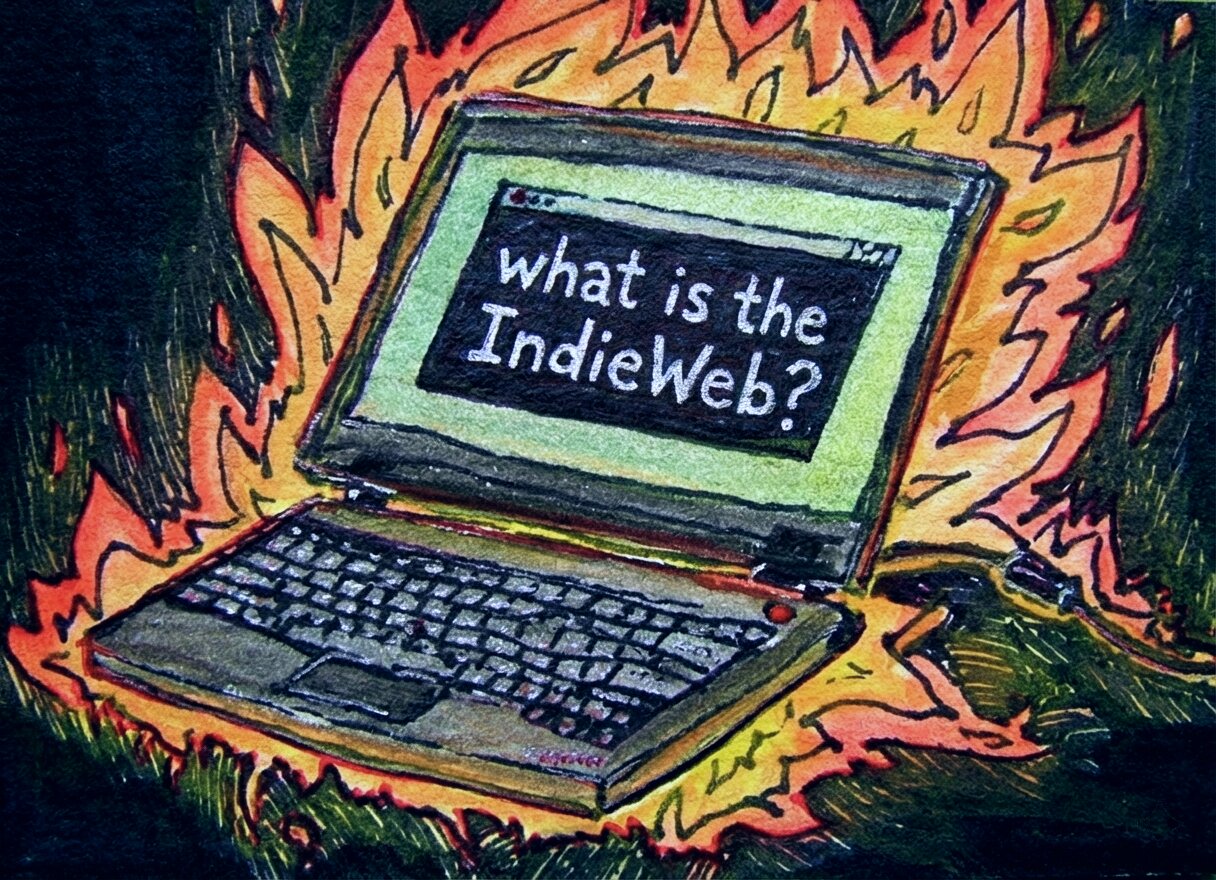
Illustration by Sarah Klockars-Clauser | Source (Edited by the Author)
What is the IndieWeb?

Recently, I had a conversation with the wonderful IndieWeb curator and Infosec specialist Mike Sass a.k.a. Shellsharks. He wrote about how he found Medium to not be a part of the IndieWeb after someone else shared my Medium article praising omg.lol.
He ended up writing a blog post attempting to define what the HumanWeb exactly is. It is a really good write-up and I suggest you read it if you're curious about the IndieWeb, as I think it covers things better than I could.
But, just for fun, I thought I'd write out what I think this part of the Internet is, and why it's important. If nothing else, I think it's a fun blog post to publish!
A Note on Terminology
In his blog post, Shellshark uses the term "Human Web" to identify the distinct, non-corporate and human-made Internet. I like it a lot! He mentions there are a few terms used like the small web, or the old web. I also know of smolweb the Good Internet and cozyweb (which is actually very different and a rabbit hole unto itself for another time).
I'm just going to be using the term IndieWeb throughout this article, as it is the most popular term. I enjoy seeing this term as an umbrella definition that encapsulates all of the above, since it is the most popular, but YMMV.
Now, let's get into things.
Starting From Base Principles
If we are to assume IndieWeb.org is canonical, then, as Shellsharks iterated, the three core principles are:
- Your content is yours, and in your control.
- You are in control of your site and your content. You can post what you want, in any format you want.
- Your site is connected. Your content can be distributed anywhere else on the web and your site can facilitate replies, likes, and other status messages.
I think these are excellent points, but I disagree that they ought to be the fundamentals. For me, I think the fundamentals of the IndieWeb should be:
1. Good faith code. Good faith writing.
This, I believe, is the biggest separation from mainstream corporate oligopoly social media platforms and the IndieWeb. If you're on the IndieWeb, you're not publishing your site with invasive trackers, annoying advertisements, bloated webpages or a11y-hostile design.
Likewise, you aren't writing from a place of bad faith, such as assuming the worst in others or having a general misanthropic view of things. To be a netizen on the IndieWeb, you have to have the belief the Internet can still be good and a tool for empowerment and creativity.
I believe if this is the fundamental principle, everything else will follow. This isn't about purity testing or being as ethical as possible. Rather, it is about trying your best to make a website and digital presence with your human skills.
It does, though, mean you should be thinking about the tools you're using to be on the Internet. Such as your hosting provider, the frameworks you use, etc. Are these tools made in good faith by humans trying their best? Or are they just expendables making shareholders happy?
Using tools created in good faith means your content will be your own, because they won't be trying to hoarde or monetize your work or data for their own sake. You won't be met with dark patterns or a locked-in walled garden.
2. A Pro-social Attitude
Shellshark has issues with the third point on the IndieWeb's list, about how your IndieWeb sight needs to be "connected" and questions having social media features would be required for an indie website.
And I think if we view this as the IndieWeb attempting to mimic popular social media platforms, then I absolutely agree. It is an arbitrary principle at best.
Not to mention if you're using one of the popular static site generators for your site, then getting a comment system or webmentions or a guestbook up and running is a serious technical challenge! You aren't working with databases. In my case, I'm using Netlify's API and web hooks to get these operating and functional.
However, I think that there's a really important distinction to make here: The web is meant to be social! That's the whole point of being online. To cultivate friendships and a community of other pro-social people who share your interests. Funnily enough, this is antiethical to the increasingly lonely corporate web, which prioritizes showing you the work of strangers, creators, and influencers for the sake of retention and engagement.
I think the principle needs to be reworded like this: Your site has some sort of social element, and this can be as simple as basic contact information. Whether that's plain text email, or a link to your Mastodon, or IRC server, whatever!
You don't need to syndicate your work (although RSS is nice) or have "likes" on your blog posts, but I do believe there should be some sort of dialogue available, rather than a one-way shouting-into-the-void experience.
3. Be Fun. Be Accessible. Be Small.
This one is interesting and honestly very challenging.
To start, I absolutely love whimsy in UI/UX, to have fun individual design incorporated in your site. There are so many incredible examples of people being creative and developing sites which are pieces of art. James' Coffee Blog showcases hundreds of delightful ideas. Just take a look at any Neocities site and you'll see collage-style layouts, colourful pixel art, and hand-drawn assets and elements that make sites pieces of interactive art.
Shellshark emphasizes this point greatly, saying he thinks the "indie" in IndieWeb is more for "individualism" rather than "independent". Your site can have personality. You have the ability to express yourself in ways that sterile, boring, all-look-the-same corporate social media platforms never allow.
And yet, at the same time, your site needs to be accessible to everyone. It needs to work with screen readers, it needs to follow the Web Content Accessibility Guidelines (WCAG) with its four core POUR principles: Perceivable (information presented to users in ways they can perceive, including text alternatives for images and proper color contrast), Operable (UI must be navigable via keyboard, with enough time to read content, and without epileptic content), Understandable (readable text and predictable functionality), and Robust (content must work with current and future technologies, including assistive tools like screen readers). These are requirements ensuring your site works for people using screen readers, keyboard navigation, alternative input devices, and more. This shouldn't be at odds with a fun, creative, unique website, but often times it sadly is.
And yet, and yet, at the same time, your site needs to be small. Performance is fundamental to whether people can actually access your work. The 512KB Club is a movement to keep pages under 512 KB, which is about 1/2 of the optimal page weight. Be thoughtful about every asset: compressing images, using lazy loading for images and resources below the fold. Embrace progressive enhancement, building your site to work with just HTML first, then layering on CSS and JavaScript as enhancements rather than requirements.
Your site should function without JavaScript, because JavaScript can fail to load for countless reasons whether that's corporate firewalls, mobile network optimization, personal security software, or just slow connections. And it means prioritizing system fonts with tools like modern font stacks, loading instantly with zero network requests.
Like I said, it's challenging! There is a delicate balance to the above three, and yet all are so important to be considering when you make a website. And I absolutely understand it is a lot to ask somebody that's just getting into web development for the first time. Again, this is about good faith mindfulness, not bad faith purity tests.
The IndieWeb is a Spectrum!
In his blog post, Shellsharks lists what Medium fufills and doesn't in terms of IndieWeb principles: Your own domain? Yes. Data ownership? For now, yes. Individual expression? Definitely not.
I agree with this, but I don't agree that it's a binary. I think there are a lot of different ways to use the Internet and get your work on the Internet. For the time being, ease-of-use/accessible options often come with trade-offs in regards to these IndieWeb principles. Some platforms will offer you more freedom and choice and flexibility but might be more technical and complicated as a result.
Regardless of your skill level, though, there are trade-offs. I think of Carl Sagan's quote, to make an apple pie from scratch, you must first invent the universe.
Even if you're running your own server on the bare metal of a Libreboot'd ThinkPad X220, your domain is still managed by a registrar. You don't truly "own" a domain, you lease it, subject to ICANN policies and the continued operation of the global DNS infrastructure. Your HTTPS connection relies on certificate authorities like Let's Encrypt or commercial providers whose root certificates must be trusted by browsers.
If you're using a CDN like Cloudflare or BunnyCDN to speed up your site, you're depending on their infrastructure. If you choose your hosting to be a VPS, shared hosting, or running on cloud infrastructure like Hetzner or DigitalOcean you're trusting someone else's servers, data centers, and network connections. Hell, even the electricity powering your server comes from a utility company, and your internet connection flows through an ISP whose infrastructure you have no control over.
And guess what? All of that is okay! Because my first principle is that we use good faith tools made by good people. Does this mean you won't get fucked over by greed or enshittification at some point? No, of course not. It's the honour system. It's trust. Faith in humanity and other people. That's a good thing to keep and protect and grow and nourish.
That's exactly why we're here. That's why we're building the IndieWeb in the first place. ❤️





Comments
To comment, please sign in with your website:
How it works: Your website needs to support IndieAuth. GitHub profiles work out of the box. You can also use IndieAuth.com to authenticate via GitLab, Codeberg, email, or PGP. Setup instructions.
Signed in as: