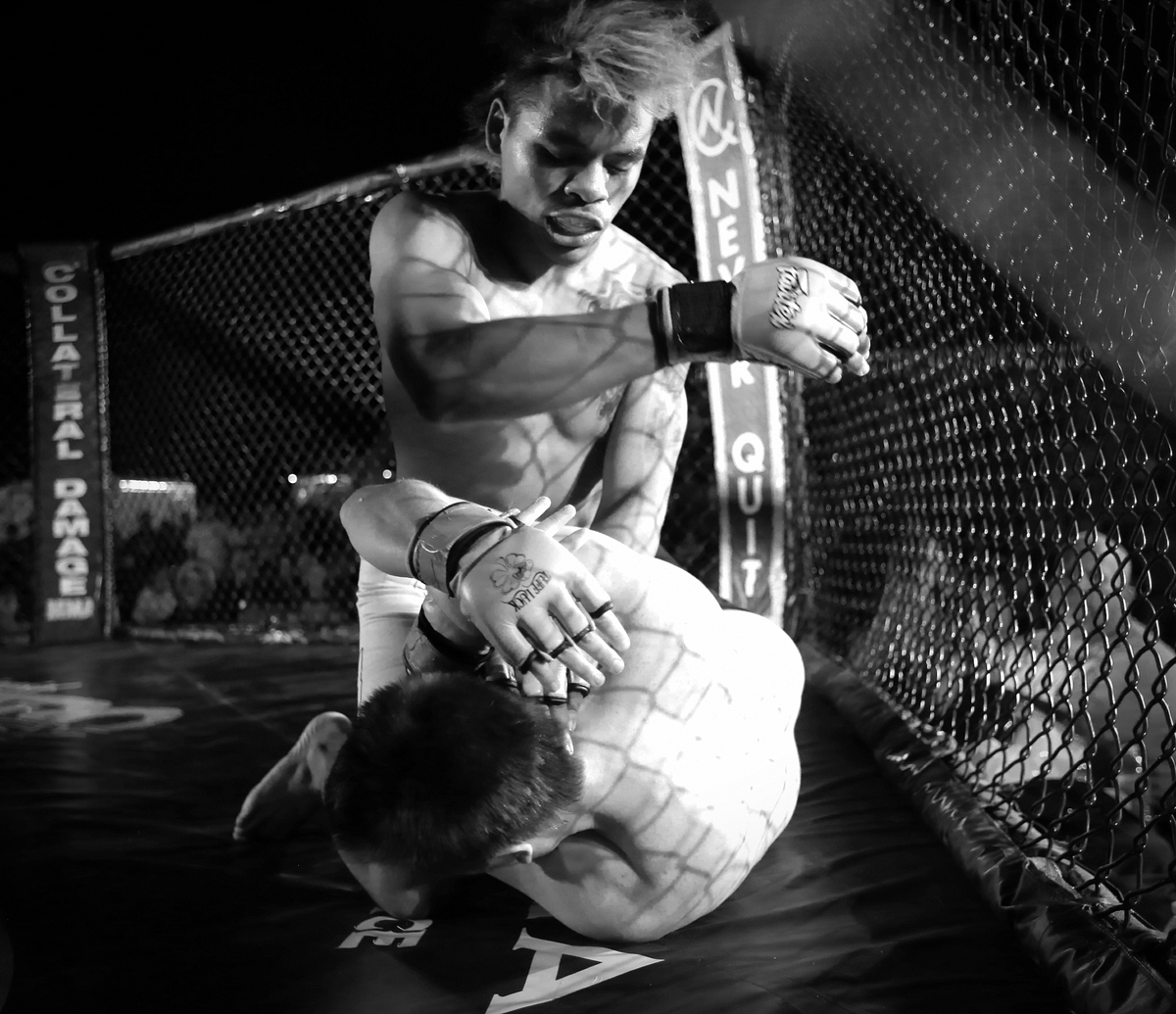
Chris “Taco” Padilla, fighter, Hardbody MMA, strikes Kenny Wyckoff, fighter, Fight Ugly MMA, during Summer Fight Night V at Del Valle Field, June 20, 2014 via Wikimedia Commons
The Only Real Sport

To begin, I disclaim I am not a sports guy. Never have been. I enjoy stuff like chess, poetry, and learning French. The internal, the literary, the cerebral. The closest I came to mainstream fandom was watching the Toronto Blue Jays so-nearly win the 2025 World Series, a brief flirtation with devastating heartbreak ending with a firm resolution: never again.
But there’s one exception. One arena I’ve spent seven years now watching, with human beings stripping everything away until only the essential remains. The Ultimate Fighting Championship.
In truth, this obsession wasn’t originally mine, I inherited it from my younger brother who was getting into Brazilian Jujitsu while I was shoplifting books. But his thesis eventually became my gospel, the thing that makes sense when nothing else does, and it goes like this. Fighting, as in combat sports and as in consensual violence, is the oldest sport known to man. Before we had rubber balls or carbon-fibre sticks or sprawling courts or astroturf’d fields, we had our fists. If there are three men left in the world, two will be fighting and the third will be spectating.
Consider what happens when conflict escalates in any other sport. Basketball players chest-bump and posture. Baseball benches clear in slow-motion theatre. But in hockey? They drop the gloves. Two men. One ref. The arena holds its breath. This is how we actually settle things. Not through the bureaucracy of committee or arbitration of league review. Through the duel. Shot-for-shot. There’s an absurd honour here. Dignity transcending team colours and corporate sponsorship. No bullshit manufactured narratives of stick-and-ball sports. Something far more transcendent.
Unlike team sports, where you cheer for an abstract collective and blame diffuses across rosters and coaching staffs and front office decisions, the solo combat offers only the fighter. There is either a rise or fall. An end result that’s binary. There is no collective responsibility, no careful logistics of rotations or substitutions. Just the person in the octagon. Skills and training and their physical body meeting another physical body. Everything else—the walkout music, the sponsors plastered on shorts, the commentary team building mythology? Becomes secondary.
These fighters aren’t millionaires, not even close.
The median UFC fighter earns $91,250 annually. The average hovers around $152,000 to $228,000, but that includes outliers like the infamous Conor McGregor, who earned an estimated $30–50 million in 2025 (mostly through unrelated business ventures). Strip away the top earners and you’re left with fighters making $10,000 to $30,000 per fight, competing maybe two or three times per year if they’re lucky.
Do the math. $2,500 to $7,500 per month. Before taxes and paying their coaches (around 10–20% of purse). Before covering medical bills that insurance won’t touch because fighters are classified as independent contractors, not employees. Seventy fighters earned less than $20,000 in 2022.
Compare this to the NBA, where the average player salary is $10.8 million. Or the NFL, where it’s $2.7 million. The UFC fighters, meanwhile, receive only 18.6% of the company’s revenue—compared to 50% in the NBA and NFL. When the UFC earned $387 million in profit in 2022, most fighters on the roster still struggled to make rent.
And yet they fight. Week after week, card after card. They absorb brain trauma for peanuts. They tear ligaments for grocery money. They break bones for the privilege of doing it again in three months. Only the winner gets a bonus.
UFC is one of the only major sporting events that’s genuinely co-ed. Women don’t fight on a separate night or a secondary card. There’s the same octogon, same main events, and same spotlight instead. How many NBA fans watch the WNBA? The answer is depressing and predictable. But UFC? Ronda Rousey became the first female fighter to headline a UFC pay-per-view at UFC 157 in 2013, and the event was wildly successful.
Amanda Nunes, one of the greatest female fighter of all time, held titles in two weight divisions simultaneously and defeated every legendary name in the sport. When she fought Ronda Rousey at UFC 207, Rousey earned $3 million just to show up (30 times what Nunes made) yet Nunes destroyed her in 48 seconds.
There is still misogyny and pay gaps, yes. Women still earn significantly less than men at the lower tiers. But the barrier to entry? Nonexistent. If you can fight, you fight. The sport doesn’t care about your gender. The sport cares only your ability to survive five minutes in a cage with another who wants to separate your consciousness from your body.
After seven years of watching fights, I’ve begun to appreciate how little casual fans understand. When a fight moves to the ground and becomes wrestling, you hear the groans and the boos, the impatient calls to “stand them up.” These are people who see grappling as boring, merely two sweaty bodies entangled in what looks like a awkward hug.
But there’s a high-level chess match happening on that canvas. Every shift of weight and every angle of the hips. Every grip on a wrist or twist of an ankle. The strategic calculation of two people trying to predict the other’s movements three steps ahead while avoiding a chokehold, an armbar, a guillotine. When Khabib Nurmagomedov submitted Conor McGregor at UFC 229 with a neck crank in the fourth round, it wasn’t luck. Rather, it was the culmination of 15 minutes of positional dominance, of grinding McGregor down until his will broke along with his body.
Fair-weather fans want blood. Knockouts. To see someone’s lights go out in spectacular fashion. But fighters and students of the sport know the beauty in the technical. The subtle art of controlling another human being’s movement. The way a fighter can make their opponent carry their weight and exhaust them to create openings that didn’t exist five seconds earlier.
This makes the “why” of the sport compelling in ways surface-level violence never could. People pearl-clutch about brutality they don’t understand. Or they write it off as homoerotic theatre. Or they indulge in bloodlust without appreciation for craft. The percentage of fans who genuinely understand what they’re watching, who appreciate the art and the romance that’s accumulated over decades remains disappointingly small.
And yet the fighters continue to fight.
Let me tell you about romance. About the forgotten Shamrock brothers, pioneers of the sport who fought when there were almost no rules. About the entire Gracie family lineage, Brazilian jiu-jitsu practitioners who proved that technique could overcome size and strength.
About Conor McGregor vs. Khabib Nurmagomedov, a blood feud. In April 2018, McGregor threw a dolly at a bus carrying Khabib and other fighters, shattering windows and injuring two people. The incident stemmed from Khabib confronting McGregor’s teammate Artem Lobov days earlier. When they finally fought in October 2018, the bad blood was real. McGregor had targeted Khabib’s family, his religion, his ethnicity during promotion. Khabib dominated for four rounds before submitting McGregor, then immediately jumped the cage fence to attack McGregor’s cornerman Dillon Danis, triggering a multi-person brawl that remains one of the most infamous moments in sports history.
UFC 229 generated 2.4 million pay-per-view buys. The highest in UFC history. The tension was so intense that the first press conference was held in an empty arena due to safety concerns. Khabib received a nine-month suspension and $500,000 fine; McGregor got six months and $50,000. Seven years later, the feud still continues on social media, with no rematch in sight. Khabib retired at 29–0 half a decade ago in 2020, refusing to give McGregor what he wanted most.
Or, consider the leg breaks. In December 2013, Anderson Silva, the greatest middleweight champion in UFC history, threw a leg kick at Chris Weidman. Weidman checked it. Silva’s shin snapped both tibia and fibula, the bone bending 90 degrees at a spot where there’s no joint. Silva crumpled to the canvas, screaming in agony. The injury was so severe he was carried out on a stretcher, facing over a year of rehabilitation at age 38.
Fast forward to April 2021. Chris Weidman fights Uriah Hall at UFC 261. First kick of the fight. Weidman throws it. Hall checks it. Weidman’s leg snaps. The same gruesome injury, the same horrific angle. Hall became the first fighter in UFC history to win without throwing a single strike. Poetic justice delivered seven years late, the irony too heavy to bear.
These anecdotes are oral tradition for people who follow the sport. Scripture passed down through highlight reels and Reddit threads. Every fighter carries the mythology of those who came before. The victories, the defeats, the career-ending injuries that remind us this isn’t theatre.
UFC fans are watching three-hour videos breaking down fight technique. They’re consuming hour-long video essays analyzing fighting styles and career trajectories. They’re rewatching entire fight cards, studying the details frame by frame. The depth of knowledge required to truly appreciate high-level MMA makes most sports look elementary. You need to understand:
- Striking (boxing, kickboxing, Muay Thai, karate, taekwondo)
- Grappling (wrestling, Brazilian jiu-jitsu, judo, sambo)
- Cardio conditioning and weight cutting
- Fight IQ and strategy
- Psychological gamesmanship
A casual basketball fan can enjoy the game by understanding “ball goes in hoop.” But to appreciate why Khabib’s relentless chain wrestling and suffocating ground control made him undefeated? Why Anderson Silva’s inside leg kicks and counter-striking dominated for seven years? Why Amanda Nunes’ combination of knockout power and submission skills made her unbeatable in two divisions?
You need to understand technical complexity that requires actual study. And people do study. Obsess. Arguing on forums about hypothetical matchups and stylistic advantages. Active engagement with the craft takes a lifetime to master.
So why do they fight?
Not the obvious answers of money, fame, or glory. Those are illusions for most fighters on the roster. The real answer, I think, is darker and more human. Some people are wired for this. There’s a satisfaction in testing yourself against another person’s will to survive. Violence, when consensual and bounded by rules and tradition and honour, becomes truth.
When two fighters touch gloves and the referee steps back, everything else falls away. No hiding behind teammates or equipment or officiating controversies. Two bodies, two wills, two sets of skills meeting in primal contest.
The UFC has major issues. The pay disparity is real. The lack of a fighters’ union means exploitation continues unchecked. The brain trauma and long-term health consequences remain completely unaddressed. Dana White’s promotion tactics are more showman carny than commissioner, and his politics are beyond concerning. The sport has serious problems that need serious solutions.
But when the cage door closes and the lights drop and 20,000 people hold their breath as two fighters circle each other, looking for openings, measuring distance, calculating risk?
That’s when the sport strips away all pretense and becomes what it always was. The oldest sport known to us. If there are three people left in the world, two will be fighting, and I’ll be the one watching. Everything else is noise.
Brennan Kenneth Brown is a Queer Métis author and web developer based in Calgary, Alberta. He founded Write Club, a creative collective that has raised funds for literacy nonprofits. His work spans poetry, literary criticism, and independent journalism, with over a decade of writing publicly on Medium and nine published books. He runs Berry House, a values-driven studio building accessible JAMstack websites while offering pro bono support to marginalized communities.
Support my work: Ko-fi | Patreon | GitHub Sponsors | Gumroad | Amazon Author Page. Find more at blog.brennanbrown.ca.
Comments
To comment, please sign in with your website:
How it works: Your website needs to support IndieAuth. GitHub profiles work out of the box. You can also use IndieAuth.com to authenticate via GitLab, Codeberg, email, or PGP. Setup instructions.
Signed in as:
No comments yet. Be the first to share your thoughts!