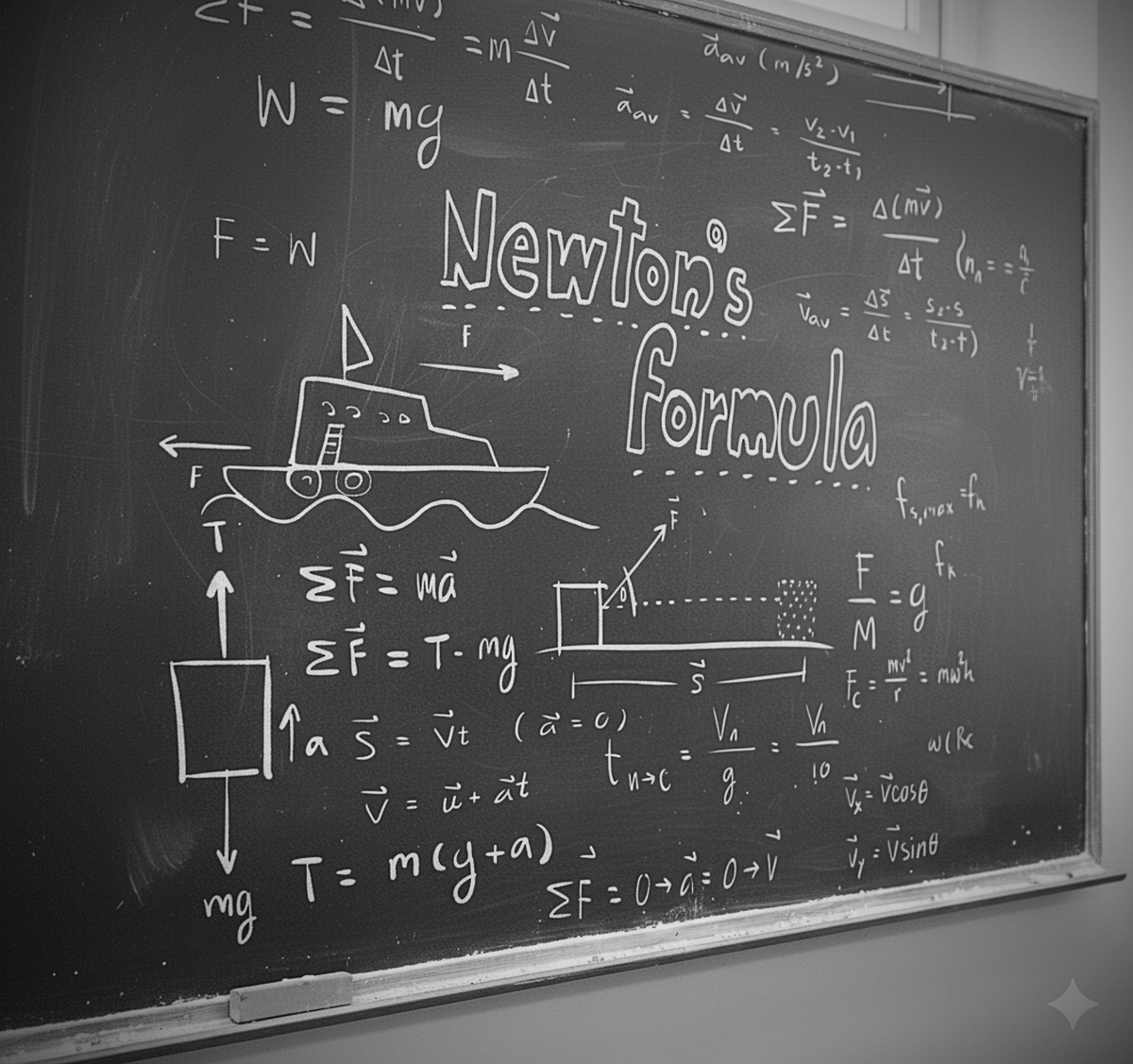
How does this relate to writing? Read on. | Source (edited by the author)
THE INERTIA EFFECT: Stop Optimizing

Fifteen browser tabs open and organized on the brand new laptop. Nine related to note-taking systems. Three comparing project management apps. There’s a Medium article titled “How I Write 10,000 Words a Day.” Another reads “The Ultimate Morning Routine for Writers.” The last tab? A Moleskine notebook in the Amazon cart, black, lined, leather-bound. $24.99 plus shipping.
It’s finally the perfect morning.
The amount of words written today? Zero.
Sound familiar? This isn’t a confession, but rather an obituary. For the version of me that believed tools create art, that systems birth brilliance, that the right app or morning ritual or ergonomic chair would transform me into someone who actually writes instead of someone who thinks about writing while researching the optimal conditions for writing.
If you’re reading this, you’re probably this person. You’ve spent more hours watching YouTube videos about productivity than being productive. You own three premium subscriptions to writing software you haven’t opened in months. Your desk drawer contains four unused journals, spines uncracked, pages virgin-white and reproachful. Tsundoku, the Japanese call it 積ん読, “buying books and not reading them.” Writers have our own version, buying tools we never use, systems we never implement, courses we never finish.
As a web dev, I know there’s a name for this in programming, premature optimization. Donald Knuth, computer scientist, captured it perfectly decades ago:
“Programmers waste enormous amounts of time thinking about, or worrying about, the speed of noncritical parts of their programs, and these attempts at efficiency actually have a strong negative impact.” Stop building the perfect writing system before you’ve written a single fucking sentence.
Make it work, make it right, make it fast. In that order. Always. First, you write code that does the thing. Ugly. Inefficient. Held together with digital duct tape. It works, though.
Only then do you refactor. Clean it up. Make it elegant. Finally, if it’s actually too slow (and usually it isn’t), you optimize for speed.
You don’t spend six months architecting a perfect system before writing line one. You don’t research every possible approach. You don’t wait for ideal conditions. You start with something that works, however badly, and improve from there.
We want to reverse this. We want to make it perfect before we make it work. We need the ideal morning routine, perfect app, the right notebook, proper desk setup, curated playlist, and a French press coffee at exactly 195°F. Optimizing for conditions we haven’t earned because we haven’t done the work those conditions are meant to support.
I admit I did this for years. I tried Scrivener, Ulysses, Bear, Notion, Obsidian, Roam Research. Each promised to be the tool that would finally unlock my productivity. Distractions from the blank page. I built elaborate systems for capturing ideas. Tags, folders, backlinks, visual graphs showing how concepts connected. Beautiful. Sophisticated. Empty.
Because I had no ideas worth capturing. I was organizing emptiness.
Research on premature optimization shows why this fails, “it lets [you] focus on things that are relatively easy for them to handle… Premature optimization provides a convenient distraction from doing that work.” Setting up a system feels productive. It’s tangible, completeable, safe. The actual writing? Terrifying. Because that requires confronting whether you have anything to say. You organize instead. Prepare instead.
You prepare to write the way some people prepare to swim. Standing on the dock, adjusting their goggles, checking the water temperature, reading about proper stroke technique, watching videos of Olympic swimmers, buying a new swimsuit. Everything except getting in the water.
i. FALSE BINARY
In writing circles, our nomenclature divides us into tribes. Planners and pantsers. Methodical or chaotic. The architects and the gardeners. Those who outline every scene before writing versus those who, as Stephen King puts it, “fly by the seat of their pants.”
The planner camp has notorious transphobe J.K. Rowling with her elaborate spreadsheets tracking every plot thread. The pantser faithful, Stephen King, famously distrusts plot for two reasons—“first, because our lives are largely plots even when you add in all our reasonable precautions and careful planning and second, because I believe plotting and the spontaneity of real creation aren’t compatible.”
There’s truth in both approaches. Rowling’s intricate planning made Harry Potter. King’s intuitive method birthed The Shining, Carrie, over 60 novels total. Different processes, both wildly successful.
The war between pantsers and planners obscures the real enemy.
Planning itself isn’t the problem. The problem is when planning becomes a substitute for writing. Architecting the perfect outline instead of writing. When research becomes procrastination with intellectual pretensions. When “I’m still developing the character” means “I haven’t started.”
Because Harvard Business Review research reveals excessive planning often leads to a 30% decrease in actual task completion. The more you plan, the less you do.
Your brain rewards planning with little hits of dopamine. It feels like progress. Checking items off a pre-writing checklist releases the same neurochemicals as actually completing the work. Except you haven’t completed anything. Building an increasingly elaborate cage around your unwritten story, standing back to admire the craftsmanship of the bars.
I used to rabbit-hole myself into research and craft essays (not unlike this one). That lasted until I actually started writing daily. Now? I’m writing this essay the day before I publish it. I outlined it last night. Not three months ago. Not after extensive research. Last night. The outline took forty minutes. The writing took about three hours.
The amount of planning should match the amount of doing. If you’ve written nothing, you don’t need a system. You need a sentence.
ii. INERTIA
Bill Nye taught us something incredibly important on PBS in his theme song. Newton’s first law. Basic physics. “Inertia is a property of matter.” In other words:
Objects in motion tend to stay in motion. Objects at rest tend to stay at rest. It applies to writing more than any craft advice you’ll read in workshop. Writing and planning are not just different activities—they’re antithetical states. Planning is potential energy. Static. Fixed. Safe. Writing is kinetic. Chaotic. Alive.
You can’t be in both states simultaneously. Switching between states requires massive energy. Getting a still object moving takes more force than keeping a moving object in motion.
Every time you stop writing to plan, you lose momentum. The runner who stops mid-race to retie their shoes. To adjust their playlist. To check if they’re following the optimal stride pattern.
Meanwhile, the person who just keeps running, even with sloppy form, crosses the finish line first.
Musicians call this Gear Acquisition Syndrome. Guitar players who spend thousands on pedals and amps instead of practicing. Photographers who own more lenses than they have portfolio pieces. “People buy exercise equipment they don’t use, books they don’t read, software they never master. Buying them is the easy part and gives us the false impression that we’ve become their masters.”
For writers, our GAS looks different but functions the same. We collect notebooks. Apps. Courses on craft. Books about writing. We build tsundoku towers of unread how-to manuals while avoiding the one thing that would actually improve our writing: writing.
Research on creative professionals shows this stems from “fear of creativity itself… Uncertainty gives rise to fear of failure, criticism or even critique.” Buying a new notebook doesn’t require vulnerability. Setting up Obsidian doesn’t risk rejection. Researching the perfect morning routine won’t expose whether you’re actually good at this.
But writing? Writing is terrifying. Because you might discover you have nothing to say. Or that what you do have to say is mediocre, derivative, boring. Better to stay in preparation mode forever. Better to have potential than to test it against reality.
I learned this by accident. Started writing an essay every day out of desperation, not discipline. The essays were rough. Most still are. But something strange happened around week three: ideas started appearing. Not from some magic system or perfect routine. From writing.
Before this practice, I had maybe six ideas in my “ideas file.” Vague concepts. Half-thoughts. Mostly the same tired themes rephrased. I tried creating systems to generate ideas—I had a whole methodology. Notes on interesting articles. Prompts. Questions. Systems for systems for systems. The file stayed empty.
Now? I have more ideas than I can use. Not because I got better at capturing them. Because I’m in motion. The writing generates the ideas. The doing creates the concepts. Objects in motion stay in motion.
That’s the secret they don’t tell you: You can’t think your way into writing. You can only write your way into thinking.
iii. SILVER BULLETS
Beginner writers ask me how I beat writer’s block, or what my routine is. What app do you use? Which notebook brand? How many hours? What about music—silence or soundtrack?
I want to reply, no, you don’t have writer’s block. You have zero drafts.
You can’t have writer’s block before you’ve written 100,000 words. That’s not block, that’s being a beginner. Being a beginner doesn’t require solutions to problems you haven’t encountered yet. It requires you to write badly for a very long time until you write less badly for slightly less time.
The successful writers aren’t successful because they found the perfect pen. Stephen King writes six pages a day, about 1,000 words, in a cluttered office with his dog at his feet. Anthony Trollope wrote 250 words every 15 minutes, timing himself with a pocket watch, while working a full-time job as a postal inspector. He produced 47 novels this way. James Joyce wrote 90 words a day. Ninety. It took him eight years to finish Ulysses.
They’re writing. That’s it. That’s the whole secret.
But we don’t want that secret. It’s too simple. Too hard. We desire complexity because complexity lets us avoid work while feeling productive. If writing success requires the perfect system, we can spend years building systems. If it just requires writing, we’re out of excuses.
The research on Gear Acquisition Syndrome tells us how “it’s rooted in insecurity… a psychological cycle where gear purchases mask fears of inadequacy, perfectionism, and the need for social validation, rather than addressing genuine creative needs.”
You’re not buying that Moleskine because you need better paper. You’re buying it because owning it feels like being a writer without requiring you to write. Same with the app subscriptions. The courses. The books about craft. All expensive armour against the vulnerability of actual creation.
I write in Bear. Costs me less than $20 a year. Could I use something else? Sure. Google Docs. Notepad. A napkin. The tool doesn’t matter. What matters is that I open it every morning and start typing. That’s the whole system. Open. Type. Close. Tomorrow, repeat.
Before I had any system worth having, I needed to build the habit of showing up. And showing up meant accepting that the first hundred pieces would be garbage. Maybe the first thousand. Nobody wants to hear that. We want the shortcut, the hack, the one weird trick that bypasses the grinding work of getting competent.
There is no shortcut. Research shows that people who wrote down their goals were 33% more likely to achieve them versus those who just thought about goals. But notice the verb: wrote. Not planned. Not organized. Not optimized. Wrote.
The middle way exists. Spend 20% of your time planning, 80% doing. That ratio (allegedly) maximizes productivity while preventing analysis paralysis. If you’re spending equal time planning and writing, you’re in the danger zone. If planning exceeds doing, you’re not a writer. You’re a professional planner who fantasizes about writing.
iv. EARNING KEEP
I write first thing, before coffee, before checking email, before the day’s demands calcify into excuses. I write 750 words minimum. I don’t edit until I’ve hit my word count. I publish without overthinking.
But I didn’t know any of this before I started writing daily. I couldn’t have. These aren’t arbitrary rules I found in a productivity book, they’re patterns revealed through months of trial and error. Earned knowledge, not borrowed wisdom.
You can’t skip this part. You can’t read the routine of someone else and import it wholesale. Your body isn’t my body. Your schedule, your energy patterns, your creative rhythms—all different. To find out what works for you means to try different things. To fail. To adjust. To try again.
This is why buying courses about writing is mostly useless. Not because the information is bad, actually, often it’s excellent. But because knowledge without practice is just trivia. You need to fail first.
You need to write a terrible opening paragraph 50 times before advice about opening hooks means anything. You need to lose and bore your readers halfway through an essay before “structural arc” is more abstract craft terminology.
I learned how to get boosted on Medium by getting boosted on Medium. Not by taking someone’s $200 Udemy course. I wrote until one essay got boosted. Then I kept going until I got another. Then I looked at what they had in common. Now I understand what Medium’s curators look for. Because I produced enough volume to see patterns emerge from the data of my own work.
That’s the only way learning happens for writers. Theories mean nothing until they’re tested against the page. Objects in motion stay in motion.
v. START UGLY
“I don’t know what I think until I write it down.”
—Joan Didion
Close this article.
Open a blank document. Not tomorrow. Now. Right now.
Write 200 words. Any 200 words. About anything. They will be bad. Let them be bad. Bad writing can be edited. A blank page cannot.
Pick any writing tool, I don’t care which. Stick with it for three months. No switching. Let it disappear. One tool. One time. One place. For ninety days minimum.
Pick a time to write. Same time every day. Make it non-negotiable. The research on successful writers is unanimous here. Routine matters more than inspiration. Toni Morrison wrote before dawn. Stephen King works 8:30am to 12:30pm. Haruki Murakami writes for five to six hours starting at 4am, then runs 10 kilometers. No waiting for the muse. They’re showing up. The muse finds the writer.
Buy nothing new for 30 days. No apps. No courses. No notebooks. Use what you have. Scarcity is the mother of invention and breeds creativity.
This won’t feel good at first. The writing will be rough. You’ll miss the comfort of preparation, of possibility, of potential. Potential is safe. Potential never disappoints. Actual work? Actual work confronts you with reality.
After a month, you’ll have written 6,000 words minimum, probably more. Bad words. Mediocre words. But real words, words that exist outside your head. And some of them will surprise you. Will contain a turn of phrase you didn’t know you had in you. Will articulate something you didn’t realize you thought until you wrote it.
You’re failing because you’re planning when you should be writing.
Objects at rest stay at rest. Objects in motion stay in motion. You can’t optimize your way to momentum. You can only start moving (badly, clumsily, without grace) and let the motion build.
Write one ugly sentence. Then another. Then another.
That’s it. That’s the whole secret. Everything else is just elaborate procrastination wearing the mask of preparation.
Start.
Comments
To comment, please sign in with your website:
How it works: Your website needs to support IndieAuth. GitHub profiles work out of the box. You can also use IndieAuth.com to authenticate via GitLab, Codeberg, email, or PGP. Setup instructions.
Signed in as:
No comments yet. Be the first to share your thoughts!