
Photo by Berke Citak on Unsplash
The Current State of the Internet should TERRIFY You

If you’ve been on the internet for the last couple decades, you know how it has changed for the worse. The wild, weird, personal web, the one with custom GeoCities pages and LiveJournal communities and Blogger sites that looked however their creators wanted? Replaced by a handful of sanitized platforms where everything looks the same, acts the same, and serves the same corporate interests. This isn’t nostalgia talking. The numbers tell a dire story about what we’ve lost and what’s at stake if we don’t act now.
This is why I’ve created 🍓 Berry House. A small, values-driven studio focused on building fast, accessible websites and thoughtful content. But more than that, it’s a commitment to something that feels increasingly radical: reclaiming the internet from algorithm-driven homogeneity and returning it to something more human, creative, and meaningful.
And I’m going to explain exactly why this is so important. Buckle in.
CRISIS BY NUMBERS
Let’s start with the most obvious shift, centralization. As of 2025, 5.65 billion people use the internet worldwide. That’s 68.7% of the global population. But where are they spending their time?
This consolidation is the culmination of decades of corporate media concentration. In 1983, 90% of U.S. media was controlled by 50 companies. By 2011, that same 90% of media is controlled by just 6 companies. Now, in 2025, the internet has followed the same trajectory.
Over 5.42 billion people actively use social media platforms. That’s 94.2% of all internet users. Not just “some” of the internet, but virtually everyone online is now channelled through a handful of corporate platforms. Facebook has 3 billion monthly active users. WhatsApp serves 2.8 billion. Instagram reaches 2 billion. TikTok has 1.92 billion. YouTube, the second-most visited website on earth, claims 2.5 billion.
Google controls over 90% of the search engine market. Three companies: Meta, Google, and ByteDance, essentially control where and how most of humanity experiences the internet.
The average person now spends 2 hours and 23 minutes per day on social media. That’s over 14 billion hours spent daily across the global population. In the Philippines, that number jumps to over 4 hours. And people aren’t just using one platform, the average person actively uses 6.8 different platforms monthly.
We are living in these platforms. And that means we’re living under their rules, their algorithms, their surveillance.
ALGORITHM PRISON
Remember when the internet was something you explored? When you followed links from one interesting site to another, discovering weird corners and niche communities? That internet is functionally dead.
Today’s web is algorithmically curated. Your feed isn’t chronological but instead optimized for engagement, which means it’s optimized to keep you scrolling, clicking, reacting. The “follow” button has become meaningless. You don’t control what you see anymore.
Here’s how broken it’s become: users spend only 7% of their time on Instagram consuming content from people they actually know. On Facebook, it’s only 17%. And nearly 50% of new Facebook users have zero friends after 90 days. Up from just 8–10% in 2012. Social media isn’t social anymore. It’s just media. Curated, engagement-optimized content from strangers and brands.
Only 50.8% of people cite “keeping in touch with friends and family” as a reason for using social media. The platforms have succeeded in making us forget what we even came there for.
Nearly half of Gen Z wish social media had never been invented, citing concerns about its impact on their focus and productivity. Yet they can’t stop using it. The platforms are designed to be addictive. Users spend an average of 47.3 minutes per day on TikTok alone, the highest of any major platform.
Why? To amplify emotionally charged, divisive content, that’s what keeps people engaged. Studies have found that TikTok’s algorithm can increase misogynistic content by 400% within just five days of use. Facebook’s algorithm shifts have created waves of clickbait, passive consumption, and decreased social interaction, all while the company falsely claims to optimize for “meaningful interactions.”
UNPRIVATE
If you’re on these platforms, you’re being watched. Constantly. Comprehensively. Creatively. This is what scholar Shoshana Zuboff calls “surveillance capitalism,” a system where personal data is collected 24/7, shaping everything from consumer choices to elections to public policy. The United States is one of the only developed nations without comprehensive data privacy protections, leaving most uniquely vulnerable to corporate surveillance.
The violations are everywhere. Meta violated California’s Invasion of Privacy Act by tracking users through the Flo period tracking app. ICE uses private medical and financial information for deportations. Amazon Echo devices are subject to warrants for audio recordings. And the discrimination is systematic: in LA’s Operation LASER, 84% of “chronic offenders” were Latino and African American, while facial recognition error rates are up to 100 times greater for darker-skinned faces.
As of 2024, 94% of organizations say their customers wouldn’t buy from them if they didn’t protect data properly. Yet 86% of Americans say data privacy is a growing concern. Why the disconnect? Because we’ve been told we have no choice.
71% of consumers say they would stop doing business with a company if it gave away sensitive data without permission. Yet only 29% of consumers say they understand how well a company protects their data. We’re flying blind, trusting corporations that have repeatedly proven they can’t be trusted.
The numbers get worse, as 62% of Americans don’t believe it’s possible to go through daily life without companies collecting data about them. They’re probably right. The average cost of a data breach reached $4.62 million in 2024, and that’s just what companies admit to.
Meanwhile, 48% of organizations are entering non-public company information into GenAI apps. Your data is being fed into AI systems, analyzed, packaged, and sold in ways you’ll never fully understand.
DEATH OF THE INDIE
Twenty years ago, blogging was democratic. Anyone could start a blog, customize it however they wanted, and find an audience. And the numbers show people are still trying: there are over 600 million active blogs on the internet, with over 6 million blog posts published daily, that’s roughly 2.5 billion posts annually. The number of U.S. bloggers grew by 10 million between 2014–2020. WordPress powers 43% of all websites, with over 500 new WordPress sites created daily.
And there’s money in it. According to Wix, the average U.S. blogger earns approximately $103,446 per year, with successful bloggers making $8,000 to $30,000 per month. 80% of bloggers drive strong marketing results for their businesses.
But here’s the kicker, 96.55% of pages get no organic search traffic from Google. Only 5.7% of pages will rank in the top 10 search results within a year of publication. And 75% of search engine users don’t look beyond the first page of results.
What does this mean? Your independent blog is functionally invisible. Google’s search algorithm changes, zero-click searches (where users get answers without clicking any links), and the dominance of major platforms mean that unless you’re already established or playing the SEO game perfectly, no one will find your work.
Meanwhile, the infrastructure itself is consolidating. 2025 has seen explosive telecom M&A activity with multi-billion dollar deals. Of approximately 1,900 small-scale fiber companies in the U.S., 400 are M&A candidates, meaning the physical pipes of the internet are also being swallowed by giants.
When I look at my own Medium stats, I can count the people who’ve read my recent articles in full on one hand. A year ago, I was getting far more engagement writing more self-centered content. I thought I’d improved, but the empirical evidence says otherwise. The platforms changed, not me.
52% of bloggers cite attracting traffic from search engines as their primary challenge in 2024. It’s harder than ever to be seen, heard, or discovered unless you’re on a major platform. Where you trade visibility for control.
WHAT WE LOST (AND ARE STILL LOSING)
This centralization isn’t just inconvenient. It’s an existential threat to creativity, community, and autonomy online. Creativity dies under algorithmic curation. When success means gaming an algorithm (writing headlines a certain way, using trending sounds, posting at optimal times) you’re no longer creating art. You’re creating content optimized for a machine. Research suggests YouTube’s recommendation algorithm “directs user attention away from other videos and discourages the creation of content that is not mainstream.”
Community becomes commodified. The groups you build on Facebook or Discord don’t belong to you, they belong to Meta and Discord. If the platform changes its policies, raises its prices, or simply decides your community violates some opaque guideline, it’s gone. All those relationships, all that work, evaporated.
Your digital identity is rented, not owned. Your Instagram handle, your Twitter followers, your TikTok videos. None of it is really yours. You’re a tenant, and the landlord can evict you anytime.
Privacy becomes a privilege, not a right. If you want to be findable online, you have to accept surveillance. Want to build an audience? Hand over your data. Want to sell products? Pay for ads on platforms that already profit from your presence.
A REAL WAY FORWARD
Here’s the truth that corporate platforms don’t want you to know. You don’t need them.
You can have a website that looks however you want. That works however you want. That you own. Not just the content, but the platform itself. Your posts, your design, your rules. No algorithm deciding who sees your work. No terms of service that change overnight. No data harvesting.
This isn’t a pipe dream. The technology exists right now. It’s called the JAMstack—JavaScript, APIs, and Markup—and it’s how Berry House builds every site.
WHY JAMSTACK?
JAMstack sites are fast. Like, blazingly fast. Google Lighthouse scores of 95+ across the board. Performance, accessibility, SEO, best practices. No database queries slowing things down. No server rendering delays. Just clean, static files served from a global CDN.
They’re secure. No databases to hack. No login forms to exploit. No PHP vulnerabilities. Just HTML, CSS, and JavaScript.
They’re cheap, often free. Platforms like Netlify and Vercel offer generous free tiers for hosting static sites. You’re not paying monthly fees to WordPress or Wix. You’re not locked into Squarespace’s pricing model.
And most importantly, they’re yours. Every file is in plain text: Markdown for content, HTML/CSS for structure and style. You can take those files and move them anywhere. Host them yourself. Switch hosting providers. Migrate to a different framework. There’s no vendor lock-in. No proprietary database format. No “export” button that doesn’t quite work.
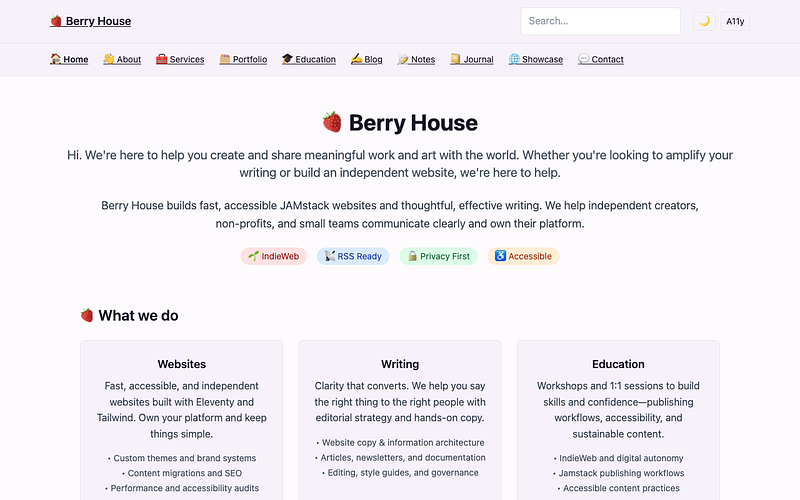
THE BERRY HOUSE MODEL
Here’s why I named this agency Berry House: berries make JAM and are also full of seeds. I want to plant the seeds for a new Internet.
JAMstack sites are front-end static websites. Perfect for sharing information and creating media. If that’s your purpose, this is exactly what you need. The beautiful part is, though, that if you later need something more complex with a back-end, when your seed starts to blossom, having an excellent front-end is still excellent and necessary.
With JAMstack, you have everything in plain text that’s easy to migrate into larger initiatives (which we strongly encourage!). We’re planting seeds for a sprawling digital garden and a new age of the internet.
Berry House operates on a dual mission:
- Professional JAMstack development and content strategy for corporate clients, independent creators, and small teams who want to own their platform
- Pro bono and pay-what-you-can services for marginalized communities, vulnerable individuals, and low-income nonprofits Every paid project helps subsidize accessible services for those who need them most. It’s a model that lets me do what I love. Building clean, fast, accessible websites all the while making a real difference for communities that are often priced out of quality web services.
For Everyone
- Custom JAMstack Development: Bespoke websites built with Eleventy, Hugo, or Astro
- Website Migration: Moving from WordPress, Wix, or other platforms to JAMstack
- Performance Optimization: Speed, SEO, and UX improvements
- Content Strategy: Information architecture, voice and tone, content calendars
- Maintenance & Support: Ongoing updates and troubleshooting
For Nonprofits & Marginalized Communities
- Pro Bono Engagements: Free services for qualifying organizations
- Pay-What-You-Can: Sliding scale pricing based on your resources
- Accessibility Audits: Free accessibility reviews for community sites
- Open Office Hours: Free consultations to discuss your needs View full services →
The Values Guiding This Work
Digital Autonomy: You should own your content, data, and platform. No algorithmic feeds. No platform lock-in.
Accessibility-first: Fast, semantic, keyboard-navigable sites that work for everyone, including people using assistive technology.
Sustainability: Calm technology you can maintain without a team. Low overhead, long-term thinking.
Transparency: Open source where possible. Clear communication. Plain language documentation.
Community: Building spaces where emerging voices can be heard. Amplifying marginalized perspectives.
URGENCY
We’re at a crossroads. The internet as we use to know it, the one that empowered individual voices, enabled weird experiments, fostered genuine communities, is being replaced by a lobotomized, surveilled, algorithm-optimized shopping mall built on rot.
But there’s hope. 80% of internet users regularly read blogs, which is 4.08 billion people worldwide. Over 77 million comments are left on WordPress.com blogs monthly. The audience is still there. People want independent voices. They’re tired of algorithm-curated feeds and corporate content.
Over 63% of blog traffic comes via mobile devices, and search engines drive 70–80% of blog traffic, meaning if you build it right, with proper SEO and accessibility, people will find you. You just need to own the platform.
If we don’t act now, if we don’t start building alternatives, supporting independent platforms, and reclaiming digital autonomy, then that audience will disappear entirely, funneled into platforms where corporations decide what gets seen and what gets buried.
Having your own website is powerful. And fun. It doesn’t have to be difficult or expensive. With JAMstack, you get speed, security, and ownership. All the benefits of modern web development without the overhead of traditional CMS platforms.
BUILT TO LAST
If you’re reading this and thinking, “I need a website that’s fast, accessible, and truly mine” then let’s talk. If you’re a nonprofit or marginalized creator who needs web support but can’t afford typical agency rates**,** then reach out. That’s exactly why Berry House exists.
And if you’re already building in this space, on the IndieWeb, with JAMstack, championing accessibility, let’s connect. The future of the web is collaborative, not competitive.
The internet doesn’t have to be what corporate platforms have made it. We can still build something better. Something human. Something that lasts.
Welcome to Berry House. Let’s plant some seeds together. 🍓
Get in Touch
Email: hi@berryhouse.ca
Book a consultation: Schedule a free 30-minute call
Explore services: berryhouse.ca/services
Support this work:
Comments
To comment, please sign in with your website:
How it works: Your website needs to support IndieAuth. GitHub profiles work out of the box. You can also use IndieAuth.com to authenticate via GitLab, Codeberg, email, or PGP. Setup instructions.
Signed in as:
No comments yet. Be the first to share your thoughts!