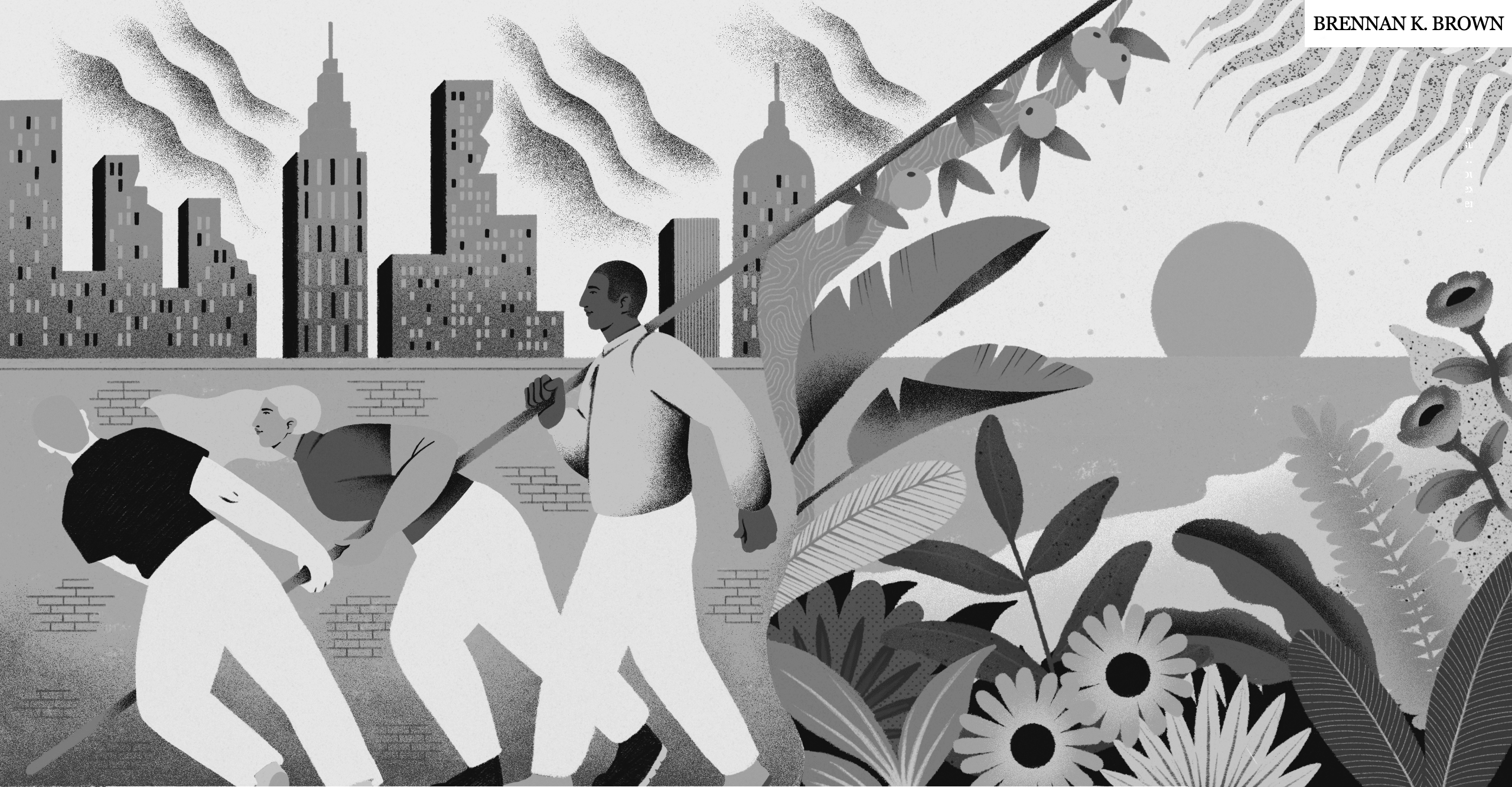
Illustration by Michelle Pereira
THE COMPASSION ECONOMY
Windows at Element Cafe fog with steam and breath. There’s the ambient noise of me and twenty other people who should be at work. 2:47pm on a Tuesday afternoon in Calgary. Everyone locked into a staring contest with laptop screens, performing the theatre of productivity while actually refreshing job boards, editing resumes that will be scanned by ATS algorithms trained to reject us. I imagine them messaging each other about how we can’t do this anymore.
PART ONE: THE ROMANCE OF BEING LAZY.
The +15 skywalks connect empty office towers like arteries in a body forgetting how to pump blood.
I’m supposed to write a story about work here. But in 2025, nobody is happy at work. Thirty-five percent of Gen Z reported being happy at their jobs last year. Not fulfilled or passionate, but happy. Thirty-five percent. Which means two-thirds of us are performing an elaborate charade where we pretend that spending the majority of our waking hours doing something that makes us miserable is normal, is necessary, is the only way to live.
The older generations call us entitled. Lazy. There’s a viral terminology around our refusal to participate in their delusion: quiet quitting, bare minimum Mondays, lazy girl jobs. But where did it come from?

Gabrielle Judge was 26 when she coined the term “lazy girl job” in a TikTok that got 3.6 million views. She wasn’t celebrating laziness. She was naming something we all felt but couldn’t articulate. The absurdity of a system that calls you lazy for wanting to pay your rent and have dinner with friends. For choosing a job that doesn’t require you to romanticize your own exploitation.
She chose the word “lazy” on purpose. Satire as survival mechanism. Anything less than burning yourself out is considered a moral failure in American hustle culture.
Another woman created Bare Minimum Mondays, the radical idea that you might ease into your work week instead of arriving Monday morning already exhausted from the dread that consumed your entire Sunday. Marisa Jo Mayes was 29 when she started it. She’s received hundreds of messages from people whose bosses quietly adopted it. Hundreds of messages that all say the same thing. I thought I was the only one.
That’s the quiet part nobody wants to say out loud. We all think we’re alone in feeling like this. Like we’re the problem. Like if we just worked harder, wanted it more, optimized our morning routine, we’d finally be okay. 82% of employees are at risk of burnout this year. Eighty-two percent. There’s no personal moral failure, just intentional design flaw.
There’s a meme that went viral on r/antiwork, the Reddit community that exploded from 100,000 to 2.9 million members during the pandemic. It shows a person applying clown makeup in stages. First panel: “Maybe if I work hard.” Second panel: “Go above and beyond.” Third panel: “Never use sick or vacation days.” Final panel, full clown makeup: “The company will notice and appreciate.”
A woman named Penny saw that meme and immediately recognized herself. She’d been working 60-hour weeks as a pharmaceutical consultant, asking for help, asking for support, getting promises and pay raises but never the actual thing she needed: less work. She quit. Went freelance. Now uses r/antiwork to remind herself she’s not alone in pursuing a life that isn’t dominated by work.
She saw herself in the clown. You probably do too.
All the statistics feel like science fiction until you realize they’re just describing your life. Peak burnout now hits at age 25 instead of 42. Think about that. We used to burn out at 42, after decades of work. Now we’re burning out before we’ve even finished paying off student loans.
70% of Gen Z and Millennials reported burnout symptoms within the last year. 91% experienced high pressure or stress at some point. The cost? $322 billion annually in lost productivity. But that’s the wrong question, isn’t it? The wrong math. It doesn’t matter what it costs businesses, it matters what it costs us.
Nearly 60% of Gen Z graduates can’t find jobs. That’s not a typo. Sixty percent. 4.3 million young people are NEETs—not in education, employment, or training. Just… existing in the gap between what we were promised and what’s actually available.
In Calgary, where I write this, youth unemployment sits at 18.3%. The office towers downtown are gorgeous, especially at sunset. Steel and glass reaching toward sky. But walk through them on a Friday and count the empty desks. The hybrid work revolution means we’ve learned we can do these jobs from anywhere. And so we’ve learned most of these jobs probably don’t need to exist.

Let me tell you about meaninglessness. Not as a philosophical concept, but as a documented psychological state. Work alienation has four dimensions: powerlessness, meaninglessness, social isolation, and self-estrangement. Corporate speak which translates to: you have no control, your tasks are pointless, you’re disconnected from your coworkers, and you no longer recognize yourself.
Meaninglessness comes from working on tasks that lack variety, perceived significance, and identity. From being asked to do things that feel illegitimate. Irrelevant. Like when you spend three hours in a meeting that could have been an email, or when you’re told your work is essential while being paid $15 an hour with no benefits, or when you realize your entire job is to make a rich person richer while you can’t afford your own rent.
Social isolation is the exclusion from, or absence of relationships with, colleagues. Which sounds like a nice way of saying you’re lonely at work. Workplace loneliness reduces work engagement and causes job dissatisfaction. It makes you physically present but psychologically absent. A withdrawal state. A living death.
And self-estrangement—that’s the worst one. That’s when you look in the mirror and don’t recognize the person staring back. When you’ve spent so long performing a role that you’ve forgotten who you are underneath the performance.
You might think this is depression, but it isn’t. This is a syndrome resulting from chronic workplace stress that has not been successfully managed. The World Health Organization classified this as an occupational phenomenon. Your job is making you sick and that’s deemed normal and okay.
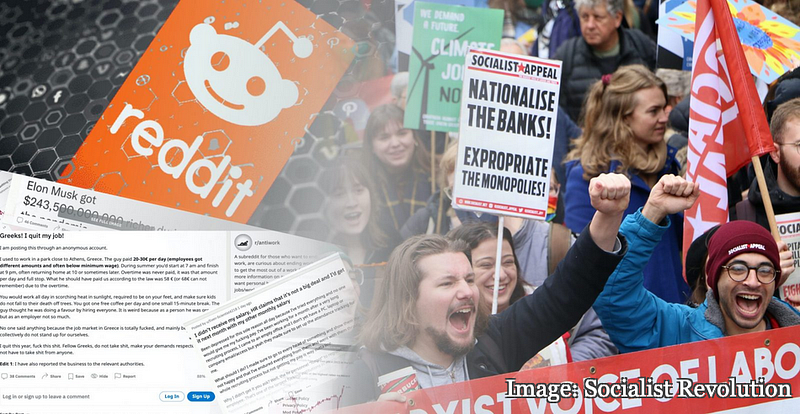
Ann Hubbard is 56. She’s a retail worker, a member of the Communist Party, active on r/antiwork. She used to be a history teacher until her mother got dementia and she had to quit to provide care. Lost her house. Struggled to find teaching work after her mother died. Ended up at a retail store, barely getting by.
“You’re not worth anything if you don’t generate revenue,” she said. “It’s very, very stressful to know that you’re not valued by society.”
There’s another story from r/antiwork. Nick from Phoenix. Worked in a factory. A kiln exploded during ignition and nearly killed him. He was an expert. The equipment was ancient and improperly maintained. They fired him instead of improving safety.
And Alison, who left New York: “Since I started my working career at age 16, I’ve never once had an employer that didn’t harass me or discriminate against me for my gender, my age or my disabilities.” These aren’t isolated incidents. This is a system working exactly as designed.
PART TWO: A REAL SOLUTION.
What do we do? That’s the question, right? The one that follows all the depressing statistics and personal horror stories. What do we actually do.
Here’s where I’m supposed to offer a solution. Links to a flashy landing page with ten steps to better work-life balance. A newsletter that will give you five ways to optimize your career. A self-help conclusion that makes you feel hopeful while changing absolutely nothing.
But this problem isn’t individual. The solution can’t be either.
Only 6% of Gen Z say their primary career goal is to reach a leadership position. We’re looking for the emergency exit instead of climbing the corporate ladder. And once we find it, we will build something else entirely.
There’s a different economy happening in the margins. No stock ticker or quarterly earnings report. The operating principles sound naive until you realize they’re actually ancient. Reciprocity, solidarity, care.
Mutual aid is what happens when communities take care of each other because governments won’t and corporations can’t profit from it. It’s not charity, but rather solidarity. It treats everyone as equals and focuses on collective care and shared responsibility.
During the pandemic, mutual aid networks sprouted up everywhere. Not because people suddenly got generous. Because systems failed and we realized we could save each other. Community fridges where you take food without proving you deserve it. Neighborhood meal shares. Carpools and childcare swaps and rent strikes and tenants unions.
Every time someone takes food from a community fridge without having to debase themselves, that’s a small revolution.
Research shows that community mutual aid networks and social relationship capital significantly reduce household financial vulnerability. That’s not touchy-feely stuff. That’s measurable impact.
The solidarity economy is the formal term for what I’m calling the compassion economy. A post-capitalist framework built on equity, cooperation, democracy, sustainability. It includes worker cooperatives, community land trusts, time banks, participatory budgeting. Ways of organizing economic life that don’t require someone to be exploited for someone else to profit.
People’s faith in the status quo is gone. There’s growing openness to new narratives, new models, new paradigms. This moment—this crisis of meaning and burnout and impossibility—is also an opening.
In May 2025, over 300 organizers gathered in Atlanta for “Solidarity at Scale: Converging Our Movements for Systems Change.” They’re not waiting for permission, and are building alternative institutions that put people and planet over profit, creating “a world in which many worlds fit.”
It’s happening in Jackson, Mississippi. In Cleveland. In Barcelona. In mutual aid networks across Los Angeles and Chicago. In community land trusts and worker cooperatives and time banks. A million small acts of refusal and creation.
Dean Spade writes that mutual aid is “the radical act of caring for each other while working to change the world.” It’s grounded in solidarity, not charity. It acknowledges that when basic needs aren’t met, it’s not a personal failing—it’s systemic.
I’m writing this from Calgary, where the unemployment numbers make national news and the oil money bleeds more than it flows, and young people flood in from across Canada looking for opportunity, only to find the same impossible math everywhere. Rent costs $1,800 for a one-bedroom and entry-level jobs pay $16 an hour and you need five years of experience for a junior position and also you might be laid off in six months when the market shifts.
But there are those who organize the community, who are learning the names of their neighbours and their struggles instead of their LinkedIn profile. The compassion economy isn’t a distant utopia. It’s happening now. In the margins, in the gaps, in the spaces between what capitalism offers and what we actually need to survive.
We’re not advocating for laziness. We’re advocating for actual lives. Where you can afford rent and go to your friend’s birthday party. Where taking a sick day doesn’t risk your job. Where your value as a human isn’t determined by how much wealth you generate for someone else.
We’re tired of the work ethic that says suffering is virtue. We’re done performing passion for jobs that don’t pay enough to live. We’re refusing to pretend that this is sustainable.
48% of Gen Z don’t feel financially secure. More than half live paycheck to paycheck. This while we’re told to be grateful for the opportunity to work. Plainly, the answer isn’t to try harder within this system. The answer is to stop pretending the system is immutable and inevitable.
I used to think I wasn’t resilient enough, wasn’t driven enough, wasn’t willing to sacrifice enough for success. Then I found people organizing mutual aid in their neighbourhoods. Found the solidarity economy framework that names what we’re all feeling. This is broken, and we don’t have to accept it.
We’re building something else. Not asking permission. Not waiting for institutions to change. Just… building.
Community fridges. Time banks. Cooperative housing. Worker-owned businesses. Childcare collectives. Tool libraries. Skill shares. Tenant unions.
Profit isn’t the point. Care is the point. Connection is the point. Building a world where we acknowledge the interdependence of our well-being instead of pretending we’re all isolated individuals competing for scarce resources.
The coffee shop is closing. We’re all packing up our laptops, our false productivity, our performance of purpose. Outside, the +15 skywalks still connect those empty offices. I think of how, only a few blocks away in Sunalta, at street level, there’s a community garden. A little free library. A sign for the neighbourhood meal share.
The question isn’t whether alternative economies are possible. They already exist. The question is whether we have the courage and imagination to make this central instead of marginal. To stop treating capitalism as inevitable and start treating compassion as foundational.
We’re practicing a different kind of world. Where your value isn’t determined by your productivity. Where community isn’t a luxury. Where care is reciprocal instead of transactional.
Every time you share food with a neighbour, you’re practising it. Every time you swap childcare or fix someone’s bike or teach a skill without charging, you’re practising it. Every time you refuse to perform gratitude for exploitation, you’re practising it. There’s a quiet revolution in refusing to be a clown anymore. To fail at capitalism is to succeed at aiding humanity.
Mutual Aid Networks in Mohkinstsis
Calgarians Helping Calgarians (Facebook Group) Over 5,200 members helping each other with food, moving, essentials, and support. Managed by sisters Kathy Fyfe and Sharon Moore for over a decade. No money requests allowed—just neighbors helping neighbors. As one member said: “This group has saved me—literally saved me.”
United African Diaspora Mutual aid serving Calgary’s Black and African communities. Started summer 2020 to address gaps in support for newcomers and marginalized communities during COVID-19.
Calgary Community Fridge Take what you need, leave what you can. No questions asked, no proof of need required. Fresh produce available to anyone, anytime.
Housing Cooperatives
Southern Alberta Co-operative Housing Association (SACHA) 403–233–0969 | #110, 2526 Battleford Ave SW
SACHA supports 13 housing co-ops across Calgary with approximately 1,200 units. Co-op housing offers security of tenure, democratic control, and monthly costs ranging from $500-$1,387 for three-bedroom units—significantly below market rent. Waitlists can be 2–8 years, but they’re worth joining.
Individual Calgary Co-ops:
- Sunnyhill Housing Co-operative (Sunnyside)
- Ramsay Heights Co-operative—403–264–6615
- Hunter Estates Housing Co-operative—403–275–2534
- Prairie Sky Cohousing (intentional community model, ~40 people in 18 units)
Food Security
Calgary Food Bank 403–253–2055 (Hamper Request Line) | 5000 11 Street SE Emergency food hampers available every 14 days. Now operates on a client choice model—you pick what you need instead of receiving a pre-packed hamper.
Brown Bagging for Calgary’s Kids (BB4CK) 403–264–7979 | #110, 909 11 Ave SW Provides free school lunches to kids at over 230 Calgary schools. If your child needs lunch, they’ll work with you and the school to make it happen. No limit on how many times you can access support.
Calgary Co-op In 2024, Calgary Co-op raised $2.8 million through community campaigns. Drop off non-perishables at any location. They also support Fresh Food Rescue initiatives.
General Support & Resources
211 Alberta Call/Text: 211 (24/7) Free service connecting you to community, social, health, and government services across Alberta. If you’re struggling, start here.
United Way of Calgary and Area Funds programs addressing poverty, housing, mental health, and community building across Calgary.
Calgary Homeless Foundation Beyond emergency shelter, they provide prevention programs, diversion supports, and one-time financial aid to help keep people housed.
What You Can Do Right Now
If you need help:
- Call 211 to find services that match your needs
- Join “Calgarians Helping Calgarians” on Facebook
- Request a food hamper from Calgary Food Bank (403–253–2055)
- Apply to housing co-op waitlists through SACHA—even if they’re long, get on them now
If you want to help:
- Stock the Calgary Community Fridge with fresh food
- Join mutual aid groups and respond to requests
- Volunteer with BB4CK to pack school lunches (12+ years old)
- Drop non-perishables at any Calgary Co-op location
- Donate to organizations through Calgary Foundation’s Community Knowledge Centre
If you want to organize:
- Research starting your own community fridge or meal share
- Connect with SACHA about converting existing buildings into co-op housing
- Start a neighborhood skill-share or time bank
- Organize tenant meetings in your building
- Create your own Facebook group for your community
Comments
To comment, please sign in with your website:
How it works: Your website needs to support IndieAuth. GitHub profiles work out of the box. You can also use IndieAuth.com to authenticate via GitLab, Codeberg, email, or PGP. Setup instructions.
Signed in as:
No comments yet. Be the first to share your thoughts!