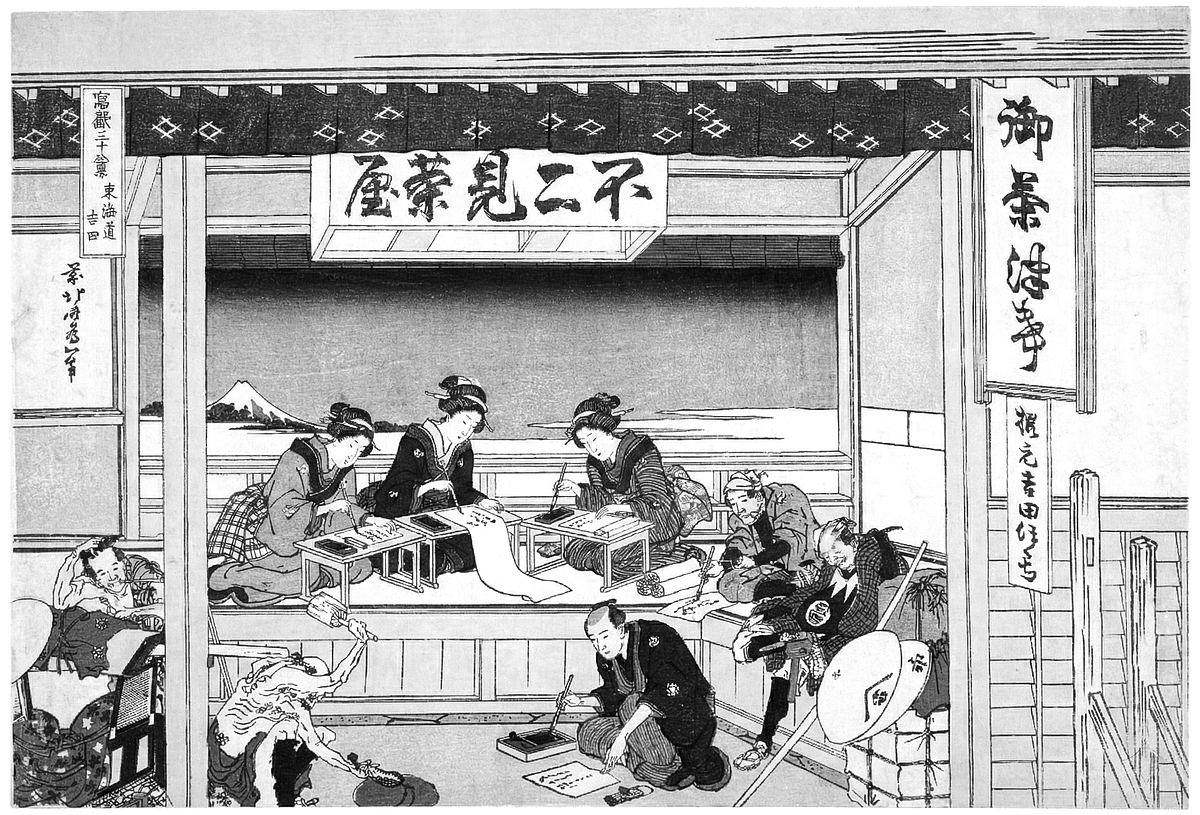
Yoshida on the Tokaido (Tokaido Yoshida), from the series “Thirty-six Views of Mount Fuji (Fugaku sanjurokkei)” by Katsushika Hokusai (Edited by the Author)
THE ART OF THE MICROESSAY
- The snow outside brightens the streetlights, yet dampens all the noise. Your first writings back in elementary school were probably short. Just a couple sentences, right? Over the years, you learn how to write longer, how to develop arguments. Flesh out the scene. But then you begin to return to the original form. A pair of lungs learning how to breathe. Contract. Expand. Contract. The end is built into the beginning.
- If I had time, I would have written you a shorter letter. It’s funny, I’m reminded of Picasso, who started his painting career so young with beautiful portraits. He could have remained a master of realism. Instead, his art transcended. The Blue Period’s melancholy to the Rose Period’s warmth. The African-influenced mask-like faces. Cubism’s fractured forms. The work distilled. Concentrating on intuition rather than strict observation. Reduction until the purest ideas remained.
- Microessays aren’t really any different than Picasso. It takes a long while to be able to write something of length, with both meat and fat on the bones. Longform is tricky, time-consuming, and there’s research to be done. The microessay, though, takes even more work. You are compacting and distilling. You are finding what is only the essence. This is surgical.
- The microessay is a contemporary form, but lineage reaches back a millennium. In Japan, essays existed centuries before they developed in Europe. The zuihitsu means “following the brush” emerged when Sei Shōnagon wrote The Pillow Book, a collection of loose-yet-connected essays and fragments responding to her surroundings. A hybrid form of lists, observations, anecdotes, poetry, reportage, confession. To follow the brush suggests a certain not-knowing, that whatever results will be down to discovery rather than plan.
- Modern microessays, 100–800 words, live in the space between poetry and prose, between thought and fragment. Built for our commutes, substantial enough to carry weight. The creation of order depends on disorder. Juxtapositions, contradictions, random materials, pieces of varying lengths. How thinking works.
- You may mistake the microessay for the LinkedIn broetry. For the multitude of short sentiments flooding the fields and drowning any fertile ground. A common misconception. The difference is comparable to #instapoetry versus the haiku or tanka. The shi, fu, ci, lüshi. The sijo and hyangga. Steep traditions with delicate care and consideration. Each line can take years to get right.
- Specifics? Three lines with a 5–7–5 syllable pattern, 31 characters in 5–7–5–7–7 rhythm. Strict tonal patterns and parallelism, precision and musicality. Three-line poems of 14–16 syllables each, with the third line employing a surprise. And, the hyangga, poems from Unified Silla using Chinese characters in a system called hyangch’al. Lineage.
- You’re hungry, and you fish for a bag of sunflower seeds. A poem is never finished, only abandoned. Lingering always remains for the careful artist. Neurotic. Writing must take the shape of an open-palm. Of giving away freely. Abandonment is surrender.
- And fiction? A flash in the pan. The six-word story; the 280-character “twitterature”; the “dribble” or “minisaga” (50 words); the “drabble” (100 words). Roots in prehistory, recorded at the origin of writing. Aesop’s Fables, Panchatantra, Jataka tales. Later: Nasreddin, Zen koans. Every sentence reveals something we didn’t know before.
- What is the physical precedent for the microessay? Pocket notebooks have found themselves resurrecting in popularity. Field Notes, Midori passport-size leather, tiny dollar-store composition notebooks. Any will do. Always on you, and always waiting to be filled. Effortlessly organized into wooden boxes for archives, afterwards.
- You are limited, constrained. There is a tightness. It is easy to succumb to claustrophobia. Don’t. You have more with less. Ingredients for creativity and invention. Mindfulness. Every word must matter. An intentional walk into the woods. Earn your keep, you have miles to go before you sleep.
- Weaving and braiding can occur, but each microessay must be self-contained. Open the window and find a still image of the wooden bench across the street lit by the moon. There is obviously more than the bench, more than the moon, and yet this is a complete, full, whole picture. Everything in the frame, and in the frame alone.
- Chew on the sunflower seeds to pass the time, a good alternative to tobacco. Our life is full of microplatforms. And yet microessays are endangered. How? Twitter launched in 2006 becoming the digital town square where the retweet button could catapult ideas to hundreds of millions of screens. 140 characters (later 280). Should’ve been perfect for microessays.
- In January 2022, Elon Musk began secretly accumulating Twitter stock. By April, he was largest shareholder, and made an offer. Twitter’s board accepted. He completed the acquisition October 2022. He fired half the company, laid off comms, took Twitter private, merged it into X Corp. By April 2023, it was X. The platform that could have housed thoughtful microessays became a melted wasteland.
- Now we have Bluesky, Mastodon, Threads. An ecology where we can post our 280-character-long meditations. Instead, there are just ragebait opinions foaming at the mouth like rabid birds. The spritz of limelight right in the eye. Blinding. Is there an alternative? Palatable and created from palettes. Walking walls of words.
- Butterfly, mammoth, and… spool? Spin like Rumpelstiltskin. Weave truth into gold. Pay the price by having the truth be naked. Anybody can attack you, call you out, dredge up old rotting eavesdrops full of dead brunette leaves and embarrassments from your past. Be careful. Was Grendel’s mother merely protecting him?
- There is nothing inherently wrong with brevity. Think of where we must constrain ourselves the most. The medium reveals the vulnerable importance. Limited by what our hearts can withstand saying aloud. Notes passed in class. Rehearsed apology. The one-page resume. Confessional text to our crush. Resignation letter. What our tombstone will say.
- The trick is the act; the nebulous intention. Our mouths are so used to being wide open and salivated that we’ll gulp down the small delicate kumquat—that tart, bitter-sweet citrus jewel with its edible peel and flesh that bursts when you bite—without a second thought. That’s what we need: thoughts. Plural. Multiple. Contradictory. Held simultaneously.
- Of course, there is the religious element here as well. How many prayers are longer than a page? Psalms are beloved for the ease with which they can be memorized. When’s the last time you memorized a poem? A phone number of a loved one? How much of that mind are you truly using? Grey matter. What matters?
- What is your container? Your vessel? Before even thinking about what you want to say, what you want to convey to this cold, loud world. Look outside and see your breath fog like smoke outside the black mesh of the frame. How long will your words last?
- Sometimes, there is an obvious beginning. Scene set. Action and images. The pacing around the desk, the nervous chewing of the seeds, the taste of salt in your mouth distracting you from the difficulty of sitting on something so short and small. Fragile. Handle with care, you tell yourself.
- Sometimes, there is an obvious end. You get lucky and have a loving hospice nurse, you’re read your last rites. Pre-order the coffin and the formaldehyde and instruct the desairologist on what shade of pink you want on your dead blue lips. This isn’t how it actually goes, though. A fleeting thought about tomorrow’s groceries. Instead, walking, then nothing.
- But there is always a centre. Core. Corecore. All shapes have a middle no matter how esoteric or fucked-up. You walk towards the other edge and bump into somebody else doing the same halfway through. The calculus of the thesis is within the gentle kiss, not the obvious message. In the shower a few days later, not on the page.
- You daydream for a moment, imagining a bluebird landing on your windowsill, tilting a curious head, gesturing for you to feed her a seed. If only life were so romantic. Our fantasist writings, lingering like a fire escape covered in bolted metal locks. One day, maybe, one day you will be visited by magic. Real magic.
- To be a good writer requires sacrifice. Requires death. Death of the ego. Doubt and hesitation. Pride. You have far better taste than you do skill and ability at first. You will hate what you write. Write anyways. Cut all of your hair, if you have to. Ask your sister to burn everything upon your death. Remember how a butterfly will die if her wings are touched even just once.
- You fidget, you grow impatient waiting for the impossible. Clouds of clout and Scandinavian cloudberries fill your mind. What comes after this? Like a lover, you desperately ask, where’s my engagement? Where did the sunflower seeds go? Maybe they were planted. Maybe they began growing once again.
- We will be villains. Wormfood and wormwood and mycological wonders. This is what the microessay teaches us. The network of things. Atomic ideas. Index cards filled with a single whole. Elegance swaying like cake batter or a glass chandelier. The whole must not be greater than the sum of her parts.
- Life is nothing but cycles. The ancient four temperaments. Sanguine, choleric, melancholic, phlegmatic. The cycle is within food/word webs. Ideas are consumed, digested, transformed, and released as new energy. Primary producers capture raw energy, primary consumers transform material, secondary consumers refine and concentrate, and decomposers break down completed work to nourish future creation. Think too of the phosphorus cycle, the cycle of precipitation, the process of recycling. Everywhere.
- With the window open, you hear the pattern of steps crunching into the fresh newborn snow. Proof of life. You ask yourself what the future holds, and maybe you hold a mirror up to the past. You look at the Picasso print you bought at a thrift shop hanging on your bedroom wall. Sunflowers. The end is built into the beginning.

Comments
To comment, please sign in with your website:
How it works: Your website needs to support IndieAuth. GitHub profiles work out of the box. You can also use IndieAuth.com to authenticate via GitLab, Codeberg, email, or PGP. Setup instructions.
Signed in as:
No comments yet. Be the first to share your thoughts!