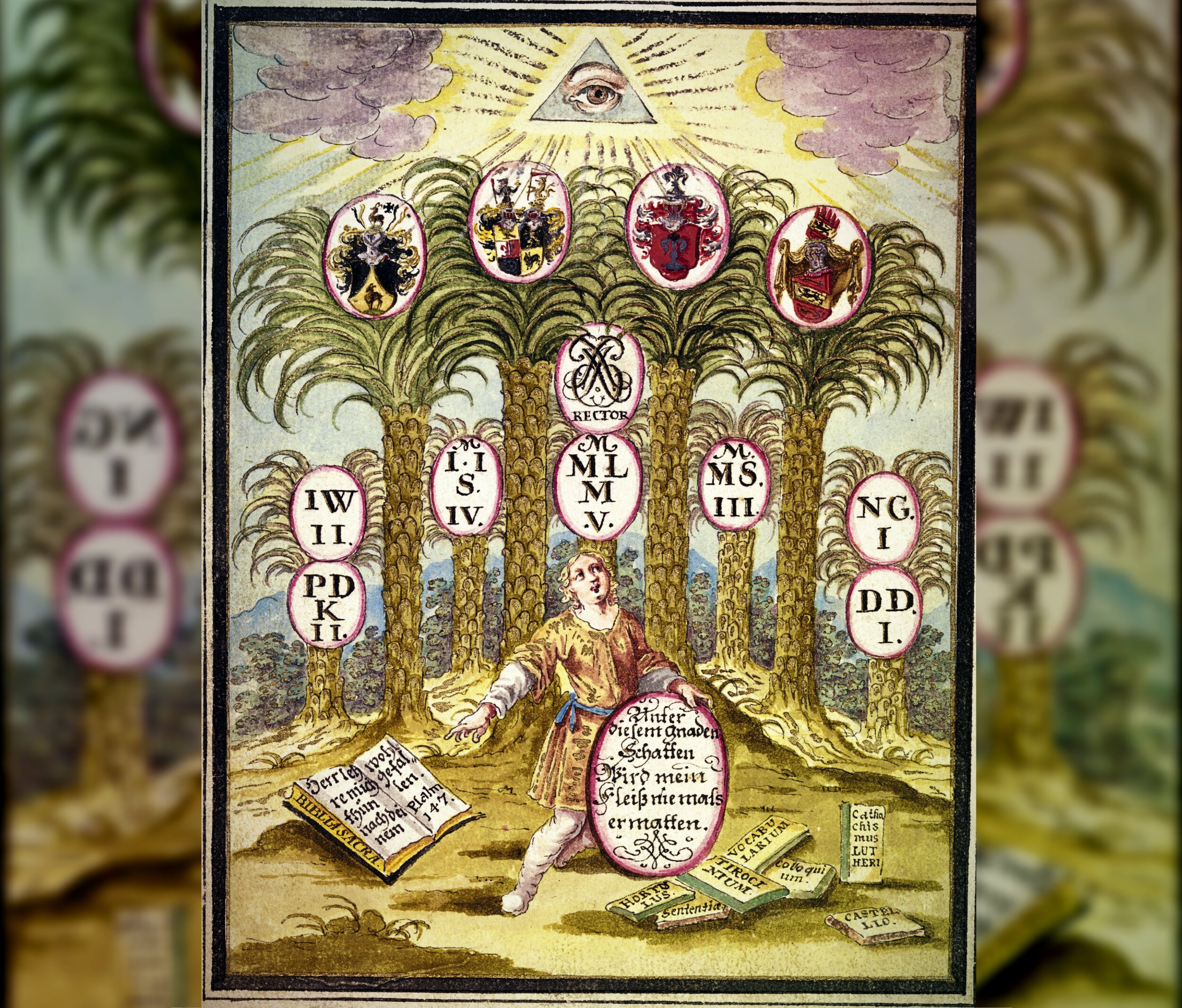
Knabe mit einem Schild unter Palmen (Boy with a Sign Under Palm Trees) by Johannes Esaias Nilson (1721 - 1788) | Source (edited by the Author)
STORYTELLING Part Two: The (Literal) Magic of Writing
Why do I choose writing as my choice of medium for storytelling? Now, that's a good question.
Narrative and storytelling can be expressed through many different mediums: visual art, filmmaking, performing arts, sculpture, printmaking, music, on and on. For me, I believe there's an elegance in how utilitarian writing is. Let me start with information density.
I. THE SIZE OF SYMBOLS
A plain text file stores roughly one byte per character. This entire essay, roughly 3,500 words, is about 25 kilobytes. A single small JPEG image in 24-bit colour at 200x200 pixels is already 100 kilobytes before compression. A two-minute smartphone video is several hundred megabytes. A feature film, uncompressed, is hundreds of gigabytes.
The information density of text is so wildly outsized compared to every other medium that it almost feels like cheating. Text files are kilobytes (megabytes if you're really longwinded) compared to the much larger raw files of photography, digital art, and especially filmmaking. This is a limitation of physics and the current state of compression algorithms, but it means that writing can travel farther, faster, across more devices and connection speeds, than any other form.
And because of this asymmetry, it is also one of the most durable mediums. Plain text is the cockroach of file formats, requiring no proprietary software, no specific operating system, no codec, no rendering engine. A .txt file written in 1985 can be opened today by anything. The same sadly cannot be said for your 2010 Flash animation, your HDR ProRes footage, your layered PSD. There is a wayward robustness to the written word.
There is also an equalizing aspect. To begin, all you need is a text editor or a pen and paper. Sure, many different mediums don't actually require expensive equipment and you can certainly fall down consumerism with writing if you're talented enough (ask anyone who's gone deep on fountain pens), but writing remains one of the most accessible artforms. Your notes app. A receipt from the pharmacy. The back of a napkin in a diner. The organizational systems writers use are, too, themselves writing: journals, outlines, index cards, commonplace books, Zettelkasten, drafts. The metadata of your thinking is legible in the same form as the thinking itself.
The 4 E's
4E cognition is a framework from cognitive science that makes sense of this. 4E is a relatively young, interdisciplinary field which proposes cognition is not a process that happens inside the skull, but is a performance of the entire coupled brain-body-environment system.
The four E's are embodied (cognition involves the whole body, not just the brain), embedded (it is shaped by physical, social, and cultural context), enactive (it is a continuous two-way exchange between organism and world, creating meaning through interaction rather than just receiving it), and extended (it can be offloaded onto tools, technologies, and external systems that become genuine extensions of the mind). As cognitive scientist Evan Thompson puts it:
"You need a brain to have a human mind, but your mind isn't inside your brain; it's a relation between you and the world."
Writing is the best illustration of that claim. Technologies like writing, Thompson notes, "have provided a new kind of external memory, extending personal and cultural memory." The page is not where you record thoughts you've already had. The page is where thoughts happen.
The organizational systems writers use are themselves writing, literally and mechanically. The journal, the outline, the index card, the commonplace book, the Zettelkasten. These are not filing systems for pre-formed thoughts. They are the thoughts, externalized and extended. The mind working in material interaction with language. When I write here, into this glowing rectangle, my cognition is not entirely inside me. Part of the cognition is on the screen itself. That's 4E cognition.
And the public education system, for all its failures, is designed at its stated best to give everyone the rudimentary tools for this art form—writing—that other mediums don't enjoy. Schools teach children to write before they teach them anything else. Public libraries are built around written language in ways that no other art form enjoys. Sociologist Eric Klinenberg calls libraries "palaces for the people," following Andrew Carnegie's formulation, arguing they function as social infrastructure in addition to being cultural institutions. Research has found an inverse relationship between the density of public libraries in a country and levels of economic inequality. More libraries, less inequality.
Most people live within reach of a library branch. Most people, again sadly, do not live within reach of a contemporary art gallery, a film archive, a recording studio, a print lab.
This is certainly not nothing. There is a magic to writing that I want to sit inside after reading Poetry as Spellcasting. I've been circling for a while and now I want to go in.
II. THE MAGIC OF SYMBOLS
Long before anyone sat down to write an essay about the magic of writing, the words we used to describe what writing does were themselves spells. The language itself has always known this.
Grammar comes from the Greek grammatike tekhnē, the art of letters, gramma meaning "a letter, something drawn or written." But in the Middle Ages, when Latin literacy was so rare that those who possessed it were regarded with equal parts wonder and suspicion, grammatica began to mean not just language but learning in general. Learning, to the unschooled masses, included astrology and witchcraft.
The Old French gramaire carried both meanings at the same time: the study of language, and the study of magic, enchantment, and the occult sciences. That single word then forked. French kept grammaire for the grammar side. For the spell side, it wandered north through Scotland, where a single consonant drifted—L for R and emerged as glamour, defined as a magic spell, an enchantment cast over the eyes of the beholder, reality made to appear as something other than itself. And that same gramaire also became grimoire, the magician's manual, the book where the spells are written down.
Grammar, glamour, grimoire. The same word, pressed through seven centuries like a hand through water, arriving on three different shores with three different names. The word for "learning" became the word for "enchantment" became the word for "the book of summonings."
And spelling? The word spell itself was the Germanic spiel, originally just a tale or sermon. It became, in Edmund Spenser's hands, words that wrought changes in the universe. Words of power.
The infrastructure of literacy has been trying to tell us something for a thousand years. We just stopped listening.
Writing in Egypt
The ancient Egyptians called their hieroglyphs medju neter, words of the Gods. The force that animated language they called heka, which is also the word for magic and the name of the deity who was present at the moment of creation, the generative power the gods themselves drew upon to make the world.
In the Coffin Texts, heka speaks directly. I am Heka. I existed before you gods came into being. Magic was far more than special ability. Magic was prior to everything. Magic was the first thing. The hieroglyphic determinative for heka, which is the symbol appended to indicate what conceptual category a word belonged to, is a papyrus scroll. In other words, the sign for writing and the sign for cosmic power are the same image.
That is theology, not coincidence.
The written word was understood to be literally alive and carrying the presence of what it named. This is why scribes, carving hieroglyphs of dangerous animals in tomb walls, would split the image in two, to kill the image and prevent it from animating and harming the dead. The image of the snake was not pointing toward a snake. The image was the snake.
III. THE REALITY OF SYMBOLS
The Japanese call it kotodama (言霊). Word-spirit, the Shinto understanding that sounds can magically affect objects. Positive words carry positive power and negative words negative power. Calling someone's name out loud affects them whether or not they can hear you.
Japan has a classical epithet, kototama no sakiwau kuni, translating to "the land where the mysterious workings of language bring bliss." The ancient Greeks had logos: reason, word, the ordering principle of the cosmos with which John's Gospel opens:
In the beginning was the Word.
Not: in the beginning there was a concept that was eventually transcribed. Was. Present. Immediate. Prior to everything.
Across traditions that never spoke to each other, across five millennia of separate development, on separate continents, in languages with no common root, you will find the same claim. Language does not describe the world. Language makes it.
When I write the gleam off a blue car at sunset. Five words. Twenty-four characters. A fraction of a kilobyte. And something happens in you.
Your visual cortex activates as if you were actually seeing the light. Measurably in fMRI data. Your hippocampus imposes narrative order: there's a car, there's someone near it, there's a time of day, there's an implied emotional register (for sunsets are never neutral). Your theory-of-mind regions activate, trying to model whose perspective this is, what they want, what they're about to do. Your anterior insula registers something in the vicinity of what you'd feel if the warmth of that light were actually on your skin.
So when I write about the gleam off a blue Pontiac Firebird at sunset. A young woman standing beside it, one hand resting flat on the hood, watching the light die on the metal beneath her palm. The blood orange of that light, the warmth still in the steel, the oversaturated color in a photograph taken by someone who loved that parking lot and her, something happens in your brain that is not just comprehension. The same regions that would fire if you were actually there fire instead. You know her, somehow. You don't know her name, or what she's leaving behind, but the patternicity engine in you has already written it. The syuzhet is arranging the fabula of your imagination into something that feels like a whole.
Which is neuroscience arriving, very late, at what the traditions already knew. In his essay "Text of Bliss: Heaping Disruption at the Level of Language", poet Kenji C. Liu draws on the kotodama tradition to arrive at a thesis landing within me like a stone dropped into still water: If sign and signifier are not a relationship but a single thing, if the word for grief and the experience of grief are not two things connected by a thin thread of convention but one indivisible event, then to use a word is to conjure and activate what it refers to. To write is to cast a spell.
Not in metaphor or poetry. Literally and immediately.
When I name grief on the page, I am not pointing at grief from a safe distance. I am calling it into the room. When I write healing, I have begun the healing. The word and the thing: not a relationship. A single thing.
Through symbols alone, the little marks on screens and pages, agreed-upon conventions between minds that have never met, the image and idea of something is transmitted. This is telepathy and we treat it like it's ordinary. We do it while lying in bed on a Tuesday night, half-asleep, reading a Libby-borrowed library book or scrolling through someone's blog about their argument with their sister and the television show they can't stop thinking about.
IV. THE SPELLCASTING OF SYMBOLS
Reading Liu reordered something in me, naming what was already there. The path from my grade 9 spiral notebook to this blog has been a slow awakening. A slow burn of epiphany pointing me back toward what I've been doing all along. The spells have always been spells. I just didn't know the domain, the tradition, or the field I was working within. The naming changes the weight. If words conjure reality, then what responsibility do we bear for what we summon? What care are we taking with the spells we cast? What do we owe the grief we call into being?
I think of Audre Lorde. As Alexis Pauline Gumbs documents in Survival Is a Promise: The Eternal Life of Audre Lorde, Lorde spent her entire literary life writing toward the dead. Her childhood friend Genevieve, who made survival at Hunter High School thinkable, died by suicide at sixteen. Lorde felt as though she saw it coming and could not stop it, and the guilt of that stayed in her body for decades.
She attended séances in high school with her friend Diane di Prima, trying to summon Byron and Shelley through the table. Later, she would write toward Genevieve instead. The first word of the first poem in Lorde's first book is Genevieve. She recited a memorial poem for her months before her own death, when radiation from cancer treatment had begun to break her voice, and the people gathered in that Berlin room heard her say I love these early lyrics. They are so dear.
Lorde spent her whole life leaving spaces in the lines where the dead might answer. The poem as threshold. The poem as a door left ajar, a candle left burning for someone who may not come.
Isn't this what we're all doing when we create? Creating space for what isn't quite there yet, for what may not arrive in our lifetime? The poem goes out, as Lorde said to students near the end of her life. It has work to do. Part of that work is the transformation of whoever made it.
In the opening invocation of motherworld: a devotional for the alter-life, Destiny Hemphill writes from a liminal space, a summoning: & as you summon other worlds, may other worlds summon you. The poem, Hemphill explains, is not something created and then released, finished. The poem creates you in return. The summoning moves in both directions at once. You call and you are called.
The reciprocity is the point. The reciprocity is the medicine.
This is what I kept trying to say in my abandoned thesis on poetry and healing. Writing is not medicine in some abstract, comforting, metaphorical sense. Medicine physically. Materially. The poem in the mouth, in the body, on the page. Not representative of the thing but the thing itself. The word and the world are a single thing, as Liu argues. The poem about healing is not a document of healing. It is the healing.
I am still learning to approach the blank page as a site of conjuring, medicine-making, and consequence.
My spiritual path is difficult and confusing. A syncretism of Mahayana Buddhism and Métis ceremony and half-remembered Christianity incantation and whatever else has lodged itself in me over thirty years of being porous to tradition. But it makes more sense to me now with this framework. Every practice I've been drawn to seems operates on the same premise in different keys. Prayer, mantra, gospel, ceremony. All of them built on the understanding that language is generative. You don't describe the intention. You speak it into being.
V. THE VOYEUR OF HUMANITY
I confess I am a voyeur of humanity. The democratization of writing and the Internet means there are deeply unfindable blogs to find, where someone has poured themselves and their life onto a webpage. Dated entries about medical appointments, or strained relationships with family members, or gushing about a new television show they stayed up too late watching. For where do we live but in days? The mundane is our humanness and our intimacy.
I think everyone has something worth saying. To write it down not only means there's a record of your life, but you have to process life during the act of writing it down. The narrative self requires a narrator. And narration is the act of becoming.
Oral traditions across the world recognized this long before Western philosophy arrived to explain it. The Okanagan storyteller Jeannette Armstrong puts it this way:
"Through my language I understand I am being spoken to, I'm not the one speaking. The words are coming from many tongues and mouths of Okanagan people and the land around them. I am a listener to the language's stories, and when my words form I am merely retelling the same stories in different patterns."
I think about this often. When I write here, whose story am I actually telling? Is it mine? Is it a pattern that's been repeated in different languages for 12,000 generations, since someone first pressed ochre hand-prints into cave walls, to say I was here. This hand was real. Witness me?
We are still pressing our hands to the wall and hoping someone reads the warmth still in the stone.
VI. THE WISHING WELL & MARS
Which brings me to the wishing well. The coin, and the wish. The longitudinal distance between what I have and what I want, the cream of the crop, the status symbols. The flakes of rust already lifting from the copper as it falls through the water. Is it the tradition itself I'm after? Thousands of years of people standing at a threshold, pressing metal to their lips, throwing something forward into the dark on the strength of a word that doesn't quite become sound. I write down my wish. I conjure.
I conjure tulips in spring. I conjure Mars. The red rock desert, the pitch-black sky in the middle of the day, the dust, the silence that has never been interrupted by anything human.
More than 700 people have left this planet, by the most recent count. I will not be among them. Nobody I know will be among them.
I am permanently, irrevocably confined to Earth-as-sphere. One pale blue dot orbiting a middling star in one of somewhere between one and two trillion galaxies in the observable universe. Within this pixel roughly 158 million unique books have been published. Seven thousand languages currently spoken. Thousands of distinct living cultures. One hundred and ninety-five countries. And I will not read most of those books. Will not walk in most of those countries. I will touch a corner of it. I will be one person, with one life, in the only century I'm going to get.
I conjure the pitch-black sky during the day on Mars.
How quiet it must be.
And how completely, irrevocably, I will never know.
And I ask from inside this radical confinement: what do we do with the fact of our limitation? How do we account for the enormity of what we cannot reach, the worlds we cannot summon?
We write. Into the constraint. Into the gorgeous, overwhelming impossibility of a world so overfull of meaning and horror and beauty and complexity that I could conjure it every day until I die and only touch a fraction. Only ever cast a corner of the spells available to be cast. Only ever press my hand to a fraction of the available walls. We are finite creatures pressing words against the infinite.
To say here. Right here. Something was here. Not to capture or document.
The wishing well isn't the distance between what you have and what you want. It's the act of reaching.
The coin is the word. The water is the dark. You throw it forward and wait for the echo that tells you how much depth there is down there. You are not shouting into an endless nothing.
& as you summon other worlds, may other worlds summon you.
Coda
So I write. Another quiet Calgary night, the crow outside is silent now, the cedar smoke long gone, my screen is redshifted and dim. I write because writing is the oldest and cheapest and most durable form of saying that I exist, and my existence has a shape, and here is that shape, offered to you freely, across whatever distance separates us.
And somewhere in this essay, if the words did what words do, you briefly stood beside a blue Pontiac Firebird at sunset. You felt the warmth of the hood. You watched a young woman's hand rest flat on the metal, watched her watch the light die on the steel. You knew something about her—where she'd been, what she was weighing—though I never told you her name, or what she was leaving, or what had made the leaving necessary. The narrative brain filled it in. That's the Libet gap. That's the spell, the incantation, the conjuring. Not symbols pointing towards the thing, but becoming the thing itself.
The magic.


Comments
To comment, please sign in with your website:
How it works: Your website needs to support IndieAuth. GitHub profiles work out of the box. You can also use IndieAuth.com to authenticate via GitLab, Codeberg, email, or PGP. Setup instructions.
Signed in as:
No comments yet. Be the first to share your thoughts!