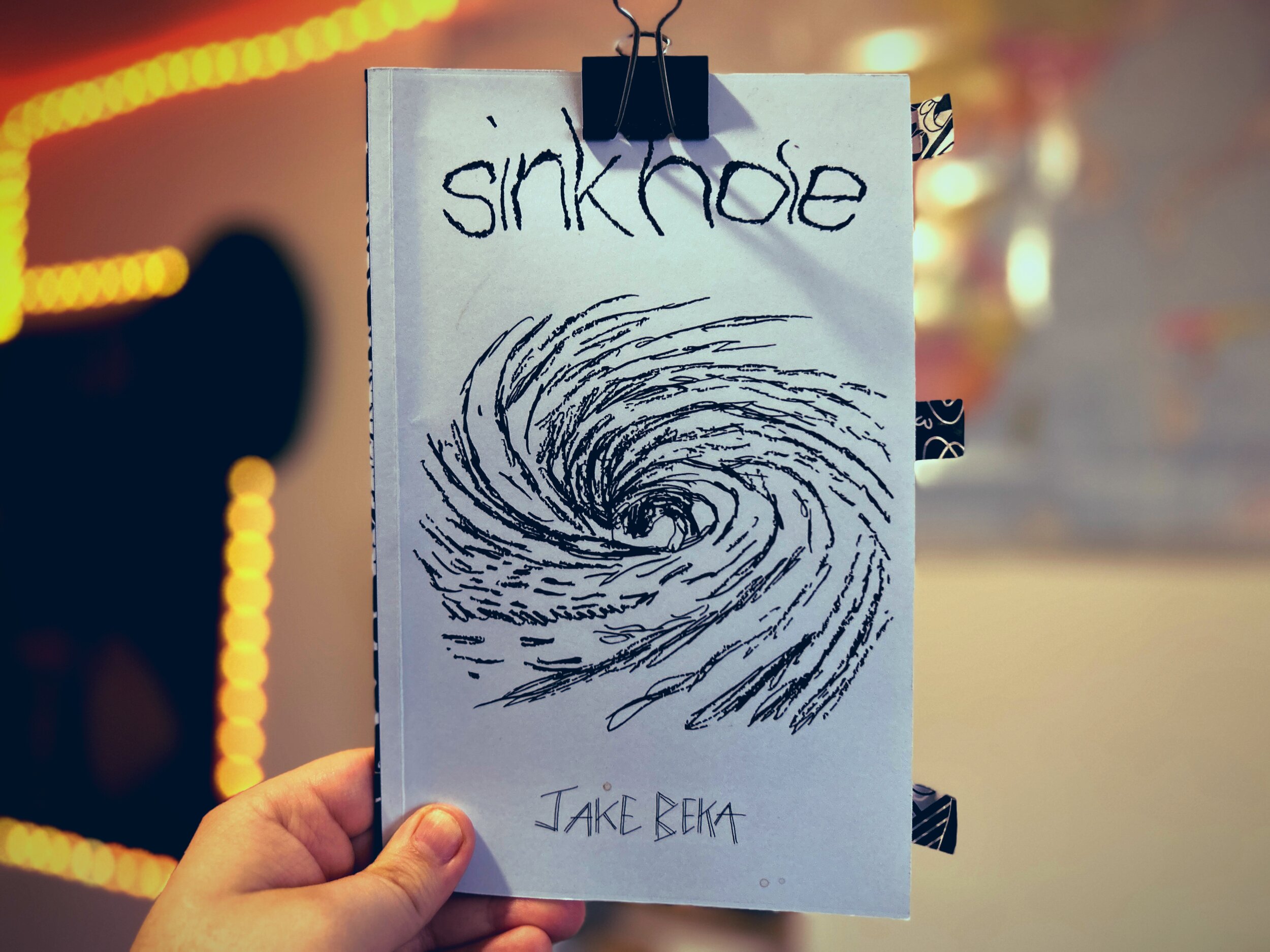
Photo taken by the author, cover design by Nate Ross
REVIEW: Falling Into Sinkhole (Jake Beka, 2026)

Full disclosure before I begin this review: I know Jake Beka personally. In fact, I wrote a review for him a few years ago that became the foreword to his first poetry chapbook, I'm Just Waiting for Something to Happen. He is currently the Vice President of Publications for Write Club, the creative writing collective I founded, and was responsible for the release of the club's third anthology, On the Fringe: A Collection of Progression and Regression.
I was excited and surprised to see Beka release his sophomore poetry collection—eleven poems. Forty-some pages. A chapbook undulating from the Pitt River valley in BC to Joburg to Budapest to Antwerp to Kathmandu to Mexico City, and arrives, breathlessly, at a seven-year-old staffy named Javier roaming the streets—a Bodhisattva. Can Xue declares in the epigraph between poems 8 and 9: Underneath the hole is another hole. Do you dare go down?
The first thing to understand about SINKHOLE is that Beka isn't writing about going down a mere single hole. He's writing about how holes replicate. How one absence punches through a family, a body, a city, a continent, all the way down through geologic time.
SINKHOLE opens with a Bolaño epigraph pontificating the book's thesis: a body swallowed by a crater streaked with red, or a latrine streaked with red, and the ambiguity is the point. Beka is not interested in letting you decide which is more dignified. The wound and the waste are the same.
The book's throughline and Beka's thesis is patrilineal damage. Beka names it explicitly in the third poem of the collection. "A patrilineal Sink Hole / forms in the middle of the dusky / street and swallows and gulps / down / the crumbling / sidewalk." Everything radiates from this, whether backwards into the starved lamb of Pa's failed Folkestone farm (poem 6), or forwards into the absent fathers of Joburg and the missing Papa that every J-named character is circling. The fathers aren't villains, exactly. They're just men who are missing, or late, or yelling, or drunk, or dead by their own hand, or not there to pick up the phone. The violence isn't spectacular, but instead the casual everyday erosion of presence. But that erosion leaves a hole that keeps getting wider, keeps pulling new things in. The sinkhole doesn't form because of one man's failure. It forms because of the accumulated weight of every man's failure, compressing the ground until the street just goes.
We begin with the first poem in the Pitt, a tributary of the Fraser, east of Vancouver, glacier-fed and cold. There's unresolved dialogue from a seal on Echo Island here, refusing to answer its own question, and this the chapbook's first refusal of urgency. Beka's poems often end abruptly. And there is an abundance of wordplay and ambiguity throughout the book starting here: The Pitt, the pit, the hole, the father, the death, the origin. You don't reach any by striving. You don't escape them by fleeing. It comes for you when you're ready/it doesn't wait until you're ready.
Throughout, Beka treats both landscape and the body as degraded ecosystems. The Pitt's glaciers are melting. Harrison Lake is polluted bodily fluids. The logging roads are collapsed. The White Rock coast has a blinded gull choking on plastic. The Budapest bath has hydrogen sulphide leaking from ancient mosaic panes. The Kathmandu streets are scarred by decade-old earthquake damage. The Mexico City alleyways have fleas fraught with disease and three-host ticks burrowing in a staffy's tumored ears. Every landscape is already sick. Every body is already metabolizing its own damage. There is ecological grief along with the personal. Recognition that the external world and the internal world are both living with the same inheritance, the same colonial residue, and the same slow collapse. The strip-searched trees in poem 8. The electrified fence in Joburg. The abandoned logging roads in poem 1. Identical violence at different scales.
Then there's the always-capitalized Black throughout nearly every poem. Black Ice, Black ash, Black clouds, Black Pitbull with burn marks on its back, Black garbage bag, Black tea, Black market-bought ghost glocks, Black balaclavas, Black widow, "nowhere among the Void." I wonder if Beka is playing with race, here. The Black feels like a presence that keeps appearing where absence and threat and erasure converge. The Pitbull with burn marks in poem three is chained, marked, barking across the alley while the patrilineal sinkhole opens in the street. Is this deliberate racial coding or an aesthetic tic? Beka isn't being explicit about it, which is either the point or a problem, depending on what he's actually doing there. Perhaps similarly, I don't think I fully understand what Beka is doing with gender and womanhood in this project—there are iterations of the protagonist who are women, but the identity is lacking in comparison. For instance, there's a particular mention of a woman's interest in BDSM pornography and breathplay, but it's only discovered second-hand and there is too much shame and embarrassment to confront this directly. The speaker never dares tread any deeper or closer than that.
The autobiographical elements in the book I'm still mulling over: There's Jakob in the South Africa phone call. Jakov downloading ghost guns in the skytrain. Jacek smoking hashish in Kathmandu. Javier the rejected poet, Javier the dog. James who dove off Dover. Jaimie eating fish at White Rock while his little brother pokes a dying seagull. Joey the burnt-out barista. Júlia sinking to the bottom of the Budapest bath. Julieta in a Kathmandu hotel, adrift in honey oil smoke.
I think these are all versions of the same soul running from the same hole, arriving at different coordinates, finding it waiting. A metempsychosis. The soul cycling through bodies, geographies, genders, decades, unable to outrun its own cosmology. The Buckaroo Banzai epigraph makes this explicit: No matter where you go, there you are. We know this already. Moving to Budapest doesn't fix you. Taking the train from Gdansk to Bucharest doesn't fix you. Smoking hashish in Nepal in the garden of a paranoid hippie tradition that already tried this and already failed also doesn't fix you. The Pit travels in the ribs. Poem 8, "žal," is the fulcrum of this realization. The speaker has climbed out of the crater, hand over hand, and stands on scorched ground looking back down into it. Not grief as clean rupture, but grief as residue. As weather. As the thing that comes with the Chinooks and doesn't leave with them.
In the fourth poem, Beka builds on the word while over and over. Simultaneous present-tense scenes, five different people in five different registers. James poking a dying crab on White Rock. Jaimie eating soggy fish and chips, malt vinegar dripping onto his Sonic Youth shirt. Jakov on the skytrain, watching Bonnie Blue in one private tab and ordering 3D-printed ghost guns in another. Beka references how Hart Crane dove into the Gulf of Mexico in 1932, waving at the sailors on deck.
It's easy to tell that SINKHOLE is a chapbook with genuine cosmological ambition, with Beka trying to account for inherited damage across geographies and generations. Maybe particularly his own. The sinkhole in the title does not swallow you. Rather, it just keeps forming. Right there, in the dusky street, in the middle of the block, in the part of the city you thought you'd already escaped. The patriarch's weight, compressed into the ground for long enough, and then—hm? The sidewalk crumbles. Your foundation collapses.
Where does SINKHOLE succeed? Everywhere it refuses comfort. The seal that asks Are you ready? and doesn't wait for an answer. The black rectangle on the page where the television screen goes dark. The connection that dissolves mid-word: plea | sehel : pus ple | asehelp. Beka's formal instincts are sharpest when enacting rather than describing the dissolution—when the line break or the typographic rupture is the thing that breaks, and not just a representation of it. Where does SINKHOLE strain? Occasionally in the middle distance. Poem 6, "starved fettered lamb," is the weakest. Dense with image, thin on interiority, the connections between the lamb and James and Pa gestured rather than metabolized. Poem 10 in Kathmandu is gorgeous in patches, but it sometimes lists where it should tunnel. The chapbook knows how to go deep and sometimes Beka settles for wide.
Beka, I think, is proclaiming the beautiful and the degraded are the same. And the man disappears into it regardless of which it is. Beka takes that grammar and runs it through eleven poems, across four continents, through three generations of missing fathers, through ecosystems being strip-mined and bodies being discarded, and he never once lets you think you've reached the bottom. SINKHOLE will not offer you catharsis. But it does offer the Kṣitigarbha option of descent into the hell you've been circling, solidarity with the mangy dog, and the acknowledgment that the Pit will reach you when you're ready. It is sometimes too loud in its accumulation of global crises and sometimes too knowing about its own literary debts. But at its best it is writing the inheritance of male absence as a force reshaping geography, contaminating water tables, and following you across borders into bathhouses and budget hotels and every empty parking lot at midnight where you can't find the exit.
SINKHOLE is available for purchase in paperback on Amazon.
Comments
To comment, please sign in with your website:
How it works: Your website needs to support IndieAuth. GitHub profiles work out of the box. You can also use IndieAuth.com to authenticate via GitLab, Codeberg, email, or PGP. Setup instructions.
Signed in as:
No comments yet. Be the first to share your thoughts!