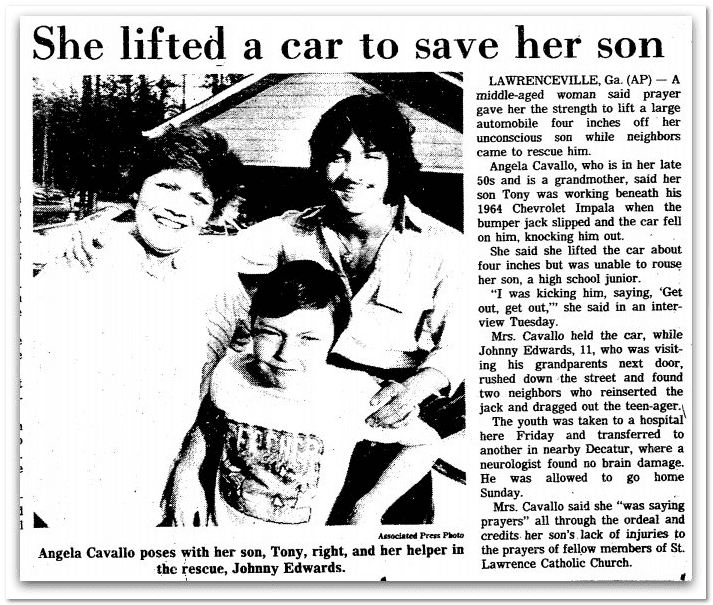
Newspaper Clipping from Springfield Union (Springfield, Massachusetts), 14 April 1982, page 25
OUR HYSTERICAL STRENGTH
In 1982, a mother’s hands found the underside of a Chevrolet Impala. The metal was still warm from her son’s work beneath it, the jack having given way like so many other false supports. Angela Cavallo didn’t think—thinking would have meant hesitation, would have meant loss. Her fingers curled around two tons of American steel, and she lifted.
We know the science of what happened next: adrenaline flooding her system, protective limits dissolving like sugar in rain, muscles recruiting beyond their prescribed boundaries. Her body understood something her mind could not grasp—that limitations are sometimes just stories we tell ourselves, stories that keep us safe until safety becomes its own kind of danger. The term for this phenomenon is, I think, fitting. Hysterical strength. The word hurled at us often for our beliefs, our values, our compulsion to move forward for the betterment of all by any means necessary.
I think about Angela’s hands a lot these days. About how they looked afterward, probably trembling, probably torn. About how they could never repeat what they had done, even if she had wanted to. The price of miraculous strength is usually paid in slow installments of pain, in the quiet accounting of damaged tissue and exhausted systems.
We stand now in our own moment of falling jacks and trapped futures. The weight above us is not steel but something more diffuse—a convergence of crises that press against our collective chest, making it harder to breathe. Climate readings tick upward like a mechanical countdown. Democracy shudders on its foundations. The bonds between us fray like old rope.
The question isn’t whether we’ll have to lift this weight. The question is whether we’ll do it together, before the crushing begins in earnest.
Science tells us what happens in these moments of impossible strength, but science cannot tell us why a grandfather in Minnesota once lifted a grain auger off his grandson, then never spoke of it again. Cannot explain why, in 2015, when Lauren Kornacki found her father trapped beneath a BMW, her body somehow knew exactly what to do, even as her mind went blank with terror. The weight of metal, the weight of love, the weight of necessity—all of these conspire to remake us into creatures of pure possibility.
They never talk about the trembling afterward. How Lauren’s hands shook for days. How that grandfather probably woke up in the dark, haunted not by what he did, but by how close he came to having to live in a world where he hadn’t been strong enough.
Our world trembles now with similar weight. We watch as algorithms sort humanity into profitable segments of rage. We see children in schools practicing how to die, while legislators debate the price of their fear. We witness the temperature climb degree by degree, each tick upward another pound of pressure on our collective chest. The seas rise. The forests burn. The very air becomes a carrier of our collective failures.
In Utah, 2011: A group of teenagers lifted a burning car off a trapped motorcyclist. None of them could have done it alone. Together, their bodies wrote a new chapter in the physics of possibility. Their muscles screamed. Their tendons stretched to breaking. But they held on.
We must hold on.
When Jeff Smith’s teenaged daughters lifted that tractor off of him 2012, the girls didn’t stop to calculate the cost to her body. When Tom Boyle lifted a Chevrolet Camaro off a trapped cyclist in 2006, he didn’t pause to consider the years of back pain that would follow. They simply looked at what needed to be done and did it.
Look around. Really look. See how hate speech flows through our social media like poison through veins. Watch how artificial intelligence threatens to remake the world before we’ve learned to remake ourselves. Feel how economic inequality has become a boot on the throat of democracy. The geopolitical tensions between superpowers vibrate like a wire pulled too tight, while mental health crises bloom in our communities like dark flowers.
These are not separate problems. They are the same problem wearing different masks. They are the car that has fallen, the tractor that has rolled, the fire that spreads. And we—all of us who can still feel the weight of tomorrow pressing down—we are the ones who must lift.
Our muscles are already recruiting: in mutual aid networks spreading like mycelium through cities, in youth climate movements rising like tides, in communities organizing against fascism with the desperate strength of those who know exactly what’s at stake. Every protest, every mutual aid kitchen, every encrypted message group, every union drive, every act of solidarity—these are our fingers finding purchase on the underside of history.
Yes, we will be damaged. Yes, some of us are already feeling the strain—the anxiety that comes with knowing too much, the depression that follows bearing witness, the exhaustion of fighting systems designed to exhaust us. Our tendons will tear. Our muscles will scream. Some of us will never be the same.
But what is the alternative? To stand aside and watch the weight descend? To live in the aftermath of our own hesitation?
No. Like Angela Cavallo, like Lauren Kornacki, like Hannah and Hayley Smith, like all those whose bodies have rewritten the rules of possibility, we must lift. Together, with the strength of the desperate, with the power of those who have run out of alternatives. We must lift until the weight shifts, until those trapped beneath can breathe again, until we have rewritten the rules of what is possible.
Our hands are finding their places now. Can you feel it?
Comments
To comment, please sign in with your website:
How it works: Your website needs to support IndieAuth. GitHub profiles work out of the box. You can also use IndieAuth.com to authenticate via GitLab, Codeberg, email, or PGP. Setup instructions.
Signed in as:
No comments yet. Be the first to share your thoughts!