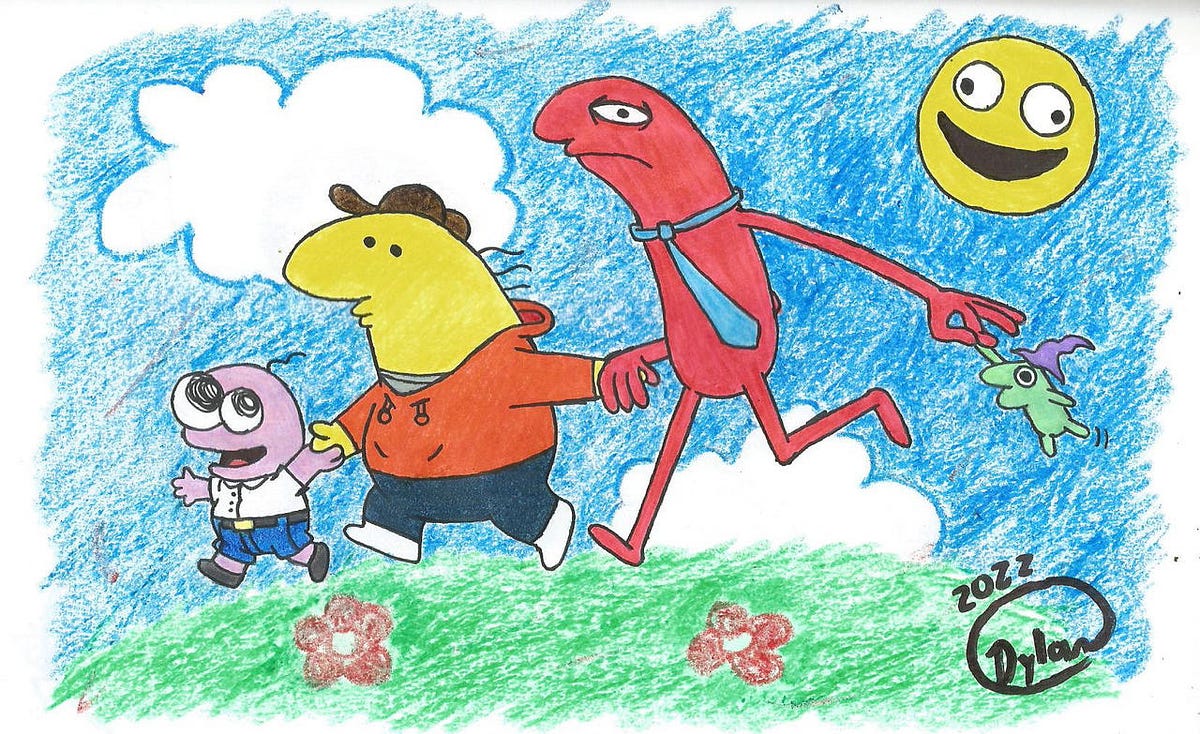
“Little critters that love to live, laugh and love” by Tumfuleri via DeviantART (used with permisison)
No, Smiling Friends WON’T Become the Next Rick and Morty

The discourse has already begun. Reddit threads, Twitter timelines, YouTube comments, and Discord servers. Prophecy gets repeated with increasing urgency:
Smiling Friends is going to become the next Rick and Morty.
Not in popularity, though the show’s already a hit, but in toxicity. In cringe. In the cultural rot turning passionate fandom into something putrid, where enthusiasm curdles into entitlement and appreciation warps into ownership.
The fear isn’t irrational, we’ve seen this movie before. We watched Adult Swim’s Rick and Morty ascend from cult favourite to cultural juggernaut, and what happened? Fans doxxing female writers, McDonald’s locations requiring police intervention over sauce packets, and a fanbase so convinced of its own intellectual superiority that “to be fair, you have to have a very high IQ to understand Rick and Morty” became the Internet’s efficient shorthand for insufferable pretension.
But Smiling Friends can’t become the next Rick and Morty. There’s fundamentally different architecture, philosophically. The shows are inverse functions and opposing forces. Where one valorizes cynicism, the other celebrates sincerity. Where one weaponizes intelligence, the other embraces emotional honesty. Where Rick and Morty gave us a protagonist whose supposed genius justified his monstrousness, Smiling Friends gives us Pim.

The God Complex and Its Disciples
Who is Rick Sanchez? The drunk, dimension-hopping genius whose nihilism defined a generation. Rick aggressively dismantles meaning, treating existence as a cosmic joke where nothing matters. Everything’s replaceable, including his own family.
Fucked up this dimension? There’s always another one. Destroyed a relationship? Find a version of yourself that didn’t. The show frames his pain as proof of his superiority. To be smart is to see through the illusion. To understand the universe is to be crushed by meaninglessness.
A significant portion of its audience internalized this. Rick became aspirational. His intellectual elitism, his misogyny, his emotional unavailability were personality traits to be emulated. Scholarly article by Nicolas Holm writes how the nihilistic worldview was celebrated; weaponized and turned into an excuse for being an asshole.
Of course, the Szechuan sauce incident crystallized everything wrong with the dynamic. McDonald’s brought back a 1998 promotional dipping sauce after Rick and Morty referenced it. Police were called to multiple locations. Fights broke out. One man jumped on a counter screaming “I’m Pickle Rick” before collapsing on the floor. A McDonald’s chef received thousands of death threats. Packets of sauce sold on eBay for nearly $1,000. Was this fandom or mass psychosis justified by the belief that being a Rick and Morty fan meant deserving special treatment?

Enter the Pink Critter
Now consider Pim Pimling. Pink, pudgy, with asymmetrical eyes and a single exposed nerve ending sprouting from his head. Pim is relentlessly optimistic —but in a grounded, almost stubborn insistence that trying to help people matters. His job is working for a company that attempts to make people smile, as if happiness were a service that could be delivered like pizza. And the show knows this is absurd. It revels in it.
The pilot episode establishes the entire framework. Pim and Charlie are tasked with making Desmond smile. Desmond holds a gun to his own head and threatens to pull the trigger if they fail. Lesser shows would use this setup for cheap edginess, turning suicide into shock comedy. Smiling Friends instead treats the philosophical debate seriously. Pim genuinely believes joy exists, even in absurd forms. Even in small moments that don’t solve everything but matter anyway.
Rick’s intelligence isolates him; he’s too smart to connect. Pim’s optimism connects him. His naivete is a choice to engage with the world as if kindness matters. The show never punishes him for this choice. Yes, he faces disappointment. Yes, his methods don’t always work. But the narrative doesn’t suggest he’s wrong, it suggests the world needs more Pims.
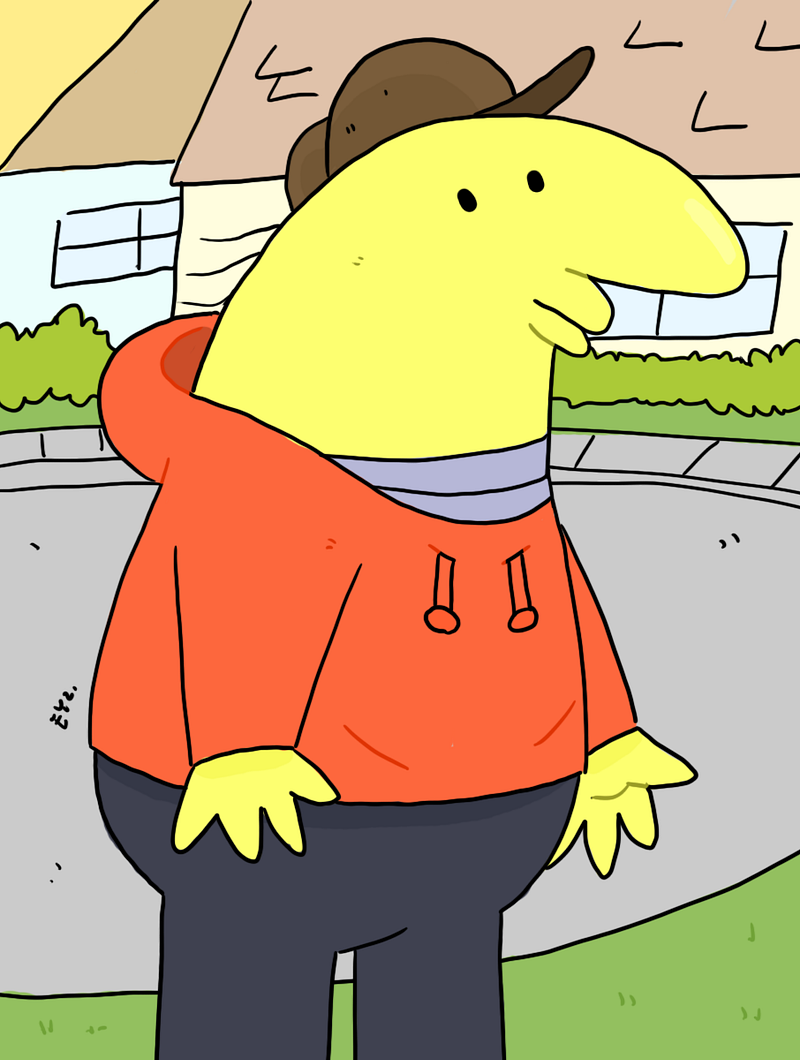
The Straight Man Who Actually Gives a Shit
Charlie Dompler, Pim’s best friend and constant companion, provides the counterweight. Large, yellow, perpetually exhausted, Charlie is the show’s vessel for cynicism, but not nihilism. He’s tired. He questions the premise of their job and would rather be home playing video games.
Except Charlie keeps showing up. He complains, sure. He cuts corners. He’d prefer the easy way out. But Charlie doesn’t abandon Pim. He stays and helps. He participates in the absurdity because, beneath his exterior, he cares about his friend. Their seven-year friendship forms the show’s emotional core, a genuine bond that survives the casual horrors of their world.
Charlie’s solution is more complex than Rick’s. Yeah, nothing might matter cosmically, but this matters. This friendship. This job. The meaning is constructed, collaboratively, between people who give a shit about each other.
The Mirror Episode
In “Frowning Friends,” a rival company appears across the street, run by Grim and Gnarly. Where Pim preaches optimism, Grim spreads nihilism. He tells a rapper to give up on his dreams. He convinces people that happiness is a lie and that trying is pointless. The only honest response to existence is despair.
And it works because nihilism is seductive. Easier. It absolves you of responsibility. If nothing matters, you can’t fail. You can’t be disappointed nor hurt. Grim and Gnarly’s business explodes, their Philosophy spreading like a virus through the city. Mr. Boss, the show’s perpetually unsettling father figure, has a psychotic break watching his life’s work crumble.
When Mr. Boss confronts Grim, he can’t maintain his Philosophy when challenged. He backpedals, revealing himself as a performative edgelord rather than a true believer. Nihilism as an aesthetic is bullshit. It’s a pose, an affectation, a way to seem deep without doing the harder work of actually giving a shit. The episode doesn’t defeat Grim and Gnarly through calling out their fundamental insincerity.
In contrast, Rick’s nihilism is treated as tragic but essentially correct. The show occasionally hints that he’s wrong, but it never fully commits. Rick remains cool. Rick remains the smartest person in the room. Rick’s intelligence continues to excuse his behaviuor. Smiling Friends says, clearly and repeatedly, that performative nihilism is just another form of giving up.

When Positivity Becomes Poison
The show isn’t naive about optimism’s pitfalls. In season three’s “Squim Returns,” Squim is introduced. He’s a hyperactive yellow ball who was the company’s very first employee. Squim is aggressively positive. Relentlessly, suffocatingly, toxically positive. He resolves conflicts with an unsettling “Squim Dance.” He responds to a widower’s grief by doing an inappropriately sexual jig. He “helps” people by giving flowers to women whose boyfriends are standing right there, by pushing wheelchair users into traffic, by refusing to acknowledge that sometimes people need to feel sad.
Pim, the show’s optimism avatar, calls him out. “There’s a time and place for enthusiasm,” he tells Squim. Some situations require acknowledging pain, not papering over it with forced cheerfulness. Squim doesn’t listen. He doubles down, convinced he’s “not being positive enough.” The police eventually shoot him dead (he survives, somehow, but that’s beside the point).
This episode differentiates between Pim’s optimism and Squim’s toxic positivity. Pim believes in trying to help people smile, but he doesn’t believe every situation demands happiness. He gets frustrated. He gets sad. He feels genuine devastation when Charlie dies (temporarily). His optimism exists in dialogue with reality. Squim’s positivity, by contrast, is a form of violence—a refusal to acknowledge others’ emotional complexity in service of his own need to always be upbeat.
Sincerity requires nuance. You can believe in kindness without being a doormat. You can try to help without being naive about the world’s cruelty. Pim works because he’s not Squim.
The creators of Smiling Friends have explicitly rejected the serialization and lore-building that Rick and Morty thrives on. “It’s supposed to just be popcorn,” co-creator Zach Hadel explained. “It’s McDonald’s of TV.” (The irony of that particular comparison aside.) There’s no puzzle to solve, no hidden meaning to decode, no Easter eggs that prove you’re smarter than other fans. Each episode stands alone. The show resets. Status quo. It’s not building toward anything except more opportunities to watch weird shit happen to characters we care about.
This structural choice matters because it removes the belief that understanding the show’s “deep lore” makes you special. Rick and Morty fans convinced themselves the show was intellectual because it referenced physics concepts and philosophical ideas. Never mind that these references were often surface-level; the appearance of intelligence was enough. The show became a shibboleth, a way to identify fellow members of the smart kids’ club.
Smiling Friends is not trying to be anything except entertaining. It’s surreal, sure, with rotoscoped segments sitting alongside stop-motion sequences and traditional animation and live-action footage. But the surrealism isn’t saying anything profound. It’s just weird because weird is funny. There’s no deeper meaning to unpack. The yellow smiley face building is a yellow smiley face building. A cigar is just a cigar, and a show about making people smile is just a show about making people smile.
The show’s popularity will grow. Season three is finished already airing, with more seasons guaranteed. Merchandise will proliferate. References will escape their original context. Some fans will inevitably be annoying. This is thermodynamics, entropy, the heat death of all good things. But the fundamental difference remains. The show’s sincerity is a shield. It’s hard to be insufferable about a show whose core message is “hey, maybe try to make people smile sometimes.” Pim Pimling gives fans permission to be… kind? Earnest? Actually give a fuck about things?
Smiling Friends finds humanity in absurdity. The suicidal Desmond in the pilot ultimately finds joy not through some profound revelation but by working as an exterminator, killing the little purple creatures that infested the office. The President finds happiness through the simple act of feeling connected to people. Mr. Frog—a violent, problematic celebrity—is shown to transcend to enlightenment after finally confronting his father after many years. The show’s world is cruel and bizarre, but within cruelty and bizarreness moments of genuine connection matter.
Rick and Morty asks “Does anything matter in an infinite universe?” and answers no. Smiling Friends doesn’t ask the question. It asserts: yes, obviously, this moment right here matters. This conversation. This attempt to help. This friendship. Not because of any cosmic significance but because we’re here, together, and we might as well try.
Smiling Friends depicts suicide, violence, corruption, disappointment, failure. But it refuses to let those things be the final word. It refuses to let nihilism win. Through the simple, stubborn insistence that trying matters. That showing up for your friends matters. That making someone smiles matters even if the universe is meaningless, even if we’re all cosmic accidents, even if nothing lasts.
In three years, we’ll know if I’m right. We’ll see whether Smiling Friends fandom remains relatively chill or whether it descends into the toxic waste dump that made admitting you enjoy Rick and Morty an embarrassment. We’ll see whether the show’s sincerity shields it from weaponization or if I’m hopelessly naive about how fandoms work.
But I think—and hope—that the fundamental difference in philosophical architecture matters. That a show about trying to make people smile, whose protagonists are decent people who care about each other, whose message is “maybe give a shit about things” instead of “nothing matters so why bother,” will fail to give the worst kinds of fans the ammunition they need to be terrible.
The face of the Smiling Friends’ office is a simple yellow circle. Two dots for eyes, a curved line for a mouth. A smiley face, the most basic symbol of happiness humans ever invented. That’s the whole show, really. The entire Philosophy compressed into the simplest possible visual language. What else is there? 😃
Brennan Kenneth Brown is a Queer Métis author and web developer based in Calgary, Alberta. He founded Write Club, a creative collective that has raised funds for literacy nonprofits. His work spans poetry, literary criticism, and independent journalism, with over a decade of writing publicly on Medium and nine published books. He runs Berry House, a values-driven studio building accessible JAMstack websites while offering pro bono support to marginalized communities.
Support my work: Ko-fi | Patreon | GitHub Sponsors | Gumroad | Amazon Author Page. Find more at blog.brennanbrown.ca.
Comments
To comment, please sign in with your website:
How it works: Your website needs to support IndieAuth. GitHub profiles work out of the box. You can also use IndieAuth.com to authenticate via GitLab, Codeberg, email, or PGP. Setup instructions.
Signed in as:
No comments yet. Be the first to share your thoughts!