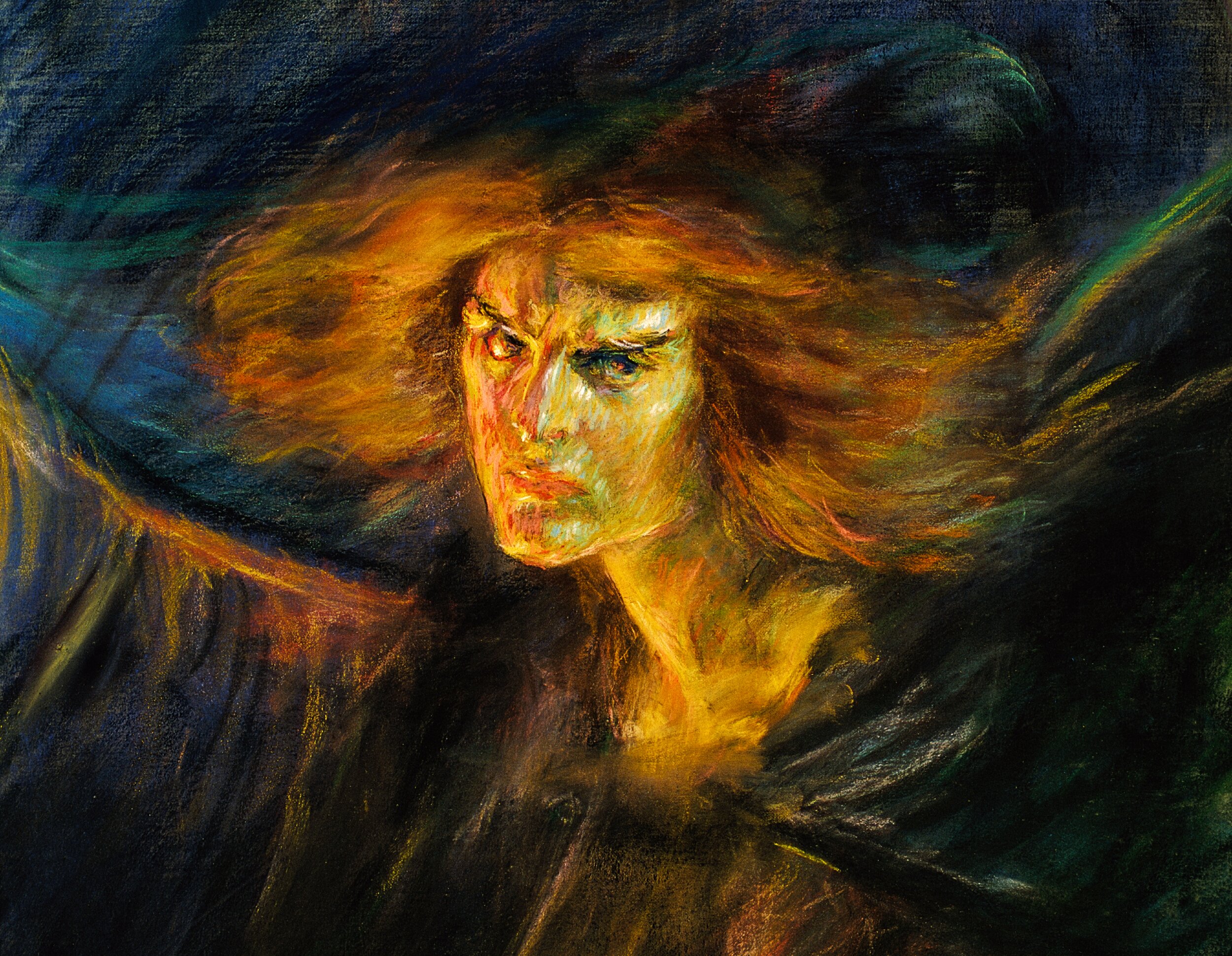
Lucifer by Alice Pike Barney, 1902 | Source (edited by the Author)
Incels Won the Culture War
CONTENT WARNING: I'm going to be doing something here that I've rarely seen done in the mainstream. I'm going to identify the deeply uncomfortable things that exist underneath casual Internet speak. I'm going to be using clinical and colloquial terminology (including offensive language) to show people exactly what culture they're unknowingly participating in. I don't want to write this, but someone has to. Take this as a serious content warning for transphobia, misogyny, and violence.
We have spent years treating incel culture as a fringe, a punchline, occurring in dark corners of the internet where the rest of us never go. The caricature created has caused us to completely fail to notice that incel vocabulary, worldview, and ideological DNA have spread into the mainstream, shaping how an entire generation of young people understand bodies, relationships, and themselves.
With memes. With slang.
The ones you're using right now. If you've ever said someone is "-pilled" on something. If you've ever joked about "maxxing" a skill or a routine. If you've ever seen a mewing GIF, or the word "sigma". "Gooning" or "coping" or "seething." All of it is from a dialect that was built by, for, and about the dehumanization of women and the radicalization of vulnerable men.
ORIGINS: A Queer Woman, A Mailing List, A Schism
"Incel" begins in 1997, when a Canadian woman known only as Alana created what she called "Alana's Involuntary Celibacy Project." It was a university student's research project. The project grew into a mailing list, and later a rudimentary forum. A support community for anyone of any gender who was lonely, who hadn't been in a relationship in a long time, who felt left behind by the social rituals of romance. Alana's own website describes how she coined the term "involuntary celibacy" as a neutral alternative to pejorative phrases like "loser virgin." She originally abbreviated it "invcel," and someone else in the community who suggested dropping the V so it wouldn't sound like "imbecile."
Alana described herself as a lesbian on her website before May of 1997, when she started the forum. The person who accidentally gave birth to one of the internet's most virulently misogynistic subcultures was a Queer woman trying to build a compassionate community around shared loneliness.
The space began with stories, heartbreak, and confusion. No ideology. Eventually the project passed out of Alana's hands, she stopped maintaining the site around 2000 as her own dating life improved. The community she'd built was handed off, and then handed off again.
By the late 2000s and 2010s, "incel" no longer described isolation. It became shorthand for a specific evil; a threat. When the perpetrator of the 2014 Isla Vista killings was glorified in incel spaces, Alana wrote: "Like a scientist who invented something that ended up being a weapon of war, I can't uninvent this word, nor restrict it to the nicer people who need it."
That's where most people start the story.
How The Game Was Played
The manosphere didn't emerge fully formed, and was treated as entertainment rather than warning signs. Its roots are usually traced to the 1970s men's rights movement, and the pickup artist scene of the early 2000s. In 2005, Neil Strauss published The Game, a bestselling memoir of his immersion in the "seduction community." VH1 turned the concept into a reality show. How I Met Your Mother made "picking up women" a running punchline and a form of aspirational bachelor mythology. The incel movement grew directly out of the PUA fad, the community of disillusioned men who had tried the techniques, found they didn't work, and were ready for a darker explanation for their failures.
The PUA worldview treated women as "targets" to be "gamed." Strauss's terminology. Negging, peacocking, "last-minute resistance." Vocabulary for sexist social manipulation in the language of self-improvement. The PUA industry was peak neoliberal misogyny. A self-help industry encouraging hypermasculine entrepreneurship, relying on fraudulent experts as pedagogical guides, and treating women as objects to be conquered rather than to be known. It was contemptible, but it was sellable. It got primetime television deals. It got a place on the New York Times bestseller list.
The techniques didn't work, though. Seminars and boot camps charged exorbitant fees to participate. Men who had been promised transformation found themselves where they started. The self-help apparatus that told them the problem was their skill set began to feel like a scam, mostly because it was. Anti-PUA forums were created, but they became havens for incels. Disillusioned men concluded the problem wasn't their techniques, but instead something unfixable. About themselves, or about women, or about the entire social order.
The Colour-Coded Mythology
Incel ideology has an internal mythology, which is why it's culturally inescapable now. The "red pill" came first. The metaphor is borrowed from The Matrix (a film that's really about transgender identity), meaning a particular kind of awakening. The revelation that the social world is not what it appears to be, that feminism is a scam, that women's liberation has actually disadvantaged men. In early manosphere and PUA communities, the red pill was primarily about techniques: negging, "game," the elaborate pseudoscience of attraction. It was a contemptible program of action, with a belief that effort could change outcomes.
The "black pill" came later. Bleaker, but more philosophically coherent. Blackpill theory holds that one's romantic or sexual failure is biologically determined and irreversible. The shape of your face and the length of the lower third of it. Your height. Your genetic lottery ticket. Techniques can't save you because women, the blackpill asserts, care only about bone structure, and bone structure can't be faked. Fatalism is at the core of incel ideology. Not just that the world is unfair, but that it was always going to be unfair, and nothing you do matters. The despair was real, and the conclusion drawn were catastrophic.
The "black pill," in its most extreme expression, represents hopelessness and resentment so total that it justifies self-destruction and the destruction of others. There was no answer, and no return. This is where the violence lives.
For both of these terms have now been laundered into everyday speech. You can be "pilled" on coffee brands, on vintage watches, on a particular programming language, or the housing market or public transit. The "-pilled" suffix is now a nearly universal signifier of enthusiastic ideological conversion. It's so innocuous-sounding, so flexible, so playful. And it was built by communities that used it to describe the process of men arriving at the conclusion that women are subhuman obstacles to the satisfaction of male desire.
The Saint and the Slogan
The name Elliot Rodger should be where most people's knowledge of incel culture begins and ends, the horrifying data point about what happens when this ideological despair turns outward.
In May 2014, he killed six people and injured fourteen others in Isla Vista, California. He described his plans to punish women for rejecting him and men for succeeding where he had failed in a video he uploaded hours prior to the attack. He was active on forums including PUAHate, and self-identified as an incel.
Incels chose to beatify Rodger. Memes with his face photoshopped onto paintings of famous Christian saints were shared in most incel forums. His manifesto, My Twisted World, became a foundational text. His name was abbreviated as "E.R." and his attacks became the basis for a slang term: "going ER," used to describe initiating a rampage or mass killing, in his honour.
Since 2014, more than 100 people have been killed or injured in the name of misogynist incel ideology.
In April 2018, Alek Minassian killed eleven people in Toronto by driving a van into pedestrians. Before the attack, he posted a Facebook message hailing Rodger by name and announcing "The Incel Rebellion has already begun!" In his subsequent police interview, when asked how he felt about those he had killed, he replied: "I feel like I accomplished my mission." The pattern repeats.
I dwell here because these memes and slang are used not only to describe but to encourage, as incel forums regularly feature posts urging members to "go ER," celebrating those who have, and discussing suicide as the only alternative. Dark theology organized around resentment rather than grace, with all the social coherence and radicalization power that implies.
Looksmaxxing, Mewing, and the Sigma Male
The pill mythology is the ideological core of mainstreamed incel culture, and the looksmaxxing ecosystem is a commercially successful export.
The term "looksmaxxing" originated on male incel message boards in the 2010s, on forums like Lookism.net, Sluthate, and PUAHate. Its premise is simple: if the blackpill is true and only genetics determine romantic success, then the only rational response is to optimize those genetics to the absolute maximum.
Looksmaxxing ranges from the mundane and healthy (exercise, skincare, better haircut—these being "softmaxxing") to the harmful and dangerous (jaw surgery, limb lengthening, "bonesmashing"—hitting yourself in the face with hard objects to induce microfractures and theoretically sharpen your features—these being "hardmaxxing").
By the early 2020s, looksmaxxing migrated from obscure forums to TikTok, where researchers found incel social media accounts deliberately rebranding around looksmaxxing to avoid crackdowns on incel-related language, while continuing to promote the same ideology. It worked.
Mewing is named after British orthodontists Mike and John Mew, whose practice of orthotropics involves pressing the tongue against the roof of the mouth to theoretically reshape the jaw. There is essentially no scientific evidence that it changes bone structure in adults. But it became a Gen Alpha staple, a harmless-seeming, goofy internet hack, kids tapping their jaws and filming themselves. I'm sure you've seen it.
Internet linguist Adam Aleksic, in his 2025 book Algospeak, traces these terms directly back to 4chan incel culture and notes he is now tracking more of them in mainstream usage than ever before. You can be "sleep-maxxing," "LinkedInmaxxing," "pizza-maxxing." The suffix has become generative slang, a combinatorial tool that generates new words on demand. But the source is still the source. The "-maxxing" suffix emerges from the incel idea that, with enough dedication, one can optimize oneself into being attractive enough to finally get women.
The term "sigma male," too, was coined by far-right activist Theodore Robert Beale in a 2010 blog post and saw early use on 4chan. The sigma male is a supposedly autonomous, self-sufficient man who operates outside the alpha/beta hierarchy. He's presented as aspirational, quietly cool, the loner who doesn't need anyone's approval. A successor to the "alpha male" manosphere framework, the pseudo-biological ranking system for men that centres dominance, aggression, and sexual entitlement. It's embedded in Gen Alpha content, applied to cartoon characters and animals and video game protagonists.
"Foid," by the way, is short for "femoid," a portmanteau of "female humanoid." A term plainly designed to dehumanize women. The Overton window has been moving towards this.
Cope, Seethe, Mald
The laundering of incel language into mainstream speech extends well beyond looksmaxxing.
"Cope." You know this word. You've probably used it. The slang usage of "cope" was first documented on Urban Dictionary in August 2019, defined explicitly as a term used by looksmaxxing incels to indicate that a given self-improvement strategy is invalid or ineffective. In its original context, to "cope" was to engage in the psychological defence of refusing to accept the blackpill—to pretend that effort or attitude could change your biologically-determined fate. It was a term of contempt, wielded against men who hadn't given up yet.
The term spread in summer 2019, then exploded during the 2020 US Presidential Election as a way to mock political opponents. "Seethe," meaning to be visibly and impotently angry, entered the same stream, deployed by the energized class of MAGA YouTubers and podcasters to celebrate liberal anguish. "Cope and seethe" became a single phrase, a shutdown move, the online equivalent of plugging your ears. Similarly, there's also "mald" (malding—simultaneously going mad and going bald with rage) and the transphobic "dilate" (added to the phrase to target trans women specifically). These words formed a vocabulary of dismissal that migrated from incel culture through the alt-right and into general internet discourse.
"Cope" is now used by politicians, journalists, sports commentators, and teenagers who have no idea where it came from. It carries the emotional logic that your feelings are a sign of weakness and that the strong accept hard truths. To disagree is to be in denial. This is the blackpill, you see?
The broader 4chan retort lexicon of "cringe," "rent free," "based," "have sex" is now so ambient in online discourse that it constitutes something close to a default register for internet argument. Every one of these terms was documented as part of 4chan's vocabulary before entering mainstream use. Most people using them today couldn't tell you where they came from, and that is the victory.
Goyslop and Mogging
I said earlier that the looksmaxxing ecosystem doesn't exist in isolation from white supremacy. The idealized "Chad" body that looksmaxxers aspire to is defined as white, muscular, aggressively dominant, and affluent. Incel ideology is the belief that men—especially white men—are entitled to sex, and that feminism and women's liberation have thwarted that. The "looks hierarchy" within these communities ranks men by race, reproducing white supremacist logic.
This has bled into the broader slang ecosystem too. We have begun seeing the marriage of looksmaxxing language and straight-up racism and antisemitism—warnings against "goyslop" (also originating on 4chan) and racialized looksmaxxing advice laced with medical-sounding terminology, like the idea that encountering an annoying woman might "spike your cortisol." "Goyslop" is not a diet-bro meme. It's antisemitism.
"Mogging" means to dominate someone by being more physically attractive and is derived from AMOG, or "Alpha Male of the Group." You might see it applied to a sports moment or a celebrity photo, similar to aura farming.
Social dominance organized by physical hierarchy has been normalized as casual vocabulary, and the harmful values that generated it remain intact beneath the surface.
The bridge between incel ideology and explicit white supremacy was architecturally designed. Andrew Anglin, founder of the rancid neo-Nazi website The Daily Stormer, openly identifies as an incel and has referred to himself as "the self-appointed spiritual successor to Elliot Rodger."
Since 2015, he has explicitly used misogyny as a recruitment strategy for the white nationalist movement. In a 2015 post, he wrote that "by putting a focus on male issues, our movement is offering something to young men who are looking at their world. Whereas race can be an obscure concept for young Whites who haven't been forced to deal with other races directly… the problem of being forced into subservience to women… is something we have all experienced as young men raised in a feminist society." Anglin recognized the persuasive power of misogynistic narratives as a stepping stone into antisemitism. Misogyny was the entry point and fascism was the destination.
Alt-right discourse and incel discourse are "virtually indistinguishable" on the topic of women. Men's rights activists, incels, and white nationalists share the same foundational belief that the social order has been overturned at male expense, and that women's liberation is the mechanism of that overturning. Slang travels without its context, serving as a Trojan horse for the connected apparatus.
Gooning
There is one more term I want to discuss before we get to the bigger picture. "Gooning" originally described a specific sexual practice—prolonged masturbation, with pornography, in pursuit of a trance-like "goon state" of hypnotic dissociation. It has existed since 2005, primarily in online male communities. For years it remained a fringe term.
Then it escaped. It now acts as a catch-all for all kinds of obsessive or "degenerate" behaviour. Doomscrolling. Binge gaming. Hours of YouTube. Any state of mindless, dissociated, pleasureless consumption is now "gooning." The word carries the implication that the activity is degrading — that you have surrendered your agency to a screen, that you have become, as the original slang put it, stupid. A goon.
And predictably, just like "-maxxing" and "-pilled," the suffix has been generalized into a flexible grammatical tool: "jestergooning," "gymgooning," and so on. Aleksic notes each of these terms broadens and loses its original referent as it hits mainstream platforms, even as it carries the structural logic of the original culture with it.
The gooner is a person who has lost control, who has become an appendage to their own compulsive stimulation-seeking, who is too weak to look away from the screen. The self-concept is of the male loser, the beta, the man who can't control himself. All incel culture's foundational neurosis. The loser is the performance. The degradation becomes the joke.
The Femcel
This is not a simple narrative or culture I'm sharing. The concept of the "femcel"—a female involuntary celibate—has existed since nearly the beginning of incel culture (remember: Alana's original forum was explicitly inclusive of all genders). But contemporary femcel communities developed their own distinct, harmful ecology. The most active femcel spaces emerged on Reddit around 2018, and r/TruFemcels was banned in January 2021 for promoting hate and migrated to platforms like Crystal.cafe and lolcow.farm, as well as to successor forums like ThePinkPill.
Academic research has found femcel communities "frequently deploy a feminist rhetoric," and many members arrive there through experiences of real gender-based violence and patriarchal harm. There is pain trying to be reckoned with in these spaces. There's community and political critique. The femosphere, as researchers have called it, contains contradictions.
But femcel communities have prominently displayed the Trans-Exclusionary Radical Feminist flag. Researchers have found that femcel communities, like their male counterparts, are entangled with biologically determinist, hierarchical understandings of race—racism understood as hardwired rather than socially constructed. The "blackpill" logic that makes male incels conclude women are biologically superficial is turned, in femcel spaces, toward the conclusion that men are biologically dangerous and irredeemable and womanhood is a biological category that must be protected from trans women.
This is what happens when you build your epistemology on essentialism. The framework replicates itself. Both the manosphere and the femosphere share the same fatalistic, gender-essentialist, red-pilled logics.
I note this because the spread of incel epistemology is not gendered in the way people assume. Harm travels in multiple directions. The logic of biological essentialism, once inside a community, does not discriminate in causing harm. It does not matter if the community is organized around men's grievance or women's grievance.
The Pipeline Was Planned
Many believe that the radicalization of boys and men online just happened. Like an organic process of people finding their way to these dark forums. A self-organized drift towards extremism.
This is not the case.
Epstein emailed 4chan's creator Christopher Poole right before /pol was founded. He had connections to Peter Thiel and Steve Bannon.
Steve Bannon farmed virtual gold in World of Warcraft. He recognized gamers as a recruitment pool for a new populist army. "These guys, these rootless white males, had monster power," he reportedly remarked.
The Bannon-Epstein relationship itself is well-documented in the DOJ files, spanning approximately 18 months from early 2018 to the night of Epstein's arrest in July 2019.
In 2014—the same year Gamergate exploded and the same year Elliot Rodger carried out his attack—Bannon enlisted Milo Yiannopoulos to act as a bridge between fringe forums and mass audiences, translating the outrage of anonymous imageboards into viral, Facebook-optimized content for Breitbart. Cambridge Analytica's data-targeting infrastructure would complete the pipeline.
Gamergate functioned as a decentralized harassment campaign coordinating death and rape threats against women, feminists, and media critics. Participants framed it as a free speech movement, "ethics in games journalism."
Not dissimilar from the rhetorical moves of "it's just a joke," "it's about freedom," and "it's about fairness"—all deployed to launder ideological content through irony and plausible deniability. Ambiguity and uncertainty are the strategy.
Epstein additionally invested money in a far-right neuroscience YouTuber, with emails showing an intermediary offering to increase the channel's viewership and suggesting guests from Epstein's network.
The online ecosystem was astroturf'd with incel-adjacent ideology, strategically, by people with money and power. Political operatives understood and actively cultivated the radicalizing power of online male grievance communities as an electoral and cultural force.
The radicalization of young men online has always been planned and funded.
Language Is the Virus
In Algospeak, Adam Aleksic describes the epidemiological spread of slang: "It's transmitted from a patient zero to another patient, and so on. When you go back and do an epidemiological analysis of how Gen Z slang broke contagion, the patient zero is almost always African-American English or 4chan, or something adjacent to it." He notes that many of these terms "immediately make sense" despite sounding like nonsense to those not terminally online. Viral and durable. Combinatorial, intuitive, fun to say.
Language shapes how we perceive the world. The categories our vocabulary gives us are the categories of our lived experience. A generation growing up with "mogging" as casual vocabulary, with the idea that physical hierarchy is natural and inevitable, is not neutral. But it is invisible, and taken for granted.
Incels won the culture war with memes. With the unwitting spread of a dialect that carries violent, harmful values within. The aesthetics were detached from the ideology early enough that the ideology could keep travelling on its own, stripped of obvious malevolence. Remixed into the texture of everyday online life.
What I'm Not Saying
I'm not saying that lonely young people—men, women, or anyone else—are immoral for seeking community online around their pain. Loneliness is real. The disconnection crisis is real. One in five men reportedly have no close friends they can confide in.. Isolation has become an endemic social emergency, and communities forming around it are often the only place people feel seen.
These terms have been detached from their origins effectively. It feels as though you can use them in innocence, maybe even reclaim them. I'm not trying to scold anyone. I've used some of these words myself without thinking.
Awareness matters. Next time you encounter a term similar to "sigma" or "looksmaxxing" or "gooning" or "cope" in a context that seems harmless—a meme, a TikTok comment, a group chat—it is worth asking where it came from, and what it was originally doing.
The people who built this language understood culture is made at the level of the word. If you can change what words people use casually, you can change what ideas they find unremarkable.
The most effective propaganda is the kind that doesn't announce itself as propaganda at all.

Comments
To comment, please sign in with your website:
How it works: Your website needs to support IndieAuth. GitHub profiles work out of the box. You can also use IndieAuth.com to authenticate via GitLab, Codeberg, email, or PGP. Setup instructions.
Signed in as:
No comments yet. Be the first to share your thoughts!