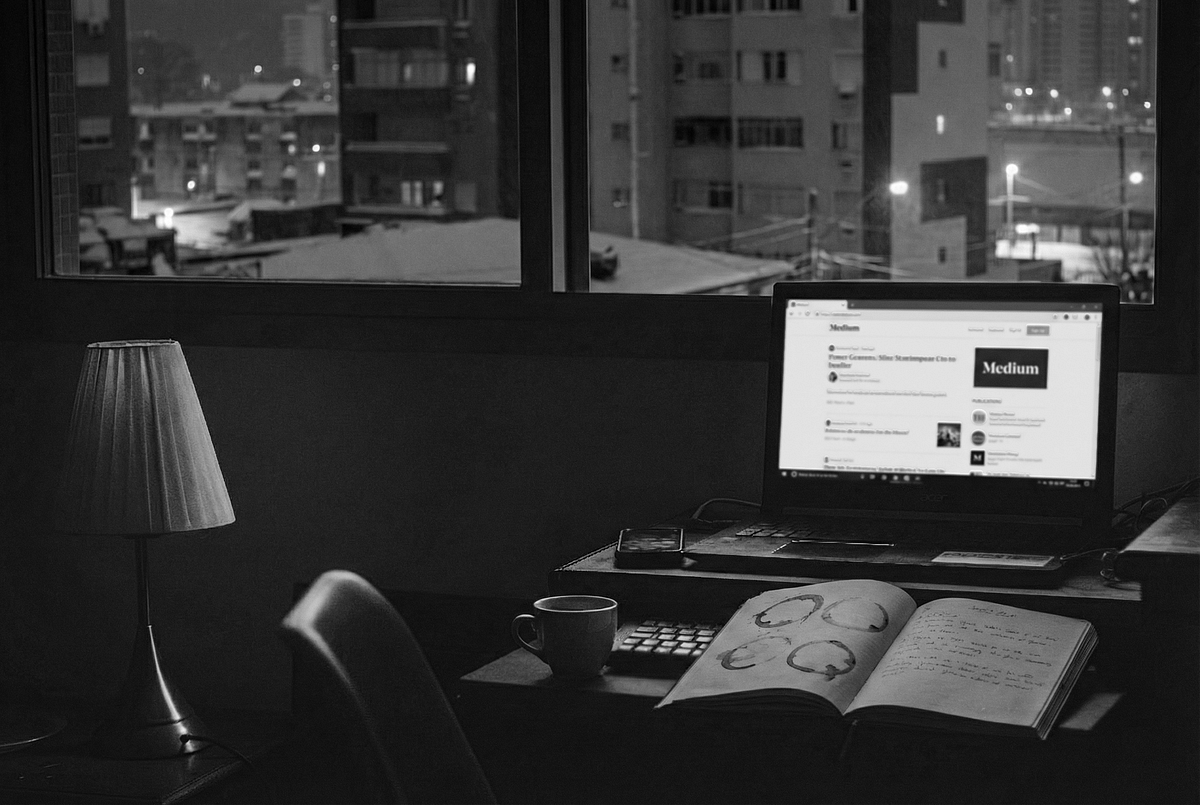
Source | (Edited by the Author)
I wrote two dozen articles on Medium in November. It made me a living wage.

The cursor blinks. 2:47 AM. My bedroom is silent except for the furnace kicking on, that metallic groan of heated air pushing through decades-old ducts. Outside my window, Calgary sleeps under the kind of cold that makes your lungs ache. Minus fifteen. Streetlights catch ice crystals suspended in the air, and they don’t fall so much as hover, uncertain.
I’m staring at the month’s numbers on my laptop screen. 24 articles published. 50,000+ words written on 750words.com (technically completing NaNoWriMo). $800 Canadian dollars earned on Medium in November.
My black decaf coffee has gone cold in the mug beside me. The one chipped on the rim, the one I should have thrown out years ago but can’t because my mother gave it to me. It still holds liquid. Still functions. The chip hasn’t killed it yet.
I am evidence that longform, substantive writing has an audience. No need to compromise your craft by churning out 60-second TikToks or Instagram reels. You don’t need to transform yourself into a “content creator” optimizing for engagement metrics and algorithmic favour.
Conventional wisdom says nobody reads anymore and attention spans have collapsed. I published 3,000-word deep dives. Not listicles or “5 Quick Tips.” Dense, demanding essays that asked readers to sit with me for 10, 15, 20 minutes at a time. And people read and stayed.
But there was a long, long road to get here. Let me tell you about the chip in the mug. Let me tell you about time.
The Long Accumulation
I’ve been writing on 750words.com since 2011, when I discovered the site during my self-quantification phase in high school. I’ve also been writing on Medium since 2015. December. I remember because it was a few months after I started working weekend shifts at Rotary Flames House. I learned to write on my lunch break the way I learned to dice onions so fast my eyes didn’t have time to water.
Over a million words live in my digital journals now, and that isn’t counting academic assignments, not counting the poetry I’ve been writing since I was fifteen. Half my life. The words pile up like snow against a fence, drifting, accumulating, eventually becoming solid enough to walk on.
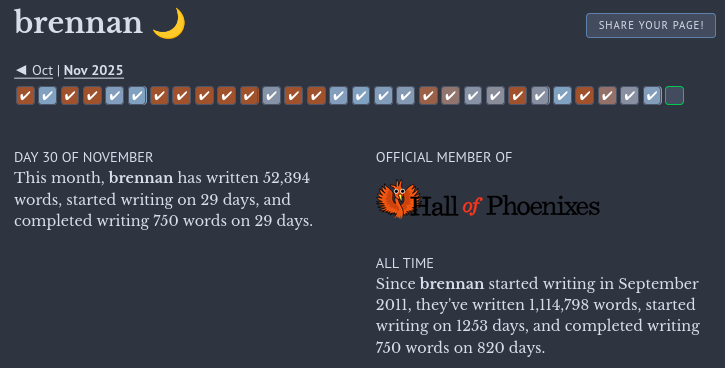
This year, I decided to really stick to writing a minimum of 750 words every single day. Not when inspired. Not when convenient. Every. Single. Day. I did that for ten months before this success. Ten months of showing up to the blank page whether I wanted to or not, whether it felt meaningful or not, whether anyone would see the result or not.
Coffee rings form on the open pages of my grid notebook. The ambience of a lone car passes by outside.
The Foolishness of Self-Imposed Limits
For years, I believed two articles a month was a good aim. Sustainable and modest. The kind of goal you hear from so-called experts and writing influencers. Pace yourself to avoid burn-out, publish twice monthly. Consistency is key.
What a beautiful lie. What a perfect cage. The truth tasted like burnt coffee. Most of that time I wasn’t writing, instead I was scrolling, researching, and “gathering material.” Professional procrastination. Then the deadline would creep up like water rising. The pressure mounted. The blank page stared back with the indifference of a mirror.
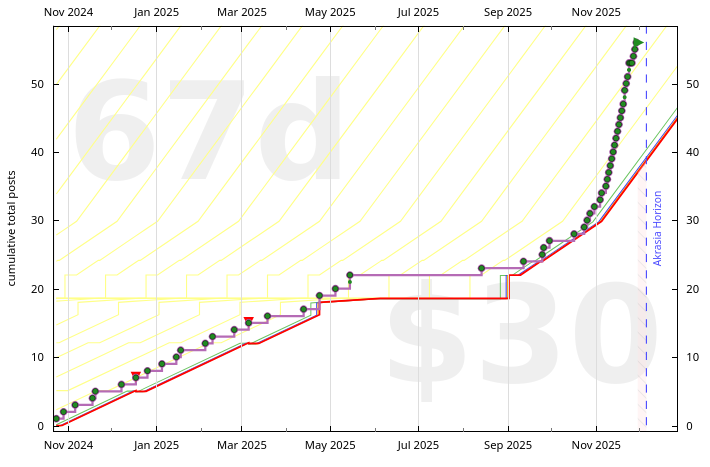
What changed this November?
Good question. There’s NaNoWriMo, yes—the now defunct annual collective delusion that 50,000 words in thirty days is somehow achievable.
There was something else. Standing in my kitchen, kettle whistling, three AM again, I realized I loved showing my work. That’s the answer. Writing publicly has been far more motivating and fun than hiding away writing a novel, or any other mysterious ambitious project that might never see the light of day.
There’s harsh solitude in “working on something big.” There’s an importance and seriousness. You’re mining in the dark. But what if you’re just alone in the dark? The showing, the sharing, the immediate communion with readers is the work.
You’re immediately held accountable, seeing what resonates. As I’ve written about earlier, momentum begets momentum.
My idea log started brimming. When you become proactive like this, you develop the art of noticing. Coffee shop conversations become the start of essays. The way light hits snow becomes metaphor. The deer outside your kitchen window with three legs becomes a poem about survival and asymmetry and the body’s negotiations with loss.
Do not get in your own way. You have radical freedom and need nobody’s permission. Push yourself. See what happens. Exercise your free will. Over and over again.
An Honest, Transparent Account
I’m going to get into the specifics of the finances. Let me lay it out plainly, the way you’d lay ingredients on a counter before cooking. Mise en place.
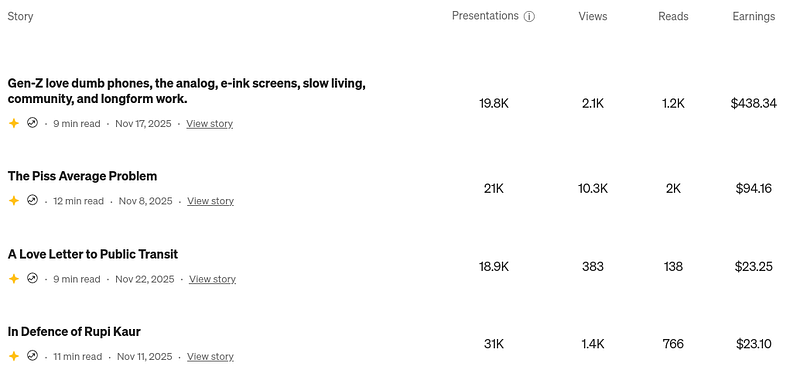
- “Gen-Z love dumb phones, the analog, e-ink screens, slow living, community, and longform work”— $438.34
19,800 presentations, 2,100 views, 1,200 reads - “The Piss Average Problem”—$94.16
21,000 presentations, 10,300 views, 2,000 reads - “In Defence of Rupi Kaur”—$23.10
31,000 presentations, 1,400 views, 766 reads - “A Love Letter to Public Transit”— $23.25
18,700 presentations, 378 views, 138 reads
Total November Stats:
- 24 articles published
- 106,975 total presentations
- 44,671 total views
- 5,579 total reads
- $580.18 in documented earnings
Notice high presentations don’t correlate with high earnings the way you’d expect. The Kaur piece had 30,000 presentations but earned less than the Gen-Z article with 19,600. Medium’s algorithm remains mysterious, but quality engagement—people actually reading, actually staying—matters more than raw impressions.
I also continued publishing on Tumblr throughout November, where I now have over 16,000 followers. I published 36 poems, crossposted 2 of my essays, and posted 1 viral image post. My top poem “Spirals” received 203 notes. “late night” became a breakout hit:
stumbling thru fluorescent-cathedral
aisles @2AM—beside a man
ghostwalking through frozen foods,
clutching microwave salvation
& a fallen angel,
The poem was about grocery shopping at 2AM. About seeking redemption in processed food and chemical light. About the cashier praying her way toward morning resurrection. Sometimes the most mundane moments crack open to reveal the sacred underneath, like breaking an egg and finding two yolks.
What Worked
I’m not going to charge you $97 for a course on “How to Make $500/month on Medium.” Instead, I’ll lay everything out here, free-of-charge:
1. Chase Everything, Especially the Uncomfortable
Even though my idea log has dozens of topics waiting—categorized, tagged, ready to be expanded upon—I don’t sift through it every morning. I do my freewriting first. I mull over shower thoughts and the half-remembered dreams that dissolve as soap bubbles the moment you try to capture them. Usually, I come up with an entirely new topic or thesis and start writing about that. Spontaneous and remote. I certainly don’t look a gift horse in the mouth.
This comes from freewriting consistently for so long. From training yourself to notice. To care about the angle of light through the blinds, about the way your neighbor’s dog barks at absolutely nothing, about the particular quality of silence after snow.
2. Give Yourself Permission to Fail Spectacularly
I was nervous writing about topics where I felt I lacked authority. I only took two semesters of software development before dropping out. Who was I to write about artificial intelligence‘s danger to mental health?
But guess what? That piece performed well. Authority isn’t always about credentials. Care enough to do the research, to think deeply, to connect disparate ideas in ways that illuminate rather than obscure.
I wrote about Thomas King and Canada’s Pretendian problem. About BoJack Horseman and suicide. About public transit and my mother’s adventures. Topics I’d never covered before, partly because I needed something fresh every day and being redundant goes against my self-imposed rules. Experimentation is permission to fail. Honest failure teaches you more than success.
3. Write What You Know
The opposite also applies, of course. Contradiction is the only honest position.
I’ve been a poet my entire life, which really helped with my Rupi Kaur article. Decades of reading criticism, of understanding literary movements, of caring deeply about who gets to be called a poet and why—that showed through. You can’t fake that kind of accumulated knowledge.
When I wrote “Mise en Place for Writers” about my four years as a cook at a children’s hospice, I wasn’t theorizing. I was sharing the specific weight of a blue ceramic knife in my hand, the creak of wooden floors that announced every arrival and departure, the temperature of properly hot water learned by feel alone.
That’s not research. That’s memory. The body remembering what the mind forgets.
4. Less Is More
I spend a solid two or three hours every day writing. That’s it. Maximum.
Writing is terrible work. Writing full-time doesn’t mean eight grueling hours churning out content like some kind of word factory, smoke pouring from the chimney, assembly line never stopping. When I freewrite, I typically hit 750 words in about twenty minutes. Then I rest. I read. I think. I return to an article full of TKs to research and fill out when the piece calls me back.
The Biggest Picture
The truth is, the vast majority of Medium writers make less than $100/month. Only the top 1% earn anything resembling full-time pay. That’s the reality. The cold water I’m pouring over your head right now.
I’m aware of how lucky I am. This could be unsustainable. Next month I might make $50. The algorithm might shift. Medium might change its policies. The universe is indifferent to my plans.
Really, though? I believe this statistic has a lot more to do with the limits people set for themselves. The way I was doing for so long. Hedging their bets, playing it safe, trying to be palatable and marketable instead of going for the throat. I will never believe that the idea that “being realistic” means giving up.
Apply overwhelming force.
Let me take you back. 2020. The pandemic has just started, and I’ve dropped out of a polytechnic where I was getting a two-year diploma in Information Technology. I took a rather large gamble. I leaned into my idealism, into my childhood dreams, and into the supposedly impossible. I went back to university as a mature student knowing I wouldn’t graduate with a bachelor’s until I was 29.
But I was going to be turning 29 anyways. So, why not?
I picked English. A Bachelor of Arts. The liberal arts. The major met with the most skepticism. How unemployable, right?
And I indeed wasn’t employed throughout my entire degree. Not with a “real job.” Instead, I started Write Club, reaching over 100 members and publishing two anthologies. I published several books of my own. I tutored pro-bono. I did crisis support on 7cups, offering what comfort I could through a screen.
For four years straight—fall, winter, spring, summer—I took full-time course loads every semester. I graduated with honors and a 3.8 GPA. My thesis was on liberating the English degree itself. I wrote about bloodwriting, about how the act of writing is still sacred.
What does that look like to you? Does that look like someone not contributing to society?
The capitalist would say yes. I haven’t formally participated in the system since my hospice job ended five years ago. I haven’t had a boss, a performance review, a yearly raise. I haven’t climbed any ladders.
And here I am, now making a livable wage simply by writing whatever I want.
Being a Writer in 2025
Medium is still staying true to its core product, which is great writing, even as competitors like Substack become multimedia marketing powerhouses. The platform introduced the Boost program, which relies on human curation to identify quality work.
The audience is sick of generic content and AI slop. The most successful articles in 2025 highlight a writer’s unique voice. Surface-level summaries don’t cut it. Medium rewards effort, consistency, and authenticity. This means:
- Depth matters. My longest articles performed best. “The Piss Average Problem” was 3,000+ words of dense analysis about AI model collapse, about the yellowing of images, about how we’re training machines on their own degraded outputs until everything becomes piss average. Not a quick read. Not a listicle. A deep dive that demanded attention and rewarded it.
- Personal voice wins. My article defending Rupi Kaur started with “Let me state my own credentials” and laid out my decade of experience. I wasn’t hiding behind objectivity. I was saying: this is who I am, this is why I care, this is why you should listen.
- Authenticity resonates. “Mise en Place for Writers” shared vulnerable details about working in a children’s hospice—stories I’d never publicly written about before. The weight of grief in a building’s walls. The particular way wooden floors creak under different gaits. The blue ceramic knife I used every morning. Stories that hold readers’ attention for 2–5 minutes are more likely to succeed. The 30-second rule means readers must spend at least that long for a read to count. Short, punchy content is of no interest to me or others.
Honest & Uncertain
I don’t know what the future holds and that terrifies me. The not-knowing, standing at the edge of something that could be wonderful or could be disastrous. That’s where life happens. That’s where the wooden floor creaks under your weight.
All I know is that I’m not going to tell myself to slow down, to be “realistic,” to not get too ambitious.
Here’s what else I know:
- I’m launching a Patreon. I want to build a community of readers who care about this work, who want to support independent literary journalism. I’ll be offering behind-the-scenes content, early access to paywalled articles, and exclusive poetry from my Tumblr.
- I’m going to keep writing every day. The 750words.com streak continues. Whether it becomes a Medium article or a journal entry or a poem doesn’t matter. The practice is the foundation.
- I’m done apologizing. I’ve increasingly watched incredibly talented people post on LinkedIn that they’re “open to new opportunities”—a euphemism for those let go and now jobless. Software development, once lucrative and stable, is cannibalizing itself. Mass layoffs in tech companies continue. The promise of stability was always a lie. Listen, there is no economic promise for you. No sure thing. No guarantee that hard work will pay off. Even if you’re one of the lucky ones in the system, are you truly going to only retire at 65? After your best decades are behind you? After your knees hurt and your back aches and the wooden floor rots?
This is learned helplessness. Conditioning toward being the docile doe. The one who has devoted himself to servitude, who has internalized the master’s voice.
There is no way toward liberation within the system. Audre Lorde taught us you cannot break down the master’s house with the master’s tools. I have an income doing what I love. There’s nobody to fire me. Nobody to terminate me without severance. Nobody to tell me my value in quarterly performance reviews.
The Best Advice is Free
If you’re waiting for permission, here it is: write.
Not perfectly. Not when inspired. Not when you have time. Not when conditions are ideal. Now. Right now. Open a document. Write one sentence. Then write another.
It will take time, but you need to start now.
Find a community—Write Club, Medium’s Writers Circle, a writing Discord server, whatever. Anything with others. Workshop. Share your work. Get feedback. But most importantly, produce.
The stats online don’t tell the full story. Distribution is mysterious. Variables multiply. If you want to write for humans, you need humanity. You need people engaging with your work honestly, telling you when something doesn’t land, and celebrating when it does.
The Real Experiment
November was proof of concept. December is where I discover if this is a fluke or a foundation. To see if my ceramic chipped mug can still hold.
What I know is that I’ve spent years being told I need to be “realistic.” Years watching the world burn while people cling to the artifice of a status quo that no longer exists. Watching the ice crystals hover outside my window, suspended, uncertain whether to fall or rise.
We must stick our meager neck out and plunge into the deep cold of winter. We owe it to ourselves to suck the marrow from the bone. To crack open the ordinary and find the sacred underneath.
Comments
To comment, please sign in with your website:
How it works: Your website needs to support IndieAuth. GitHub profiles work out of the box. You can also use IndieAuth.com to authenticate via GitLab, Codeberg, email, or PGP. Setup instructions.
Signed in as:
No comments yet. Be the first to share your thoughts!