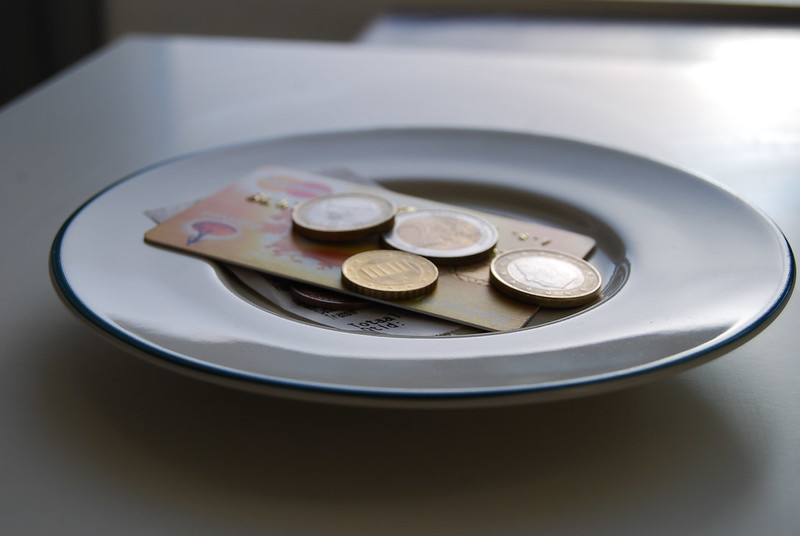
Tipping by Lea Latumahina | Source
How You Can Support Indie Creators—and You Need To

So, you walk into your favourite coffee shop for a simple vanilla latte. Then, the barista smiles warmly as they flip around an iPad with three glowing buttons: 15%, 20%, 25%. The numbers stare you down while a line of impatient customers forms behind you. You hit 20% on a $7 drink because pressing "No Tip" is admitting you're a bad person. Later, you grab some delicious takeout at that new place nearby, the iPad is spun around again. Then, you decide to get a haircut at the barber and there's another spinning iPad with a display of percentages.
Even at the self-serve frozen yogurt place where you literally did everything yourself.
I get it. Even the auto repair shop you walk into at this point asks the same thing: A tip. A little extra on top of the money you're already (over)spending.
Around 72% of Americans say tipping is expected in more places today than it was five years ago, a phenomenon dubbed "tipflation." Digital payment systems changed tipping, with research showing people tend to tip upwards of 11% more when using digital methods compared to cash. And who uses cash, anymore? The expansion of businesses accepting tips has been dramatic, with the percentage of specialty food stores like bakeries and coffee shops accepting tips increased significantly from 2019 to 2024, and specialty retailers seeing a 50% growth in tip acceptance during that same period. We're now being prompted to tip at airport newsstands, movie theater concession counters, and auto repair shops, all places that never expected gratuity before.
And there are a dwindling amount of places we can go to where this isn't the case. Public libraries, of course. City parks where you can walk among trees without anybody asking for 25% of the oxygen you breathe. The quiet corner booth at your local bookstore where you can flip through magazines without a screen demanding tribute (you might be asked to buy the magazine, though). But don't get me wrong, you should absolutely be spending more time in those kind of places, but that doesn't address the root issue here.
One of these few-remaining places that's free is our screens. The Internet. The majority of us are not paying for anything online and get hours of doomscrolling entertainment in return. There are, of course, actual heavy costs to this beyond money. Our privacy, our data, our well-being, to name a few. (Anybody remember PRISM?) There's a reason why the saying "if you're not paying, you're the product" is so popular.
The way you can ensure you're not being monitored, sold, or that your experience online is going to be a victim of enshittification? It's the answer you don't want to hear: by paying money for it.
For those unfamiliar, "enshittification" is a term coined by tech critic Cory Doctorow to describe how platforms decay over time. First, they're good to users; then they abuse users to serve business customers; finally, they extract all value for shareholders, leaving behind the bare minimum to prevent total collapse (temporarily, at least). It's specific policy choices made by powerful people who ignore warnings about the consequences.
But this isn't totally true, is it? You are paying. Regularly. You probably have plenty of subscription-based services, and they increasingly suck. Netflix raised prices again in early 2025, with Standard now at $17.99/month and Premium at $24.99/month. Disney+ decided to include ads in its cheaper tier and raised prices in October 2025, the ad-supported plan jumping to $11.99/month (up $2) and the Premium no-ads plan to $18.99/month (up $3). Spotify ran ICE recruitment ads on its free tier, featuring fear-mongering language about "dangerous illegals" before finally ending the campaign in late 2025 (though they've left the door open to running similar government recruitment ads in the future). Things get shitty even when you do pay money.
But not everything. Only big tech. Only giant companies that are held hostage to their money-hungry CEOs or shareholders who demand raises to quarterly earnings by any means necessary.
When you support small, independent businesses and creators, it allows for good work to be continued to be made without people needing to resort to working for a company that's part of a massive umbrella corporation that's going to suck.
Medium, specifically, is still independent. It's owned by A Medium Corporation, which means it hasn't been bought or acquired or sunset into oblivion. As I've advocated for plenty in the past, I think the $5/month subscription on Medium for membership is well-worth it. You get access and help support tens of thousands of writers just by reading and engaging with their work.
I'm fortunate enough to be earning a steady income just from my paywalled articles alone. And even though I do think membership is worth it, I've actually started to offer my articles for free on my personal website, 🔆 brennan.day.
I think you should support small, independent creators who make work you consume regularly. Whether that's musicians, writers, YouTubers, streamers, artists, or anything else.
And while I do have links to my Ko-fi and Patreon on my site, this article isn't about me asking for money. I'm lucky enough to not need to do that. What I am going to do, though, is list out ways you can support me (and any other small creator) in ways that don't include money but truly do go a long way:
-
Share our work! Spread the word, share my stuff on social media (Mastodon, Bluesky, LinkedIn). Recommend my themes/tools to friends, colleagues, or your dev community. Link to my projects from your blog, portfolio, or documentation. Write about your experience using my tools, if you do!
-
Star or contribute! If you're more on the tech-side, favourite one of my repositories, open issues, or submit pull requests. Fork and experiment with my themes and tools. Help with documentation by correcting typos (which I make a lot of) or by adding examples.
-
Refer a client! Introduce me to nonprofits, collectives, or indie creators that could use help from my web dev business, Berry House.
-
Join the community! Join our Discord or subscribe to the free tier of my Patreon. Attend a Write Club meeting, if you're in Calgary.
-
Collaborate! I'd love to work on something with other creatives, guest posting, going on your podcast, working on projects together, whatever it looks like. If you're doing something cool and important, I'd love to give you a shout-out.
-
Invite me to speak! I'd love to do any virtual talks (or talks based in Calgary) on the IndieWeb, Indigenous issues, the craft of writing, or anything else you think I'd be suited for.
-
Give feedback! Suggest ideas or give me criticism. I love when people comment on my posts or sign my guestbook, or just email me any thoughts you have.
-
Subscribe! Via RSS, or join the newsletter (Medium is currently the only place I have an active newsletter, I'll be using Buttondown later via RSS but right now it costs too much to justify).
Look, I know you're tired of being asked for money everywhere you go. I'm not adding another rotating iPad tip screen to your life. But when you engage with independent work (whether that's leaving a comment, sharing an article, or just telling a friend about something you loved), you're participating in an economy valuing quality over quarterly earnings.
You're helping build an internet that doesn't need to surveillance-capitalism its way into profitability. The big platforms will keep enshittifying, because that's what they're designed to do. But small creators like me? We're just trying to make good work and connect with people who care about it.
That relationship doesn't require a transaction. It just requires you to show up.


Comments
To comment, please sign in with your website:
How it works: Your website needs to support IndieAuth. GitHub profiles work out of the box. You can also use IndieAuth.com to authenticate via GitLab, Codeberg, email, or PGP. Setup instructions.
Signed in as:
No comments yet. Be the first to share your thoughts!